Quotations and Allusions in
C. S. Lewis, The Screwtape Letters
compiled
by Arend Smilde (The Netherlands)
Like most of C. S. Lewis’s books, The
Screwtape Letters (1942) contains many allusions to or quotations from
unspecified sources. Locating and checking these sources is perhaps never
vitally important, but often proves to be a rewarding enterprise.
What follows is a listing by chapter of many
such words and phrases with brief references to what I have found to be their
sources and, occasionally, notes suggesting their relevance to the context in
which Lewis uses them. I have also included a few other items where a short
explanation may be of use to some readers. The list is based on notes I made
for my Dutch translation of this book, published in 2002 as Brieven
uit de hel (fourth edition 2009) to replace a 1947
translation under the same title.
Double question marks in bold type – ?? –
follow items where I have not found the required information. Corrections and
additions including proposed new entries are welcome.
Updates are posted at irregular intervals and are listed at the end. Last update: 13 April 2026.
Preface (1960) to the 1961 edition
This preface appeared in the hardback edition of the Screwtape
Letters and Screwtape Proposes a Toast (London: Geoffrey Bles, 1961),
underwritten with the words “C. S. Lewis / Magdalene College / Cambridge / May
18, 1960”. The last three paragraphs were later used as a preface for
“Screwtape Proposes a Toast” when it was published as the opening item in the
volume Screwtape Proposes a Toast and Other Pieces (London: Fontana
Books, 1965).
¶ 1960 preface, par. 1 it was during
The Guardian
» Religious weekly
magazine founded in 1846 by a follower of the Oxford Movement, a Catholicizing
movement within the Church of England led by John Henry Newman, Edward Pusey,
John Keble and others. C. S. Lewis was a subscriber. The magazine was discontinued
in 1951.
¶ 1960 preface, par. 3 of course, sales
The Road Mender, John
Inglesant, and the Life of the Bee
» Examples of the kind of book which, on the rare occasions when we are
reminded of their existence, remind us of past days when they were very
popular:
– The Roadmender (1902) is a Christian
book of meditations on the road to heaven. It was the second and last book of
the English author Michael Fairless (pseudonym for Margaret Fairless Barber).
– John Inglesant (1881), the first
book published by the English writer Joseph Henry Shorthouse, is a historical
novel which made its author at once famous.
– The Life of the Bee is the English translation of La vie des abeilles
(1901) by the Franco-Belgian writer Maurice Maeterlinck.
¶ 1960 preface, par. 10 the proper question
the opposite ... of
Michael
Michael is the name
of an archangel who is described as a sort of celestial military leader in
several places in the Bible (Daniel 10, Revelation 12) and in Jewish
apocalyptic literature.
¶ 1960 preface, par. 13 these forms are
Dionysius
Anonymous theological
author (c. 500 C.E.), also known as
Pseudo-Dionysius since his work was formerly attributed to Dionysius the
Areopagite, a man briefly mentioned in the Acts of the Apostles (17:34).
Fra Angelico
Italian fresco painter
and Dominican friar of the early 15th century, mainly active in Florence and
nearby Fiesole. He was beatified in 1982.
¶ 1960 preface, par. 14 in the plastic
Raphael
Raffaello Sanzio (1483-1520),
Italian painter and architect.
houris
In Muslim belief, a houri is a nymph of Paradise.
¶ 1960 preface, par. 15 the literary symbols
Dante
Dante Alighieri (1265-1321),
Italian poet. His main work, the so-called Divina
Commedia, is the allegorical account of a journey through Hell, Purgatory
and Paradise.
Ruskin
John Ruskin
(1819-1900), English art critic. He was a champion of the so-called
Pre-Raphaelites, a school of painters who strove to revive the fidelity to
nature and realistic colour which they thought
typical of Italian painting before Raphael.
as Ruskin rightly
remarked
??
Milton’s devils
See C. S. Lewis’s
book A Preface to Paradise Lost
(1942), chapters XIII “Satan” and XIV “Satan’s Followers”.
Goethe’s
Mephistopheles
In the late-medieval
Faust legend, Mephistopheles (a fancy Greek name) is the devil who succeeds in making
the magician and astrologer Dr. Faustus sell his soul to him in exchange for
worldly pleasures. A German Historia von
D. Johann Fausten was published in 1587 and soon followed by several
translations. Around 1590 an English play on the theme was written by
Christopher Marlowe, whose Doctor Faustus was tempted by power rather than
pleasure. In Goethe’s play Faust
(1808, 1832) it was neither power nor pleasure so much as knowledge. For
Lewis’s view of “Goethe’s Mephistopheles” see also Perelandra, chapter 10.
¶ 1960 preface, par. 16 a little man
Chesterton
Gilbert Keith Chesterton
(1874-1936), prolific English writer and poet and a major influence on C. S.
Lewis.
Satan fell through
force of gravity
Chesterton, Orthodoxy (1908), chapter 8, last
paragraph but four.
¶ 1960 preface, par. 17 i
like bats
the Managerial Age
This way to
characterize the period when The
Screwtape Letters was written is perhaps a relic from that same period
rather than from the year 1960 when Lewis wrote this Preface to the Toast. In 1941 the American philosopher
James Burnham published The Managerial
Revolution, identifying a new class of “managers“ as the real rulers of the
world. A fine discussion of this work is George Orwell’s in Collected Essays, Journalism and Letters,
Vol. 4 (1968), No. 46.
Dickens
Charles Dickens
(1812-1870), English novelist; the “dens of crime” are described, for example,
in his novel Oliver Twist.
¶ 1960 preface, par. 18 milton has told
devil with devil
damned Firm concord holds
John Milton, Paradise Lost II, 496-497.
¶ 1960 preface, par. 21 but, as in
As in Grimm’s story, des träumte
mir nur / Der Räuberbräutigam
i.e. “The Robber Bridegroom”, a folk tale in the
German collection Kinder- und Hausmärchen (Nr. 40), compiled by Jacob and Wilhelm Grimm and first published in 1812
(translated by Margaret Hunt as Household
Tales, 1884-1892). In the quoted words, des
is a typo for das: “das träumte mir nur.”
¶ 1960 preface, par. 22 i am told
Stephen McKenna’s The
Confessions of a Well-Meaning Woman
...
personna
A typo for persona.
David Lindsay’s
neglected Voyage to Arcturus
A Voyage to Arcturus (1920), a philosophical fantasy and science fiction
novel by Scottish writer David Lindsay
(1876-1945).
¶ 1960 preface, par. 24 some
have paid
“My heart ... showeth
me the wickedness of the ungodly”
Psalm 36:1 as
translated in the Anglican Book of Common
Prayer. This translation is now
controversial or discredited. Recent versions rather have it that the ungodly
can see their own wickedness when looking into their own hearts.
Thus Moffatt translates, “An impious spirit inspires the ungodly man”.
Nevertheless the old translation made sense to C. S. Lewis, as appears from the
way he used this same line from Psalm 36 in his Reflections on the Psalms, chapter 12.
¶ preface, par. 25 i was often asked
Swift’s big and
little men
i.e. the inhabitants
of the imaginary countries Brobdingnag and Lilliput respectively, in Gulliver’s Travels (1726), a novel by
Jonathan Swift.
the medical and
ethical
philosophy of Erewhon
Erewhon (“Nowhere” spelled reversely)
is a satirical novel by Samuel Butler published anonymously in 1872. It tells
of a country where crimes are dealt with by surgical or hospital treatment.
Anstey’s Garuda Stone
In Vice Versa: A Lesson to Fathers, a
school story by F. Anstey published in 1882, a father is magically transformed
into his son and vice versa. The Garuda
Stone is the magical device by which father and son swap roles.
¶ preface, par. 26 i had, moreover,
“answerable style”
Milton, Paradise Lost IX, 20. Milton is musing
on the sadness of the task ahead in Book IX, which is to describe the actual
Fall of Man:
foul distrust, and breach
Disloyal on the part of man, revolt
And disobedience
but then reflects
that the subject is really “not less but more heroic” than the stuff
traditionally considered to be heroic – on one condition:
If answerable style I can obtain
Of my celestial patroness.
Thus while Lewis doubts
his own ability to deal with spiritual heights,
Milton hesitates before taking a plunge down.
Traherne
Thomas
Traherne (1637–1674), Anglican divine; author of Centuries of Meditations,
first published in 1908. The book is a collection of five hundred short
reflections on religion, each of the five chapters containing one hundred of
them and hence called “Centuries”. Traherne’s prose is generally regarded as
exquisitely poetical and better than his poetry. Lewis too, when he was
re-reading the book in 1941, thought it “almost the most beautiful book (in
prose, I mean, excluding poets) in English” (CL II, 505, to Arthur Greeves).
the canon of “functionalism”
¶ preface, par. 27 then, as
years
Saturday Evening Post
The Saturday Evening Post was one of the most widely read American weekly magazines
in the mid-twentieth century. “Screwtape Proposes a Toast” was first published
here on 19 December 1959.
Subsequently
the “Toast” was published as an appendix to a new edition of The Screwtape
Letters which first appeared in Britain (London, Geoffrey Bles 1961) and
then in the US (Macmillan, New York 1962). The U.S. edition of The
Screwtape Letters and Screwtape Proposes a Toast was often reprinted, both in
hardback and paperback. In Britain, the “Toast” was reprinted as one of seven
items in Screwtape Proposes a Toast and
Other Pieces (London: Fontana Books, 1965; with at least eleven reprints
util 2017). In 2000 it was also included in the comprehensive Essay
Collection, ed. Lesley Walmsley (London: HarperCollins), which was
re-issued in two volumes in 2002.
Dedication
To
J. R. R. Tolkien
» John
Ronald Reuel Tolkien (1892-1973), one of C. S. Lewis’s intimate friends during
the period 1930-1950. They were the key figures in the “Inklings”, a small
informal literary club with weekly meetings where writing work in progress was
read aloud and criticized. Much of Tolkien’s The Lord of the Rings was first presented there, and Tolkien later
wrote that he thought Lewis’s encouragement had been vitally important for the
completion of that huge work. From 1936 onward Lewis dedicated many of his
books to fellow Inklings. See Humphrey Carpenter, The Inklings: C. S. Lewis, J. R. R. Tolkien, Charles Williams and their
friends (George Allen & Unwin, London 1978; paperback edition
HarperCollins, London 1997).
Epigraphs
Martin
Luther (1483-1546) and Thomas More (1478-1535) were
enemies: Luther was the instigator of the Reformation in 1517 while More
developed into a prominent defender of the Catholic church and died for the
cause. Their continued status as heroes of Protestantism and Catholicism
respectively was confirmed in More’s case by his canonization as a Saint in
1935. The joint presentation here of very similar statements from these two men
is a statement on the part of C. S. Lewis. As a Christian writer Lewis took the
general line that he did best to disregard any church divisions and stick to
what he considered the very important stretches of “merely Christian” common
ground (cf. the beginning of Screwtape’s letter 25). Nevertheless Lewis
regarded the divisions of Christendom as a tragedy. He never wrote much on
Luther, but in a 1947 letter he compared Thomas More with another Protestant
adversary, William Tyndale:
All
the writings of the one and all the writings of the other I have lately read
right through. Both of them seem to me most saintly men and to have loved God
with their whole heart: I am not worthy to undo the shoes of either of them.
Nevertheless they disagree and (what racks and astounds me) their disagreement
seems to me to spring not from their vices nor from their ignorance but rather
from their virtues and the depths of their faith, so that the more they were at
their best the more they were at variance.
(Collected Letters II, 815; to Don Giovanni
Calabria, 25 November 1947)
Lewis
was reading all of More and Tyndale since he had been commissioned to write a
volume on the sixteenth century for the Oxford History of English Literature.
That book was published in 1954 as English
Literature in the Sixteenth Century. It has long passages on Thomas More
(pp. 165-181), with some references to Luther; and on William Tyndale (pp.
181-192), where Lewis points out “how tragically narrow is the boundary between
Tyndale and his opponents” and “what Tyndale is attacking is a mere travesty of
what his best opponents held; as what they attack is also a travesty of his own
view.”
Five years after The Screwtape Letters appeared, it was read in translation by an
Italian monk called Don Giovanni Calabria, who sensed a peculiar talent for
promoting Church reunion. He wrote a Latin letter of appreciation and a
correspondence followed – all in Latin – which lasted for years. (On a 1947
photograph of Lewis, the Italian translation of Screwtape, or Lettere di Berlicche, can
be seen to lie on his desk in the foreground; this photo was used as a cover
illustration for Walter Hooper’s C. S.
Lewis: A Companion and Guide, 1994.) Lewis’s letters to Calabria were first
published in 1989 with parallel English translation by Martin Moynihan and are
now contained in Lewis’s Collected
Letters, volumes II and III. In both cases Calabria’s surviving letters to
Lewis were included. A much fuller Italian edition was published in 1995
as Una gioia insolita: Lettere tra un
prete cattolico e un laico anglicano. The passage
quoted above is quoted from this correspondence.
A book called C. S. Lewis and the Catholic Church (2003) by Joseph Pearce opens
with an observation about the two epigraphs of The Screwtape Letters:
Not only is
Luther a Protestant and More a Catholic, but these two men are also accounted
champions of their respective parties, each having fought fearlessly for his
own position. What is more, many of their fiercest confrontations were fought
against one another, often in scathing letters and treatises. ... The fact that
both voices recommend laughter at the absurdity of evil is a testament to a
conviction, seen elsewhere in Lewis’s works, that the Christian perspective of
comedy, in both the light-hearted and in the cosmic sense, will in the end win
out over the tragic divisions that have historically beset the Body of Christ
on earth.
“The
best way to drive out the devil ... is to jeer and flout him ...” – Luther
»
From Martin Luther’s Tischreden
(Table Talk). The oldest source for
this quote is Joannes Aurifaber’s edition, first published in 1566 (facsimile
reprint 1968), Chapter 25, “Vom Teufel
und seinen Werken” (“Of the Devil and his Works”,
Fol. 278-307). Lewis used the first and the last sentence of a page-long
section under the sub-heading “Den Teufel kan man mit Verachtung vnd lecherlichen Possen vertreiben” (“The Devil
can be chased away by scorn and crazy jokes”), Fol. 290. The last sentence of
the following excerpt is in Latin. The words in bold type are roughly
those quoted by Lewis.
Doctor Luther sagte / wenn er des Teufels mit der heiligen Schrifft vnd mit ernstlichen worten / nicht hette können los
werden / so hette er in offt
mit spitzigen worten vnd lecherlichen bossen vertrieben / Vnd wenn er im sein
Gewissen hette beschweren wollen / so hette er offt zu im gesaget / Teufel ich hab auch in die Hosen geschissen / hastu es auch gerochen / vnd zu
den andern meinen Sünden in dein Register geschrieben. Item / Er hette zu im gesagt / Lieber
Teufel / ists nich gnug /
an dem Blut Christi / so fur meine Sünde vergossen
ist / so bitte ich dich / du wollest Gott fur mich
bitten. ... Quia est superbus Spiritus, & non potest ferre contemptum.
Doctor Luther
said that when he couldn’t get rid
of the devil with Holy Scripture and serious language, he had often expelled
him by tart remarks and crazy jokes. And when he [the devil] tried
to burden his [Luther’s] conscience, he would often tell him, “Devil, I’ve been
doing it in my pants, have you smelled it and added this to your list of all my
sins?” Again, he told him, “My dear Devil, should the Blood of Christ shed for
my sins not have been enough, please do pray to God for me.” ... For he is a proud
spirit, and cannot bear scorn.
Not
only does this longer excerpt give a fuller idea of Luther’s jokes; in calling
the Devil a “proud spirit” Luther is also showing all the more resemblance to
Thomas More. In the Weimarer Ausgabe, the
standard critical edition of Luther’s works, the passage is printed in volume 6
of the Tischreden
(=TR 6, 1921), pp. 210-211, Nr. 6817.
Lewis was perhaps quoting freely from a
biography of Luther by Jules Michelet (Mémoires de Luther, écrits par lui-même, 1835) in
the form of a compilation of original sayings, as translated from the French by
G. H. Smith (The Life of Luther, gathered
from his own writings, 1846), p. 78 (Book V, ch.
6):
The best way
to expel the devil, if he will not depart for texts from Holy Scripture, is to
jeer and flout him.
While
the phrase “to jeer and flout him” exactly matches the Screwtape epigraph, the final words “He cannot bear scorn” are
lacking both in Smith’s translation and in Michelet’s French text (Vol. 3, p.
188 in the 1835 edition). They do appear, however, in the translation by
William Hazlitt of the same book, also published in 1846 (The Life of Luther, written by himself), p. 332:
The best way
of getting rid of the devil, if you cannot do it with the words of the Holy
Scripture, is to rail at and mock him. He cannot bear scorn.
As
Hazlitt points out in his preface, he used a slightly later French work on
Luther, Audin’s Histoire de la vie, des ouvrages
et de la doctrine de Luther (1841, 5th edition 1845), to make
additions to Michelet’s work. Hazlitt “paid especial attention to the many
extracts from the Tischreden”,
comparing various translations, including the earliest (1650) by Captain Bell.
Lewis’s presentation as a single saying of what is really the first and the
last sentence of a page-long passage may thus go back to Hazlitt or one of
Hazlitt’s sources. A footnote to Lewis’s 1938 essay “Donne and Love Poetry in
the Seventeenth Century” suggests that Hazlitt’s translation was indeed the one
he used (Selected Literary Essays, p.
117, note 1).
“The devill ... the prowde spirite ...” – Thomas More
» Thomas More (see note above) was an English scholar
and statesman. The quotation is from his last work, A Dialoge of Comfort against Tribulacion (Book II, ch.
16), written in
prison while he awaited execution for
treason after refusing to swear an oath declaring King Henry VIII supreme head,
under God, of the Church of England.
The dialogue is between a young Hungarian, Vincent, and his aged uncle Antony,
and set between the battle of Mohács (1526) and the siege of Vienna (1529),
with divided Christendom badly failing to make a united front against the
Turkish onslaught. Antony counsels his nephew about ways to endure the coming
“tribulations” of conquest and domination by the Turks. As they are talking
about the temptation of “horrible thoughts” (including thoughts of suicide),
Antony explains that
the manner of the fight
against temptation must stand in three things: that is, in resisting, and in
contemning, and in the invocation of help.
His second point – contempt – is developed as
follows:
Some folk
have been clearly rid of such pestilent fancies with very full contempt of
them, making a cross upon their hearts and bidding the devil avaunt. And
sometimes they laugh him to scorn too, and then turn their mind unto some other
matter. And when the devil hath seen that they have set so little by him, after
certain essays, made in such times as he thought most fitting, he hath given
that temptation quite over. And this he doth not only because the proud spirit
cannot endure to be mocked, but also lest, with much tempting the man to the
sin to which he could not in conclusion bring him, he should much increase his
merit.
C.
S. Lewis, in his book on 16th-century English literature, has called More’s Dialogue of Comfort against Tribulations
“the noblest of all his vernacular writings”. Noting that “it was written in
the Tower while More waited for death (for all he knew, death by torture,
hanging, cutting down, alive, and disembowelling)” he saw “a fairly close
parallel” to Boethius’ Consolation of
Philosophy. Lewis concludes his reflections on the Dialogue with the remark that “I would not quote much from this
book; it is (or was) accessible in a cheap reprint and should be on everyone’s
shelves” (English Literature in the
Sixteenth Century, Book II, I.1, pp. 177-181).
Written in 1534, first published anonymously
in 1553 and reprinted with More’s Utopia
in Everyman’s Library in 1910, the Dialogue
was edited “with modifications to obsolete language” by Monica
Stevens in 1951. The above quotation is from the Stevens edition,
available online from Gutenberg: http://www.gutenberg.org/ebooks/17075;
a PDF is available at www.lewisiana.nl/screwtapequotes/More1534.pdf.
A good later edition is the one by Frank Manley (Yale University Press 1977),
with Lewis’s quote on page 158.
Preface
The
history of the European War
»
The Second World War formally started on 1 September 1939. In Great Britain,
the war was initially a matter mainly of mobilization, without much obvious
enemy action directly affecting the daily life of citizens. In the early summer
of 1940, when large parts of the European continent had been conquered and
occupied by Germany, the “Battle of Britain” began as German bombers began to
raid cities in England, notably London. The
Screwtape Letters were probably written during the second half of 1940.
They were originally published as a serial in a Church of England weekly
magazine called The Guardian, from
May till November 1941.
I
as
if you supposed that argument was the way
»
The opening theme of The Screwtape Letters is that of a column
(“Notes on the Way”) which Lewis wrote for the literary magazine Time and Tide, published on
29 March 1941; the first Screwtape letter followed on 2 May 1941 in The Guardian. Two years later Lewis was
to develop the Time and Tide piece
into a paper for the Oxford University Socratic Club: “Bulverism, or The
Foundation of Twentieth-Century Thought” (for publication details about this
paper see www.lewisiana.nl/cslessays).
II
“the
body of Christ”
»
1 Corinthians 12:27; Ephesians 4:12.
III
Glubose
»
cf. Lewis’s note on the Latin verb glubo in
his 1961 essay “Four-Letter Words” (Selected Literary Essays, 1969, p.
171):
As for glubo, that grossest verb of all, few forget the one
place where they have met it. Glubit magnanimi Remi nepotes is
screamed at us by Catullus in the rage of a man so miserable that his only wish
is to wound (lviii).
Technically a
word for peeling or husking, in Catullus’s obscene usage it is the treatment
given by a tragically degenerated woman to certain men, i.e. to their penises,
in ways that are left to the reader’s imagination. Presumably Lewis chose the
name more for the grossness of the sound than for these associations; the
fiendish tasks carried out by Glubose either here or
in letter XVII do not seem to have erotic meaning. Lewis first read and enjoyed
the Roman poet Catullus (c. 84–c. 50 B.C.) in his late teens, but
in a letter of 6 March 1917 explicitly states that he had so far “only read ⅓ or so of him” (Collected Letters II,
p. 288). There can be little doubt that he read the rest within three years at
the most, if only because he studied Greek and Latin language and literature in
1919-1920. In his 1936 book The Allegory of Love (ch.
1, p. 5) he refers to Catullus and Propertius as Roman poets who “vary the
strain with cries of rage and misery”. The reference to these same moods in
1961 suggests an implicit refence in 1936 to the same poem, nr. 58 of
Catullus’s 116 carmina:
|
Caeli, Lesbia
nostra, Lesbia illa, Illa Lesbia,
quam Catullus unam Plus quam se
atque suos amavit omnes, Nunc in
quadriviis et angiportis Glubit
magnanimos Remi nepotes. |
O Caelius,
our Lesbia, that Lesbia, |
the elder brother in the Enemy’s story
»
Luke 15:25ff, the parable of the Prodigal Son.
IV
Coleridge,
“with moving lips and bended knees”
»
Samuel Taylor Coleridge (1772-1834), English poet and philosopher. The words
quoted are from “The Pains of Sleep” (1803, published 1816), a 52-line poem
which begins as follows:
Ere
on my bed my limbs I lay,
It
hath not been my use to pray
With
moving lips or bended knees;
But
silently, by slow degrees,
My
spirit I to Love compose,
In
humble trust mine eye-lids close,
With
reverential resignation,
No
wish conceived, no thought exprest,
Only
a sense of supplication;
A
sense o’er all my soul imprest
That
I am weak, yet not unblest,
Since
in me, round me, every where
Eternal
Strength and Wisdom are.
“Not to what I think thou art but to
what thou knowest thyself to be”
» ?? [the
original may be in Latin, perhaps in Augustine or Anselm]
VI
“Thy
will be done”
From
the Lord’s Prayer, Matthew 6:10.
VII
the
parties of Paul and of Apollos at Corinth
I
Corinthians 1:12 and 3:4.
VIII
when
a human, no longer desiringlewi, but still intending,
to do our Enemy’s will ... asks why he has lewisnabeen
forsaken, and still obeys
»
cf. Matthew 27:47, “My God, my God, why hast thou forsaken me?”
See
also George Macdonald, “The Eloi”, in Unspoken
Sermons Vol. I (1867), quoted by Lewis in his Macdonald
Anthology (1946), Nr. 38:
The
highest condition of the Human Will, as distinct, not as separated from God, is
when, not seeing God, not seeming to itself to grasp Him at all, it yet holds
Him fast.
XI
“No
passion is as serious as lust”
»
From The Life and
Opinions of Tristram Shandy, Gentleman (1759-1767) by
Laurence Sterne (1713-1768), Book VII, chapter xxxiv.
Walter Shandy is writing to his brother Toby with advice on how to seduce
women:
“Avoid all kinds of pleasantry and facetiousness
in thy discourse with her, and do whatever lies in thy power at the same time,
to keep from her all books and writings which tend thereto: there are some
devotional tracts, which if thou canst entice her to read over – it will be
well: but suffer her not to look into Rabelais, or Scarron, or Don Quixote –
They are all books which excite laughter; and thou knowest, dear Toby, that
there is no passion so serious, as lust.”
XII
“without whom Nothing is strong”
»
Slightly adapted (with a capital N for Nothing) from the Church of England’s Book of Common Prayer (Fourth Sunday
After Trinity, The Collect):
O God, the
protector of all that trust in thee, without whom nothing is strong, nothing is
holy: Increase and multiply upon us they mercy ...
The
pun perhaps goes back to Charles Williams, He Came Down From Heaven
(1938), last chapter, penultimate paragraph. Williams is paraphrasing fragments
from the Lord’s Prayer:
… but now is
its grand terror, in a word as short as any in the prayer, in the little
monosyllable “as”. “Forgive us… as we
forgive…’ in the manner that… to the extent that… […] Forgive us as – and
then the thing, as if startled at its own daring and shocked at its own danger,
rushes up into a heavenly fear: “lead us not into temptation”, do not abandon us to such a trial: what is the
nothingness that is we to do there? deliver us, deliver us from evil, from the
evil that man chose once to know, the evil of split knowledge and the agony of
the good turned against itself, the evil therefore of the deprivation of good,
of the loss of joy, the illusion of love in the self and the monstrous
duplicities that follow the self: deliver us, deliver us. “Thou only art holy,
thou only art the Lord”; “without
thee Nothing is strong” – out of
that Nothing deliver us, by ourselves becoming nothing to ourselves, having no
power to be except in the kingdom. “For thine is the kingdom” …
XIII
Childe
Harold
»
Principal character in Childe Harold’s
Pilgrimage: A Romaunt (1812), a poem in four
cantos by George Byron (1788-1824). The hero is a young man who disillusioned
with his empty pleasure-seeking existence and looks for distraction in far-away
places.
Werther
»
Principal character in Die Leiden des jungen Werther (1774; The Sorrows of Young Werther), the first novel published by Johann
Wolfgang von Goethe (1749-1832).
active habits are strengthened by repetition but passive
ones are weakened
»
Joseph Butler (1692-1752), The Analogy of
Religion to the Constitution and Course of Nature (1736), Part I, “Natural
Religion”, chapter 5, “Of a State of Probation, as Intended for Moral
Discipline and Improvement”, section II.
... in like manner as habits belonging to
the body are produced by external acts: so habits of the mind are produced by
the exertion of inward practical principles; i.e. by carrying them into
act, or acting upon them; the principles of obedience, of veracity, justice,
and charity. (...) But going over the theory of virtue in one’s thoughts,
talking well, and drawing fine pictures, of it; this is so far from necessarily
or certainly conducing to form a habit of it, in him who thus employs himself,
that it may harden the mind in a contrary course, and render it gradually more
insensible; i. e. form a habit of
insensibility to all moral considerations. For, from our very faculty of
habits, passive impressions, by being repeated, grow weaker. Thoughts, by often
passing through the mind, are felt less sensibly: being accustomed to danger,
begets intrepidity, i. e. lessens fear;
to distress, lessens the passion of pity; to instances of others’ mortality,
lessens the sensible apprehension of our own. And from these two observations
together; that practical habits are formed and strengthened by repeated acts,
and that passive impressions grow weaker by being repeated upon us; it must
follow, that active habits may be gradually forming and strengthening, by a
course of acting upon such and such motives and excitements, whilst these
motives and excitements themselves are, by proportionable degrees, growing less
sensible; i. e. are continually less
and less sensibly felt, even as the active habits strengthen.
XV
Creative
Evolution
»
A concept developed by the French philosopher Henri Bergson (1858-1941); his
book Évolution créatrice was
published in 1907 (English: Creative
Evolution, 1911) and won him the 1927 Nobel Prize for Literature.
Scientific
Humanism
»
The term does not designate any recognized school of thought, but has been used
since the 19th century by some
thinkers to specify and recommend their own variety of modern, secular
humanism. This variety more or less originated with the English biologist
Thomas Huxley (1825-1895). His grandson Julian Huxley advocated “a scientific Humanism,
global in extent and evolutionary in background” as guiding philosophy for the
newly formed United Nations shortly after the Second World War. In 2005, the
American biologist E. O. Wilson called scientific humanism “the only worldview
compatible with science’s growing knowledge of the real world and the laws of
nature” and the one most likely to lead to a better world.
This
is not straw splitting
» Typo alert
– From the 1955 Fontana edition of The
Screwtape Letters onward, many editions have the erroneous text “This is now straw splitting.”
XVI
Maritain
»
Jacques Maritain (1882-1973), French Roman-Catholic philosopher and essayist.
XVII
sole
Colbert
»
A fish dish; sole is a species of flatfish (Solea solea).
XVIII
…
merely one more mode in which a stronger self preyed
upon a weaker
» Typo alert
– On page 93 of the Fontana edition (1955), Fount Paperbacks edition (1977),
and reprints at least until the thirty-fourth impression (1982), stronger is
misprinted as stranger.
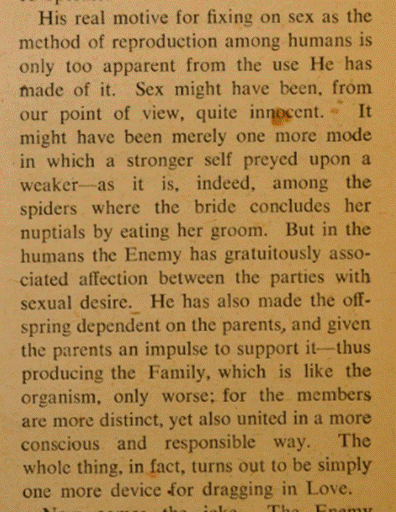
The
relevant paragraph from Letter XVIII as it first appeared in The
Guardian, 29 August 1941
“one
flesh”
Genesis
2:24, restated in Matthew 19:5, Mark, 10:7-8, Ephesians 5:31, and
I Corinthians 6:16.
XXII
“pleasures
for evermore”
»
Psalm 16:11 (KJV).
Thou
wilt shew me the path of life: in thy presence is fullness of joy: at thy right
hand there are pleasures for evermore.
“the
regions where there is only life and therefore all that is not music is
silence”
»
From George Macdonald (1824-1905), Unspoken
Sermons I (1867), “The Hands of the Father”.
Nor shall we
ever know that repose in the Father’s hands, that rest of the Holy Sepulchre,
which the Lord knew when the agony of death was over, when the storm of the
world died away behind his retiring spirit, and he entered the regions where
there is only life, and therefore all that is not music is silence, (for all
noise comes of the conflict of Life and Death) – we shall never be able, I say,
to rest in the bosom of the Father, till the fatherhood is fully revealed to us
in the love of the brothers.
Part
of this passage is included as Nr. 41 in Lewis’s Macdonald
Anthology (1946).
Milton
» John
Milton (1608-1674), English poet. His chief work is the epic poem in twelve
“Books”, Paradise Lost (1667), with
Satan as one of the principal characters.
that
such changes of shape are a “punishment” imposed on us
»
See Milton’s Paradise Lost, Book X,
lines 494-585, especially 516 and 575.
Pshaw
»
An allusion to the Anglo-Irish dramatist George Bernard Shaw (1856-1950; 1925
Nobel Prize for Literature). His ideas about a Life Force (a term related to
Henri Bergson’s élan vital), were
expressed in his play Man and Superman
(1903) and most notably in the preface and fifth part of Back to Methuselah (1921).
XXIII
the
World and the Flesh ... a third Power remains
»
Cf. the phrase from the Church of England’s Book
of Common Prayer, Eighteenth Sunday after Trinity, The Collect:
Lord, we
beseech thee, grant thy people grace to withstand the temptations of the world,
the flesh, and the devil, and with pure hearts and minds to follow thee the
only God ...
Screwtape
hardly defines his “third Power” but obviously he reckons Religion to be a
great stimulus to diabolical attitudes. He comes back to this at the end of the
table speech which was published as an appendix to The Screwtape Letters in 1961, “Screwtape Proposes a Toast”. There
he describes “different types of Pharisees” in hell thus:
Some were all rules and relics and rosaries; others
were all drab clothes, long faces, and petty traditional abstinences from wine
or cards or the theatre. Both had in common their self-righteousness and the
almost infinite distance between their actual outlook and anything the Enemy
really is or commands. The wickedness of other religions was the really live
doctrine in the religion of each; slander was its gospel and denigration its
litany. How they hated each other up there where the sun shone! How much more
they hate each other now that they are forever conjoined but not reconciled.
Their astonishment, their resentment, at the combination, the festering of
their eternally impenitent spite, passing into our spiritual digestion, will
work like fire. Dark fire. All said and done, my friends, it will be an ill day
for us if what most humans mean by “religion” ever vanishes from the Earth. It
can still send us the truly delicious sins. The fine flower of unholiness can
grow only in the close neighbourhood of the Holy. Nowhere do we tempt so
successfully as on the very steps of the altar.
the
documents ... cannot be added to
»
This idea was actually proved false when the Dead Sea scrolls were discovered
in the later 1940s, not many years after Lewis wrote The Screwtape Letters. He briefly deals with this issue in his Reflections on the Psalms (1958),
chapter 3.
a crop of new Napoleons, new Shakespeares, new Swifts
» Biography has long been a popular branch of
literature in Great Britain. Old subjects keep attracting new biographers, and
new biographies are usually published with a pretence that some really new
facts or insights are being offered.
Lewis made the same combined criticism
of the modern “quest for the historical Jesus” and the biography industry in
his 1940 paper “Why I am not a Pacifist” (first published in the US the 1980
edition of The Weight of Glory and other Addresses en
in the UK in Timeless at Heart, 1987).
Sophists ... Socrates
»
In the decades around 400 B.C., Sophists were itinerant teachers in ancient
Greece, especially influential in Athens. Two famous early Sophists were
Protagoras and Gorgias; an extreme case was Callicles (in Plato’s dialogue Gorgias). Their sceptical and relativist
ideas were systematically refuted in the course of their debates with Socrates,
as described in Plato’s dialogues.
It should be added that Socrates was
really active on two fronts: he “found himself confronted both by moral conservatives using an incoherent moral vocabulary as
if they were sure of its meaning and
by sophists whose innovations he found equally suspect” – Alasdair MacIntyre, A Short History of Ethics (2nd ed., 1998),
chapter 3, “The Sophists and Socrates”, p. 18 (italics added). An excellent
brief treatment of the antagonism, both in its historical and its timeless
aspects, can be found in an essay by Juan F. Frank, “The Platonic Inspiration of Pieper’s
Philosophy”, in: Bernard
N. Schumacher (ed.), A Cosmopolitan Hermit. Modernity and Tradition in the Philosophy of
Josef Pieper,
CUA Press, Washington
D.C. 2009, pp. 251-278.
a Christian writer ... recommends his own version of
Christianity on the ground that “only such a faith can outlast the death of old
cultures and the birth of new civilisations”
»
Reinhold Niebuhr, An Interpretation of
Christian Ethics (1935), chapter 1, “An Independent Christian Ethic”, p. 34
(chapter’s last paragraph):
A
vital Christian faith and life is thus under the necessity of perennially
preserving its health against the peril of diseases and corruptions arising out
of its own life; and of protecting itself against errors to which non-mythical
religions tempt it. Most of its own weaknesses arise when the mythical
paradoxes of its faith are resolved; most of the perils from the outside come
from the pessimism and dualism of mystical and rational religion. Only a vital
Christian faith, renewing its youth in its prophetic origin, is capable of
dealing adequately with the moral and social problems of our age; only such a
faith can affirm the significance of temporal and mundane existence without
capitulating unduly to the relativities of the temporal process. Such a faith
alone can point to a source of meaning which transcends all the little
universes of value and meaning which “have their day and cease to be” and yet
not seek refuge in an eternal world where all history ceases to be significant.
Only such a faith can outlast the death of old cultures and the birth of new
civilizations, and yet deal in terms of moral responsibility with the world
in which cultures and civilizations engage in struggles of death and life.
XXV
merely
Christian ... mere Christianity
»
“Mere Christianity” is an expression borrowed from a passage in Church-history of the Government of Bishops
and their Councils (1680) by the English Puritan theologian and church
leader Richard Baxter (1615-1691). On
the book’s title page Baxter calls himself “a hater of false history”. On the
penultimate unnumbered page [xv] of an introductory passage, “What History is
Credible, and what not”, he writes:
... but you know
not what Party I am of, nor what to call me; I am sorrier for you in this than
for my self; if you know not, I will tell you, I am a
CHRISTIAN, a MEER CHRISTIAN, of no other Religion; and the Church that I am of
is the Christian Church, and hath been visible where ever the Christian
Religion and Church hath been visible: But must you know what Sect or Party I am of? I am against all Sects and dividing
parties: But if any will call Meer
Christians by the name of a Party,
because they take up with meer Christianity,
Creed, and Scripture, and will not be of any dividing or contentious Sect, I am
of that Party which is so against Parties: If the Name CHRISTIAN be not enough,
call me a CATHOLICK CHRISTIAN; not as that word signifieth
an hereticating majority of Bishops, but as it signifieth
one that hath no Religion, but that which by Christ and the Apostles was left
to the Catholick Church, or the Body of Jesus Christ
on Earth.
Lewis
made the same reference to Baxter in the title for his collected and revised
radio talks of the years 1941-1944: Mere
Christianity. He explained this choice in his Preface to that book,
published in 1952. Earlier that same year he used Baxter’s term in a letter to
the editor of the Church Times (8
Feb. 1952; Collected Letters vol.
III, p. 164).
Byronic
»
i.e. in the manner of Lord Byron, the Romantic poet whose Childe Harold was referred to in chapter XIII, above.
whenever all men are really hastening to be slaves or
tyrants
» Lewis
probably intended this as a brief diagnosis of modern society’s most virulent
disease at the time of writing, i.e. the 1940s. This same diagnosis found
famous expression in F. A. Hayek’s the
Road to Serfdom (1944) and George Orwell’s Nineteen Eighty-Four (1949).
XXVI
the
negative unselfishness
»
The manners described here may be typically British rather than generally
human.
“If people knew how much ill-feeling Unselfishness occasions, it would not
be so often recommended from the pulpit”
» ??
“She’s
the sort of woman who lives for others – you can always tell the others by
their hunted expression”
» ??
– Lewis may well be quoting
himself here.
… that “love” is not enough, that charity is
needed …
Perhaps an allusion to William Morris’s poem, Love
is Enough, which Lewis later quoted in the opening line of the last
chapter, “Charity”, of his book The Four Loves.
XXVII
“praise
and communion with God is the true prayer”
» ??
Boethius
» Anicius
Manlius Severinus Boetius, Roman statesman and philosopher (480-524). As a
prisoner of the Gothic king Theoderic he wrote The Consolation of Philosophy (De
consolatione philosophiae). The reference here is
to the last part, Book 5.
C. S. Lewis summarized and discussed
Boethius as a thinker about the problem of freedom in The Discarded Image (1964), chapter IV/D:
…
God is eternal, not perpetual, Strictly speaking, He never foresees; He simply
sees. As a human spectator, by watching my present act, does not at all
infringe its freedom, so I am none the less free to act as I choose in the
future because God, in that future (His present) watches me acting.
… I cannot help thinking that
Boethius has here expounded a Platonic conception more luminously than Plato
ever did himself.
Only
the learned read old books
»
In a piece written in 1944 Lewis explained the importance of not confining
one’s reading to contemporary authors:
We may be sure that the characteristic blindness of the
twentieth century – the blindness about which posterity will ask; “But how could they have thought
that?” – lies where we have never suspected it, and concerns something about
which there is untroubled agreement between Hitler and President Roosevelt ... None of us can fully escape this
blindness, but we shall certainly increase it, and weaken our guard against it,
if we read only modern books. Where they are true they will give us truths
which we half knew already. Where they are false they will aggravate the error
with which we are already dangerously ill. The only palliative is to keep the
clean sea breeze of the centuries blowing through our minds, and this can be
done only by reading old books. Not, of course, that there is any magic about
the past. People were no cleverer then than they are now; they made as many
mistakes as we. But not the same mistakes. They will not flatter us in the
errors we are already committing; and their own errors, being now open and
palpable, will not endanger us. Two heads are better than one, not because
either is infallible, but because they are unlikely to go wrong in the same
direction. To be sure, the books of the future would be just as good a
corrective as the books of the past, but unfortunately we cannot get at them.
Originally
the preface to a translation of St. Athanasius (The Incarnation of the Word of God), this piece was later published
as “On the Reading of Old Books”; for bibliographical details see www.lewisiana.nl/cslessays.
bunk
»
A reference to the assertion “History is more or less bunk”, made by Henry Ford
(1863-1947), pioneer and captain of car industry, during an interview published
in the Chicago Tribune of 25 May
1916. The saying got wings in the briefer form “History is bunk”. During a
lawsuit brought by Ford against the Chicago
Tribune in 1919, his own astounding lack of historical knowledge was
revealed when he guessed 1812 as the year of the American Revolution. When
reminded of his notorious maxim, he backed out by explaining that he “did not
say it was bunk. It was bunk to me [...] but I did not need it very bad.”
XXVIII
“Experience is the mother of illusion”
»
Immanuel Kant, Critique of Pure Reason (1781;
transl. Meiklejohn 1855) I: Transcendental Doctrine of Elements, 2.2.1,
“Of the Conceptions of Pure Reason”, Section 1, “Of ideas in general”, par. 7.
For as regards nature, experience presents us
with rules and is the source of truth, but in relation to ethical laws
experience is the parent of illusion, and it is in the highest degree
reprehensible to limit or to deduce the laws which dictate what I ought to do,
from what is done.
In the original German (Kritik
der reinen Vernunft, I. Transzendentale Elementarlehre, 2.2.1, ʻVon den Begriffen der reinen Vernunftʼ,
erster Abschnitt, ʻVon den Ideen überhauptʼ):
Denn in Betracht der Natur gibt uns Erfahrung die Regel an die Hand und ist
der Quell der Wahrheit; in Ansehung der sittlichen Gesetze aber ist Erfahrung
(leider!) die Mutter des Scheins, und es ist höchst verwerflich, die Gesetze
über das, was ich tun soll, von demjenigen herzunehmen, oder dadurch
einschränken zu wollen, was getan wird.
The
majority of the human race dies in infancy
» Cf.
Lewis’s letter of 18 June 1945 to Miss Gladding (Collected Letters II,
660):
If
we accept Xtianity at all and then also take into
account the enormous infant mortality of the human race as a whole (in a 17th
century family 12 children of whom 4 grew up seems to be about normal) we must,
I think, believe that the fact of becoming an animal organism and
undergoing bodily death is an essential element in being a risen immortal soul
in Christ.
XXIX
Attila
»
King of the Huns in the first half of the 5th century C.E.
Shylock
»
One of the protagonists in Shakespeare’s play The Merchant of Venice.
courage
is ... the form of every virtue at the testing point
»
cf. Plato, Republic 429c-430b
(translation by Robin Waterfield, 1994):
...
courage is a sort of retention ... I mean the retention of the notion, which
has been inculcated by law through the agency of education, about what things
and what kinds of things are to be feared. And by its retention “under all
circumstances” I meant keeping it intact and not losing it whether one is under
the influence of pain or pleasure, desire or aversion. ... So this ability to
retain under all circumstances a true and lawful notion about what is and is
not to be feared is what I’m calling courage.
XXX
…
have had efficient tempters
» Typo alert
– The 1955 Fontana edition, the 1977 Fount Paperbacks edition, and its reprints
at least until 1982 have the erroneous text “efficient tempers.”
This
web page was published on 29 October 2010
31
December 2010
– added note to as if you supposed..., Letter I
13
May 2011
– added note to when a human..., letter VIII
20-25
July 2011
–
added notes on the epigraphs (quotes from Luther and Thomas More); with thanks
to Emanuel Contac, Bucharest, Romania, for research on the Luther quote
12
December 2011
–
added info on Josef Pieper in note on Sophists,
letter XXIV
23
March 2012
–
improved and expanded note on merely
Christian, letter XXV
4
May 2012
– added
note on active habits are strengthened...,
letter XIII
27
May 2013
– expanded note on a crop of new Napoleons..., letter XXIII
–
expanded note on the second epigraph (quote from Thomas More)
20 May 2015
–
added note on a Christian writer ...
recommends..., letter XXIII
25
September 2015
–
added note on courage, letter XXIX
17
March 2017
–
added “Typo alerts”, letters XV and XXX
17 May 2019
− last
sentence (about Hazlitt’s translation) added to second note on Epigraphs.
27 June 2020
– added
typo alert, letter XVIII, and added note on that “love” is not enough,
letter XXVI
22 October 2020
– added
note on The majority of the human race, letter XXVIII
14 May 2021
–
expanded note on without whom Nothing is strong, letter XII
25 February 2023
–
expanded note on Boethius, letter
XVII
10 March 2024
with
thanks to Todd May:
– some
minor corrections
– added
notes to the 1960 Preface, moved from
www.lewisiana.nl/essayquotes/index.htm#toast to this page
– added
note on “Thy will be done”, letter VI
– added
note on the parties of Paul and of Apollos, letter VII
– added
note on “one flesh”, letter XVIII
21 June 2024
– added
note on “No passion is as serious as
lust”, letter XI; with thanks to
Lewis Newburn
13 April 2026
– added note
on the name “Glubose” in letters III and XVII; with
thanks to Lewis Newburn