Quotations
and Allusions in
C.
S. Lewis’s shorter writings
compiled by Arend Smilde
(Utrecht, The Netherlands)
One hundred and twenty-one of C. S. Lewis’s essays and other short
pieces are here annotated in varying degrees of detail.
The opening two-part survey
should help you find particular essays, or essays from particular volumes:
– First comes a list of “Volumes used”: these are all the volumes from which any or
all essays are annotated. Each volume title is preceded by an abbreviation,
such as “Trp” for the 1949 volume entitled Transposition.
– The abbreviations are used in the second list, “Essays
annotated”. The essay titles are here given in alphabetical order, each
essay’s year of origin is mentioned, and references are given to the volume(s)
in which each piece has been published.
For a survey of volumes with their tables of contents and further
bibliographical information, see www.lewisiana.nl/cslessays.
In 2000, nearly all of Lewis’s short prose writings were collected in
one large volume entitled Essay
Collection & Other Short Pieces, edited by Lesley Walmsley
(HarperCollins, London). For a publication history see www.lewisiana.nl/shorterwritings.
Please note that the present attempt at annotation has no pretence of
completeness. A row of six dots …… indicates those places where I hope to add
details sooner or later. A double quotation mark in bold type (??) marks places where, so far, I can’t
provide help but rather need it. Suggestions for ways to fill out these places
are welcome.
The notes are translated, adapted and developed from notes made to my
Dutch translations of these essays, published published
in successive volumes from 2001 onward. Thanks are due to Paul Leopold
(Stockholm, Sweden) for much help on many points ever since February 2004, when
this website was one week old and he wrote me to send the first suggestion for
improvement.
This page was first posted in August 2008. Significant Updates are listed at the end. Last update:
27 April 2025.
|
SURVEY number of essays 1. Volumes used annotated here /
contained in volume |
||
|
Reh Trp WLN AfP SPT OW SMRL CRf SLE Und FSE GD WG TOW FST PC TH CRn CpR I&I |
REHABILITATIONS,
London 1939 TRANSPOSITION,
London 1947 (USA:
THE WEIGHT OF GLORY, New York 1947) THE WORLD’S LAST
NIGHT, New York 1960 THEY ASKED FOR A
PAPER, London 1962 SCREWTAPE PROPOSES
A TOAST, London 1965 OF OTHER WORLDS,
London 1966 STUDIES IN MEDIEVAL
AND RENAISSANCE LITERATURE, CHRISTIAN
REFLECTIONS, London & Grand Rapids 1967 SELECTED LITERARY
ESSAYS, Cambridge 1969 GOD IN THE DOCK,
Grand Rapids 1970 FERN-SEED AND
ELEPHANTS, London 1975 GOD IN THE DOCK, London
1979 THE WEIGHT OF GLORY, New
York 1980 OF THIS AND OTHER WORLDS,
London 1982 FIRST AND SECOND THINGS, London 1985 PRESENT CONCERNS, London 1986 TIMELESS AT HEART, London 1987 CHRISTIAN REUNION, London 1990 COMPELLING REASON, London 1996 IMAGE AND IMAGINATION, Cambride
2013 |
1 / 9 5 / 5 7 / 7 7 / 12 8 / 8 9 / 13 1 / 14 14 / 14 1 / 22 49 / 49 8 / 8 13 / 13 9 / 9
17 / 17 19 / 19 10 / 10 12 / 12 24 / 24 3 / 53 |
|
|
|
|
|
2. Essays annotated – alphabetical order |
|||||||||||
|
year of |
Essay click on title to go to the notes |
first printed or reprinted in a collection; excluding volumes in right-hand column |
other volumes |
||||||||
|
1960 |
1965 |
1966 |
1967 |
1970 |
1975 |
1980 |
1982 |
|
|||
|
1945 |
- |
- |
- |
- |
- |
- |
- |
- |
PC 1986 |
||
|
1944 |
- |
- |
- |
- |
Und |
- |
- |
- |
TH 1987 |
||
|
1961 |
- |
- |
- |
- |
Und |
- |
- |
- |
FST 1985 |
||
|
1956 |
- |
- |
- |
- |
Und |
- |
- |
- |
CRn 1990 |
||
|
1644 |
- |
- |
- |
- |
- |
- |
- |
- |
PC 1986 |
||
|
1941 |
- |
- |
- |
- |
Und |
- |
- |
- |
FST 1985, CpR 1996 |
||
|
1945 |
- |
- |
- |
- |
Und |
- |
- |
- |
TH 1987, CpR 1996 |
||
|
1944 |
- |
- |
- |
- |
- |
- |
- |
- |
CRn 1990 |
||
|
1940 |
- |
- |
- |
CRf |
- |
- |
- |
- |
- |
||
|
1939 |
- |
- |
- |
CRf |
- |
- |
- |
- |
Reh 1939 |
||
|
1946 |
- |
- |
- |
- |
- |
- |
- |
- |
- |
||
|
1963 |
- |
- |
- |
- |
Und |
- |
- |
- |
CRn 1990 |
||
|
1940 |
- |
- |
- |
- |
Und |
- |
- |
- |
CRn 1990 |
||
|
1944 |
- |
- |
- |
- |
- |
- |
- |
TOW |
- |
||
|
1946 |
- |
- |
- |
- |
Und |
- |
- |
- |
FST 1985, CpR 1996 |
||
|
1957 |
- |
- |
- |
- |
Und |
- |
- |
- |
CRn 1990 |
||
|
1944 |
- |
- |
- |
- |
- |
- |
- |
- |
PC 1986, CpR 1996 |
||
|
1954 |
- |
- |
- |
- |
- |
- |
- |
- |
AfP 1962, SLE 1969 |
||
|
?1943 |
- |
- |
- |
CRf |
- |
- |
- |
- |
- |
||
|
1946 |
- |
- |
- |
- |
- |
- |
- |
TOW |
- |
||
|
1943 |
- |
- |
- |
- |
Und |
- |
- |
- |
GD 1979 |
||
|
1944 |
- |
- |
- |
- |
- |
- |
- |
- |
PC 1986, CpR 1996 |
||
|
1959 |
WLN |
- |
- |
- |
- |
FSE |
- |
- |
- |
||
|
1952 |
- |
- |
- |
- |
- |
- |
- |
- |
PC 1986 |
||
|
1943 |
- |
- |
- |
- |
- |
- |
- |
- |
PC 1986, CpR 1996 |
||
|
1941 |
- |
- |
- |
- |
Und |
- |
- |
- |
CRn 1990 |
||
|
1959 |
- |
- |
- |
CRf |
- |
FSE |
- |
- |
- |
||
|
1942 |
- |
- |
- |
- |
Und |
- |
- |
- |
FST 1985, CpR 1996 |
||
|
1943 |
- |
- |
- |
- |
Un |
- |
- |
- |
TH 1987 |
||
|
?1944 |
- |
- |
- |
CRf |
- |
- |
- |
- |
- |
||
|
1955 |
- |
- |
- |
- |
- |
- |
- |
TOW |
- |
||
|
1948 |
- |
- |
- |
- |
Und |
- |
- |
- |
GD 1979 |
||
|
1959 |
WLN |
SPT |
- |
- |
- |
- |
- |
- |
- |
||
|
1945 |
- |
- |
- |
- |
Und |
- |
- |
- |
GD 1979 |
||
|
1945 |
- |
- |
- |
- |
- |
- |
- |
- |
PC 1986, CpR 1996 |
||
|
1950 |
- |
- |
- |
CRf |
|
FSE |
- |
- |
- |
||
|
1937 |
- |
- |
- |
- |
- |
- |
- |
TOW |
I&I 2013 |
||
|
1944 |
- |
- |
- |
- |
Und |
- |
- |
- |
FST 1985, CpR 1996 |
||
|
1949 |
- |
- |
- |
- |
Und |
- |
- |
- |
FST 1985, CpR 1996 |
||
|
1956 |
- |
- |
- |
- |
- |
- |
- |
- |
SMRL 1966 |
||
|
1944 |
- |
SPT |
- |
- |
- |
- |
WG |
- |
Trp 1947, AfP 1962 |
||
|
1956 |
- |
- |
- |
- |
- |
- |
- |
- |
PC 1986 |
||
|
1944 |
- |
- |
- |
- |
- |
- |
- |
- |
PC 1986, CpR 1996 |
||
|
1957 |
- |
- |
- |
- |
- |
- |
- |
- |
PC 1986, CpR 1996 |
||
|
1951 |
- |
- |
- |
- |
Und |
- |
- |
- |
TH 1987, CpR 1996 |
||
|
1944 |
- |
SPT |
- |
- |
- |
- |
WG |
- |
AfP 1962 |
||
|
1960 |
- |
- |
OW |
- |
- |
- |
- |
- |
TOW 1982 |
||
|
1960 |
- |
- |
- |
CRf |
- |
- |
- |
- |
- |
||
|
1945 |
- |
- |
- |
- |
Und |
- |
- |
- |
GD 1979 |
||
|
1939 |
- |
- |
- |
- |
- |
FSE |
WG |
- |
Trp 1947 |
||
|
1939-61 |
- |
- |
- |
- |
Und |
- |
- |
- |
TH 1987 |
||
|
1955 |
WLN |
- |
- |
- |
- |
- |
- |
- |
AfP 1962, CRn 1990 |
||
|
?1946 |
- |
- |
- |
- |
Und |
- |
- |
- |
GD 1979 |
||
|
1945 |
- |
- |
- |
- |
Und |
- |
- |
- |
FST 1985, CpR 1996 |
||
|
1941 |
- |
- |
- |
- |
Und |
- |
- |
- |
CRn 1990 |
||
|
1945 |
- |
- |
- |
- |
- |
FSE |
WG |
- |
Trp 1947 |
||
|
1942 |
- |
- |
- |
- |
Und |
- |
- |
- |
GD 1979 |
||
|
1946 |
- |
- |
- |
- |
Und |
- |
- |
- |
CRn 1990 |
||
|
1945 |
- |
- |
- |
- |
- |
- |
- |
- |
PC 1986 |
||
|
1947 |
- |
- |
- |
- |
- |
- |
- |
- |
FST 1985, CpR 1996 |
||
|
1963 |
- |
- |
- |
- |
Und |
- |
- |
- |
GD 1979 |
||
|
1943 |
- |
- |
- |
- |
- |
- |
- |
- |
PC 1986 |
||
|
1944 |
- |
- |
- |
- |
Und |
- |
- |
- |
GD 1979 |
||
|
1960 |
- |
- |
- |
- |
- |
- |
- |
TOW |
I&I 2013 |
||
|
1940 |
- |
- |
- |
- |
- |
- |
- |
- |
PC 1986 |
||
|
1949 |
- |
- |
- |
- |
- |
- |
- |
TOW |
- |
||
|
1949 |
- |
- |
- |
CRf |
- |
- |
- |
- |
- |
||
|
?1959 |
- |
- |
- |
- |
- |
- |
- |
TOW |
- |
||
|
?1943 |
- |
- |
- |
CRf |
- |
- |
- |
- |
- |
||
|
1958 |
- |
- |
OW |
- |
- |
- |
- |
TOW |
- |
||
|
1948 |
- |
- |
- |
- |
- |
- |
- |
- |
PC 1986, CpR 1996 |
||
|
1955 |
WLN |
SPT |
- |
- |
- |
- |
- |
- |
AfP 1962 |
||
|
1952 |
- |
- |
OW |
- |
- |
- |
- |
- |
TOW 1982 |
||
|
1947 |
- |
- |
OW |
|
|
|
|
- |
TOW 1982 |
||
|
1944 |
- |
- |
- |
- |
Und |
- |
- |
- |
FST 1985 |
||
|
1946 |
- |
- |
- |
- |
Und |
- |
- |
- |
FST 1985 |
||
|
1952 |
- |
- |
OW |
- |
- |
- |
- |
- |
TOW 1982 |
||
|
1950 |
- |
- |
- |
- |
Und |
- |
- |
- |
TH 1987, CpR 1996 |
||
|
1958 |
- |
- |
- |
- |
- |
- |
- |
TOW |
- |
||
|
1944 |
- |
- |
- |
- |
- |
- |
- |
TOW |
- |
||
|
1946 |
- |
- |
- |
- |
- |
- |
- |
TOW |
- |
||
|
1953 |
- |
- |
- |
CRf |
- |
- |
- |
- |
- |
||
|
1943 |
- |
- |
- |
CRf |
- |
- |
- |
- |
- |
||
|
1948 |
- |
- |
- |
- |
Und |
- |
- |
- |
GD 1979 |
||
|
1944 |
- |
- |
- |
- |
- |
- |
- |
- |
PC 1986 |
||
|
1955 |
- |
- |
- |
- |
- |
- |
- |
- |
PC 1986, CpR 1996 |
||
|
?1955 |
- |
- |
- |
CRf |
- |
- |
- |
- |
- |
||
|
1958 |
- |
- |
- |
- |
Und |
- |
- |
- |
TH 1987 |
||
|
1958 |
WLN |
- |
- |
- |
- |
FSE |
- |
- |
- |
||
|
1945 |
- |
- |
- |
- |
Und |
- |
- |
- |
GD 1979 |
||
|
1941 |
- |
- |
- |
CRf |
- |
- |
- |
- |
- |
||
|
1946 |
- |
- |
- |
Und |
- |
- |
- |
- |
TH 1987, CpR 1996 |
||
|
?1946 |
- |
- |
OW |
- |
- |
- |
- |
|
TOW 1982 |
||
|
1958 |
- |
- |
- |
- |
Und |
- |
- |
- |
FST 1985 |
||
|
1945 |
- |
- |
- |
- |
Und |
- |
- |
- |
CRn 1990 |
||
|
1959 |
WLN |
SPT |
- |
- |
- |
- |
- |
- |
- |
||
|
1963 |
- |
- |
- |
CRf |
- |
- |
- |
- |
- |
||
|
1945 |
- |
- |
- |
- |
Und |
- |
- |
- |
FST 1985 |
||
|
1962 |
- |
- |
- |
- |
- |
- |
- |
- |
PC 1986 |
||
|
1956 |
- |
SPT |
- |
- |
- |
- |
WG |
- |
- |
||
|
1948 |
- |
- |
- |
- |
Und |
- |
- |
- |
FST 1985 |
||
|
1952 |
- |
- |
OW |
- |
- |
- |
- |
|
TOW 1982 |
||
|
1945 |
- |
- |
- |
- |
- |
- |
- |
- |
PC 1986 |
||
|
1943 |
- |
- |
- |
- |
- |
- |
- |
- |
PC 1986, Cpr 1996 |
||
|
1954-5 |
- |
- |
- |
- |
- |
- |
- |
TOW |
I&I 2013 |
||
|
1944 |
- |
SPT |
- |
- |
- |
- |
WG |
- |
Trp 1947, AfP 1962 |
||
|
c. 1956 |
- |
- |
- |
- |
- |
- |
- |
TOW |
- |
||
|
1948 |
- |
- |
- |
- |
Und |
- |
- |
- |
GD 1979 |
||
|
1945 |
- |
- |
- |
- |
Und |
- |
- |
- |
FST 1985 |
||
|
1940 |
- |
- |
- |
- |
Und |
- |
- |
- |
CRn 1990 |
||
|
1962 |
- |
- |
- |
- |
- |
- |
- |
TOW |
- |
||
|
1947 |
- |
- |
- |
- |
Und |
- |
- |
- |
FST 1985, CpR 1996 |
||
|
1963 |
- |
- |
- |
- |
Und |
- |
- |
- |
GD 1979 |
||
|
1941 |
- |
SPT |
- |
- |
- |
- |
WG |
- |
Trp 1947, AfP 1962 |
||
|
1950 |
- |
- |
- |
- |
Und |
- |
- |
- |
GD 1979 |
||
|
1957 |
- |
- |
- |
- |
Und |
- |
- |
- |
CRn 1990 |
||
|
1940 |
- |
- |
- |
- |
- |
- |
WG |
- |
TH 1987, CpR 1996 |
||
|
1958 |
- |
- |
- |
- |
Und |
- |
- |
- |
TH 1987, CpR 1996 |
||
|
1945 |
- |
- |
- |
- |
Und |
- |
- |
- |
FST 1985 |
||
|
1951 |
WLN |
- |
- |
- |
- |
FSE |
- |
- |
- |
||
|
1954 |
- |
- |
- |
- |
Und |
- |
- |
- |
FST 1985, CpR 1996 |
||
|
|
*
original (1967) title: Modern Theology and Biblical Criticism |
||||||||||
THE HOBBIT
First
published anonymously in The Times Literary Supplement, 2 October 1937;
first reprinted in Of This and Other Worlds, 1982. Another review by
Lewis, even shorter, appeared in The Times of 8 October 1937 and
was reprinted in Image and Imagination (2013).
Alice,
Flatland, Phantastes, The Wind in
the Willows
– Lewis Carroll, Alice’s Adventures in Wonderland (1865) and
its sequel, Through the Looking-Glass (1871).
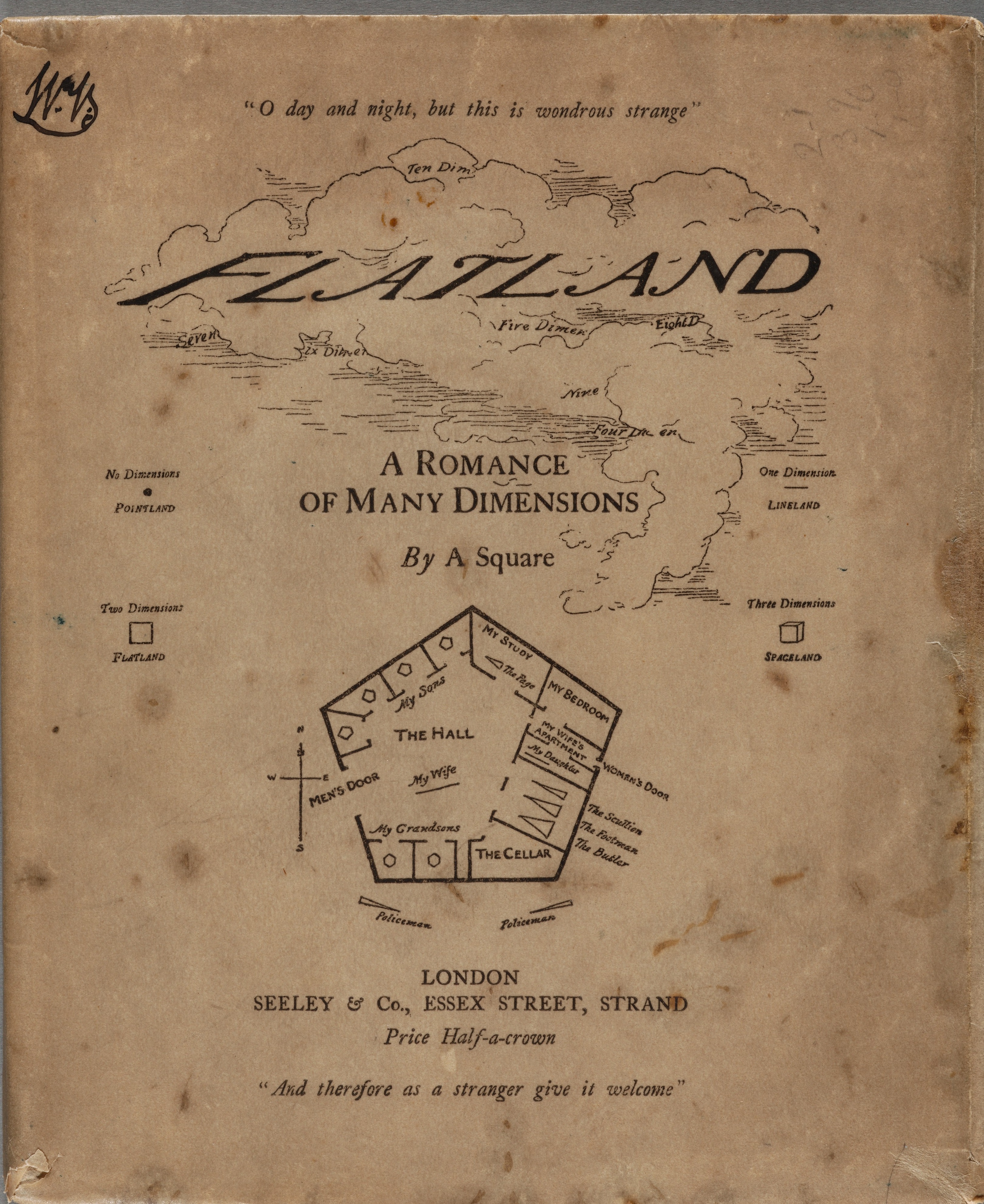
– Edwin A. Abbott, Flatland: A Romance of Many
Dimensions, (1884).
– George Macdonald, Phantastes: A Faerie
Romance for Men and Women (1858).
–
Kenneth Grahame, The Wind in the Willows (1908).
LEARNING IN WAR-TIME
A sermon preached on
Sunday 22 October 1939 at the invitation of the vicar of St Mary the Virgin,
the Oxford University church. The Bible text which Lewis chose for his sermon
was Deuteronomy 26:5, “A Syrian ready to perish was my father” (“My father was
a wandering Aramean” in the NIV and in Moffatt’s translation). A playful
prefiguration of his message is found at the end of a letter he wrote to his
brother three weeks earlier (2 October 1939; CL2, 280):
By
the bye, did I tell you I’d found in the Anglo-Saxon chronicle the perfect
summing up of my personal war aims − “During all this evil time Abbot Martin
retained his abbacy”?
The sermon text was
originally duplicated for students under the title “None Other Gods: Culture in
Wartime” and then printed as “Culture
in War-Time” in The Student
Movement 42/6, March 1940. In late 1940 it
appeared in a volume edited by Ashley Sampson, Famous English Sermons (Thomas Nelson, London 1940). Lewis’s first
appearance as a Christian preacher thus got him admitted into a company that
included Bede, Donne, Taylor, Baxter, John Wesley, Newman, and other luminuaries from the past (cf. CL2, 353). The present title
was first used when Lewis included this text among the five addresses brought
together in the 1949 volume Transposition
(U.S.A.: The Weight of Glory,
revised & expanded edition 1980).
For a comprehensive discussion
of the sermon See Joe Ricke,
“An Unlikely Preacher: C. S. Lewis and the War-Time Sermon”, Sehnsucht
15 (2019), 55-100.
par. 4 this
indeed is
Periclean
Athens ... the Parthenon ... Funeral Oration
i.e.
ancient Athens during its Golden
Age, the period of Pericles (c. 495-427 BC).
The Parthenon is the great temple for the goddess Athena Parthenos (“Virgin
Athena”) on the Acropolis in Athens, built at the instigation of Pericles
between 447 and 438 BC. His famous funeral oration (recorded by Thucydides in
the History of the Peloponnesian War,
II.34-45) was for Athenian soldiers killed during a military expedition in 440
BC. What Lewis wants to point out seems to be that the Parthenon was built in
war-time.
mathematical
theorems in beleaguered cities
Archimedes (“arch-measurer”,
287-212 BC), the greatest mathematician of ancient times, was killed during the
Roman conquest of his hometown Syracuse while he was busy drawing circles on
the floor of his home. The Roman proconsul Marcellus had given special orders to
save the life of Archimedes, but in spite of that a soldier unknowingly killed
him. The last words of Archimedes reputedly were noli turbare circulos meos, “Don’t make havoc of my circles!”
metaphysical
arguments in condemned cells
This may be a reference to
Boethius (480-524 ce), a Roman
scholar and aristocrat after the fall of the Roman Empire. He held a high post
in the government of the Ostrogoth king, Theoderic, but fell into disgrace, was
imprisoned in Pavía, and cruelly executed for high treason. His book De consolatione
philosophiae (The Consolation of
Philosophy) was reputedly written in prison. Actually, Lewis doubted the
truth of this, as appears from his chapter on Boethius in The Discarded Image (1964): “This is not the language of the
condemned cell” (p. 77).
make jokes
on scaffolds
Very probably
a reference to Sir Thomas More (1478-1535). Almost twenty years after his
execution by order of king Henry VIII, More’s son-in-law William Roper wrote a Life of Sir Thomas More. Among several examples of the charity and good
cheer with which he approached his death by behading,
the biography includes the joke:
And so was he by Master
Lieutenant brought out of the Tower, and from thence led towards the place of
execution. Where, going up the scaffold, which was so weak that it was ready to
fall, he said merrily to Master Lieutenant, “I pray you, Master Lieutenant, see
me safe up, and for my coming down, let me shift for myself.”
discuss the
last new poem while advancing to the walls of Quebec
This refers to an often
repeated and embroidered anecdote about Thomas Gray’s “Elegy Written in a
Country Churchyard” (1751). British general James Wolfe is said to have recited
this poem just before he gained victory – and was killed – in the Battle of Quebec
(or Battle of the Plains of Abraham), 13 September 1759. The source appears to
be a biography of John Robison (1739-1805), an Edinburgh professor of natural
philosophy, written by his successor John Playfair and published in Transactions of the Royal Society of
Edinburgh, vol. VII (1815), pp. 495ff. Robison had served in Canada in 1759
as tutor to the son of a British admiral. As Playfair wrote in 1815,
An anecdote which he
[Robison] also used to tell deserves well to be remembered. He happened to be
on duty in the boat in which General Wolfe went to visit some of his posts the
night before the battle, which was expected to be decisive of the fate of the
campaign. The evening was fine, and the scene, considering the work they were
engaged in, and the morning to which they were looking forward, sufficiently
impressive. As they rowed along, the general with much feeling repeated nearly
the whole of Gray’s “Elegy” (which had appeared not long before, and was yet
but little known) to an officer who sat with him in the stern of the boat;
adding, as he concluded, that “he would prefer being the author of that poem to
the glory of beating the French to-morrow”.
Thomas Gray lived until 1771, but none of his
preserved letters suggests that the story ever came to his ears. See Edward E.
Morris, “Wolfe and Gray’s ‘Elegy’”, English
Historical Review vol. XV, No. 57 (January 1900), pp. 125-129.
comb their
hair at Thermopylae
cf. Herodotus, Histories VII.208-209. During the Persian
Wars of the early 5th century BC, King Xerxes sent a scout to find out the size
of the Greek army encamped at Thermopylae. The few men seen by the scout
happened to be some of the Spartan crack troops of King Leonidas; and they were
“practising athletic exercises and some combing their
long hair”. King Xerxes was astonished to
hear this since he expected the Greeks to run before the much larger Persian
army. He did not know, and refused to believe when someone told him, that these
men had “a custom which is as follows; whenever they are about to put
their lives in peril, then they attend to the arrangement of their hair.” The
Spartans lived in the region called Laconia, which is how the word “laconical” has come to be used for some of their
characteristic behaviour.
par.
7 it is for a very
“Whether ye eat or drink or
whatsoever ye do...”
I Corinthians 10:31, just
after Paul has told the Christians at Corinth they may go to dinner parties
given by pagans and eat whatever is set before them.
par.
8 all our merely natural
having two [eyes], to be cast
into Gehenna
Matthew 18:9. “And if
thine eye offend thee, pluck it out, and cast it from thee: it is better for
thee to enter into life with one eye, rather than having two eyes to be cast
into hell fire” [kjv]. In Old
Testament times, gê hinnom or
‘Valley of Hinnom’ was a ravine not far from Jerusalem where in the course of
centuries a variety of gruesome scenes took place. By the time of the New
Testament the place was perhaps used for dumping and burning rubbish while the
name had acquired the meaning of “hell”; cf. several places in Matthew (such as
5:29, 10:28, 23:33) and a few in the other three gospels. Since Lewis, in the
second paragraph of the present essay, insisted on using “the crude
monosyllable”, it seems strange that, while quoting the Authorized Version, he
should here be following the modern practice of not translating the name.
par.
9 we are now
Matthew
Arnold ... spiritual in the sense of the German geistlich
Matthew Arnold (1822-88),
English poet and critic. The sense intended appears to be sense 6 in the Oxford English Dictionary, “Of or
pertaining to, emanating from, the intellect or higher faculties of the mind;
intellectual”. However, OED quotes no instances from Arnold. Lewis made
the same reference in an essay he was writing at the time of this sermon,
“Christianity and Culture” (1939):
The
present inordinate esteem of culture by the cultured began, I think, with
Matthew Arnold – at least if I am right in supposing that he first popularized
the use of the English word spiritual in the sense of German geistlich. This was nothing less than the
identification of levels of life hitherto usually distinguished.
“as to the Lord”
Colossians 3:22-23. “Servants,
obey in all things your masters according to the flesh ... And whatsoever ye
do, do it heartily, as to the Lord; and not unto men.” See also Ephesians
6:5-7.
Bacon
... to offer the author of truth the unclean sacrifice of a lie
Francis
Bacon (1561-1626), English statesman, philosopher and essayist; quoted from The Advancement of Learning, I.1.3
For certain it is that
God worketh nothing in Nature but by second causes; and if they would have it
otherwise believed, it is mere imposture, as it were in favour towards God, and
nothing else but to offer to the Author of truth the unclean sacrifice of a
lie.
See
also Bacon’s Novum Organum, I.89 (translated from the Latin by Peter
Urbach and John Gibson, 1994:
Others
more cunningly surmise and reflect that if intermediate causes are unknown,
everything can more readily be referred to the divine hand and wand, a matter,
as they think, of great importance to religion; which is nothing other than
“wishing to please God through a lie.”
The
translaters of the latter passage added a reference
to Job 13:7, “Will ye speak wickedly of God? and talk deceitfully for him?”
Theologia Germanica
A
mystical text dating from the mid-14th
century, with guidelines for a Christ-like life that would lead to perfect
union of God and man. The treatise was much commended by Martin Luther, who
devised the title – Theologia Deutsch – to reflect the fact that it
was written in German, not Latin. The further implication was that the book had
all the advantages of plain language and simple devotion unencumbered by
academic learning. As Luther wrote in his preface:
When one contemplates God’s
wonders it is obvious that brilliant and pompous preachers are never chosen to
spread his words. ... I wish to warn everyone who reads this book not to harm
himself and become irritated by its simple German language or its unadorned and
unassuming words, for this noble little book, poor and unadorned as it is in
words and human wisdom, is the richer and more precious in art and divine
wisdom. ... It is obvious that such matters as are contained in this book have
not been discussed in our universities for a long time, with the result that
the holy Word of God has not only been laid under the bench but has almost been
destroyed by dust and filth.
par.
10 that is the essential
the great
cataract of nonsense
cf. Lord Macaulay’s essay, “Mr.
Robert Montgomery’s Poems”, in Critical
and Historical Essays (1843). This is a devastating critique of
Montgomery’s 1830 poems “The Omnipresence of the Deity” and “Satan”, intended
to illustrate Macaulay’s point that
the
avenues to fame [are] blocked up by a swarm of noisy, pushing, elbowing
pretenders, who, though they will not ultimately be able to make good their own
entrance, hinder, in the mean time, those who have a
right to enter.
Toward the end of the first poem
discussed, there is
...
the deathbed of a Christian made as ridiculous as false imagery and false
English can make it. But this is not enough. The Day of Judgment is to be
described, and a roaring cataract of nonsense is poured forth upon this
tremendous subject.
Lewis quoted the same
phrase less than three weeks later in a letter of 11 November 1939, referring
to the exuberance of his friend Hugo Dyson (CL2, 288).
par.
14 the third enemy
the streets of Warsaw
Lewis was talking less than a
month after the beginning of the Second World War – the German campaign in
Poland – which ended with the heavy bombing and surrender of Warsaw. In
retrospect, the sermon can be seen as Lewis’s opening move in the peculiar kind
of war work he was to take up, giving talks both on the air and for audiences
of airforce men all over the country.
a permanent city
Hebrews 13:14. “For here have we
no continuing city, but we seek one to come.” [kjv]
CHRISTIANITY AND LITERATURE
par.
5 now the new testament
The Unjust Judge
Luke 18:1-8.
Donne
points out that we are never told He laughed
John Donne (1572-1631), English poet,
who was also a famous preacher. Lewis refers to Donne’s Lent sermon on I
Timothy 3:16, preached before the king on 16 February 1620:
Be
pleased to consider this great work of believing, in the matter, what it was
that was to be believed: ... that from that man ... ingloriously executed as a Traytor, they should look for glory, and all glory, and
everlasting glory? And from that melancholick man,
who was never seen to laugh in all his life, and whose soul was heavy unto death; they should look for joy, and all
joy, and everlasting joy ... ?
Donne
seems to be describing impressions rather than facts about Jesus. From a Lent
sermon on John 11:35 (Jesus weeping at the grave of Lazarus), preached on 28
February 1623, Donne appears indeed to be skeptical
about an old influential document which described Jesus as one who was “never
seen to laugh”
In that letter which Lentulus is said to have written
to the Senate of Rome, in which he gives some Characters of Christ, he saies, That Christ was never seene
to laugh, but to weep often. Now in what number he limits his often, or upon
what testimony he grounds his number, we know not. We take knowledge that he
wept thrice. He wept here, when he mourned with them that mourned for Lazarus; He wept againe,
when he drew neare to Jerusalem, and looked upon that
City; And he wept a third time in his Passion.
There is one more Donnean
reflection on Christ and laughing, in a sermon of unknown date on
I Thessalonians 5:16 (“Rejoyce evermore”). Commenting on a passage in
Saint Basil, Donne points out that the “Woe unto you that laugh now!” (Luke
6:25) is
“cast
upon a dissolute and undecent, and immoderate
laughing, not upon true inward joy, howsoever outwardly expressed.”
He goes on to insist that
“Joy,
and cheerfulnesse ... hath the nature of a
commandment” and “Not to feele joy is an argument
against religious tendernesse, not to show that joy,
is an argument against thankfulnesse of the heart:
that is a stupidity, this is a contempt. ... It mis-becomes not wisdome and gravity to laugh in Gods deliverances, nor to
laugh to scorne those that would have blown up Gods
Servants ...”
(Quoted from The Sermons of John Donne,
ed. Potter & Simpson, 10 vols., 1953-1962)
Lewis was aware of Donne’s
saying at least since 1924, when he was shown a new poem by his friend Cecil
Harwood on the subject (cf. Lewis’s diary as published in All My Road Before Me, 21-24 June 1924, p. 339).
par.
11 applying this principle
the Aristotelian doctrine of mimèsis
……
the
Augustan doctrine about the imitation of Nature and the Ancients
……
par.
13 if you said
au moins je suis autre
“At least I am
different.” Rousseau, Confessions, beginning of Book I.
St Augustine ... “a
narrow house too narrow for Thee to enter...”
Confessiones
I.5. “Angusta est
domus animae meae quo venias ad eam:
dilatetur abs te. Ruinosa est: refice
eam.”
Wordsworth, the
romantic who made a good end
……
par. 14 in this
sense
he
knows that in his flesh dwells no good thing
Romans 7:18. “For I
know that in me (that is, in my flesh,) dwelleth no good thing: for to will is
present with me; but how to perform
that which is good I find not.” [kjv]
Thomas Aquinas, ipsa ratio hoc habet etc.
S.T. I-II, Q. 34 a. 1
ad 1. “Reason itself demands that the use of reason be
interrupted at times” (Benziger Bros. edition, 1947).
...as we can eat, to the glory of God
I Corinthians 10:31.
Pater prepared for pleasure as if
it were martyrdom
Walter Pater
(1839-1894), English literary critic, central figure of an earnest aesthetic
group in Oxford, and proponent of “art for art’s sake”. Lewis is probably
referring, in particular, to what he called Pater’s “vaguely narrative essay” Marius the Epicurean (1885), discussed
in Lewis’s letter to Arthur Greeves of 10 January 1932 (Collected Letters II, 33):
In Pater [the purely
aesthetic attitude to life] seems almost to include
the rest of the spiritual life ... Perhaps it is his patronage of great things which is so offensive – condescending to add the Christian religion to his
nosegay of spiritual flowers because it has a colour or a scent that he thinks
would just give a finishing touch to the rest. It is all balls anyway – because
one sees at a glance that if he really
added it it would break up the whole nosegay view of
life. In fact that is the refutation of aestheticism: for perfect beauty you
need to include things which will at once show that mere beauty is not the sole
end of life. If you don’t include them, you have
given up aestheticism: if you do, you must
give it up Q.E.D.
par.
15 now that i see
Di sè medesmo rise
“He laughed at
himself.” Dante, Paradiso XXVIII, 135.
CHRISTIANITY AND CULTURE
First published in Theology, March 1940,
166-179; first reprinted in Christian Reflections, ed. Walter Hooper
(Eerdmans, Grand Rapids 1967), 12-36. In the Introduction to the 1967 volume,
Hooper presents a list of the allegedly “entire controversy”. The list actually
lacks the final instalment, published in February 1941 under the title “Mr. Lewis’s
Peace Proposals” and consisting of two letters – one by George Every and the
other by S. L. Bethell. A full facsimile text of the controversy, including two
preceding essays by Every and Bethell, can be downloaded here (PDF).
After
Every’s final published contribution, Lewis wrote two further responses in
letters of 28 January and 4 February 1941, published in Collected
Letters II, 466-469.
par.
1 at an early age
the friends of culture seemed to
me to be exaggerating
A passage at the end of The Personal Heresy: A Controversy
(1939) by E. M. W. Tillyard and C. S. Lewis, published less than a
year before the present essay, suggests that Lewis is here criticizing a former
habit of his own. The book is a series of six essays, three by each author in
alternation and written in the course of the 1930s. Lewis wrote the original
version of the opening essay in 1930, the year of his conversion to Theism, and
he became a Christian in September 1931. In a note appended to the 1939 book
(pp. 147-150), he admitted that there was as discrepancy between his own view
of poetry in the first essay and that in his last. In the first, as he now
noticed, he had
assumed
(i), what now seems to me very unlikely, that large
groups of human individuals possess a common consciousness; and (ii) that if
they do, this common consciousness would be so superior to that of the
individuals that it might be called “angelic”. In fact, I have exaggerated.
par.
2 the present inordinate
Matthew Arnold ... spiritual in the sense of German geistlich
Matthew
Arnold (1822-88), English poet and critic. The sense intended appears to be
sense 6 in the Oxford English Dictionary,
“Of or pertaining to, emanating from, the intellect or higher faculties of the
mind; intellectual”; but OED quotes no instances from Arnold. Lewis made
the same reference in “Learning in War-time”, a sermon he had preached in the
previous year (1939).
Croce
Benedetto Croce
(1866-1952), Italian idealist philosopher whose main work was in the field of
aesthetics.
the poetics of I. A. Richards
Ivor Armstrong
Richards (1893-1979), English literary critic, Professor of English at Harvard
University, 1944-1963.
the editors of
Scrutiny
cf. Lewis’s Collected Letters II, 252, where Walter
Hooper explains that
The editors of this
periodical, which ran from 1932 to 1953, expressed a belief in a “a necessary
relationship between the quality of the individual’s response to art and his
general fitness for a humane existence”. Lewis was appalled to find this “ inordinate
esteem” expressed in the pages of Theology.
Housman, Mr Charles Morgan, and
Miss Sayers
– Alfred Edward Housman (1859-1936), classical scholar
and widely-read English poet (A
Shropshire Lad, 1896).
– Charles
Langbridge Morgan (1894-1958),
English novelist, playwright and drama critic for The Times
– Dorothy L. Sayers (1893-1957), English writer; she
first became famous for her detective stories, but by the time of this
controversy over Christianity and Culture she developing new reputations as
playwright and Christian apologist.
Interestingly, when Sayers found one of her
plays reviewed by Charles Morgan in 1946, she commented that “if highbrow ‘littery’ blokes like him are going to start taking me
seriously, the world is coming to an end!” – The Letters of Dorothy Sayers, ed. Barbara Reynolds, vol. 3 (1998),
p. 272.
par.
9 it might be important
Hooker
has finally answered the contention that Scripture must contain everything
important or even everything necessary.
Richard Hooker,
(1554-1600), English (Anglican) theologian, author of The Four Books of the Lawes of Ecclesiastical Polity and, as such,
a founding father of the Anglican Church. The reference is to Book I, ch. 14, “The
sufficiency of Scripture unto the end for which it was instituted”:
He that should take upon him to teach men how to
be eloquent in pleading causes, must needs deliver unto them whatsoever
precepts are requisite unto that end; otherwise he doth not [do] the thing
which he taketh upon him. Seeing then no man can plead eloquently unless
he be able first to speak, it followeth that ability
of speech is in this case a thing most necessary. Notwithstanding every
man would think it ridiculous, that he which undertaketh
by writing to instruct an orator should therefore deliver all the precepts of
grammar because his profession is to deliver precepts necessary unto eloquent
speech...
In like sort, albeit Scripture do profess to
contain in it all things that are necessary unto salvation; yet the meaning
cannot be simply of all things which are necessary, but all things that are
necessary in some certain kind of form; as all things which are necessary, and
either could not at all or could not easily be known by the light of natural
discourse; all things which are necessary to be known that we may be saved, but
known with presupposal of knowledge concerning
certain principles whereof it receiveth us already
persuaded, and then instructeth us in all the residue
that are necessary.
par.
11 st augustine
regarded
dementia ... honestior
et uberior
“Madness” ... “higher
and richer”. The full Latin passage reads “Tali dementia honestiores
et uberiores litterae putantur quam illae
quibus legere et scribere didici.” – “Madness like
this is thought a higher and a richer learning, than that by which I learned to
read and write” (Augustine, Confessions I.13,
transl. Edward B. Pusey).
miserabilis insania ...
quid autem mirum cum infelix pecus etc.
“Miserable madness
(...).What marvel that an unhappy sheep, straying from Thy flock, and impatient
of Thy keeping, I became infected with a foul disease?” (Confessions III.2, Pusey’s translation). Recent Latin editions read
mirabilis (“astonishing”) for
miserabilis.
par.
12 st jerome,
allegorizing
St Jerome ... cibus
daemonum ...carmina poetarum etc.
St Jerome, or
Hieronymus (347-420 c.e.), Latin
Church Father and Bible translator. The Epistle referred to is a letter to Pope
Damasus I. The Latin words quoted mean “the food of demons ... songs of poets,
worldly wisdom, the glittering verbosity of rhetoricians.”
Webster’s White Devil
John Webster (c. 1580–c. 1630), English dramatist. Lewis is referring to one of
Webster’s two famous plays (the other being The
Duchess of Malfi), first produced in 1608 – The White Divel: Or the Tragedy of Paolo Giordano Ursini, Duke of Brachiano, With the Life and Death of Vittoria Corombona the famous Venetian Curtizan.
Keats’s
phrase about negative capability or “love of good and evil”
English
poet John Keats
(1795-1821) in a letter to his brothers
George and Tom, 21 December 1817.
It struck me what
quality went to form a Man of Achievement, especially in Literature, and which
Shakespeare possessed so enormously – I mean Negative Capability, that is, when
a man is capable of being in uncertainties, mysteries, doubts, without any irritable
reaching after fact and reason – Coleridge, for instance, would let go by a
fine isolated verisimilitude caught from the Penetralium of mystery, from being
incapable of remaining content with half-knowledge. This pursued through
volumes would perhaps take us no further than this, that with a great poet the
sense of Beauty overcomes every other consideration, or rather obliterates all
consideration.
par. 15 thomas à kempis i take
Thomas à Kempis
Late medieval writer
and mystic (c. 1380-1472), German
Augustinian monk and member of the spiritual movement called “Modern Devotion”
(Devotio moderna). He is generally considered to
be the author of De imitatione
Christi (The Imitation of Christ),
which in the early years of printing was the most widespread book after the
Bible and remained one of the most widely read books of Christian devotion.
par. 16 in the theologia germanica
Theologia Germanica
A mystical text dating
from the mid-14th century, with guidelines for a Christ-like life that would
lead to perfect union of God and man. The treatise was much commended by Martin
Luther, who devised the title – Theologia Deutsch
– to reflect the fact that it was written in German, not Latin. [Also referred
to in Learning in War-time.]
par.
18 i found the famous
Gregory
... our use of secular culture
Pope Gregory the
Great (or Gregory I, c. 540-604) ……
par.
19 in milton i
found
Milton ... Areopagitica
John Milton
(1608-1674), Areopagitica: a Speech of Mr
John Milton for the Liberty of Unlicensed Printing to the Parliament of England
(1644).
par.
21 whether because i am
chain
of being
……
Newman ... “Liberal Knowledge its Own end”
……
par.
24 2. but is culture
“working the thing which is good”
Ephesians 4:28, as
quoted in the previous paragraph.
Let him that stole steal
no more: but rather let him labour, working with his hands the thing which is
good, that he may have to give to him that needeth.
par.
28 this view gives
Bentham ... the issue between pushpin and
poetry
Jeremy Bentham
(1748-1832), influential English writer on law, originator of Utilitarianism in
philosophy. Lewis is referring to The Rationale of Reward (1825), Book
III, chapter 1:
Prejudice apart, the
game of push-pin is of equal value with the arts and sciences of music and
poetry. If the game of push-pin furnish more pleasure, it is more valuable than
either. Everybody can play at push-pin: poetry and music are relished only by a
few. The game of push-pin is always innocent: it were well could the same be
always asserted of poetry...
par.
29 4. it was noticed
“willing
suspension of disbelief”
Coleridge, Biographia
Literaria (1817), Chapter XIV, second paragraph:
...the plan of the LYRICAL
BALLADS; in which it was agreed, that my endeavours should be directed to
persons and characters supernatural, or at least romantic; yet so as to
transfer from our inward nature a human interest and a semblance of truth
sufficient to procure for these shadows of imagination that willing suspension
of disbelief for the moment, which constitutes poetic faith.
par.
30 (a) to the perfected
being
learned in Gethsemane
Matthew 26:36ff, and parallel places in Mark 14 and
Luke 22.
Galahad
is the son of Launcelot
In medieval legend, Launcelot or Sir Lancelot du Lac
is one of the chief Knights of the Round Table at King Arthur’s court. As a
representative of the ideal of
knighthood he is far from perfect; but his natural son Galahad goes a
lot further in that respect.
par.
31 (b) the road described
The
road described by Dante and Patmore
Dante Alighieri 1265-1321), Italian poet. ……
Coventry Patmore (1823-1896), English poet, author of The Angel in the House, a poetic celebration
of married love.
Charles Williams (1886-1945) ……
eunuchs
for the Kingdom’s sake
cf. Matthew 19:12. “For there are some eunuchs, which
were so born from their mother’s womb: and there are some eunuchs, which were
made eunuchs of men: and there be eunuchs, which have made themselves eunuchs
for the kingdom of heaven’s sake. He that is able to receive it, let him
receive it.”
romantic love also has proved a
schoolmaster
cf. Galatians 3:24.
“Wherefore the law was our schoolmaster to bring us unto Christ, that we might
be justified by faith.”
par. 33 (e) the
dangers of
(note) Sehnsucht
as “spilled religion”
A reference to the English poet, essayist and
philosopher T. E. Hulme (1883-1917) in his lecture “Romanticism and Classicism”, written c. 1911 and published in Speculations (1924, ed. Herbert
Read).
You don’t believe in Heaven, so you begin to
believe in a heaven on earth. (...) The concepts that are right and proper in
their own sphere are spread over, and so mess up, falsify and blur the clear
outlines of human experience. It is like pouring a pot of treacle over the
dinner table. Romanticism then, and this is the best definition I can give of
it, is spilt religion” (Speculations, p. 118).
par. 34 i have dwelt chiefly
in Ricardian terms
i.e. in terms borrowed from I. A. Richards, mentioned
in the second paragraph of the present essay. The term “storehouse of values” comes from Principles of
Literary Criticism, p. 32:
The arts are our storehouse
of recorded values. They spring from and perpetuate hours in the lives of
exceptional people, when their control and command of experience is at its
highest, hours when the varying possibilities of existence are most clearly
seen and the different activities which may arise are most exquisitely
reconciled, hours when habitual narrowness of interests or confused
bewilderment are replaced by an intricately wrought composure.
Lewis is perhaps using the term partly because it also
appeared in the firtst
paragraph of “The Necessity
of Scrutiny”, i.e.
the article by Brother Every which he was responding to. Every was in turn
quoting the manifesto in which the editors of Scrutiny – Knights, Culver
and the Leavises – had published their purpose when
that journal was launched in 1932; they were quoting Richards.
N.B. “Ricardian” is
printed as “Richardian” in the Essay Collection published in 2000.
par.
37 has it any part
the
sweeping of the room in Herbert’s poem
George Herbert (1593-1648), English poet. The reference is to
his poem “The Elixir”:
Teach me, my God and
King,
In all things Thee to see,
And what I do in anything,
To do it as for Thee. (...)
All may of Thee
partake:
Nothing can be so mean
which with this tincture – For Thy sake
–
will not grow bright and clean.
A servant with this
clause
Makes drudgery divine:
Who sweeps a room as for Thy laws,
Makes that and th’ action fine.
par.
38 if it is argued
“stock” … response
As with the earlier
“Ricardian” term (see note to par. 34, above), Lewis may be referring not only
to the term as it appears in Richards’s work but to Brother Every’s quoting it:
For the health of our
Christianity we need sound and orthodox but sensitive and repsonsive
theolology, a theology addressed to the “best minds
in the class” … But we also need other kinds of criticism, and literary
criticism more especially. … We need [to be] keen to detect stock responses and
bogus reactions. Scrituiny needs and indeed
demands a healthy theology, but Theology cannot do its work without Scrutiny.
(“The Nececcity of Scrutiny”, final paragraph,
including final sentence)
Sidney’s poetics
Sir Philip Sidney
(1554-1586), English courtier, soldier, poet and critic; author of Apologie for Poetrie (1595), later called Defence of Poesie.
……
II
Address
the Editor of Theology
The editor since 1939 was Alec R. Vidler (1899-1991), English
theologian and prolific writer.
par.
2 to mr carritt
i reply
Mr Carritt
E. F. Carritt (1876-1964) had been Lewis’s philosophy tutor at
Oxford during the years 1920-1922 as Fellow of University College. He was still
active in that function in 1940. During the academic year 1924-1925 Lewis
replaced him and so got his first experience as a lecturer.
the fruition of God
cf. Westminster Catechism, Q & A 1.
“What is the chief end of man? – Man’s chief end is to glorify God, and to
enjoy him forever.”
Puritan, quotha!
“Quotha” is an obsolete way
to express mild sarcasm about someone’s using a particular word or expression.
The original form is “Quoth he”, i.e. “Says he”.
III
par.
8 2. in theology, may, 1940
“sweet,
sweet, sweet poison”
Shakespeare, King
John I.1, 212.
par.
12 if any real disagreement
M. de Rougemont ... “ceases to be a devil only when it ceases to be a
god”
Denis de Rougemont
(1906-1985), Swiss Francophone author.
L’amour et l’Occident,
Book VII, chapter 5: “Dès qu’il [l’Éros] cesse d’être
un dieu, il cesse d’être un démon.”. A translation of this book was
first published as Passion and Society,
and later, revised and expanded, as Love
in the Western World (1956). Lewis reviewed it in Theology, June 1940. The review was never reprinted but is now
available online at http://tjx.sagepub.com/content/40/240/459.full.pdf+html.
par. 15 i hope it is now
I
enjoyed my breakfast this morning ... I think it was a good thing ... but I do
not think myself a good man for enjoying it
cf. George Macdonald, The Princess and Curdie, chapter 3,
quoted by Lewis in his Macdonald Anthology
(1946), Nr. 342.
It is a good thing to eat your breakfast, but you don’t
fancy it’s very good of you to do it. The thing is good – not you ... There are
a great many more good things than bad things to do.
… a very fine one.
Lewis’s “Peace Proposals for Brother Every and Mr Bethell” were followed
by two further letters to the editor, one from Every and one from Bethell,
published in the Theology issue of February 1941: “Mr. Lewis’s
Peace Proposals”. This conclusion to the exchange is not listed in
Walter Hooper’s preface to Christian Reflections.
DANGERS OF NATIONAL REPENTANCE
This is the first article Lewis wrote for the Angical
weekly newspaper The Guardian,
15 March 1940. After two more contributions (“Two Ways with the Self” and
“Meditation on the Third Commandment”) he began contributing his thirty-one weekly “Screwtape Letters” to this
periodical in May 1941.
par. 2 if they are
ipso facto
(Latin) “by the fact
itself”, i.e. necessarily, unavoidably.
par. 3 such an escape
Where passions have
the privilege to work ...
William Wordsworth’s
long poem The Prelude was published
in 1850 but written in the years 1799-1805. Book XI is the last of three Books
describing the author’s “residence in France” in 1792 and his “juvenile errors”
(XI, 54) as an enthusiastic supporter of the French Revolution.
Colonel Blimp
A cartoon character
in the London newspaper Evening Standard
in the 1930s. He was the type of a pompous, irascible and reactionary army
officer. See also Lewis’s brief 1944 essay “Blimpophobia”
in Time and Tide, reprinted in Present Concerns (1986).
and the Russians
Lewis was delivering
this paper in 1940, while the Soviet Union was still formally an ally of
Germany.
we must forgive ...
or we are damned
Matthew 6:14-15,
18:32-35; Mark 11:26.
the Fifth Commandment
“Honour
thy father and thy mother” (Exodus 20:12).
whom he hath not seen
cf. 1 John 4:20.
par. 4 it is not
to “hate” his mother
for the Lord’s sake
Luke 14:26.
If any man come to
me, and hate not his father, and mother, and wife, and children, and brethren,
and sisters, yea, and his own life also, he cannot be my disciple.
hard sayings of our
Lord
John 6:60, the only
place in the gospels where a saying of Jesus is described as a “hard saying” or
“hard teaching”. The phrase has received a wider application for such sayings
of Jesus as display a similar sort of hardness.
brother and child
against parent
Cf. Matthew 10:21.
And the brother shall
deliver up the brother to death, and the father the child: and the children
shall rise up against their parents, and cause them to be put to death.
(See also Matthew 10:35-36 and
Luke 12:52-53.)
M. Mauriac’s
Vie de Jésus ... “Pourquoi
cette stupeur ... ”
François Mauriac
(1885-1970) was a French writer and Nobel laureate for Literature 1952. As a
Catholic he began adult life with Modernist leanings but never felt comfortable
in that position. His Vie de Jésus (1936,
translated as Life of Jesus in 1937)
marked his final rejection of Modernism. In his preface to the second edition
(also 1936) he added a specific attack on Alfred Loisy,
a leading Modernist, and on the routinely preconceived denial of the supernatural. As a novelist Mauriac hoped with his
biography of Jesus “to convince the reader that the Jesus of the Gospels is the
very opposite of an artificial, composite being”. He had tried to sketch the
portrait of a man who appeared to various people as “the same man under two
aspects; one, yet different according to the heart which reflects him:
worshipped by the poor [who overdo their respect for the divinity by ignoring
the humanity of Jesus] and hated by the proud [who hate the pretenstions
of divinity because they nly see the humanity]
because of that which is divine in him, and precisely therefore misunderstood
by both” (translated from the French first edition, pp. viii-ix, with inserted
explanation from the preceding passage).
Chapter 9, “Judas”, largely consists of
sayings of Jesus, including the one from Matthew 10:21. Each saying is followed
by an imagined silent comment from Judas, like the one quoted by Lewis.
Almost two decades later, Lewis made the same
reference in The Four Loves, chapter 6, fourth paragraph (“Judas ...
laps it up easily”). As appears from Collected
Letters II, 213, he read the French original in 1937; and six years later,
after reading Dorothy L. Sayers’s The Man
Born to be King in 1943, Lewis wrote to her that “since
Mauriac’s Vie de Jésus nothing has moved me so much” (ibid., p. 577). Likely enough, more
elements from Mauriac’s book found their way into Lewis’s work. Thus Mauriac,
having quoted Matthew 10:37 at another point in the chapter on Judas, comes
close to suggesting Lewis’s later “trilemma”, i.e. the idea that Jesus must
have been either mad, or bad, or God. Also, the way Lewis began his book Miracles (1947) may have been partly
inspired by the opening sentences of Mauriac’s preface:
De tous les historiens, l’exégète
est le plu décevant. S’il appartient à l’espèce de ceux qui d’abord nient le
surnaturel et qui en Jésus ne discernent pas le Dieu, nous sommes assuré qu’il
n’entend rien à l’objet de son étude et pour nous toute sa science ne pèse un
fétu.
[ Of all historians the most deceptive is the exegete. If he is one of
those who start off by denying the supernatural and does not discern God in
Jesus, then we can be sure he understands nothing of the object of his study
and as far as we’re concerned, all his knowledge doesn’t weigh a straw. ]
TWO WAYS WITH THE SELF
This is the second
article Lewis wrote for The Guardian,
a Church of England weekly newspaper, 3 May 1940. After one more contribution
(“Meditation on the Third Commandment”) he began contributing his thirty-one
weekly “Screwtape Letters” to this periodical in May 1941.
par. 1 self-renunciation is thought
St François de Sales ...
avec des remonstrances douces et tranquilles
A two-page excerpt in
translation containing this passage can be found on Paul Ford’s website. François de Sales
(1567-1622) was bishop of Geneva and Annecy; his Introduction à la vie dévote appeared in
1609. Lewis referred to the same passage in his last book, Letters to Malcolm (1964), chapter 18.
Julian of Norwich
English mystic and
anchoress (c. 1342–c. 1413).
New Testament ... love my neighbour “as myself”
Matthew 19:19, 22:39;
Mark 12:31.33; Romans 13:9; Galatians 5:14; James 2:8.
“hate his own life”
Luke 14:26; John
12:25.
par. 2 we must not
Shelley ..
self-contempt as the source of cruelty
cf. Shelley’s The Revolt of Islam (1818) VIII.21.
Yes, it is Hate ...
Whom self-contempt arms with a mortal sting ...
See also Lewis’s
essay “Shelley, Dryden, and Mr Eliot”, dating from the 1930s, in Selected Literary Essays (1969), p. 198:
To a Christian,
conviction of sin is a good thing because it is the necessary preliminary to
repentance; to Shelley it is an extremely dangerous thing. It begets
self-contempt, and self-contempt begets misanthropy and cruelty.
a later poet ... the
man “who loathes his neighbour as himself”
??
“ideological taint”
Lewis used the same
phrase in the first few paragraphs of his 1941 essay “Bulverism”.
David Lindsay’s
Voyage to Arcturus
A science-fiction
novel published in 1920. Lewis read it in 1935 or 1936 and found himself
inspired by it to make his own attempt at writing science-fiction.
“Richard loves
Richard ...”
Shakespeare, Richard III, V.3, 184.
par. 3 now, the self
Macdonald ... “to be
allowed a moment’s respite ...”
Cf. George
Macdonald’s sermon on “Self-Denial” (Luke 9:23-24), Unspoken Sermons, second series, Nr. 11. Lewis is not quoting very
accurately, yet without changing Macdonald’s sense. A fuller and correct quote
including the present phrase is in Lewis’s George
Macdonald: An Anthology (1946) as Nr. 158.
Tacitus, immitior quia toleravat
Tacitus (c. 56–c. 117
CE) was one of the great historians of ancient Rome. The correct reference is
Book I, section 20; immitior
is either a typo or an alternative
form for inmitior.
Tacitus is talking of Aufidienus Rufus,
long a private, then
a centurion, and latterly a camp-marshal, [who] was seeking to reintroduce the
iron discipline of the past, habituated as he was to work and toil, and all the
more pitiless because he had endured.
(translation by John Jackson, Loeb 249, Tacitus Vol. II, p. 280).
THE NECESSITY OF CHIVALRY
First published on 17 August 1940 in Time and Tide, a political and literary weekly
review magazine founded in 1920. This was the first of a total of twenty-five
contributions from Lewis to the magazine (essays, poems and book reviews)
during the 1940s and 1950s. The present piece was first reprinted in October
1940 as “The Importance of an Ideal” in Living
Age, an American monthly magazine which aimed “to bring to readers, for their information,
representative expressions of opinion throughout the world.”
The Necessity of Chivalry
The title might be a
play on an article by George Every, “The Necessity of Scrutiny”, published in
the joural Theology in March 1939. Lewis had
written a lengthy response published in the same journal in March 1940 under
the title “Christianity and Culture”.
“Thou wert the meekest man”, says Sir Ector to
the dead Launcelot
Le Morte Darthur, Book XXI, chapter 12. This is the last chapter of the great late-medieval collection of
Arthurian legend, compiled by Thomas Malory and printed in 1485 by William
Caxton. The telling and retelling of stories about the semi-legendary King
Arthur and the knights of the Round Table was a tradition that spread from
England to France during the twelfth century. The characteristic figures and
features of these stories came to be collectively called “the matter of
Britain”, distinguished from “the matter of France”, in which the historical
Charlemagne was supposed to be the central figure. In France both traditions
acquired a more and more “courtly” or chivalric flavour. The figure of
Launcelot, the type of the ideal Arthurian knight, first emerged in the work of
French author Chrétien de Troyes (c.
1135−c. 1183).
blood and iron
After the German locution Eisen und Blut (“iron and blood” − mostly quoted as Blut und Eisen), from an 1862 speech by
the then new Prime Minister of Prussia, Otto von Bismarck.
“he wept as he had been a child that had been
beaten”
Le Morte Darthur, Book XIX, chapter 5.
Homer’s Achilles
Achilles is the hero of the Iliad, one of the two long poems ascribed to the ancient Greek poet
Homer (8th century B.C.). The “wrath” of Achilles is announced in the opening lines as the poem’s main theme. The climax comes near
the end of Book XXII (330f) as Achilles triumphs over the Trojan prince and
army commander Hector.
the Sagas … “stern to inflict … stubborn to
endure”
The Sagas are semi-historic stories from 9th-
and 10th-century Iceland, passed down orally until most of them were committed
to writing during the 13th century. The quoted expressions are taken from an
introductory poem on the barbarians of ancient Scandinavia by the English poet
Robert Southey (1774-1843), in Icelandic
Poetry (1797), a
translation of the Poetic Edda.
Attila “had a custom of fiercely rolling his
eyes …”
Edward Gibbon, Decline and Fall of the Roman Empire (1776-88), chapter 34. Attila
(c. 400-453) was king of the Huns
during the last two decades of his life, the period of the Hun empire’s
greatest power and extent; it collapsed after his death.
Dartmoor
England’s main prison for long-term convicts, in
the southwestern region of the same name, in the county of Devon.
by a “modern invocation”
Shakespeare, King
John III.4, 42 (Constance):
O that my tongue were in the thunder’s mouth!
Then with a passion would I shake the world,
And rouse from sleep that fell anatomy
Which cannot hear a lady’s feeble voice,
Which scorns a modern invocation.
In Shakespeare’s vocabulary, modern means “ordinary”, “everyday”.
Lexicographer C. T. Onions (a colleague of Lewis’s at Magdalen College),
notes in his 1911 Shakespeare Glossary that
this is a “peculiarly Elizabethan” meaning and “the only Shakespearean sense”.
Lewis appears to be slyly identifying this sense with post-Enlightenment
meanings so as to enhance any negative connotations on both sides of the
equation. Nevill Coghill, a friend of Lewis and a fellow scholar of English,
later wrote in a commemorative essay that “it delighted him [Lewis] that he
could find no use of the word modern
in Shakespeare that did not carry its load of contempt.” (“The Approach to
English”, in Light on C. S. Lewis,
1964, p. 60).
Kipling
Rudyard Kipling (1865-1936), English poet and
novelist, exponent of British patriotism and advocate of British imperialism.
Nobel Prize for Literature 1907.
Stalky, Nelson, Sidney
− Kipling wrote Stalky & Co. (1899), a volume of short stories about
boarding-school boys; the figure of Stalky was modeled
on Kipling’s own former schoolmate, the later general Lionel Charles Dunsterville (1865-1945).
− Horatio Nelson (1758-1805) was a famous British admiral.
− Sir Philip Sidney (1554-86) was an English poet and soldier who acquired the
reputation of embodying the type of the ideal aristocrat.
“escapism”
Lewis’s critique on lazily pejorative uses of
this term was certainly inspired by his friend J. R. R. Tolkien’s
1938 lecture, “On Fairy Stories”, published in Essays Presented to Charles Williams (Oxford U.P., 1947), 38-89,
esp. pp. 75ff; also found in the volume of Tolkien’s essays The Monsters and the Critics, ed. Frank
Williamson and Christopher Tolkien (Allen & Unwin, London 1983), 109-161,
esp. 147ff. Lewis’s readiness to adopt this criticism can already be sensed in
his earliest published prose work, the
Pilgrim’s Regress; see, for example, Book VI, last page of chapter 3 (Mr.
Neo-Angular: “Do you take me for an escapist?”).
WHY I AM NOT A PACIFIST
Paper read to a
pacifist society in Oxford, 1940 (for a possible further specification of the
date see note on “Terris Bay”). First published in 1980 in the enlarged edition
of The Weight of Glory and other
addresses, a volume of Lewis’s essays originally published as the American
edition of Transposition (Geoffrey
Bles, London 1949).
par. 2 but even in
“if it had power as
it has right, would absolutely rule the world”
Joseph Butler
(1692-1752), Fifteen Sermons preached at
the Rolls Chapel (1726), Sermon II, “Upon Human Nature” (p. 24 in the 1841 edition published by
Thomas Tegg, London).
Thus, that principle by which we
survey, and either approve or disapprove our own heart, temper, and actions, is
not only to be considered as what is in its turn to have some influence; which
may be said of every passion, of the lowest appetites; but likewise as being
superior; as from its very nature manifestly claiming superiority over all
others; insomuch that you cannot form a notion of this faculty, conscience,
without taking in judgment, direction, superintendency. This is a constituent
part of the idea, that is, of the faculty itself; and to preside and govern,
from the very economy and constitution of man, belongs to it. Had it strength,
as it has right; had it power, as it has manifest authority, it would
absolutely govern the world.
par.
15 first as to
a Mediterranean world
in which Carthaginian power succeeded Persian
Lewis was probably
thinking of what G. K. Chesterton wrote in The
Everlasting Man (1925), Part 1, chapters 6 and 7, e.g. in the following
passage from ch. 7:
It is not for us to
guess in what manner or moment the mercy of God might in any case have rescued
the world; but it is certain that the struggle which established Christendom
would have been very different if there had been an empire of Carthage instead
of an empire of Rome.
par. 23 it may be
Eugenists
People advocating,
developing or practicing a science-based improvement of humanity as a
biological species. As an ideal, eugenics enjoyed wide support in the modern
world, especially the United States, until the rise of Hitler in the 1930s.
Douglasites
Supporters of the
Douglas Plan, an economic program proposed in the early 1920s by the British
engineer C. H. Douglas (1879-1952), author of Social Credit (1924). He hoped to
achieve a better balance or mutual adjustment in the developments of wage and
price levels. Lewis learnt about the “Douglas scheme” in the early 1920s
through his friend Owen Barfield, who for some time supported it (cf. Astrid
Diener, The Role of Imagination in
Culture and Society: Owen Barfield’s Early Work, 2002, pp. 168-170,
referring to John L. Finlay, Social
Credit: The Engligh Origin, 1972).
Federal Unionists
Members of the Federal Union,
A pro-European British movement founded in November 1938 by Charles Kimber,
Derek Rawnsley and Patrick Ransome.
par. 25 the special human
Arthur and Aelfred,
Elizabeth and Cromwell, Walpole and Burke
A small selection of
main figures of British history. Arthur
is a semi-legendary Celtic hero who perhaps lived around 500 CE; as “King
Arthur” he became a hero of European popular literature from the 12th century
onward. Aelfred is the 9th-century
Alfred the Great, King of the West Saxons, notable scholar, writer, and
champion of learning. The long reign (1558-1603) of Queen Elizabeth I, England’s last Tudor
monarch, was notable for commercial growth, maritime expansion,
flourishing arts, and much of Shakespeare’s
life and work; Oliver Cromwell
(1699-1658) was a leader of the parliamentary army during the mid-17th-century
Civil War and acted as “Lord Protector of the Commonwealth” for the last five
years of his life; Robert Walpole
(1676-1745), father of the writer Horace Walpole, was a British statesman who
effectively acted as the country’s Prime Minster before the position was
explicitly recognized; Edmund Burke
(1729-1797) was an Irish-born British statesman, orator and conservative
political theorist.
my Beowulf, my Shakespeare, my Johnson or
my Wordsworth
A selection of high
points of English literary history. Beowulf is a heroic poem perhaps
dating from the 6th century; Shakespeare
lived from 1564 to 1616; Samuel Johnson
(1709-1784) was a poet, essayist and lexicographer immortalized by his
conversation as recorded in the 1791 biography by James Boswell; William Wordsworth (1770-1850), author of The Prelude, was one of Lewis’s favourite English poets.
par. 26 so much for
Terris Bay
“Terris” may well be
a typo or the result of a
misreading at some stage: HMS Jervis Bay was a
British convoy escort which was sunk by a German battleship in the Atlantic
Ocean on 5 November 1940.
Another plausible candidate for a ship to be
mentioned here would the SS Athenia,
the first British vessel (a passenger ship) sunk by Nazi Germany during the
Second World War, on 3 September 1939, 400 km to the northwest of Ireland.
with Homer and
Virgil, with Plato and Aristotle, with Zarathustra and the Bhagavad-Gita, with
Cicero and Montaigne, with Iceland and with Egypt
Homer (8th century BC), Greek poet, author of the Iliad and Odyssey; Virgil (70-19
BC), Roman poet, author of the Aeneid;
Plato (428-347 BC) and his pupil Aristotle (384-322 BC), Greek
philosophers; Zarathustra, or
Zoroaster, Persian prophet who probably lived long before 1000 BC; Bhagavad-Gita, a long poem and sacred text of
Hinduism probably dating from around 200 BC. Iceland
refers mainly to the Eddas (the Elder or Poetic Edda and Younger or Prose
Edda), two Icelandic compilations of Norse myths both dating from the 13th
century. “Egypt” likely refers to
expressions of ancient Egyptian wisdom such as Lewis cited in the Appendix to The Abolition of Man (1943), notably the
quote in section 8(a) from Pharaoh Senusert III:
To take no notice of
a violent attack is to strengthen the heart of the enemy. Vigour
is valiant, but cowardice is vile.
as Johnson replied to
Goldsmith, ‘Nay Sir ...’
Boswell, The Life of Samuel Johnson, 7 May 1773,
paragraph opening “I introduced the subject of toleration”; the occasion is a
dinner party at the booksellers Dilly, with Goldsmith, Langton, Claxton, Mayo, Toplady, Temple, Johnson and Boswell present.
Goldsmith. “But how is a man to act, Sir? Though firmly
convinced of the truth of his doctrine, may he not think it wrong to expose
himself to persecution? (...) Is it not, as it were, committing voluntary
suicide?”
Johnson. “Nay, Sir, if you will
not take the universal opinion of mankind, I have nothing to say. If mankind
cannot defend their own way of thinking, I cannot defend it. Sir, if a man is
in doubt whether it would be better for him to expose himself to martyrdom or
not, he should not do it. He must be convinced that he has a delegation from
heaven.”
par. 27 i am aware
Hooker thought “the
general and perpetual voice ...”
Richard Hooker
(1554-1600), English theologian, Of the Lawes of Ecclesiastical Polity I.8.3. This is a
paraphrase of a much older Latin proverb, Vox
populi, vox Dei (“voice of the people, voice of God”), which is of
uncertain origin but certainly already old in the days of Charlemagne (8th-9th
century); see Wikipedia article on this maxim.
supercession
Possibly a typo for supersession; both words are possible.
par. 29 i shall consider
securus judicat
Augustine, Contra epistolam Parmeniani, III.4, §24,
in Migne, Patrologia Latina, Vol.
XLIII, col. 101).
Securus judicat orbis
terrarum bonos non esse qui se dividunt ab orbe terrarum in quâcunque parte
orbis terrarum.
(“The entire world judges with security that they are
not good who separate themselves from the entire world in whichever part of the
entire world.”)
The phrase, securus judicat,
played a crucial part in the conversion of John Henry Newman to Catholicism in
1845.
Thirty-Nine Articles
The “Articles of
Religion”, a statement of the doctrines of the Church of England, dating from
1563 and later included in the Book of
Common Prayer. In 1672 adherence was made a requirement for holding civic
office; this ruling remained in force until 1824. Lewis is quoting the last
sentence of Article 37.
Dissenters ...
Presbyterians
In British history,
Dissenters or Nonconformists were protestant Christians who refused to join the
established, Anglican church. Within this category, a large sub-category were
the Presbyterians, who adhered to a Calvinistic theology and mode of church government.
the ruling of Thomas Aquinas
Summa Theologica II.II, Q. 40, Art. 1. “Et sicut licite defendunt
eam materiali gladio contra interiores quidem perturbatores, ... ita etiam gladio
bellico ad eos pertinet rempublicam tueri ab exterioribus hostibus.”
Augustine, “If
Christian discipleship ... ‘Do violence to no man’ ...”
The Bible passage is
taken from Luke 3:14. Lewis appears to be loosely rendering a passage on the
subject in Augustine’s Contra Faustum Manichaeum (Against Faustus the Manichaean) XXII.74:
... What is the evil
in war? Is it the death of some who will soon die in any case, that others may
live in peaceful subjection? This is mere cowardly dislike, not any religious
feeling. The real evils in war are love of violence, revengeful cruelty, fierce
and implacable enmity, wild resistance, and the lust of power, and such like;
and it is generally to punish these things, when force is required to inflict
the punishment, that, in obedience to God or some lawful authority, good men
undertake wars, when they find themselves in such a position as regards the
conduct of human affairs, that right conduct requires them to act, or to make
others act in this way. Otherwise John, when the soldiers who came to be
baptized asked, What shall we do? would have replied, Throw away your arms;
give up the service; never strike, or wound, or disable any
one. But knowing that such actions in battle were not murderous but
authorized by law, and that the soldiers did not thus avenge themselves, but
defend the public safety, he replied, “Do violence to no man, accuse no man
falsely, and be content with your wages.” But as the Manichæans
are in the habit of speaking evil of John, let them hear the Lord Jesus Christ
Himself ordering this money to be given to Cæsar, which John tells the soldiers
to be content with. “Give,” He says, “to Cæsar the things that are Cæsar’s.”
For tribute-money is given on purpose to pay the soldiers for war. Again, in
the case of the centurion who said, “I am a man under authority, and have
soldiers under me: and I say to one, Go, and he goeth;
and to another, Come, and he cometh; and to my servant, Do this, and he doeth
it,” Christ gave due praise to his faith; He did not tell him to leave the
service. ...
(translation by
Albert H. Newman, 1887; Nicene and
Post-Nicene Fathers, Series I, Vol. 4, pp. 515-516.)
par.
30 the whole christian
“Resist not evil ...”
Matthew 5:39.
given to all who ask
him
Cf. Matthew 5:42, “Give
to him that asketh thee, and from him that would
borrow of thee turn not thou away.”
par. 31 there are three ways
in more logical
language ... simpliciter ... secundum quid
The Latin phrase secundum quid literally means “according
to something”. In a chapter on the word “Simple” in his book Studies in Words (1960; second edition
1967, pp. 168-169), Lewis mentions a “logical branch” as the first of three
strands in the development of the word’s meaning. He notes that “for purely
logical purposes it is best to use in English the Latin word” (i.e. to use simpliciter), and that “our older
writers use simply in precisely this
way”. Also, he quotes a passage from Thomas Aquinas (S.T. II.1, Q. 6, Art. 6) in which simpliciter is paired with secundum
quid as its opposite. Lewis then defines simpliciter as
“in itself”, intrinsically,
unconditionally, not in relation to special circumstances ... without
qualification
and submits that
the opposites ... would be
expressed by reservations: “in a way”, “in a sense”, ... “in the
circumstances”.
Lewis’s example of the “homicidal maniac, attempting
to murder a third party”, is perhaps unfortunate since the injury in question
here is not the attempt at murder (which could be reckoned injurious simpliciter), but the attempt “to knock me out of the way” (which in different
circumstances might be welcome or justified). Presumably it is only the latter
and less sensational injury simpliciter
which is to be borne patiently.
they may be then
other motives
typo for “there may be then” etc.
par. 32 that is my
St John Baptist’s
words to the soldiers
Luke 3:14.
a Roman centurion
Matthew 8:10, Luke
7:9.
too many historical
Jesuses ... liberal, pneumatic, Barthian, Marxist
A year or so later
Lewis developed the theme of the many “historical Jesuses” in The Screwtape Letters, chapter 23.
MEDITATION ON THE THIRD COMMANDMENT
First published on 10
January 1941, this was the last of three articles Lewis wrote for The Guardian before he he began contributing his thirty-one weekly “Screwtape
Letters” to this periodical in May 1941.
par. 1 from many letters
The Guardian
A weekly religious
newspaper founded in 1846 to uphold High Church Tractarian principles within
the Church of England. Lewis was a subscriber. The paper ceased publication in
1951. (Today’s British daily newspaper of the same name, founded in 1821, was published
as The Manchester Guardian until
1959.)
M. Maritain’s
Scholasticism and Politics
Jacques Maritain
(1882-1973), French Catholic philosopher and major figure in the revival of
Thomistic philosophy in the early 20th century. Scholasticism and Politics (Macmillan, New York and Geoffrey Bles,
London, 1940) is a volume of nine lectures delivered in the United States in
the fall of 1938. Although this is a translation (edited by M. J. Adler), the
collection as such was never previously published in French. The originals of
the last three essays – “Action and Contemplation”, “Catholic Action and
Political Action” and “Christianity and Earthly Civilizations”, had been
published in a French volume titled Questions
de conscience (1938).
par. 3–5 what, then, will [etc.]
Philarchus ... Stativus ... Spartacus
Fictitious types with
pseudo-classical names suggesting their respective characters – Reactionary
(“lover of old things”), Conservative (“steadfast”), Revolutionary (Spartacus
was the leader of a slave uprising in the Roman Republic, 73-71 BC).
par. 7 it is not
late medieval
pseudo-Crusaders
Expeditions to the
Baltic region, north-eastern Europe, by 14th-century West European knights in search of the supposed glory and
adventure of the original crusades of the 12th and 13th centuries (undertaken
to liberate Jerusalem and fight Islam). The pseudo-Crusaders’ nominal purpose
was to convert or exterminate Europe’s last pagan tribes, notably the Prussians
– whose name was eventually adopted by German conquerors of the region.
Covenanters
Protestant Christians
of the Presbyterian persuasion in 16th- and 17th-century Scotland, who
covenanted – i.e. took an oath – to stand firm for their faith.
Orangemen
Members of the Orange
Order (or Orange Association, or Loyal Orange Institution), founded in 1795 to
defend Protestant supremacy in Ireland. It was called after the Dutch-born king
William of Orange, who had secured a major Protestant victory in 1690.
par. 9 m. maritain has hinted
Nonconformity
A generic label for
the position of “dissenting” Protestants in British history, i.e. those who
would not “conform” to the theology or church order of the Anglican Church.
the dove and the
serpent
Matthew 10:16.
Behold, I send you
forth as sheep in the midst of wolves: be ye therefore wise as serpents, and
harmless as doves.
EVIL AND GOD
The Spectator,
7 February 1941, an announced response to Joad’s
article “God and Evil”, published in the previous issue. In November
1942, the popular philosopher and prolific writer C. E. M. Joad (1891-1953) published a 363-page book
under the title God and Evil which
includes a response to Lewis’s present critique. For a general discussion of
Joad and Lewis and their exchanges, see Joel Heck, “From Vocal Agnostic to
Reluctant Convert: C. S. Lewis and C. E. M. Joad”, Sehnsucht Vol. 3 (2010), pp. 11-31;
however, Heck’s essay does not explore the comparatively abundant material
provided by Joad’s 1942 book, including a passage in which Joad explains why he
has a high regard for “Mr. Lewis’s competence as an exponent of Christian
doctrine”.
par.1 dr joad’s article
Zoroastrians
Adherents of the
ancient Iranian religion which traced its origin to the prophet Zarathustra (or
Zoroaster, from Greek Zoroastres), who
probably lived long before 1000 B.C.
mechanism and
emergent evolution
In Joad’s 1942 book,
the two subjects are treated in the third and forth
chapters respectively. In the 1920s Joad had himself been a believer in
emergent evolution and an admirer of its most eloquent spokesman in Britain,
Bernard Shaw.
emergent evolution
Emergent Evolution is the title of the Gifford Lectures for 1922-1923 by British
psychologist and polymath C. Lloyd Morgan (1852-1936). Like the French
philosopher Bergson (1859-1941), Lloyd Morgan addressed the problem that the
Darwinian theory of evolution failed to explain many cases of development from
“lower” to “higher” organisms. Reason,
consciousness and life itself were conspicuous examples. These and suchlike
phenomena he called emergents.
using the word God to
mean “whatever the universe happens to be going to do next”
Lewis is here perhaps
mainly thinking of Space, Time and Deity
(1920) by Samuel Alexander, a friend of Lloyd Morgan. Alexander’s work
originated as the Gifford Lectures for 1916-1918.
Mellontolatry
Greek mellon = the
future.
par. 2 we are left
Victorian
philosophers
While it is hard to
say if Lewis had any specific late-19th-century “philosophers” in mind, Joad in
his 1942 reply to Lewis (God and Evil, p. 69) conceded the essential point –
that the Victorian and Edwardian ages in England were abnormal; they
constituted a wholly unrepresentative little pocket of security and decency in
the immense desert of man’s beastliness and misery.
Boethius waiting in
prison
Boethius
(480-524 ce), a Roman scholar and
aristocrat after the fall of the Roman Empire, held a high post in the
government of the Ostrogoth king, Theoderic, but fell into disgrace. His book De consolatione
philosophiae (The Consolation of
Philosophy) was reputedly written while he was in prison, awaiting cruel
execution for high treason. Actually, Lewis doubted the truth of this
traditional account, as appears from his chapter on Boethius in The Discarded Image (1964), p. 77: “This
is not the language of the condemned cell”.
Augustine meditating
on the sack of Rome
The church father St
Augustine (354-430) wrote his best-known apologetic work, The City of God (De civitate Dei) in response to the sack of Rome by the
Visigoths in the year 410.
it was the last
century which was the abnormality
As noted, Joad later conceded
the point about an alleged “new urgency” of the problem of evil; he quoted
Lewis’s passage about Boethius and Augustine (God and Evil, p. 69). However, Joad maintained and developed at
great length his own dualism as the most plausible view (chapter 3, “The
Obtrusiveness of Evil”, pp. 68-111, esp. 92-98 and 108-111). In his last book, The Recovery of Belief (1952), chapter
3, “The Significance of Evil”, Joad finally gave up his dualism too. He there
also talks of his own generation as “the generation of optimists that
flourished before 1914” (Recovery, p.
81).
par. 7 good and evil
on all fours
An expression
frequently used by Joad.
Ormuzd and Ahriman
In ancient Iranian
religion, Ormuzd (or Ahura Mazda) is the god of
light, and Ahriman (or Angra Mainyu) is the god of darkness.
“fell, incensed
points”
Shakespeare, Hamlet V.2.62.
’Tis dangerous when
the baser nature comes
Between the pass and fell incensed points
Of mighty opposites.
those who are
prepared to reinstate Ormuzd and Ahriman
i.e. those who, like
Joad, propose to revive Dualism.
BULVERISM
First published as “Notes
on the Way”, Time and Tide, 29 March 1941; revised as “Bulverism”,
a paper for the Oxford Socratic Club, 7 February 1944, and published, with
additional notes by the Club’s secretary, in The Socratic Digest, vol. II, June 1944. – The theme of this piece
is closely related to that of the first instalment of Lewis’s Screwtape Letters, which appeared
elsewhere one month after “Bulverism” appeared in Time and Tide.
par. 1 it is a disastrous
Emerson
Ralph Waldo Emerson
(1803-1882), American poet, essayist, and “Transcendentalist” philosopher. His
two series of Essays appeared in 1841
and 1844 respectively. Lewis is referring to
the second series, Nr. 2, “Experience”. About three-quarters through the essay,
a paragraph begins:
It is very unhappy, but too late to be helped, the
discovery we have made that we exist. That discovery is called the Fall of Man.
The purport of the
passage in Emerson is roughly the same as in Lewis.
for over two hundred years
Lewis is evidently thinking
here of a philosophical turning point in the early 18th century. He may have
been thinking of George Berkeley (1685-1753).
par. 2 we have recently
The Freudians
Sigmund Freud (1856-1939)
had died in London less than two years before Lewis first published this piece.
The Marxians
a less usual form of
“Marxists”, evidently chosen here to correspond with “Freudians”.
Elizabeth [I] a great queen
??
“ideologically tainted” at the
source
not a piece of actual
Marxist terminology, but a play on the term “psychologically tainted” as used
in the Freudian critique, above. Lewis wrote about “ideological taint” as a
phrase typically used by “the hard boiled economist” in his brief essay “Two Ways
with the Self” of May 1940.
par. 4 if they say
philosophical idealism
Lewis was writing in
circumstances where this philosophical school, no less than Christian theology,
was widely considered obsolete. Idealism had been the dominant philosophical
school in Oxford quite recently, in the decades around 1900. After 1920 it had
quickly ceded its position to Realism. This new school tried to emulate
scientific method and certainty in philosophy and developed, via logical
positivism, into the analytical philosophy of the mid-20th century. For a
monograph on the position of Lewis and a few other thinkers with regard to this
development see James Patrick, The
Magdalen Metaphysicals: Idealism and Orthodoxy at
Oxford, 1901-1945 (Mercer University Press 1985).
par. 6 in other words
In the course of the last fifteen
years
i.e. roughly since
the mid-1920s; Lewis became a Fellow of Magdalen College, Oxford, in 1925.
par. 6 i
find the fruits
I can see early enough that some
people
Here is a typo in the text as found in the 1970 volume God in the Dock published by Eerdmans. The original and correct text,
found elsewhere, is “I can see easily enough” etc. The Eerdmans volume has been
reprinted without corrections at least until well into the 2010s.
par. 12 but our thoughts
reasons only, and no causes
This paragraph is
perhaps the earliest instance of Lewis publicly formulating the idea which
later came to be known as his “argument from Reason”. It is reiterated in the
additional notes and immediately followed there, as on several later occasions,
by a brief version of his “moral argument” (“The same argument applies to our
values”, etc.). Both arguments also appear briefly in Lewis’s 1942 sermon
“Miracles” and are presented in more detail in his book Miracles (1947), chapters 3 and 5.
par. 19 the relation between
created by an Imagination
In giving this turn
to his “argument from Reason” and “moral argument”, Lewis is showing his
continued allegiance to the Idealist school which by this time had almost
vanished from the philosophical scene.
RELIGION: REALITY OR SUBSTITUTE?
First delivered as a sermon
at the University Church of St. Mary the Virgin, Oxford, at some point before
17 August 1941, when Lewis referred to it in a letter to Alec Vidler (CL2,
490). For World Dominion, in which the text was first published in
September-October 1941, see introductory note to “Myth Became Fact”. Walter Hooper mentions some additions made “a
few years later” but gives no details about the occasion. Possibly, Lewis
preached this sermon once again in his local parish church at Headington Quarry
on 29 March 1942.
par. 7 but enough of
the part where Eve ... sees
herself in a pool of water
Milton, Paradise
Lost IV, 477-491.
Barfield … “vegetarian jazz”
Owen Barfield (1898-1997) was a lifelong friend of Lewis since both
men’s first year in Oxford, 1919. Lewis is probably referring to Barfield’s
1930 essay “Death”, which appears to have much impressed Lewis at the time
(Collected Letters I, 899 and III, 1519-20). It was never published until 2008 (in VII,
vol. 25, pp. 45-60). Half-way through this essay Barfield writes,
…the higher power of understanding embraces the lower. The crowd
outside the Palais de Danse looks on at the crowd outside the
concert-hall with amusement and contempt. Who shall ever convince it that a
Brandenburg Concerto is not a sort of bloodless, vegetarian, substitute for
Swing − a “mock” Swing? Yet some day it will have to find this out for itself.
So also must each man find out for himself … that the nothingness of the self
(provided it is willed) is not Nothing, but Something.
par. 10 have we
now
the American in the old story
From Dracula, a Gothic horror novel by Bram Stoker published
in 1897. At the end of chapter 14, John Seward, the administrator of an insane
asylum, describes a conversation with his mentor Professor Abraham Van Helsing.
In an attempt to prepare Seward for the utterly odd and gruesome truth about
his former patient Lucy, Van Helsing (a Dutchman who speaks broken English)
mentions several phenomena which are hard to believe and yet evidently true. Seware then responds:
“Professor, let me be your pet
student again. Tell me the thesis, so that I may apply your knowledge as you go
on. At present I am going in my mind from point to point as a mad man, and not
a sane one, follows an idea. I feel like a novice lumbering through a bog in a
mist, jumping from one tussock to another in the mere blind effort to move on
without knowing where I am going.”
“That is good image,” he said.
“Well, I shall tell you. My thesis is this: I want you to believe.”
“To believe what?”
“To believe in things that you
cannot. Let me illustrate. I heard once of an American who so defined faith:
‘that faculty which enables us to believe things which we know to be untrue.’
For one, I follow that man. He meant that we shall have an open mind, and not
let a little bit of truth check the rush of a big truth, like a small rock does
a railway truck. We get the small truth first. Good! We keep him, and we value
him; but all the same we must not let him think himself all the truth in the
universe.”
“Then you want me not to let some
previous conviction injure the receptivity of my mind with regard to some
strange matter. Do I read your lesson aright?”
“Ah, you are my favourite
pupil still. It is worth to teach you. Now that you are willing to understand,
you have taken the first step to understand.
THE WEIGHT OF GLORY
A sermon preached at the University Church of St. Mary the Virgin, Oxford, on Sunday 8 June
1941. This was less than two months after Lewis had begun lecturing at Royal
Air Force bases, one month after his Screwtape Letters began to be
serialized in the church newspaper The Guardian, and two months before
he gave his first BBC radio talk. The sermon was first published in Theology, November 1941, and it was his last contribution to this monthly
magazine.
par.
1 if you asked
Kant
Immanuel Kant (1724-1804),
German philosopher. His position as one source of the “notion” rejected here is
more fully discussed by Lewis in The Problem of Pain (1940), chapter 6.
par.
5 in speaking of
inconsolable secret
This curious expression returns
near the end of par. 11 of the present essay. It is evidently related to the
only two other places in Lewis’s books where the word “inconsolable” appears at
all: That Hideous Strength ch. 15.1 (“the inconsolable wound with which man is born”)
and Surprised by Joy ch. 5 (“Joy” as an “inconsolable longing”).
Wordsworth
William Wordsworth (1770-1850),
English poet; the reference is to his autobiographical long poem, The
Prelude. In 1962 Lewis mentioned
this as one of the ten books which had influenced him most.
the nonsense that Mr.
Shaw puts into the final speech of
Lilith
George Bernard Shaw (1856-1950),
English dramatist, Nobel laureate for Literature 1925, was still alive when
Lewis wrote this; hence the “Mr.” which Bergson’s name must do without. The
“final speech of Lilith” is the end of his play Back to Methuselah
(1921):
Of Life only there is no end; and though of its
million starry mansions many are empty and many still unbuilt, and though its
vast domain is as yet unbearably desert, my seed shall one day fill it and
master its matter to its uttermost confines. And for what may be beyond, the
eyesight of Lilith is too short. It is enough that there is a beyond.
Lewis quoted the same passage almost literally
in his science-fiction novel Out of the
Silent Planet (1938) as the end of Weston’s speech to Oyarsa,
chapter 20.
Bergson
Henri Bergson (1859-1941),
French philosopher, Nobel Prize for Literature 1927; author of Évolution Créatrice
(“Creative Evolution”, the concept mentioned earlier in this paragraph). He
developed the notion of an élan vital
as a solution to what he considered to be otherwise insoluble problems in the
Darwinian theory of evolution. The French expression was usually rendered as
“Life Force” in English and in that form got currency through the work of Shaw
(see note above).
par.
6 do what they will
“Nor does the being hungry prove that we have bread”
Misquoted,
but with no loss or change of meaning, from Matthew Arnold’s early dramatic
poem Empedocles on Etna (1852), I.2:
Fools! That in man’s brief term
He cannot all things view,
Affords no ground to affirm
That there are Gods who do;
Nor does being weary prove that he has where to rest.
par.
10 when i began
Milton
John Milton (1608-1674), author
of Paradise Lost. During the English Civil War of the mid-17th century
he sided with the Puritans and held a post in Cromwell’s government.
Johnson
Samuel Johnson (1709-1783),
English poet, critic, lexicographer, renowned conversationalist, and the
subject of James Boswell’s famous biography The
Life of Samuel Johnson (1791).
Thomas
Aquinas
Italian Dominican monk and
scholar (1225-1274), author of the Summa Theologiae. He was one of the major thinkers of
the European Middle Ages and was canonized as a Saint of the Roman Catholic
church in 1323.
the
parable ... “Well done, thou good and faithful servant”
Matthew 25:21 and 23, parable of
the Talents.
Prospero’s
book
At the end of The Tempest, Shakespeare’s last finished play, the
magician Prospero abjures his magic. The book is his book of spells which he
throws into the sea to be rid of it (V.1, 50f):
I’ll
break my staff,
Bury it certain fathoms in the earth,
And deeper than did ever plummet sound
I’ll drown my book.
“it is not for her to bandy
compliments with her Sovereign”
After
Boswells Life of Samuel
Johnson, February 1767. The King having paid Johnson the compliment that he wrote
“so well”, Johnson made no reply because, as he later explained, “When the King
had said it, it was to be so. It was
not for me to bandy civilities with my Sovereign.”
a weight or
burden of glory
cf. 2
Corinthians 4:16-17.
... though our outward man
perish, yet the inward man is renewed day by day. For our light affliction,
which is but for a moment, worketh for us a far more exceeding and eternal
weight of glory.
par.
11 and now notice
“the journey homeward to habitual self”
John Keats
(1795-1821), Endymion II.276.
“Nobody
marks us”
After Shakespeare, Much ado
about nothing, I.1, 100 (Beatrice speaking). “I wonder that you will still
be talking, Signior Benedick; nobody marks you.”
par.
12 perhaps it seems
“I never knew you. Depart from
Me.”
Matthew 7:22-23,
toward the end of the Sermon Mount. “Many will say to me in that day, Lord,
Lord, have we not prophesied in thy name? and in thy name have cast out devils?
and in thy name done many wonderful works? And then will I profess unto them, I
never knew you: depart from me, ye that work iniquity” [kjv]. See also
Luke 13:27.
par.
13 and this brings
we are to be given the Morning
Star
cf. Revelation 2:28, from the
message to the church in Thyatira, “I know thy works, and charity, and service
... I will put upon you none other burden. But that which ye have already hold
fast till I come. And he that overcometh, and keepeth my works to the end, to him will I give power over
the nations ... And I will give him the morning star.” [kjv]
“beauty born of murmuring sound”
From a poem without title by
Wordsworth, “Three years she grew...” (1799), stanza 5:
The
stars of midnight shall be dear
To her; and she shall lean her ear
In many a secret place
Where rivulets dance their wayward round
And beauty born of murmuring sound
Shall pass into her face.
par.
14 and in there
As
St. Augustine said, the rapture of the saved soul will “flow over” into the
glorified body
A reference to Augustine’s
Epistle CXVIII, to Dioscorus, par. 14:
|
Tam potenti enim natura Deus fecit animam, ut ex ejus plenissima
beatitudine quae in fine temporum sanctis promittitur, redundet etiam in inferiorem naturam, quod est corpus, non beatitudo quae furentis et intelligentis est propria, sed plenitudo sanitatis, id est incorruptionis vigor. |
For God has endowed the soul with a nature so
powerful, that from that consummate fullness of joy which is promised to the
saints in the end of time, some portion overflows also upon the lower part of
our nature, the body – not the blessedness which is proper to the part which
enjoys and understands, but the plenitude of health, that is, the vigour of incorruption. |
torrens voluptatis
“Stream
of delights”; from Psalm 36:8 (or 35:9) in the Vulgate version. “They have
their fill of choice food in thy house, the stream of thy delights to drink.”
[Moffatt’s translation, 1935]
FIRST AND SECOND THINGS
First published in Time and Tide, 27 June 1942. – More than
a year after “Bulverism”, this was Lewis’s next article for Time and Tide. He had become a bestselling
author after The Screwtape Letters
were published as a book in February 1942. The first collection of Lewis’s BBC radio talks were
published a few weeks after this essay.
par. 1 when i
read
Time and Tide
A political and literary
weekly that began appearing in 1920 with a left-wing slant but gradually moved
to a more right-wing and more Christian position. Lewis’s friend Charles
Williams was a regular contributor from 1937 onward ujhtil
his death in 1945 and Lewis himself contributed a total of twenty-five pieces
(essays, reviews, poems) in the period 1940-1960, including reviews of
Tolkien’s The Lord of the Rings.
one golden summer in adolescence
The summer of 1912,
as later described by Lewis in Surprised
by Joy (1955), chapter 5.
“Ride of the Valkyries” ... The
Ring
Der Ring des Nibelungen (The Nibelung’s
Ring) is a cycle of four operas by the German composer Richard Wagner
(1813-1883) on themes and characters from Germanic mythology and the medieval
German epic poem Nibelungenlied. The
“Walkürenritt” (“Ride of the Valkyries”) is a famous
episode in the second opera, Die Walküre.
par. 2 the mention of
people who call might right
The catchphrase Might is Right got currency as the title
of a Social-Darwinist book published in Chicago in 1896. The author, using the
pseudonym Ragnar Redbeard, has never been identified.
par. 6 the longer i looked
On cause mieux quand on ne dit pas
Causons...
From the Mémoires
du prince Eugène de Savoie, écrits par lui-même (Duprat-Duverger, Paris
1810), p. 183. The fact that Lewis quoted from a source like this is
almost certainly due to the fact that his brother was an accomplished amateur
historian of 17th-century France.
MIRACLES
A sermon preached on
Sunday, 27 September 1942 at St. Jude-on-the-Hill, a church in northern London,
immediately after Lewis had delivered the second instalment in his third series
of BBC radio talks. A short version of the sermon was first published on 2
October in The Guardian, the Anglican
weekly which had serialized The Screwtape
Letters in 1941. The fuller text appeared in Saint Jude’s Gazette nr. 73, October 1942. See Lewis’s letter of 28 September 1942 to Rosamund Rieu (Collected Letters III, 1545-6).
In
January 1942 Lewis had become President of the newly founded Oxford Socratic
Club, which he characterized as “an arena specially devoted to the conflict
between Christian and unbeliever”. From that time on he regularly wrote essays
which, in retrospect, clearly pointed toward his book Miracles (1947).
par. 3 the experience of
irrational physical processes
The passage is an
early example of what was later called Lewis’s “Argument from Reason” (John Beversluis, 1985) and still later “Lewis’s Dangerous Idea”
(Victor Reppert, 2003). A slightly earlier version is found in Lewis’s essay
“Bulverism” (1941/1944); the most developed versions in his essays are those in
“De futilitate”
(1942-43) and “Religion without Dogma?” (1946). After the argument’s final and
fullest presentation in chapter 3 of Miracles,
Lewis’s use of the term “irrational” was one of several things criticized by
philosopher Elizabeth Anscombe during a meeting of the Socratic Club (1948). In
the book’s revised edition (1960) most instances of the word were therefore
changed into “non-rational” or similar alternatives; see ww.lewisiana.nl/anscombe/appendices.pdf, Appendix C.
the concept of nature itself
Lewis’s thinking here
is very similar to that of R. G. Collingwood (1889-1943) as expressed in The Concept of Nature (1945).
Collingwood died at age 53 only a few months after Lewis wrote this; he was an
Oxford colleague of Lewis at Magdalen College and, philosophically, a fellow
defender of the old “Idealist” school against the rising tide of analytical
philosophy. See James Patrick, The
Magdalen Metaphysicals: Idealism and Orthodoxy at
Oxford, 1901-1945 (Mercer U.P. 1985), chapter 4.
par. 4 if we frankly
rule out the supernatural as the
one impossible explanation
Put this way, it might
be hard to find actual examples of the position Lewis is here attacking. Most
fighters for secularism in the name of science, including T. H. Huxley in
the 19th century and Richard Dawkins in the 20th, have been keen to allow the
theoretical possibility of a supernatural reality but insist that the
supposition is too improbable to count for anything in practice.
Herodotus
a
Greek traveller and writer of the fifth century BC. His Histories (“Investigations”) is the earliest Greek prose work to
have survived in its entirety and is considered to be the beginning of
evidence-based historical writing as distinct from legend and mythology
uncritically repeated and developed through the ages.
par. 6 i
have only recently
George Macdonald
The Scottish fantasy
writer and novelist (1824-1905) was one of Lewis’s major spiritual guides. The
point made here about miracles is expressed in passages Lewis included in his George Macdonald: An Anthology (1946) as items 26, 73, 99. See also Miracles,
chapter 15, par. 12.
Athanasius ... in his little book
On the Incarnation
i.e. De incarnatione Verbi by the 4th-century church father Athanasius of
Alexandria. When a new English translation was published in 1944 as The Incarnation of the Word of God,
Lewis wrote a preface which was later reprinted as “On the Reading of Old
Books”. He points out there that “[Athanasius’s] approach to the Miracles is
badly needed today”.
“Our Lord took a body like …”
While the present rendering of this approach is given in quotation marks, it is
in fact a paraphrase of the third chapter (§§14-18) in Athanasius’ work.
par. 9 when he fed
No miracle is in fact more
significant
In Miracles, chapter 15, par. 10, this
statement is improved as “In reality the miracle is no less, and no more,
surprising than any others” and concludes the paragraph. Lewis then skips some
25 lines of the essay and starts the next paragraph with his comment on the
“vulgar anti-God” paper, now described as “one of the most archaic of our
anti-god papers”.
pre-human form which the embryo
will recapitulate in the womb
“Recapitulation”
is a process which actually has a small place in scientific embryology. The
German Darwinian biologist Ernst Haeckel made much of it in his contributions
to evolution theory – too much for later science. Richard Dawkins in The Ancestor’s Tale (2004) states that
recapitulation theory “is now regarded as a small part of what is sometimes but
not always true” (“Rendezvous 32: The Choanoflagellate’s Tale”)
some finite being such as Genius
Typo alert: the text as
printed and reprinted in God in the Dock
(Eerdmans, 1970) has “infinite being” instead of the correct “finite being”.
par. 12 well, in one
contrary to the nature of things
There may be an
allusion here to De rerum natura (On the Nature of Things), a didactic
poem teaching an ancient form of philosophical materialism by the Roman poet
Lucretius (98-55 BC). In Lewis’s terms, since Lucretius is a pre-scientific
ancestor, his picture of the universe was indeed a universal picture, not a story, and thus could not
accommodate a winding-up process.
Humpty-Dumpty
As appears from Miracles, chapter 16, Lewis in this
passage is taking his cue from The Nature
of the Physical World by Sir Arthur Eddington (1928), chapter 4, “The
Running-Down of the Universe”. Eddington makes the same use of the children’s
rhyme about Humpty Dumpty.
par. 13 obviously, an event
pure negative spirituality
Typo alert: Some editions have misprinted spirituality
as spiritually.
Schrödinger wants seven
dimensions
Erwin Schrödinger
(1887-1961), Austrian physcist, Nobel laureate 1933.
Lewis is probably referring to a quotation from Schrödinger as given and
discussed in a book of popular science by James Jeans, The Mysterious Universe (1931), chapter 5, “Into de Deep Waters”.
par. 14 my time is
impossible that we should even
explain
All editions appear
to have a typo here; even is almost certainly to be read as ever.
par. 15 to say this
“ifs and ands”
The expression dates
from the early 16th century, when “and” was frequently used to mean “if”. The
phrase effectively means “ifs and ifs”. Lewis’s precise meaning here can be
further gauged from the way he uses the same phrase in Miracles, chapter 11 (par. 9, “It will be agreed...”, p. 90 in the
1960 Fontana edition):
Laws give us only a universe of “Ifs and Ands”: not
this universe which actually exists. What we know through lawas
adn general principles is a series of connections.
But in order for there to be a real univese the
connections must be given something to connect; a torrent of opaque actualities
must be fed into the pattern.
the act of generation
Typo alert: the text as printed and reprinted in God in the Dock (Eerdmans, 1970) has
“generations” instead of the correct “generation”.
Julian of Norwich
English mystic and
anchoress (c. 1342–c. 1413).
THE FOUNDING OF THE OXFORD SOCRATIC CLUB
The Socratic Digest was an irregularly
published compilation of papers presented to the Oxford University Socratic
Club during the Club’s first twelve years, when C. S. Lewis was its President.
A total of five issues appeared (1943, 1944, 1945, 1948 and 1952); a complete reprint in one volume was published in 2012.
A survey and discussion of the Club’s history of this period is offered in
Walter Hooper’s essay “Oxford’s Bonny Fighter”, in C. S. Lewis at the Breakfast Table, edited by James T. Como (1979,
new edition 1992, republished in 2005 as Remembering
C. S. Lewis).
par. 1 like a quietly efficient
Byron’s Don Juan
Lord Byron’s long satirical poem Don Juan, first published in 1819-1824.
Lewis is referring to the appearance of the Russian general Suvorov as
described in Canto VII, stanza 46ff:
He flitted to and fro a dancing light,
Which all who saw it followed, wrong or right. (...)
’T is thus the spirit
of a single mind
Makes that of multitudes take one direction,
As roll the waters to the breathing wind,
Or roams the herd beneath the bull’s protection;
Or as a little dog will lead the blind,
Or a bell-wether form the flock’s connection
By tinkling sounds, when they go forth to victual;
Such is the sway of your great men o’er little. (...)
There was not now a
luggage boy but sought
Danger and spoil with ardour much increased;
And why? because a little – odd – old man,
Stripped to his shirt, was come to lead the van. (...)
But so it was; and
every preparation
Was made with all alacrity: the first
Detachment of three columns took its station,
And waited but the signal’s voice to burst
Upon the foe: the second’s ordination
Was also in three columns, with a thirst
For Glory gaping o’er a sea of Slaughter:
The third, in columns two, attacked by water.
our Chairman
Stella Aldwinckle
(1907-1990) studied theology in Oxford in the 1930s and joined the Oxford
Pastorate in 1941.
meeting once a week
The first meeting
took place on 26 January 1942 in Somerville College, Oxford, a women’s college
where Stella Aldwinckle acted as an adviser to the students.
Socrates ... “follow
the argument wherever it led them”
In Plato’s work,
perhaps the one place where the maxim is found more or less as quoted by Lewis
is the dialogue The Sophist, 224e.
The speaker is not Socrates (who hardly figures in this text) but the budding
young philosopher Theaetetus from Sounion in conversation with “a stranger from
Elea”:
... I have to follow where the
argument leads.
An echo of this,
again from the mouth of Theaetetus, is found in 237b:
Assume my consent to anything you
wish. Consider only the argument, how it may best be pursued; follow your own
course, and take me along with you.
A similar idea is
expressed in the dialogue Theaetetus,
named after the same young man, now in conversation with Socrates. The relevant
words are again not spoken by Socrates, but by a secondary character, the geometricion Theodorus (169c-d):
socrates. ... many a Heracles and many a
Thesus, strong men of words, have fallen in with me and belaboured
me mightily, but still I do not desist, such a terrible love of this kind of
exercise has taken hold on me. So, now that it is your turn, do not refuse to
try a bout with me; it will be good for both of us.
theodorus.
I say no more. Lead on as you like. Most assuredly I must endure whatsoever
fate you spin for me, and submit to interrogation. However, I shall not be able
to leave myself in your hands beyond the point you propose.
socrates. Even
that is enough. And please be especially careful that we do not inadvertently
give a playful turn to our argument and somebody reproach us agian for it.
theodorus.
Rest assured that I will try so
far as in me lies.
An actually Socratic
expression of the same idea is found later in the same dialogue. Socrates urges
his conversation partners to persist in their joint attempt (after two
failures) to define “knowledge”. Referring to a story of a man who is asked
whether the water won’t be too deep, he goes on
(200e):
The man who was
leading the way through the river, Theaetetus, said: “The result itself will
show;” and so in this matter, if we go on with our search, perhaps the thing
will turn up in our path and of itself reveal the object of our search; but if
we stay still, we shall discover nothing.
(translations by H. N. Fowler,
Loeb edition, 1921).
Further instances of
Socrates expressing this or some similar idea are found in Crito 46b, in Phaedo
46b, 95b and 107b, and in Republic
(Politeia) 394d:
I certainly don’t know yet; we must let our
destination be decided by the winds of the discussion.
(translation by Robin Waterfield, Oxford U.P.
1994)
Lewis was using the
expression at least as early as January 1924, when he began writing “a thesis
for St John’s [College, Oxford]” as part of an attempt to apply for a
fellowship. Having decided to write “an answer to Bertrand Russell’s ‘Worship
of a Free Man’” and done some preparatory reading, he
sat down with paper
in front of me and began to follow the argument where it would lead me,
conscientiously avoiding the conclusions I desired to reach. It led me almost
into impossible antimonies: but I got a lot of interesting stuff.
–– All My Road Before
Me: The Diary of C. S. Lewis 1922-1927, ed. Watler Hooper
(1996), 8 January 1924
par. 2 there had been
sansculottisme
Sans culotte is French for
“without knee-breeches”. During the French Revolution, revolutionaries of the
poorer classes tended to wear pantaloons or trousers and so came to be called sans-culottes. The name later came to
refer to revolutionary or left-wing extremists in general.
par. 5 others may have
too sacred to be
talked of
cf. Lewis’s quote in
“The Decline of Religion” (1946) from a passage in J. H. Newman’s Parochial and Plain Sermons II (1835),
Nr. 15, “Self-Contemplation”.
... solemn truths, too sacred to be
lightly mentioned ...
what a man does with
his solitude
Alexander Whitehead, Religion in the Making (1926), Lecture
I: “Religion is what the individual does with its own solitariness”. Also
quoted in Lewis’s essays “Membership” (1945) and “The Decline of Religion”
(1946).
DOGMA AND THE UNIVERSE
First published in
the Anglican weekly The Guardian, 19
and 26 March 1943; the second part was originally titled “Dogma and Science”. –
Several passages from this essay were almost literally reproduced in Lewis’s Miracles (1947).
par. 3 in one respect
Riddell Lectures
A yearly academic
course of lectures founded in 1928 at the University of Durham, intended to
explore “the relation between religion and contemporary thought”. Sir Edmund
Taylor Whittaker (1873-1956) was an English mathematician in Cambridge, Dublin
and Edinburgh. After Whittaker the next speaker to be invited had been C. S.
Lewis; he delivered the 15th series of Riddell Lectures in February 1943 as The Abolition of Man.
par. 5 when the doctor
came down and was incarnate for
us men and our salvation
from the Nicene Creed
(325/381 A.D.).
|
Credo ... in unum Dominum Iesum Christum ... Qui propter nos homines et propter nostram salutem descendit de cælis. |
I believe ... in one Lord Jesus Christ |
as the police treat a man when he
is arrested
This is one of the passages literally reproduced
in the first edition of Miracles
(chapter 7, par. 10); in the revised edition of Miracles Lewis specified
that he was only talking about “the policeman in the story” and put the phrase “will
be used as evidence against Him” in quotation marks (the reason is spelled out
in a letter of 18 February 1960 to his publisher; CL3, 1135).
Lewis was
in fact referring to an episode in a fantasy novel by James Stephens, The Crock of Gold (1912), chapter 14. In
Surprised by Joy (1955), ch. VII, par. 17,
recounting the year he spent at at Malvern College
(school year 1913-14), Lewis mentions that he had “lately read [The Crock of
Gold] for the first time with great excitement.” In a letter to Arthur
Greeves of February 1917 he was already referring to “the humour both of the
philosopher and the policemen” in this novel (Collected Letters I, 280); in his 1946 essay “Period Criticism”,
par. 3, he mentions the scene as one of the “inexahustibly”
comic effects in the writings of Stephens.
par. 7 we are inveterate
We are inveterate poets
In the text as
published in the American volume God in
the Dock (1970), one sentence is lacking after this. The complete text is
as follows:
We are inveterate poets. When a quantity is very
great, we cease to regard it as mere quantity. Our imaginations awake. [etc.]
the sublime
In Lewis’s English,
the concept of “the sublime” resonated with Edmund Burke’s Philosophical Enquiry
into the Origin of Our Ideas of the Sublime and Beautiful
(1757).
Pascal, Pensées, No. 206
Blaise Pascal
(1623-1662), French philosopher and mathematician. His Pensées (“Thoughts”) is a large collection of long and short notes
compiled and published posthumously. Nr. 206 in the Brunschvicg
edition (1897) corresponds to Nr. 201 in Lafuma’s
edition (1962):
Le silence éternel de ces espaces infinis
m’effraye.
overcross our spirits
A typo: for overcross read overcrow.
Lewis is alluding to Shakespeare, Hamlet
V.2, 435.
O,
I die, Horatio!
The potent poison quite oʼer-crows my spirit.
Also
quoted in Miracles (chapter 7, par.
16), overcrow was changed into overcrowd in later printings of that book’s 1960 revision.
par. 8 and this drives
that hint furnished by the
greatness of the material universe
Lewis expressed the same
idea in a very different and highly imaginative way in the “Great Dance”
episode at the close of his fantasy novel Perelandra
(=Voyage to Venus), published one
month after the present essay.
I should be suffocated in a universe that I could see
to the end of
Cf. Lewis’s letter of
27 December 1929 to Arthur Greeves (Collected Letters I, 854):
Bacon says “The whole world cannot fill, much less
distend the mind of man.” (By the way, that is the answer to those who argue that the
universe cannot be spiritual because it is so vast and inhuman and alarming. On
the contrary, nothing less would do for us. At our best, we can stand it, and
could not stand anything smaller or snugger. Anything less than the
terrifyingly big would, at some moments, be cramping and “homely” in the bad
sense – as one speaks of a “homely” face. You can’t have elbow room for things
like men except in endless time and space and staggering multiplicity.)
par. 10 i
hope you do
a fact recognized as early as the
time of St Jerome
Hieronymus of Stridon (c.
347-420), the learned Church Father who translated the Bible into Latin.
Although Lewis referred to St Jerome on several occasions in support for this
view of the first two chapters of the Bible (e.g. Reflections on the Psalms, chapter 9), no relevant passages in
Jerome can be found. Almost certainly, Lewis had misattributed to him some
remarks found in a late 15th-century treatise by the English humanist John
Colet, where Jerome is also briefly mentioned.
In St Paul, the powers of the
skies
Ephesians 2:2.
par. 12 no. it is not
the creative evolutionist, the Bergsonian or Shavian
French philosopher Henri Bergson (1859-1941)
was the author of L’Évolution créatrice (1907),
published in English as Creative
Evolution (1911). “Shavian” was a word used for the specific ideas
associated with the playwright Bernard Shaw (1856-1950); he popularized
Bergson’s notion of élan vital as
“Life Force” in his plays Man and
Superman (1903) and Back to
Methuselah (1921). Both Shaw and Bergson were Noble laureates for
Literature, in 1925 and 1927 respectively.
nature of things
The phrase appears in
the same context in Lewis’s slightly earlier essay “Miracles”, par. 12. There
might be an intended allusion to De rerum
natura by the Roman poet Lucretius (see note to par. 17, below), an ancient
proponent of a materialist view of the universe.
the real cosmic wave
??
par. 15 for example, it
the Nicene Creed
See note to par. 5,
above.
Harley Street
A street in central
London famous for its large number of medical specialists’ consulting rooms.
A modern Christian philosopher
... a process lasting from the first creation of matter
cf. Lewis’s George Macdonald: An Anthology (1946),
Nr. 138, “The Lower Forms” (a quote from Macdonald’s sermon “Life”, on John
10:10).
I trust that life in its lowest forms is on the
way to thought and blessedness, is in the process of that separation, so to
speak, from God, in which consists the creation of living souls.
par. 17 does this mean
Professor Whitehead’s philosophy
i.e. the “process
philosophy” or “process metaphysics” elaborated especially in Whitehead’s book Process and Reality (1929), where he
attempted to substitute a dynamic
ontology for the classical ontology of substances. Whitehead’s thought had a
theological offshoot in the “process theology” developed by Charles Hartshorne
(1897-2000). Lewis knew his Science and
the Modern World (1925) and sometimes quoted from it or mentioned it
approvingly.
Eadem sunt omnia semper
Lucretius (c.
95-55 BC), De rerum natura (On the
Nature of Things) III, 949.
the first and great commandment
cf. Matthew 22:38.
THREE KINDS OF MEN
First
published in The Sunday Times, 21
March 1943.
categorical
imperative
Term
introduced by Immanual Kant in his Groundwork of the Metaphysic of Morals
(Grundlegung zur
Metaphysik der Sitten (1785),
denoting a precept which a person must obey because he or she would wish all
people to obey it. Such a precept is an unconditional moral obligation, binding in all
circumstances and not dependent on a person’s inclination or purpose. Kant distinguished
it from the “hypothetical imperative”, i.e. a precept that is binding only if
some particular aim is to be achieved.
Paul
… “to live is Christ”
Philippians
1:21 (NIV).
… to me, to
live is Christ and to die is gain. If I am to go on living in the body, this
will mean fruitful labour for me. Yet what shall I choose? I do not know! I am
torn between the two: I desire to depart and be with Christ, which is better by
far; but it is more necessary for you that I remain in the body.
Even
on those terms
The
words are almost identical to those found in Lewis’s account of his own
conversion to belief in God in Surprised
by Joy, chapter XIV, last paragraph:
That which
I greatly feared had at last come upon me. … I gave in, and admitted that God
was God, and knelt and prayed: perhaps, that night, the most dejected and
reluctant convert in all England. I did not then see what is now the most
shining and obvious thing; the Divine humility which will accept a convert even
on such terms.
ON ETHICS
par.
17 what, then, shall we
I could point to ... the Egyptian
Book of the Dead, etc.
This and the
following examples also appear among Lewis’s “Illustrations of the Tao”, a list of 119 items added as an
Appendix to The Abolition of Man
(1943). In that list, these five variants of the maxim that humanity ought to be preserved all appear under the first
heading, “The Law of General Beneficence”. (See also Walter Hooper’s note to
par. 7.)
par.
20 there are many people
a scientific Humanist
“Scientific humanism”
is a term used since the 19th century by some thinkers to specify and recommend
their own variety of modern, secular humanism. This variety more or less
originated with the English biologist Thomas Huxley (1825-1895). His grandson Julian
Huxley advocated “a scientific Humanism, global in extent and evolutionary in
background” as guiding philosophy for the newly formed United Nations shortly
after the Second World War. In 2005 the American biologist E. O. Wilson
called scientific humanism “the only worldview compatible with science’s
growing knowledge of the real world and the laws of nature” and the one most
likely to lead to a better world.
par.
26 in thus recalling
Sartre ... rejects the conception
of general moral rules on the ground that, etc.
Jean-Paul Sartre (1905-1980), French philosopher, key
thinker of 20th-century Existentialism. Lewis seems
to be referring to Sartre’s tract L’exstentialisme est un humanisme (1946), par. 14, beginning “ Pour vous donner qui permette de mieux
comprendre le délaissement...”):
|
Si les valeurs sont
vagues, et si elles sont toujours trop vastes pour le cas précis et concret
que nous considérons, il ne nous reste qu’à nous fier à nos instincts. |
If values are
uncertain, if they are still too abstract to determine the particular,
concrete case under consideration, nothing remains but to trust in our
instincts. |
(English translation
by Philip Mairet as published on www.marxists.org;
paragraph starting “As an example by which you may the better understand this
state of abandonment...”).
N.B. Walter Hooper
has suggested that Lewis wrote this essay before 1943; but if Lewis is indeed
referring to this passage in Sartre, that date can hardly be put before 1946.
DE FUTILITATE
par.
1 when i was asked
Sir Henry Tizard
Sir Henry Thomas
Tizard (1885-1959), a chemist; he was elected President of Magdalen College,
Oxford, on 25 July 1942 and resigned in August 1946. His tenure was the
shortest since the early 18th century, and he was succeeded by Thomas Boase, an
art historian. Lewis, in a private letter of 15 October 1957, commented that
“We have a change of President – for the better.” (Collected Letters 2,
808).
par.
3 this cosmic futility
J. B. S. Haldane ... progress is
the exception and degeneration the rule
Lewis is obviously
thinking of the passage in Haldane’s Possible
Worlds (1927) referred to in his essay “The Funeral of a Great Myth”, par.
11.
par.
5 now it seems
Russell ... The Worship of a Free
Man
Bertrand Russell (1872-1970), English philosopher and prolific writer;
Nobel laureate for Literature 1950. His essay A Free Man’s Worship
was first published in 1903.
the Wessex novels
i.e. most of the
novels written by the British writer and poet Thomas Hardy (1840-1928).
“Wessex” was the name Hardy took from ancient British history to designate a
vaguely defined region in south-western England.
the Shropshire Lad
A Shropshire Lad (1896), a poem by
the English poet A. E. Housman (1859-1936).
Lucretius
Roman poet (c. 98-55 BC), author of De rerum natura (On the Nature of Things).
par.
12 but the distinction
I am not a subjective idealist
……
par.
19 at first sight
Swinburne, Hardy and Shelley’s
Prometheus
Algernon Charles Swinburne (1837-1909), English poet.
Thomas Hardy was mentioned above, par. 5. Percy Bysshe Shelley (1792-1822),
English poet; his verse play Prometheus
Unbound (1820) was inspired by Prometheus
Bound, the ancient Greek play by Aeschylus.
Housman ... “Whatever brute and blackguard made the
world”
Housman was mentioned above, par. 5, as author of A Shropshire Lad.
The present quotation is from his Last Poems (1922), IX, “The
chestnut casts his flambeaux”.
par.
25 i cannot and never
the atheism of a Shelley ... the
theism of a Paley
Shelley was mentioned
above, par. 18. The English theologian William Paley (1743-1805), wrote some
works that were hugely popular and influential in his day and until some time after. His Natural
Theology (1802) was an early influence on Charles Darwin.
THE POISON OF SUBJECTIVISM
First published in
the U.S. Methodist journal Religion in
Life: A Christian Quarterly of Opinion and Discussion, vol. 12 (Summer 1943),
pp. 356-365; first reprinted in Christian
Reflections, 1967.
This
was the first of Lews’s writings to be first
published in the United States and only afterwards in Great Britain. Religion in Life later also published
Lewis’s article that was later reprinted as “The World’s Last Night”. After
1980 the journal was continued as Quarterly
Review.
par.
4 but when we turn
Hooker, Butler and Doctor Johnson
– Richard Hooker (1554-1600), English theologian;
his work Of the Lawes of Ecclesiastical Politie is a defence of the Church of England as a
golden mean between Roman Catholicism and Protestant fixation on the
Scriptures.
– Joseph Butler (1692-1752), Anglican bishop,
author of The Analogy of Religion, a
defence of revealed religion against deistic attacks.
– Samuel Johnson (1709-1784), English writer,
poet, critic and lexicographer, immortalized in James Boswell’s biography
(1791).
par. 8 this
whole attempt
unum necessarium
(Latin) “the one thing needful”; a reference to Luke
10:42.
And Jesus answered
and said unto her, Martha, Martha, thou art careful and troubled about many
things: But one thing is needful: and Mary hath chosen that good part, which
shall not be taken away from her.
The Latin expression
comes from the Vulgate version of the Bible. It got some currency after the
Czech writer and educator John Amos Comenius (1592-1670) used it as the title
for his last book, Unum necessarium. Scire quid sibi
sit necessarium, in Vita & Morte, & post Mortem – “The One Thing
Needful: Knowing what is needful for us in life and death, and after death”.
par.
15 and yet it will
depositum fidei
Latin for “deposit of
faith”, i.e. the Christian faith considered as a thing entrusted to one’s care,
with an obligation to keep it unchanged; the term is derived from
I Timothy 6:20 and II Timothy 1:14.
From the Stoic and
Confucian... etc.
The passage beginning here and ending with “bricks and
centipedes instead” in the same paragraph was inserted in the American edition
of The Abolition of Man in 1946. It
appears there in Chapter 2, immediately after the first sentence of par. 18,
“In the same way, the Tao admits development
from within.” The rest of par. 18 in the first British edition (“Those who
understand its spirit” etc.) became par. 19 in the American. To the best of my
knowledge, this improvement in The Abolition
of Man has never found its way to any British edition.
as Aristotle said, no
arche
The Greek word is ἀρχή. There is a parallel passage
in The Abolition of Man (chapter II, the paragraph beginning “In the
same way...” or, in other editions, the one beginning “Those who understand its
spirit...”) where Lewis adds a note mentioning Aristotle’s Nicomachean
Ethics I.4 (1095b), VI.5 (1140b) and VII.8 (1151a).
par.
16 and what of the second
Encyclopedia of Religion and Ethics ...
triumphantly monotonous denunciations...
As in his essay “On
Ethics”, par. 7 and par. 17, Lewis is referring to the material he brought
together in the Appendix, “Illustrations of the Tao” of The Abolition
of Man. The Encyclopedia
of Religion and Ethics is a 13-volume
work edited by James Hastings, published by T & T Clark, Edinburgh in
1908-1923, and by Scribner’s, New York in 1928.
a mere chaos – though
no outline… / a mere chaos – that no outline…
Typo alert: The word “though”
in the 1967 U.S. edition of Christian Reflections (and many reprints) is
an error. It should be read as “that”, as in all British editions since the
first.
par.
17 the two grand
Pickwick
The Pickwick Papers (1837), novel by
Charles Dickens.
par.
18 so far i have
...objections from Christians
too. “Humanism”
and “liberalism” ... as terms of disapprobation
Cf. a passage in Lewis’s letter of 18 February 1940 to
his brother (Collected Letters II,
pp. 350-351):
...a
most distressing discovery I have been making these last two terms as I have
been getting to know more and more of the Christian element in Oxford. Did you
fondly believe – I did – that where you got among Christians, there, at least,
you would escape (as behind a wall from a keen wind) from the horrible ferocity
and grimness of modern thought? Not a bit of it. I blundered into it all,
imagining that I was the upholder of the old, stern doctrines against modern
quasi-Christian slush: only to find that my ‘sternness’ was their ‘slush’.
They’ve all been reading a dreadful man called Karl Barth, who seems
the right opposite number to Karl Marx. ‘Under judgement’ is their great
expression. They all talk like Covenanters or Old Testament prophets. They
don’t think human reason or human conscience of any value at all: they
maintain, as stoutly as Calvin, that there’s no reason why God’s dealings
should appear just (let alone, merciful) to us: and they maintain the doctrine
that all our righteousness is filthy rags’ with a fierceness and
sincerity which is like a blow in the face. ...
Although
Lewis is talking of a “discovery”, the experience can’t have been a total
surprise. Nor, surely, was he only thinking of 20th-century Neo-Protestantism
as represented by Swiss theologian Karl Barth. Lewis was criticizing the same
type of “fierceness and sincerity” in his allegorical autobiography, The Pilgrim’s
Regress (1933), chapter VI.2, “Three Pale Men”. One of these
Pale Men is called Neo-Angular and probably represents T. S. Eliot. In a
letter of 4 April 1934 to Bede Griffiths (Collected
Letters II, 134), Lewis noted that
an influential school of thought in both your church
and mine [i.e. Roman Catholic and Anglican] were very antagonistic to Idealism,
and in fact were availing themselves of a general secular reaction against 19th
century thought, to run something which they call Neo-Scholasticism as the cure
for all our evils. The people I mean are led by Maritain on your side and by T.
S. Eliot on ours.
par. 19 as
regards the fall
If we once admit that
what God means by “goodness” is sheerly
different...
cf. George Macdonald, Wilfred
Cumbermede, chapter 42:
However goodness may
change its forms ... it must still be goodness; only if we are to adore it, we
must see something of what it is – of itself. And the goodness we cannot see,
the eternal goodness, high above us as the heavens are above the earth, must
still be a goodness that includes, absorbs, elevates, purifies all our
goodness, not tramples upon it and calls it wickedness. For if not such, then
we have nothing in common with God, and what we call goodness is not of God. He
has not even ordered it; or, if he has, he has ordered it only to order the
contrary afterwards; and there is, in reality, no real goodness – at least in
him; and, if not in him, of whom we spring –
where then? – and what becomes of ours, poor as it is?
par. 20 the
other objection
Are these things right because
God commands them or does God command them because they are right?
The question, in one form or another, has for many
centuries been known as the “Euthyphro Dilemma” (see Wikipedia article) because it is discussed in Plato’s dialogue of
that name.
par.
21 at this point
sic volo,
sic jubeo
(Latin) “This I will, this I command.” Juvenal, Satire VI
(against women), line 223. The full saying is Sic volo,
sic iubeo; sit pro ratione voluntas:
“This I will, this I command: let [my] will takes Reason’s place.” Lewis used
the same phrase in The Abolition of Man,
chapter 3.
ambulavi in mirabilibus
supra me
“I do exercise myself in great matters, in things too high for
me.” After Psalm 131:1 in Latin (Neque ambulavi in magnis, neque in mirabilibus super me):
“Neither do I exercise myself in great matters, or in things too high for me”.
it lies, as Plato
said, on the other side of existence
Plato, Republic, Book VI (509c), in Jowett’s translation
(1894; Dover Thrift Editions 2000, p. 174):
...the good may be
said to be not only the author of knowledge to all things known, but of their
being and essence, and yet the good is not essence, but far exceeds essence in dignity and power.
In Robin Waterfield’s translation (World’s Classics,
Oxford U.P. 1993, p. 236):
...it isn’t only the
known-ness of the things we know which is conferred upon them by goodness, but
also their reality and their being, although goodness isn’t actually the state
of being, but surpasses being in majesty and might.
EQUALITY
First
published in The Spectator, 27 August
1943. This old English conservative weekly was founded in 1828. It published a
total of twenty contributions by Lewis (seven poems, nine essays, and four
letters to the editor), most of them in the years around 1945.
Aristotle
… only fit to be slaves
See
Book I of Aristotle’s Politics,
1253b-1256a, especially 1255a.
… if freemen were born as
distinguished in body as are the statues of the gods, everyone would say that
those who were inferior deserved to be these men’s slaves; and if this is true
in the case of the body, there is far juster reason for this rule being laid
down in the case of the soul, but beauty of soul is not so easy to see as
beauty of body. It is manifest therefore that there are cases of people of whom
some are freemen and the others slaves by nature, and for these slavery is an
institution both expedient and just.
Aristotle
goes on to note that there is some persistent and understandable disagreement,
“even among the learned”, about the justness of at least some forms of slavery,
and concludes (1255b):
It is clear
therefore that there is some reason for this dispute, and that in some
instances it is not the case that one set are slaves and the other freemen by
nature; and also that in some instances such a distinction does exist, when
slavery for the one and mastership for the other are
advantageous, and it is just and proper for the one party to be governed and
for the other to govern by the form of government for which they are by nature
fitted, and therefore by the exercise of mastership,
while to govern badly is to govern disadvantageously for both parties.
(translation by H. Rackham, Loeb
edition, 1932)
“these
troublesome disguises”
John
Milton, Paradise Lost (1667) IV, 740
− on Adam and Eve having said a prayer before spending their first night
together:
This
said unanimous, and other rites
Observing none, but adoration pure,
Which God likes best, into their inmost bower
Handed they went; and, eased the putting-off
These troublesome disguises which we wear,
Straight side by side were laid; nor turned, I ween,
Adam from his fair spouse, nor Eve the rites
Mysterious of connubial love refused …
Naomi
Mitchison [Hooper’s
note]
The Home and a Changing Civilisation
(1943), chapter 1, pp. 49-50.
The
error here…
This
short aside on friendship and other forms, while not perhaps very relevant in
the present context, points forward to Lewis’s later book The Four Loves (1960). Presumably his thinking about various
distinct “forms of affection” was partly inspired or stimulated by Denis de
Rougemont’s book L’amour et l’occident (1939),
of which Lewis had reviewed the English translation (Passion and Society) in 1940.
MY FIRST SCHOOL
First
published in Time and Tide, 4
September 1943.
preparatory
school
A
school (mostly boarding school) for pupils aged about 6−12. Lewis’s first
school was Wynyard School in Watford, Hertfordshire, north-west of London. He
spent two years there, from September 1908 till July 1910, when the school was
closed; see Lewis’s account in his autobiographical book Surprised by Joy, chapter 2, “Concentration Camp”. It was only
after he had written this book, i.e. long after he wrote the present essay,
that Lewis discovered that the school’s cruel headmaster and only teacher had
been certified insane in 1911.
Vice
Versa
Comic
novel by F.
Anstey (1856-1934), published in 1882. The subtitle is
A Lesson to Fathers. Father and son
magically swap their bodies and situations, enabling the father to experience
the life of a boarding-school boy.
“Yes,
Sir, and Oh, Sir, and Please, Sir brigade”
From
Ian Hay, The Lighter Side of School Life
(1914), chapter 6, in a passage on Rudyard Kipling and his novel Stalky & Co.
…
in Stalky he brings out vividly some of the salient features of modern
school life. … He depicts, too, very faithfully, the curious camaraderie
which prevails nowadays between boys and masters, and pokes mordant fun at the
sycophancy which this state of things breeds in a certain type of boy – the
“Oh, sir! and No, sir! and Yes, sir! and Please, sir!” brigade – and deals
faithfully with the master who takes advantage of out-of-school intimacy to be
familiar and offensive in school …
Squeers
Wackford
Squeers, headmaster of Dotheboys
Hall in Yorkshire, in the novel Nicholas
Nickleby (1839) by Charles Dickens.
Bunyan … the Pilgrims
Passage
a few pages before the end of the first part of The Pilgrim’s Progress (1678), by John Bunyan.
heavily
vanished
Shakespeare,
The Tempest IV, stage direction after
line 138. Heavily here means
“slowly”. Likely enough Lewis was thinking of the famous subsequent comment by
Prospero on the sudden disappearance of the dancing “Reapers” and Nymphs:
These our actors,
As I foretold you, were all spirits, and
Are melted into air, into thin air;
And like the baseless fabric of this vision,
… the great globe
itself
Yea, all which it inherit, shall dissolve,
And, like this insubstantial pageant faded,
Leave not a rack behind. We are such stuff
As dreams are made on; and our little life
Is rounded with a sleep.
portions
and parcels of the dreadful Past
From
the fourth Choric Song in the “The Lotos-Eaters” (1832), a poem by Alfred
Tennyson.
Present
Things
Lewis’s
capital letters might indicate a case of citation or allusion; if they do, then
perhaps he was echoing the way this term is sometimes used by the 17th-century
puritan theologian Richard Baxter. (Lewis began using Baxter’s term “mere
Christianity” around the time of writing this essay, first in The Screwtape Letters, chapter 25.)
IS ENGLISH DOOMED?
First
published in The Spectator, 11
February 1944.
Norwood
Report
In
1943 an advisory committee for the British minister of Education, presided by
Sir Cyril Norwood, published Curriculum
and Examinations in Secondary Schools: Report of the Committee of the Secondary
School Examinations Council Appointed by the President of the Board of
Education in 1941.
Tripos
in Cambridge ... Schools in Oxford
The
two famous old English universities each have their own traditional word for
“examination”. Both Tripos and Schools may also refer to the study
leading up to the exam or to the syllabus describing the contents of that
study.
“the
spectator” … “time and existence”
Lewis
appears to be combining two allusions: to the Specatator magazine for which he
was writing, and to Plato’s Republic VI,
486a. English translations do not usually employ the word “spectator” to render
Plato’s θεωρία (theōria), but it is actually
found in Benjamin Jowett’s 1894 version:
“How
can he who has magnificence of mind and is the spectator of all time and all
existence, think much of human life?”
Phaenomenologie des Geistes
(German)
“Phenomenology of the Spirit”. This is the title of the first major work,
published in 1807, of the German philosopher Georg Friedrich Hegel (1770-1831).
Launcelot,
Baron Bradwardine, Mulvaney
−
Launcelot is one of the knights of the Round Table in Arthurian romance from
the late 12th century onwards.
− Baron Bradwardine is a personage (father of the hero’s eventual wife) in
Walter Scott’s novel Waverley (1814).
− Terence Mulvaney is one of the soldiers in Rudyard Kipling’s Soldiers Three (1888), a volume of short
stories.
Literae
Humaniores
A
course of academic study more or less specific to Oxford and informally called
“Greats”. It combined the study of classical languages, literature and history
with that of ancient and modern philosophy. Lewis completed this study in the
years 1919-22. After this he also read English, completing this two-years
course within a year. In 1925 he found a job as Fellow and Tutor of English at
Magdalen College, Oxford, although initially he took philosophy students as
well. His remark about having been a “teacher only” in History is somewhat
mysterious: it would seem more accurate to say he had been a pupil only.
“liberal”
A
term dating from antiquity, denoting subjects or studies which were considered
to be only suitable or possible for “free” men, i.e. not for slaves, and not
supposed to have any immediate practical application. Their purpose was rather
the student’s own mental and spiritual development and the embellishment of
life. See also Lewis’s 1957 essay “Is History Bunk?”, third paragraph.
Sidney’s
Musidorus
In The Arcadia (1590), a prose romance by
Sir Philip Sidney, Book 5. Musidorus is speaking
words of comfort and encouragement to his cousin Pyrocles;
both men are condemned to death.
We have
lived, and have lived to be good to ourselves and others; our souls, which are
put into the stirring earth of our bodies, have achieved the causes of their
thither coming: they have known and honoured with knowledge the cause of their
creation, and to many men, for in this time, place and fortune, it is lawful
for us to speak gloriously, it hath been behoveful
that we should live. Since then eternity is not to be had in this conjunction,
what is to be lost by the separation, but time?
(p. 593 in
the 1907
Routledge edition available at Archive.org)
what
fruits that study has borne during its short existence
At
the beginning of the 20th century, English language and literature was a rather
new academic discipline, not yet taken quite seriously in all quarters. Lewis
himself appears to have been sceptical even until 1925; he decided to study
English mainly because it was “a rising subject” and thus, for him, an easy way
to improve his prospects on the academic job market. In Oxford, it was only in
1899 that this study got official recognition as a “School” in its own right.
The first chair was founded in 1904 and the English Faculty instituted in 1926.
Raleigh
... Ker ... Chambers
−
Sir Walter Raleigh (1861-1922) was Oxford’s first Professor of English from
1904 onwards.
− W. P. Ker (1855-1923), literary historian and medievalist, was Professor of
Poetry 1920-1923.
− R. W. Chambers (1874-1942), like Lewis a friend of J. R. R. Tolkien, was
Professor of English at University College London.
Skeat,
Furnivall, York Powell, Wright
−
W. W. Skeat (1835-1912), Professor of Anglo-Saxon in Cambridge.
− Frederick James Furnivall (1825-1910), secretary of the Philological Society
1853-1910; second editor of the Oxford
English Dictionary; founder of the Early English Text Society in 1864.
− Frederick York Powell (1850-1904), Regius Professor of Modern History in
Oxford; specialist of old English history and old Norse literature.
− Joseph Wright (1855-1930), Professor of Comparative Philology in Oxford;
editor of the English Dialect Dictionary.
we
have … conducted an Examination for Englishmen now behind barbed wire in
Germany
The
“we” referred to here includes Lewis himself. On this part of his war work,
never mentioned by any biographer of C. S. Lewis to date, see Bruce R.
Johnson’s essay, “The Efforts of C. S. Lewis to Aid British Prisoners of
War during World War II”, in Sehnsucht,
Vol. 12 (2018), 41-76.
ON THE READING OF OLD BOOKS
First published as
Lewis’s “Introduction” in Athanasius, The
Incarnation of the Word of God, translated by a Religious of C.S.M.V. (1944).
– The book was a new English version of De
incarnatione verbi, by
Athanasius of Alexandria (285-373). The translator was Sister Penelope (Ruth
Lawson, 1890-1977) of the Anglican convent at Wantage, 20 km south-east of
Oxford. She had been a pen friend of Lewis since 1939 when she wrote to thank
him for his first science fiction novel, Out
of the Silent Planet; its sequel Perelandra
(1943) was dedicated “to some ladies at Wantage”.
par. 3 now this seems
“mere Christianity” as Baxter
called it
Richard Baxter
(1615-1691), English theologian, in Church-history of the Government of Bishops and
their Councils (1680). The passage
is found on the penultimate page of the introductory chapter called “What
History is Credible, and what not”:
... but you know not what Party I am of, nor what to call me; I am sorrier
for you in this than for my self; if you know not, I
will tell you, I am a CHRISTIAN, a MEER CHRISTIAN, of no other Religion; and
the Church that I am of is the Christian Church, and hath been visible where
ever the Christian Religion and Church hath been visible...
For a full
presentation of this source see http://www.lewisiana.nl/baxter.
par. 5 i
myself was first
George MacDonald I had found for
myself
as described in
Lewis’s autobiography, Surprised by Joy
(1955), chapter 11. George Macdonald (1824-1905) was a Scottish writer of
fantasy tales and novels. Lewis reckoned Macdonald among his chief spiritual
guides and published a selection of 365 brief fragments from his writings as George Macdonald: An Anthology (1946),
with a long preface.
The supposed “Paganism” of the
Elizabethans
Lewis discussed this
in his English Literature in the
Sixteenth Century (1954), pp. 342 (Philip Sidney’s Arcadia) and 386-387 (Edmund Spenser’s Faerie Queene, and Shakespeare).
par. 6 the present book
The Scale of Perfection
Walter Hilton’s work
is more commonly known as The Ladder of
Perfection. Lewis also quoted from it at the beginning of The Problem of Pain and the end of Surprised by Joy. A passage in Lewis’s
letter to Dom Bede Griffiths of 17 January 1940 suggests that he had read this
book recently, i.e. while he was writing The Problem of Pain, and that
he was concerned about good translation (Collected Letters II, 326):
Yes, I’ve also read
the Scale of Perfection with much admiration. I think of sending the
anonymous translator a list of passages that he might reconsider for the next
edition.
par. 7 this is a good
the “Athanasian Creed”
A creed much referred
to during many centuries of the Western church; also known as the Quicunque vult from its
opening words, “Whosoever will be saved: before all things it is necessary that
he hold the Catholic Faith.”),
Athanasius contra mundum
??
Arius
His theology was a
major cause of division in the early church, and Athanasius was his chief
opponent. The Council of Nicea (325) was convened
largely in order to settle the disputes, and the promulgation of the Nicene
Creed was a triumph for Athanasius.
par. 8 when i
first opened
Xenophon
Greek writer (428-354
BC) from Athens, often praised for his plain and clear style.
His approach to the Miracles
Lewis mentioned
Athanasius along with George Macdonald for their teachings on this point in his
essay “Miracles” (1942), par. 6.
“arbitrary and meaningless
violations of the laws of Nature”
Lewis is probably
quoting from a letter to the editor in The
Guardian, 16 October 1942, written by a Mr. Peter May in reply to his essay
“Miracles”; see Lewis’s Collected Letters
II, 532.
borrow death from others
Probably a reference
to chapter 4, §21, in Athanasius’s work:
... because He was Himself Word and Life and
Power, His body was made strong, and because the death had to be accomplished,
He took the occasion of perfecting His sacrifice not from Himself, but from
others..
par. 9 the translator knows
The translator knows ...
This final paragraph
is lacking in British reprints of the essay.
The translator knows so much
more Christian Greek than I that it would be out of place for me to praise her
version. But it seems to me to be in the right tradition of English
translation. I do not think the reader will find here any of that sawdusty quality
which is so common in modern renderings from the ancient languages. That is as
much as the English reader will note; those who compare the version with the
original will be able to estimate how much wit and talent is presupposed in
such a choice, for example, as ‘those wiseacres’ on the very first page.
THE FUNERAL OF A GREAT MYTH
par.
2 such, at all events
I come to bury ... but also to
praise it
cf. Shakespeare, Julius Caesar III.2, 74.
Friends, Romans, countrymen, lend me your ears; I come to bury Caesar,
not to praise him. The evil that men do lives after them; the good is oft
interred with their bones; so let it be with Caesar.
par.
3 by this great myth
Bridges’ Testament of Beauty
Robert Bridges
(1844-1930), English poet. His long poem The
Testament of Beauty was published in 1929.
the work of Wells
H. G. Wells
(1866-1946), English pioneer of science fiction.
Professor Alexander
Samuel Alexander (1850-1938), Australian-born
philosopher who first taught at Oxford and then became Professor of Moral
Philosophy in Manchester. His two-volume main work Space, Time and Deity
(1920) resulted from his Gifford Lectures at the University of Glasgow in
1916-1918. Lewis dismissed the main thrust of Alexander’s thought in a letter
of 4 January 1947 to Ruth Pitter: “By ‘Deity’ he means ‘whatever Nature is
going to do next.’ Deity was an
organism in the pre-organic period, and was
mammals in the saurian period, and was
man among the apes and now is the super man. It’s all nonsense ...”
par. 6 we have,
first
hints and germs of
the theory in scientific circles before 1859
The best known “hint”
attracting serious scientific attention before 1859 was perhaps the one
provided by French naturalist Jean-Baptiste Lamarck in the early 19th century (Philosophie zoologique,
1809). Another one, slightly earlier and no less certainly influencing Charles
Darwin, was his grandfather Erasmus Darwin’s Zoonomia, or the Laws of Organic Life (1794–96). Scientifically less
responsible but all the more widely read in England was Robert Chambers’s Vestiges of Creation, anonymously
published in 1844. A major 18th-century move toward evolutionary science was
made in France by Georges Buffon (Histoire
naturelle, 1749–89; thirty-nine volumes including Époques de la nature, 1779).
From a Darwinian point of view, what kept all
the earlier attempts from getting it right was a tendency either to reject the
idea that species can change (“transmutation”), or to cling to the idea of some
form of purposefulness (“teleology”) in nature, or both. Darwin combined the
idea that species do change with the idea that these changes are absolutely
random. He long hesitated to publicize this novelty, but was at last prodded
into action when he found that another biologist, Alfred Russell Wallace, was
on the point of launching exactly the same theory. While the theory thus seemed
to be “in the air” and had been long and variously hinted at, it was felt by
friend and foe 1to be a real and important novelty.
For a brief history of evolutionary theory
see the article by Thomas A. Goudge on “Evolutionism” in Dictionary of
the History of Ideas (1973–1974).
par.
7 the finest expression
Shaw
George Bernard Shaw
(1856-1950), Irish-English dramatist, Nobel laureate for Literature 1925. The
first time he presented the idea of a Life Force which guides evolution was in
his long play Man and Superman
(1903). He further developed it in his “Metabiological Pentateuch”, Back to Methuselah (1921) – both in the
long introductory essay called “The Infidel Half Century” and in the last
(fifth) part, “As Far as Thought Can Reach: A.D. 31,920”. Lewis used the last
lines of Methuselah in his science
fiction novel Out of the Silent Planet
(1938), chapter 20, as an expression of what he
considered to be the height of absurdity in the “Great Myth”.
Olaf Stapledon
English writer and philosopher (1886-1950).
Denying that religion and a belief in immortality were of any use, he
postulated a sort of god-in-development. His philosophical works include A
Modern Theory of Ethics (1929), Philosophy and Living (1939) and Beyond
the ‘Isms’ (1942). Much like C. S. Lewis, he would deliberately blend his
view of life into his science fiction books, which include Last and First
Men (1930), Odd John (1935), Star Maker (1937), and Sirius
(1944).
Oceanus, in Keats’s Hyperion
Hyperion: A
Fragment (1820), II, 206-215, by
the English poet John Keats (1795-1821). “Heaven and
Earth” might be read as Uranus and Gaea, parents of the twelve gods called the
Titans in ancient Greek mythology. The Titans, having dethroned and castrated their father and set
up Cronus as their king, are then challenged by the next generation in the
person of Zeus, son of Cronus. In Keats’s version, the sun-god Hyperion is the
only Titan still undeposed, and he is the hope of his
fellow Titans. The sea-god Oceanus is the only one among them who argues for
resignation in the face of the irresistible power of the next generation –
“born of us”, he says, as they had themselves been born of Uranus and Gaea. In
the end the Titans are defeated and their reign is succeeded by that of Apollo.
In
two other essays (“Historicism” of 1950 and “the World’s Last Night” of 1951)
Lewis used, for similar purposes, a much briefer quotation from the speech of
Oceanus (II.231):
ʼtis the eternal law
That first in beauty should be first in might.
Keats also wrote another version
of the poem, called The Fall of Hyperion:
A Dream, which was published in 1856.
The Nibelung’s Ring
Der Ring des Nibelungen, cycle of four
operas by the German composer Richard Wagner (1813-1883); written in the years
1848-1874 and first performed in 1876.
letter to August Rockel ... “The
progress of the whole drama...”
The letter was
Wagner’s only one to Röckel [not Rockel] in 1854.
Lewis quoted almost exactly the same passage in his essay “The World’s Last
Night”, where the German original is given in a footnote:
Der Fortgang des ganzen Gedichtes zeigt die Nothwendigkeit, den Wechsel, die Mannigfaltigkeit, die
Vielheit, die ewige Neuheit der Wirklichkeit und des Lebens anzuerkennen und
ihr zu weichen. Wotan schwingt sich bis zu der tragischen Höhe, seinen
Untergang – zu wollen. Diess ist alles, was wir aus der Geschichte der
Menschheit zu lernen haben: das Nothwendige zu wollen
und selbst zu vollbringen.
par.
8 is shaw’s back to methuselah
Back to Methuselah
See note to par. 7,
above.
the Lucian or the Snorri ... its Aeschylus or its Elder Edda
……
par.
9 that, then, is
“The prophetic soul of the big
world”
Shakespeare, Sonnet
107.
par.
10 in the second place
Watson, quoted
in Nineteenth Century
D. M. S. Watson
(1886-1973), British palaeontologist, was Jodrell Professor of Zoology and
Comparative Anatomy at University College, London from 1921 to 1951.
The British literary magazine The Nineteenth Century was founded in
1877 and published until 1972, changing its name into The Nineteenth Century and After in 1901, and The Twentieth Century in 1951; Lewis
wrote two articles for it during the 1950s. In the April 1943 issue, pp.
167-173, “Science and the B.B.C.” appears as an article by Douglas Dewar and
Lewis Merson Davies.
Dewar (1875-1957) was co-founder (1932) and
first secretary of the Evolution Protest Movement; Davies (1882-1955) was the
author of The Bible and Modern Science
(1925, 4th ed. 1953). Their quotation from Watson is accurately reproduced by
Lewis, but is itself a combination of two widely separated passages in Watson’s
text. This original text is a 1929 address on “Adaptation” to the Zoology
section of the British Association, delivered in Johannesburg on 2 August 1929;
it was published in Nature, Vol.
3119, Nr. 124, 10 August 1929, pp.
231-234, and also in the 1930 Report of
the British Association for the Advancement of Science (http://archive.org/details/reportofbritisha30adva), pp. 88-99. As stated by Dewar and
Davies, they are quoting Watson from pp. 88 and 95 of the latter version. The
brief part before the elision comes from Watson’s second paragraph (here quoted
in full, with the words quoted underlined):
Evolution itself is
accepted by zoologists not because it has been observed to occur or is supported by
logically coherent arguments, but because it does fit all the facts of
taxonomy, of palæontology, and of geographical
distribution, and because no alternative explanation is credible.
The bit from p. 95 is
found in the following full paragraph (again with the quoted words underlined):
The extreme difficulty of
obtaining the necessary data for any quantitative estimation of the efficiency
of natural selection makes it seem probable that this theory will be
re-established, if it be so, by the collapse of alternative explanations which
are more easily attacked by observation and experiment. If so, it will present
a parallel to the theory of evolution itself, a theory universally accepted not
because it can be proved by logically coherent evidence to be true, but
because the only alternative, special creation, is clearly incredible.
On Dewar and Davies,
see Ronald L. Numbers, The Creationists,
expanded edition (Harvard U.P. 2006), pp. 166-170 and the rest of chapter 6,
“Evangelicals and Evolution in Great Britain”, which also contains this book’s
only reference to C. S. Lewis (p. 175). On Lewis and
Evolutionism, see
– Michael L. Peterson, “C. S. Lewis on Evolution and Intelligent Design”, Perspectives on Science and Christian Faith,
Vol. 62 Nr. 4 (December 2010), pp. 253-266, also available online at http://biologos.org/blog/c-s-lewis-on-evolution-and-intelligent-design-part-1
– Larry Gilman, “Which side was he on? Enlisting C. S. Lewis in the Evolution
wars”, blog posted on 5 February 2013 with sequels on 3 March and 17 July of
that year: http://theotherjournal.com/s-word/2013/02/05/so-who-owns-lewis
“special creation”
The adjective special in this phrase has a uniquely
direct relation to the noun, species.
“Special creation” is not a special way of creating as opposed to normal ways.
It is the creating (or the being created) of species, as opposed to their being
“naturally selected”. In the end, it is to be distinguished as finality from
causality.
par.
11 in the science
J. B. S. Haldane ... progress ...
is the exception
Haldane (1895-1964), British
geneticist, was Professor of Genetics and then of Biometry at University
College, London from 1933 to 1957; as such he was a colleague of D. M. S.
Watson. Haldane’s Possible Worlds is
a volume of essays published in 1927. The American edition came out in 1928 and has a slightly different
page numbering: the passage quoted here is on page 30 instead of 28. Also, the
American edition does not contain
“Last Judgment”, an influential piece of science fiction mentioned by Lewis in
some other places.
“onwards and upwards”
The same two words,
in reverse order but again in quotation marks, appear in the next paragraph. ……
par.
13 the drama proper
the Rheingold
Das Rheingold, first of the four
operas in Richard Wagner’s cycle Der Ring
des Nibelungen. In English the title is sometimes rendered as The Rhinegold.
the Volsungs
i.e. the Volsung
family, whose story is told in the Icelandic Volsunga Saga and in the medieval German Nibelungenlied.
“wantons as in her prime”
Milton, Paradise
Lost V, 295; Adam being in danger, the archangel Raphael comes to warn him
and, having entered Eden,
now
is come
Into the blissful field, through groves of myrrh,
And flowering odours, cassia, nard and balm,
A wilderness of sweets; for Nature here
Wantoned as in her prime, and played at will
Her virgin fancies, pouring forth more sweet,
Wild above rule or art, enormous bliss.
the young Beowulf
Hero of the Old
English epic poem named after him, dating from the 7th or 8th century CE.
dragging his
screaming mate by her hair (I do not exactly know why)
Cf. G. K. Chesterton
in The Everlasting Man (1925), chapter
I.1, “The Man in the Cave”, pointing out that “the more we really look at man
as an animal, the less he will look like one,” and that the Cave-Man of popular
imagination is an improbably savage creature:
So far as I can
understand, his chief occupation in life was knocking his wife about, or
treating women in general with what is, I believe, known in the world of the
film as “rough stuff”. I have never happened to come upon the evidence for this
idea; and I do not know on what primitive diaries or prehistoric
divorce-reports it is founded. Nor ... have I ever been able to see the
probability of it ... [T]hese details of the domestic
life of the cave puzzle me upon either the evolutionary or the static hypothesis
...
Chesterton then points out that one of the very few
pieces of evidence far what cave-men actually did in their caves are
cave-paintings. These do not exclude any savagery, but then neither do they
suggest it; they do testify “the impulse to paint in water-colours” and “to
make conscientious studies of how cattle swing their heads when they graze”.
Thus “so far as any human character can
be hinted at by such traces of the past, that human character is quite human and
even humane.”
Lewis wrote in his autobiography Surprised by Joy (1955), chapter 14,
that Chesterton’s Everlasting Man made
him see for the first time “the whole Christian outline of history set out in a
form that seemed to me to make sense.” He apparently read it very soon after
publication.
par.
14 but these were only
Arthur, Siegfried, Roland died
... we have forgotten Mordred, Hagen, Ganilon
Arthur is the hero of
the class of medieval legends often called after him, Arthurian legend;
Siegfried (or Sigurd) is a hero of the old Icelandic Volsunga Saga and the German Nibelungenlied;
Roland is the hero of the medieval French Chanson
de Roland. Mordred, Hagen and Ganilon are their
respective adversaries.
Universal darkness covers all
Last line of The Dunciad, a satiric work by the English poet Alexander Pope (1688-1744) about
the King of Dunces extending his empire of Emptiness and Dullness over all arts
and sciences.
Lo! thy dread empire,
Chaos! is restored;
Light dies before they uncreating word;
Thy hand, great Anarch! lets the curtain fall,
And universal darkness buries all.
we are dismissed “in calm of mind, all passion spent”
John Milton, Samson Agonistes (1671), last line. This “Dramatic
Poem” deals with the last days of the Old Testament hero Samson, who “judged
Israel twenty years”, as told in Judges 16:21-31. As a blinded captive of the
Philistines in Gaza, Samson killed himself and many of his enemies by pushing
away two pillars of the large building where he was brought to provide
entertainment with his fabulous muscular power. His father, on hearing about
the way his son died, is satisfied that “Nothing is here for tears, nothing to
wail / Or knock the breast ... nothing but well and fair, / And what may quiet
us in a death so noble.” Finally the choir sings a song of resignation to
What th’ insearchable dispose
Of Highest Wisdom brings about ...
His servants he, with new acquist
Of true experience from this great event,
With peace and consolation hath dismissed,
And calm of mind, all passion spent.
enden sah’
ich die Welt
(German) “I saw the world ending”. The line comes from an alternative
version for Brünnhilde’s song at the end of Götterdämmerung, the last
opera in the cycle Der Ring des Nibelungen, written and composed by Richard Wagner. This
alternative text is sometimes called the “Schopenhauer ending” since Wagner
wrote it in a pessimistic mood inspired by the philosopher Arthur Schopenhauer.
In the end he decided not to use it. If he had used it, the line quoted would
have been the end of the whole Ring
cycle.
par.
17 i have been speaking
the American “Humanists”
A movement, sometimes
called “the New Humanism”, chiefly associated with Irving Babbitt (1865-1933).
par. 18 the
basic idea
the Rocket
One of the first steam locomotives, designed by George
Stephenson and introduced as prize-winning model in the line
Manchester-Liverpool in1830. During its first journey an accident happened,
with one casualty.
par.
19 another source of
Mencken
Henry Louis Mencken (1880-1956), American writer and
journalist.
par.
20 the myth also
as Keats’ gods transcended the
Titans
See note to par. 7,
above, on Hyperion. The “gods” are
Zeus and Apollo.
Mima ... Stammenlied
... Nothung
Lewis is referring to
Act I of Siegfried, the third opera
in Richard Wagner’s Ring der Nibelungen.
(N.B. Mima is properly written Mime; Stammenlied has
been incorrectly printed as stamenlied in some early editions.)
par.
22 finally, modern politics
It has great allies, Its friends
are propaganda, party cries, etc.
A pastiche on the
last lines of William Wordsworth’s sonnet “To Toussaint L’Ouverture” (1802):
thou
hast great allies;
Thy friends are exultations, agonies,
And love, and man’s unconquerable mind.
ANSWERS TO QUESTIONS ON CHRISTIANITY
When Lewis proposed
to his contactman at EMI that this meeting take the
form of a “One Man Brains Trust”, he was referring to the popular BBC radio
program Brains Trust. Launched on 1
January 1941, this program featured a small panel of famous intellectuals who
gave impromptu answers to a variety of questions submitted by listeners. See
Lewis’s letters of early March 1944 to J. S. A. Ensor in Collected Letters II, pp. 604-607, and
the essay “C. S. Lewis and the BBC’s Brains Trust: A Study in Resiliency”
by Bruce R. Johnson in Seven, Vol. 30
(2013), pp. 67-92. The title of the BBC program was likely inspired by “Brain
Trust”, a name for the group of advisers which Franklin Roosevelt gathered
around himself on taking office as President of the Unites States in 1933.
par. 1 lewis: i have
it tells you to feed
the hungry
For injunctions in
the Bible, see Isaiah 58:7, Matthew 25:35, Luke 3:11, Romans 12:20, James 2:16.
question 2
I don’t see how the
problem would be different for a factory worker ...
Nevertheless, in his
correspondence with Ensor, Lewis himself had originally proposed to talk on
“How can religion be related to modern industry?” (Colleceted Letters II, 605).
question 4
Beecham’s Pills
A laxative developed
in the mid-19th century and produced until the end of the 20th century.
question 6
milk-jug
Lewis used the same
example in his Broadcast Talks
(1942), p. 38, but omitted it from the final version of this text as published
in Mere Christianity (1952), Book II,
“What Christians Believe”. The idea is a simple version of Lewis’s so-called
“argument from reason” (not his term) which he set forth in most detail in
chapter 3 of Miracles (1947, 2nd
edition 1960).
question 7
Thomas More
English scholar and
statesman (1478-1535). He took the side of the Roman church against the schism
that started with Luther’s actions from 1517 onward. Lewis provided his book The Screwtape Letters (1942) with two
similar epigraphs, one quoted from Luther and the other from More.
the sixteenth century ... I only have my knowledge from reading books
Lewis presumably had
an uncommon amount of detailed ready knowledge of 16th-century books at this
very moment; a week later he was to begin a four-part course of lectures in
Cambridge that formed the basis of his largest scholarly work, English Literature in the Sixteenth Century
(1954).
question 8
“Work out your own
salvation ...”
Philippians 2:12-13.
question 14
and also from Quakers and Welsh dissenters
Mentioned here as
examples of ultra-Protestant categories and thus contrasted with the “Jesuits,
monks, nuns” on the Catholic side.
question 15
an angry letter to
The Spectator about Church Parades in the Home Guard
Not included in the
three-volume Collected Letters, but
published (and now available online) in The Spectator of 19 November
1943.
See also Lewis’s letters of 12 July
1942, 9 March 1944 and 28 June 1945 (Collected
Letters II, pp. 524, 605-606 and 661), and his short story “A Dream” in The Spectator of 28 July 1944
(reprinted in Present Concerns, 1986, and Essay Collection, 2000. See also Stuart Barton Babbage, “To the
Royal Air Force”, in C. S. Lewis: Speaker and Teacher, ed. Carolyn Keefe
(1971); ). Lewis objected to Church Parades not only in the Home Guard but in
the regular forces as well.
For a full survey of Lewis’s presence
in The Spectator see
www.lewisiana.nl/spectator.
question 16
you are obliged to take the Sacrament
John 6:53-54.
Then Jesus said unto them, Verily, verily, I say unto
you, Except ye eat the flesh of the Son of man, and drink his blood, ye have no
life in you. Whoso eateth my flesh, and drinketh his blood, hath eternal life; and I will raise him
up at the last day.
THE PARTHENON AND THE OPTATIVE
First
published as “Notes on the Way” in Time and Tide, 11 March 1944.
par. 1 “the trouble with
Parthenon
The
Parthenon, in Athens, was the large temple built in the years 447-438 B.C. and
dedicated to the city’s patron goddess, Athena. The building has largely
survived to the present day.
Optative
In
the grammar of ancient Greek (and other languages) the optative “mood” is one
of the specific ways of inflecting a verb so as to modify its function or
meaning. Other moods are the indicative, subjunctive and imperative. The
optative mood indicates a wish or hope.
par. 3 and yet, education
The
Tempest
One
of Shakespeare’s last plays, probably written in 1610-11. Along with some
others of his late plays, The Tempest has gradually come to be
recognized as filling a third category, “romances”, in addition to the
tragedies and comedies.
par. 5 let us take
“the
adventures of the soul among books”
Possibly
a reference to Andrew Lang’s volume, Adventures among Books (1901). However,
since this title lacks “of the soul”, Lewis may actually be quoting the French
writer and literary critic Anatole France (1844-1924) in La vie littéraire, first series (1888), dedication to Adrien Hébrard:
Le bon critique est celui qui
raconte les aventures de son âme au milieu des chefs-d’oeuvre.
A good critic is he who
recounts the adventures of his soul among the masterpieces
and
Bénissons les
livres, si la vie peut couler au milieu d’eux en une longue et douce enfance!
Let
us bless books, if life could flow among them, in one long and sweet childhood!
par. 6 how easily such
Norwood-rapport
In
1943 an advisory committee for the British minister of Education, presided by
Sir Cyril Norwood, published Curriculum
and Examinations in Secondary Schools: Report of the Committee of the Secondary
School Examinations Council Appointed by the President of the Board of
Education in 1941. See also Lewis’s 1944 essay “Is English Doomed?”
par. 7 something like examination
Leavis
F.
R. Leavis (1895-1978), English literary critic, co-founder and permanent editor
of the periodical Scrutiny (1932-1953); fellow of Downing College,
Cambridge, 1931-1964.
pours
out his personality – in pure non-factual Appreciation
misprint The text as printed in Of This and Other Worlds
omits an essential fragment after the dash, concluded with another dash. In the
original 1944 text as found in Time and Tide, the part of the sentence
after the parentheses reads:
… pours out his personality – the Report says that lessons
in English are specially bound up with the teacher’s personality – in pure
non-factual Appreciation to his form.
W.
P. Ker
W. P. Ker (1855-1923), literary historian and medievalist, was the first
Quain Professor of English at University College London, 1889-1920. He was
Professor of Poetry at Oxford 1920-1923.
DEMOCRATIC EDUCATION
First
published in Time and Tide, 29 April
1944.
says
Aristotle
Politics
V.7.20-22 (1310a). Aristotle is
certainly talking of democracies, but his observation is of a more general
nature since he is at the same time speaking of oligarchies, i.e. of
“constitutions” generally:
… to have been
educated to suit the constitution does not mean to do the things that give
pleasure to the adherents of oligarchy or to the supporters of democracy, but
the things that will enable the former to govern oligarchically and the latter
to govern themselves democratically.
(translation by H. Rackham, Loeb
edition, 1932).
The
caucus-race in Alice
Lewis
Carroll, Alice’s Adventures in Wonderland
(1865), chapter 3, “The Caucus-Race and a Long Tale”.
no
nonsense about merit
Allusion
to a famous dictum by Lord Melbourne, Prime Minister of Great Britain
1834-1841: “I like the Garter; there is no damned merit in it.” The Order of
the Garter, founded in 1348 by King Edward III, is the highest order of British
knighthood (though equivalent to the Scottish Order of the Thistle).
high-brow, up-stage
...
Various
terms denoting a feeling that the people referred to are snobs or have a high
opinion of themselves. Old school tie
refers to the tie or scarf which such people wore as part of their school
uniforms and which perhaps they are still touting and cherishing as a relic
from their elite schools.
Porson
Richard
Porson (1759-1808), English classical scholar who evinced exceptional
intellectual powers at an early age, including a prodigious memory. The
comparison is not a good one since Porson, after remarkable beginnings, became
a less remarkable person as an adult.
DIFFERENT TASTES IN LITERATURE
First
published in two parts as “Notes on the Way” in Time and Tide, 25 May
and 1 June 1946.
par. 1 i
have been thinking
Ruby
M. Ayres
(1881-1955),
English popular romantic novelist. She wrote more than 135 novels.
par. 3 but i
must first
The
Niblung’s Ring, Marmion and Sullivan
– Der Ring des Nibelungen, a cycle of four operas by German
composer Richard Wagner (1813-1883) .
– Marmion: A Tale of Flodden Field (1808), a historical romance
in verse by Sir Walter Scott.
– Arthur Sullivan (1842-1900), English composer, best known for the
comic operas he wrote in collaboration with dramatist William Gilbert.
Ella
Wheeler Wilcox
American
poet (1850-1919).
par. 6 in all this
“the
holy spectral shiver”
No
source for this phrase seems traceable on the internet except Alfred
Tennyson (1904), a biography of the poet by A. C. Benson. On page 201, a
passage in Tennyson’s poem “The Passing of Arthur” is characterized as “the
kind of writing that is pure magic, that sends a holy spectral shiver through
the blood”.
Lewis in his early years liked Benson’s books
very much and in a 1917 letter to Arthur Greeves said he had read “5 or 6
Benson books” (Collected Letters I, 323).
the
“wind musique” … Pepys … “really sick …”
From the
entry for 27th February, 1668, in the Diary of
Samuel Pepys
27th. With my wife to the
King’s House to see The Virgin Martyr. the first time it hath been acted
a great while: and it is mighty pleasant; not that the play is worth much, but
it is finely acted by Beck Marshall. But that which did please me beyond any thing in the whole world, was the wind-musique when the
angel comes down; which is so sweet that it ravished me, and indeed, in a word,
did wrap up my soul so that it made me really sick, just as I have formerly
been when in love with my wife; that neither then, nor all the evening going
home, and at home, I was able to think of any thing,
but remained all night transported, so as I could not believe that ever any
musique hath that real command over the soul of a man as this did upon me; and
makes me resolve to practice wind-musique, and to make my wife do the like.
Very
shortly after Lewis’s present two-part essay appeared in Time and Tide,
he delivered a sermon in Mansfield College, Oxford, later published as “Transposition”.
The same passage from Pepys served him there as a starting point.
par. 7 hence, one’s first
The
Lays of Ancient Rome
A
volume of four ballads about the early history of Rome, published in 1842, by
the English poet Thomas Babington Macaulay (1800-1859).
Sohrab
and Rustum
A
narrative poem published in 1853, by the English poet Matthew Arnold
(1822-1888).
enable
you (like dragon’s blood) to understand
the speech of birds
In
the second act of Richard Wagner’s opera Siegfried, this is what happens
to the hero after he has slain the dragon Fafner.
par. 10 i
was suggesting
Forrest
Reid
(1875-1947),
Northern Irish novelist, literary critic and translator. Apostate appeared
in 1926, and its sequel Private Road in 1940. Lewis knew Reid
personally, from a distance, through their mutual Belfast friend Arthur
Greeves. There are several references to Reid in Lewis’s Collected Letters.
Miss
Marie Corelli’s Ardath
Marie
Corelli (1855-1924), English popular novelist of the decades around 1900. Ardath
(1889) was her fourth novel.
par. 14 if this is so
Berlioz
… Bach … Shelley … Crashaw
–
Hector Berlioz (1803-1869), French composer.
–
Johann Sebastian Bach (1685-1750), German composer.
–
Percy Bysshe Shelley (1792-1822), English poet.
–
Richard Crashaw (c. 1613-1649), English poet.
par. 15 the criterion of
Parsifal
Last opera by the German composer Richard Wagner,
first performed in 1882.
par. 16 some muddled people
The
Monarch of the Glen
Painting
of a red deer stag, completed in 1851 by the English painter and sculptor Sir
Edward Landseer. Innumerable reproductions and the use of it in advertisement
reduced its status to that of a cliché.
Tintoretto
Nickname universally used for the Italian “mannerist” painter Jacopo Robusti (1518-1594).
TRANSPOSITION
A sermon delivered on Whit-Sunday (Pentecost), 9 June 1946, in the chapel
of Mansfield College, Oxford. First published in Transposition and other
Addresses (Geoffrey Bles, London 1949) and its U.S. equivalent The
Weight of Glory and other Addresses (Macmillan, New York 1949). A
considerable addition to the text first appeared in 1962 as the essay was first
reprinted in the British volume They Aked for a Paper, in 1962. In the
U.S., the enlarged text first appeared in 1980 in a revised and expanded
edition of The Weight of Glory.
subtitle
preached on Whit-sunday
Walter Hooper in his introduction to the 1980 edition of The Weight of
Glory first suggested the date which has since been commonly ascribed to
“Transposition”: Whitsunday 28 May 1944. Almost certainly the correct date is
Whitsunday 1946, which was 9 June. See Appendix to Arend Smilde, “C. S. Lewis’s
‘Transposition’: Text and Context”, Sehnsucht vol. 13 (2019), 54-56.
par.
2 the difficulty i feel
an intermittent “variety of religious experience”
A reference to The Varieties
of Religious Experience (1902) by the American psychologist and philosopher
William James (1843-1912).
Occam’s razor
The
common name for a philosophical maxim which has come to be associated with
William of Occam, a 14th-century English philosopher. If there are several
explanations possible for a given phenomenon, then the one which requires the
smallest number of assumptions is always to regarded as the most probably
correct one.
par.
6 now it may be true
Pepys’s
Diary
Samuel Pepys (1633-1703) held various
government posts in London. During the years 1660-1669 he wrote, in a cypher or
shorthand, an uncommonly detailed and self-revealing diary. It was first
converted to readable text and published, with excisions, in 1825. Fuller
editions have followed.
par.
16 everything is different
The spiritual man judges all things and is judged of
none
I Corinthians 2:15. “But he that
is spiritual judgeth all things, yet he himself is
judged of no man.” [kjv]
par.
17 but who dares
as if the picture knew enough of
the three-dimensional world …
in his 1955 paper “On
Science Fiction”, Lewis describes one among several possible functions of his
favourite kind of science fiction:
It may represent the intellect,
almost completely free from emotion, at play. The purest specimen would be
Abbott’s Flatland, though even here some emotion arises from the sense
(which it inculcates) of our own limitations – the consciousness that our own
human awareness of the world is arbitrary and contingent.
par.
19 i believe that this doctrine
I believe that this doctrine of
a Transposition...
The section from here to the end
of par. 25 (ending in “...too flimsy, too phantasmal”) was absent from the
essay as first published in 1949; it was inserted when Lewis included the essay
in the volume called They Asked for a
Paper, in 1962.
par.
24 so with us
“We know not what we shall be”
I John 3:2. “Beloved, now are we
the sons of God, and it doth not yet appear what we shall be: but we know that,
when he shall appear, we shall be like him; for we shall see him as he is.” [kjv]
par.
25 you can put it
flesh and blood cannot inherit
the Kingdom
I Corinthians 15:50. “Now this I
say, brethren, that flesh and blood cannot inherit the kingdom of God; neither
doth corruption inherit incorruption.” [kjv]
illustrious with being
Charles Williams, All Hallow’s Eve (1914), chapter 7.
The grey October
weather held nothing of the painting's glory, yet his [Richard’s] eyes were so
bedazzled with the glory that for a moment, however unillumined the houses
were, their very mass was a kind of illumination. They were illustrious with
being. (...) The world he could see from the window gaily mocked him with a
promise of being an image of the painting, or of being the original of which
the painting was but a painting.
par.
27 1. i hope it is
Developmentalist
Probably Lewis means something
slightly different from “Evolutionst”. In the half
century or so after Darwin launched his theory of evolution in 1859, it was
normal in at least some languages to use the common word for “development”
(German Entwicklung,
Dutch ontwikkeling)
interchangeably with “evolution”. Under these circumstances a Developmentalist
would be the same as an Evolutionist. However, the former word may have been
deliberately chosen here to express a wider meaning than “Evolutionist”. As
Lewis liked to point out, evolutionism itself seemed to him a development from
an older and wider movement in European thought. By a Developmentalist he may
thus have meant someone who represents this wider movement. It is also to be
noted that the Developmentalist is here implicitly described as believing in
developments not only from natural to
spiritual, but also reversely, from spiritual to natural. A “conversion
of the Godhead into flesh” as mentioned in the Athanasian creed (cf. second
note to par. 28, below) might thus be accounted for in Developmentalist terms.
But Athanasius mentioned it only to refute it; nor is it what Lewis means by
Transposition. He may have been specifically thinking here of philosophers such
as Alfred North Whitehead (1861-1947) and science-fiction writer Olaf Stapledon
(1886-1950).
par.
28 2. i have found it
Docetism
An old theory or current in
Christian theology which holds that the human shape in which Christ walked the
earth (i.e. the Incarnation) was merely an appearance. The word derives from
Greek dokeo,
“to seem”. The heyday of Docetism was the second century C.E.
“not by conversion of the
Godhead into flesh...”
Athanasian Creed, 35.
in
mirabilibus supra me
“in
things too high for me” – Psalm
131:1. “Lord, my heart is not haughty, nor mine eyes lofty; neither do I
exercise myself in
great matters, or in things too high for me.”
A DREAM
First
published in The Spectator, 28 July
1944.
W.A.A.F.
Women’s
Auxiliary Air Force − female branch of the Royal Air Force during the Second
World War.
Drum
Major
The
phenomenon of “drum majorettes”, or “majorettes” for short, originated in the
U.S.A. during the 1930s and soon began to cross the Atlantic. The word majorette appears to be absent from
Lewis’s writings; but he was clearly correct in observing that this decorative
figure was supposed to provide a female variant of the military functionary.
L.D.V.
The
“Local Defence Volunteers” were an auxiliary army corps for men aged 17 to 65,
established in May 1940 as a way to deal with parachutists in case of a German
invasion. More than 1.5 million men had enlisted within a month, and the name
was changed to “Home Guard” in December. Conscription began the next year. The
Home Guard ceased to function in late 1944 and it was formally disbanded in
1945.
BLIMPOPHOBIA
First
published in Time and Tide, 9
September 1944.
Colonel
Blimp
Cartoon
character in the work of David Low in the London Evening Standard during the 1930s. He was the type of an irascible
and muddle-headed reactionary.
Munich
… Dunkirk
In
Munich, the capital of Bavaria in southern Germany, an agreement was reached in
September 1938 by which England, France and Italy allowed Nazi Germany to annex
a large swathe of Czech territory. It was hoped that this would satisfy Hitler
and so preserve the peace in Europe.
From
the beach at Dunkirk, on the French Channel coast, more than 338,000 allied
soldiers managed to escape to Britain at the end of May 1940 after the German
victory on the European continent.
Chamberlain … Baldwin
Stanley
Baldwin (1867-1947) was leader of the United Kingdom’s Conservative Party
1923-37, and in that period served as Prime Minister for three separate
periods, about seven years in total. In both functions he was succeeded by
Neville Chamberlain in 1937. A year later, Chamberlain made his deal with
Hitler in Munich and on coming home promised “peace in our time”.
Home
Guard
The
“Local Defence Volunteers” were an auxiliary army corps for men aged 17 to 65,
established in May 1940 in view of the threat of a German airborne invasion.
Within a month more than 1.5 million men had enlisted, and the name was changed
to “Home Guard” in December. Conscription began in 1941. The Home Guard ceased
to function in late 1944 and it was formally disbanded a year later.
Peterloo
On
16 August 1819, a large political protest meeting was organized in an area
called St Peter’s Field in Manchester. Prematurely tough police actions against
supposed cases of rowdyism resulted in six people being killed and hundreds
injured. The label “Peterloo” expressed the widely shared perception of a
shocking contrast between this low point in English history and the recent high
point at Waterloo in 1815.
“sicklied
o’er”
Shakespeare,
Hamlet III.1, 85.
To
be or not to be − that is the question;
…
And thus the native hue of resolution
Is sicklied o’er with the pale cast of thought,
And enterprises of great pitch and moment,
With this regard, their currents turn awry
And lose the name of action.
THE DEATH OF WORDS
First
published in The Spectator, 22 September 1944; first reprinted in Of
This and Other Worlds, 1982.
“peasant
slave”
This
is the meaning of villain in its original Latin form, villanus – a meaning which to some extent survived
into its earliest English uses. For a slightly more detailed discussion of this
set of examples see Lewis’s chapter “On the Fringe of Language” at the end of
his Studies in Words (1960).
“killed
with kindness”
Perhaps
an allusion to Shakespeare, The Taming of the Shrew, Act IV, last
lines of scene 1, or to A Woman Killed with Kindess
(1603), a tragedy by Shakespeare’s contemporary Thomas Heywood. The phrase
“kill with kindness” is probably older than both, without an original
application to wives or women.
MYTH BECAME FACT
First published in World Dominion, vol. XXII,
September−October 1944. – World Dominion
was a periodical or yearbook of an interdenominational missionary organisation
of the same name, founded by Roland Allen in 1917. This was Lewis’s second and
last article for World Dominion; the
first was “Religion: Reality or Substitute?” (1941). He was invited to address
a World Dominion rally in London in the summer of 1946, but he declined on the
ground that he was “an arguer not an exhorter and my target is the frankly
irreligious audience” (cf. Collected
Letters II, 718).
According
to Walter Hooper, Lewis wrote and read this piece as a paper for the Socratic
Club under the title “Reply to Mr. R.” (Collected
Letters III, 1255, note 94). However, no obvious sign of such a paper is
found either in Hooper’s list of papers and speakers for the Club (in C. S. Lewis at the Breakfast Table) or
in the Wade Center’s list of Socratic Club Speakers and Dates. In both lists, the first
potential reference after September 1944 to an earlier paper on the subject is
Austin Farrer’s paper of 28 May 1945, “Can Myth be Fact?” (reprinted in Socratic Digest, No. 3, 1945).
par. 7 the real answer
where times move. They move away
Lewis used the same
pun in his 1944 introduction to Athanasius, reprinted as the essay “On the
Reading of Old Books”.
the deism of Voltaire
Deism is the belief that
God created the universe in such a way that it could and did develop without
His taking any further action about. Voltaire (1694-1878) was one of the major
French writers of the 18th century and acquired the reputation of chief
spokesman of the Enlightenment.
the dogmatic materialism of the
great Victorians
Lewis may well use
“Victorians” in a general way so as to include any prominent materialist
thinker in 19th-century Europe. If so, the list would have to include Karl Marx
as the most influential case and several other Germans as great names in their
own day, such as Karl Vogt, Jakob Moleschott, Ludwig
Büchner and Ernst Haeckel. See Owen Chadwick, The Secularization of the European Mind in the 19th Century,
chapter 7, “Science and Religion”.
par 9 of this tragic
myth
Lewis wrote more
about myth in his prefaces to The
Pilgrim’s Regress, revised edition (1943) and George Macdonald: An Anthology (1946).
you were not knowing, but tasting
The distinction,
essential for Lewis’s idea of myth, is fairly close to that between
Contemplation and Enjoyment. He later described the latter distinction as an
“indispensable tool of thought” (Surprised
by Joy, chapter 14, par. 9-10) which he found in the work of the
philosopher Samuel Alexander in 1924. Lewis developed his ideas on enjoyment,
contemplation and myth during his long debate with Owen Barfield which he
described as their “Great War” (Surprised
by Joy, chapter 13, par. 16).
In hac valle
abstractionis | In this valley of separation
Lewis is adapting a
line from Psalm 84:6 in Latin, i.e. Psalm 83:7 in the Vulgate version: in valle lacrymarum, “in this valley of tears” (different Bible
translations have very different renderings of this phrase). Hooper’s footnote
translating abstractionis
as ‘of separation’ is strange: the most plausible word in English would seem to
be simply “abstraction”.
par. 13 those who do
“parallels” and “Pagan Christs”
This theme is
developed in “Is Theology Poetry?”, a paper Lewis delivered to the Socratic
Club in November 1944
“HORRID RED THINGS”
First published in Church of England Newspaper, 6 October
1944. – Lewis used both the title and much of the substance of this article for
chapter 10 of his book Miracles (1947),
on the relation between thought and imagination. In the book, he notes that the subject “has an
importance quite apart from our present
purpose and of which everyone who wishes to think clearly should make
himself master as soon as he possibly can.” The chapter is more than twice as
long as the essay.
par. 1 many theologians and
nineteenth-century “conflict
between science and religion”
Two very influential
19th-century accounts of the supposed conflict are John William Draper, History of the Conflict between Religion and Science (1874) en Andrew Dickson White, A History of the Warfare of Science with Theology in Christendom
(1896).
par. 2 the ordinary man
gathers from the Creed that God
has a “Son” ... “came down” from
“Heaven”
From the Nicene
Creed, the statement of Christian doctrine accepted by the Council of Nicea in 325, and with additions by the first Council of
Constantinople in 381.
|
Et in unum Dominum Iesum
Christum, |
I believe ... in one Lord Jesus Christ, |
The original Nicene
version did not include the mention of Heaven as the place Jesus came down
from, nor of the “right hand of the Father” as the place where He sat after
ascending.
Lewis also mentions, among the ordinary man’s ideas,
“some land of the dead situated beneath the earth’s surface”. This is briefly
mentioned in the Apostle’s Creed, dating from the second century:
|
... crucifixus, mortuus, et sepultus, |
... was crucified, died and was buried; |
The Anglican
“Articles of Religion” or “Thirty-Nine Articles”, dating from 1562 and included
in the Book of Common Prayer, also
have one brief article (Nr. 3) to this effect:
As Christ died for
us, and was buried, so also is it to be believed, that he went down into Hell.
par. 4 i
think there are
theosophist
Theosophy is a type
of intuition-based religiosity that sprang up in the later 19th century. More
specifically, it is the system of beliefs accepted by members of the
Theosophical Society which was founded in New York in 1875 but soon moved its
headquarters to India. Theosophical beliefs in a spiritual world did not
include the belief in a personal God and was claimed, or felt, to derive from
the ancient sacred writings of India. In The
Discarded Image, chapter VII.C (p. 156), Lewis notes that the old Platonic
idea of the soul’s “pre-existence” was revived by the Theosophists as “wisdom
of the East”.
par. 8 in the same way
God has no body, parts, or
passions
From the Westminster Confession (1646), II.1.
par. 9 the critic may
Man’s reason is in such deep
insolvency to sense
Robert Bridges, The Testament of Beauty (1929) I, 57.
par. 10 where, then, do
the line between explaining and
“explaining away”
cf. Miracles, chapter 10:
Events
on the historical level are the sort of things we can talk about literally. If
they occurred, they were perceived by the senses of men. Legitimate
“explanation” degenerates into muddled or dishonest “explaining away” as soon
as we start applying to these events the metaphorical interpretation which we
rightly apply to the statements about God.
PRIVATE BATES
First
published in The Spectator, 29 December
1944. Five weeks earlier, this weekly magazine had featured an article titled “What the
Soldier Thinks”, by an anonymous army captain. The
author argued that “the British soldier is fighting for the future of the world
and does not believe in that future.” A series of responses followed, including
letters to the editor, stray remarks in columns and a few further essays. The
debate continued in the Spectator’s
columns continuing until mid-January 1945. Lewis’s piece was one of many
contribution.
our
present Prime Minister
Winston
Churchill.
Agincourt
The
battle of Agincourt (1415), some 40 km south of Calais in northern France, was
an major event in the Hundred Years’ War between England and France. It was a
great English victory, achieved against a numerically superior French army.
heartily
wished the King could be left to get on with it by himself
Shakespeare,
King Henry the Fifth IV.1, 112-122.
Bates is talking to the (disguised) king himself, who is making an incognito
round through the army camp in the night before the battle. Excepting two
literal quotations, Lewis is rather loosely paraphrasing Shakespeare’s text. In
the play, the king has not recently been delivering a propaganda speech or
checking the effects of his propaganda; on the contrary, he has (incognito)
just remarked to Bates and his comrades that the king “is but a man” so that he
may well be really as desperate as his troops although he won’t make matters
worse by showing it. The suggestion of deleted swearwords − “(blank)” − is part
of Lewis’s modernizing paraphrase.
...
cause was just and his quarrel honourable
King Henry the Fifth IV.1, 127.
These are the incognito king’s own words.
That’s
more than we know
Ibid.,
128. This quotation and the previous (i.e. lines 127-128) are the only bits
copied literally from Shakespeare’s text.
the
supposedly “spacious” days
After
the poem “A Dream of Fair Women” (1833) by Alfred Tennyson, second stanza:
… those melodious bursts, that fill
The spacious times of great Elizabeth
With sounds that echo still.
at
least equally true of the Ellizabethan soldier
A 1927 letter of Lewis to
his brother suggests one potential literary source for for
idea about soldiers:
… I have just read Smollett’s Roderick Random [1748] which, as you probbly know, is our chief literary document for the life
of the navy in the 18th century. …His picture as a whole is much what I
expected – infernal. The resiged but bottomless
contempt of all ranks for their senior officers, the certainty that everything
is being mismanaged, and that the staff are fools and cowards is especiaaly interesting: I suppose it is the normal state in
all armies and navies.
(Collected Letters
I, 705; 9 July 1927)
heroic
and patriotic play about a “famous victory”
A
Technicolor film adaptation of Shakespeare’s Henry V was produced in 1944 with financial support from the
British government.
“How
differs it from the terrible patience of God!”
Robert
Browning, The Ring and The Book XI,
1374-1378.
This
self-possession to the uttermost,
How does it differ in aught, save degree,
From the terrible patience of God?’
THE INNER RING
par.
3 and of course
the World, the Flesh and the
Devil
A phrase in the Anglican Book of Common Prayer, in the section called
the Litany, or General Supplication: “From fornication, and all other deadly
sin; and from all the deceits of the world, the flesh, and the devil, Good
Lord, deliver us.”
The Devil ... the
association between him and me in the public mind
An
allusion to the fact that Lewis had in recent years become widely known as
author of The Screwtape Letters
(1942). The book is a series of letters of advice and warning from a senior
devil called Screwtape to his nephew, Wormwood, about the art of bringing
humans on the path of damnation.
par.
8 i must now make
Byron
... Sweet is a legacy, and passing sweet...
Lord Byron (1788-1824), English
poet; Don Juan, Canto I, stanza 125.
par.
19 we are told
the
house in Alice Through the Looking-Glass
Through the Looking-Glass
(1871) is the sequel to Lewis Carroll’s Alice in Wonderland. On several
occasions Alice finds that she will attain some ends or conditions only by not trying to.
IS THEOLOGY POETRY?
Paper read to the Oxford University Socratic
Club, 6 November 1944, and published in the “Socratic Digest” Nr. 2 (1944).
First published in book form in The
World’s Last Night, New York 1960; then in Screwtape Proposes a Toast, London 1965. The Socratic Club was
founded in 1941 by Stella Aldwinckle, who began working for the Oxford
Pastorate in that year after taking her MA in Theology. The Club was intended
to provide an “open forum for the discussion of the intellectual difficulties
connected with religion and with Christianity in particular.” Regular meetings
of the Club featured a first speaker reading a Paper, a second speaker
providing a Reply, and then a general discussion. Lewis was the Club’s
President until 1954, when he became a professor in Cambridge. He gave a total
of eleven papers for the Socratic Club, of which the present one was the sixth.
This piece may be regarded as a more explicitly Christian variety or development
of his essay “The Funeral of a Great Myth”, and was presumably written in the
same period. Some passages in the two pieces are almost identical, and so are
some of the following notes.
par. 3 the other
term
simple, sensuous and
passionate
John Milton, Of Education (1644), par. 6.
par.
5 considered as poetry
strictly Unitarian
Unitarian theology involves the doctrine that God is a
singe Person, not three. It is thus opposed to
Trinitarian theology, i.e. the traditional Christian doctrine of the Trinity,
which holds that God comprises three Persons – Father, Son, and Holy Spirit.
“of a mingled yarn,
good and ill together”
Shakespeare, All’s
Well That Ends Well, IV.3 “The web of our life is of a mingled yarn, good
and ill together.”
the Parthenon
Temple for the goddess Athena
Parthenos (“Virgin Athena”) on the Acropolis in Athens, Greece, built at the
instigation of Pericles between 447 and 438 BC.
the Orlando Furioso
i.e. The Madness
of Roland, more literally “Mad Orlando”; a romantic and humoristic long epic
poem first published in 1516, main work of Italian poet Ludovico Ariosto
(1474-1533). In The Allegory of Love,
pp. 202-203, Lewis praised Ariosto for the matchless ‘fertility of his fancy’
and for the ‘brilliance and harmony and sheer technical supremacy’ of his work.
par. 9 but i must beware
A Midsummer Night’s
Dream
One of Shakespeare’s best-known comedies, published in
1600.
Balfour in Theism and Humanism
Arthur James Balfour (1848-1930), English statesman
and philosopher. Theism and Humanism
contains his Gifford Lectures for 1913-14, which he
followed up with Theism and Thought
in 1922-23. The section referred to, on “The Aesthetic of History”, is the last
part of Lecture III. Lewis rarely mentioned or quoted from this book in his
published work, but the parallels to some of his key philosophical ideas are
evident from many of Balfour’s pages. In 1962 Lewis included Theism and Humanism in a list of ten
works which had influenced him most.
par. 11 i am not of course
H. G. Wells ... “Wellsianity”
H. G. Wells
(1866-1946), English author, pioneer of science fiction.
dragging his
screaming mate by her hair (I never could quite make out why)
Cf. G. K. Chesterton in The Everlasting Man (1925), chapter I.1, “The Man in the Cave”,
pointing out that “the more we really look at man as an animal, the less he
will look like one,” and that the Cave-Man of popular imagination is an
improbably savage creature:
So far as I can
understand, his chief occupation in life was knocking his wife about, or
treating women in general with what is, I believe, known in the world of the
film as “rough stuff”. I have never happened to come upon the evidence for this
idea; and I don not know on what primitive diaries or
prehistoric divorce-reports it is founded. Nor ... have I ever been able to see
the probability of it ... [T]hese details of the
domestic life of the cave puzzle me upon either the evolutionary or the static
hypothesis ...
Chesterton then points out that one of the very few pieces
of evidence far what cave-men actually did in their caves are cave-paintings.
These do not exclude any savagery, but then neither do they suggest it; they do
testify “the impulse to paint in water-colours” and “to make conscientious
studies of how cattle swing their heads when they graze”. Thus “so far as any human character can be hinted
at by such traces of the past, that human character is quite human and even
humane.”
Lewis
wrote in his autobiography Surprised
by Joy (1955), chapter 14, that Chesterton’s Everlasting Man made him see for the first time “the whole
Christian outline of history set out in a form that seemed to me to make
sense.” Apparently he read it very soon after publication. In 1962 he included
it as another item in the list mentioned in the note on Balfour, above.
universal
darkness covers all
Last line of The Dunciad, a satiric work by the English poet Alexander Pope (1688-1744) about
the King of Dunces extending his empire of Emptiness and Dullness over all arts
and sciences.
Lo! thy dread empire,
Chaos! is restored;
Light dies before they uncreating word;
Thy hand, great Anarch! lets the curtain fall,
And universal darkness buries all.
par. 12 such a world-drama
Nibelung’s Ring (Enden sah ich die
Welt!)
A reference to the end of Götterdämmerung,
the last part of Richard Wagner’s opera cycle Der Ring des Nibelungen.
However, the German line quoted – “I saw
the world ending” – is not to be found in the text usually published and
performed. It is the last line of Brünnhilde’s song in an alternative version sometimes called the
“Schopenhauer ending”. Wagner wrote this while in a pessimistic mood inspired
by the philosopher Arthur Schopenhauer. In the end he did not use it. If he had
done so, this would have been the concluding line of the whole Ring cycle.
Mr. Brown
“Mr Brown” must have
been one of the Socratic Club’s members or regular visitors. The meeting of 23
October 1944 featured the philosopher H. H. Price (see next note) as first
speaker, reading a paper on “The Grounds of Modern Agnosticism”.
professor
Price
H. H. Price (1899-1984)
was Wykeham Professor of Logic at Oxford 1935-59, and President of the
Aristotelian Society 1943-44. During the years 1944-51 he read three papers for
the Socratic Club. He and Lewis also provided replies to each other’s papers on
several occasions.
Lewis first met Price on 4 March 1924,
as recorded in a diary entry for that day. There are more references to Price
as well as a short biographical note on him in All My Road Before Me (1991), a large selection from Lewis’s diary
of the years 1922-27.
the Divine light ...
“lighteneth every man”
John 1:9. “That was
the true Light, which lighteth every man that cometh
into the world.”
the first lesson ... the second lesson ...
Lewis is alluding to the old rule for services of the
Church of England and other churches to have a first “lesson” (i.e. Bible
passage read aloud) from the Old Testament and then a second lesson from the
New Testament.
par. 20 2. we are invited
Dr. I. A. Richards
Ivor Armstrong
Richards (1893-1979), English literary critic and rhetorician.
par. 21 for all these reasons
the heart is
deceitful
Jeremiah 17:9, “The
heart is deceitful above all things, and desperately wicked: who can know it?”
a fortnight ago
See the note on “Mr.
Brown”, above.
the Bergsonian critique of orthodox Darwinism
Lewis means the kind
of critique mentioned briefly in his essay “The World’s Last Night”, par. 14 –
that “what Darwin really accounted for was not the origin, but the elimination,
of species”. Many scientists around 1900 were strongly critical of Darwin’s
original (“orthodox”) evolution theory. One of the most eloquent spokesmen for
these critical views was the French philosopher Henri Bergson (1859-1941, Nobel
laureate for Literature, 1927) in his Évolution créatrice (1907, published in English as Creative Evolution in 1911). Bergson
claimed that biologists could not explain the emergence of – what is nowadays
called – new genetic information. It remained a mystery how Natural Selection
could give rise to highly complex organisms, since these can only develop
through large numbers of simultaneous changes.
They cannot result from any gradual development, however long in duration.
Also, increasing complexity from a certain degree onward means decreasing
fitness for survival. Many species would on Darwin’s theory seem to be too complex to have survived, and yet actually have
survived. Bergson therefore postulated a “life force” or élan vital analogous to forces like gravitation or
electromagnetism, defining it as
an internal push that has carried life, by more and more complex forms,
to higher and higher destinies.
(une poussée intérieure qui porterait la vie, par des
formes de plus en plus complexes, à des destinées de plus en plus hautes).
(Creative
Evolution, ch. 2)
This solution never made much headway
towards acceptance in scientific circles; yet no real and final scientific
solution for the problem has been found so far.
D. M. S. Watson
D. M. S. Watson
(1886-1973), British palaeontologist, was Jodrell Professor of Zoology and
Comparative Anatomy at University College, London from 1921 to 1951. For
further details on this quotation see note to the parallel passage in Lewis’s essay “The Funeral of a Great Myth”
special creation
The adjective special in this phrase has a uniquely
direct relation to the noun, species.
“Special creation” is not a special way of creating as opposed to normal ways.
It is the creating (or the being created) of species, as opposed to their being
“naturally selected”. In the end, it is to be distinguished as finality from
causality.
Rocket
One of the first steam locomotives, designed by George
Stephenson and introduced as prize-winning model in the line
Manchester-Liverpool in1830. During its first journey an accident happened,
with one casualty.
emergent evolution
Emergent Evolution is the title of the Gifford Lectures for 1922-23 by British
psychologist and polymath C. Lloyd Morgan (1852-1936). Like Bergson (see note
above) Lloyd Morgan addressed the
problem that the Darwinian theory of evolution fails to explain many cases of
development from “lower” to “ higher”
organisms. The appearance of life, of consciousness and of reason were
conspicuous examples. These and suchlike phenomena he called emergents.
par.
24 i was taught at school
I believe in Christianity as I
believe that the Sun has risen ...
Cf. Plato’s Republic, 508b-509b, near the end of Book VI (Robin Waterfield’s
translation, 1993):
...
the eye’s ability to see has been bestowed upon it and channelled into it, as
it were, by the sun. ... So the sun is not to be identified with sight, but is
responsible for sight and is itself within the visible realm. ... The sun is
the child of goodness ... It is a counterpart to its father, goodness. As
goodness stands in the intelligible realm to intelligence and the things we
know, so in the visible realm the sun stands to sight and the things we see.
... When [the mind’s] object is something which is lit up by truth and reality,
then it has – and obviously has – intelligent awareness and knowledge. ...
[I]t’s goodness which gives the things we know their truth and makes it
possible for people to have knowledge. It is responsible for knowledge and
truth, and you should think of it as being within the intelligible realm, but
you shouldn’t identify [goodness] with knowledge and truth ... It is even more
valuable. ... [I]t isn’t only the known-ness of the things we know which is
conferred upon them by goodness, but also their reality and their being,
although goodness isn’t actually the state of being, but surpasses being in
majesty and might.
The immediate context
if the quotation is the passage that begins at 504d or, a little further back,
at 504c-d. The image of the Sun is the first of three attempts made by Socrates
to describe goodness without having to define it; the second image is that of
the Line (509d-511e). Book VII opens with the third and best-known image, the
Cave; two further allusions to the Sun are found there in 516a-b and 517b. It
is once more referred to in 532a (and again, briefly, in 533a), as Plato
mentions Dialectic as the crowning part of the philosopher-king’s education:
[S]ight ... sets about
looking at actual creatures, at the heavenly bodies, themselves, and finally at
the sun itself. Just as, in this case, a person ends up at the supreme point of
the visible realm, so the summit of the intelligible realm is reached when, by
means of dialectic and without relying on anything perceptible, a person
perseveres in using rational argument to approach the true reality of things
until he has grapsed with his intellect the reality
of goodness itself.
CHRISTIAN REUNION
par. 4 and on the
pecca fortiter
“Sin boldly”. Luther in a letter to Philippus
Melanchthon, 1 August 1521.
Esto peccator
et pecca fortiter, sed fortius fide
et gaude in Christo, qui victor est peccati, mortis et mundi ...
[“Be a sinner and sin
boldly, but even more boldly believe and rejoice in Christ, who is the
conqueror of sin, death, and the world ...”]
The Latin
text is in Werke, Weimarer Ausgabe, Briefwechsel, vol. 2 (1931), p. 372.
par. 6 to you the
depositum fidei
cf. the Latin phrases
– depositum custodi, “that which is
committed to thy trust”, 1 Timothy 6:20 and 2 Timothy 1:14.
– semel tradita sanctis
fides, “the faith which was once delivered unto the saints”, Jude v. 3.
credenda
(Latin) “things to
believe” (cf. agenda “things to do”, addenda “things to add” etc.).
par. 7 i know no
“mere Christianity”
A phrase borrowed
from the English theologian Richard Baxter (1615-1691), found in his Church-history of the Government
of Bishops and their Councils (1680). For a full presentation
of this source see www.lewisiana.nl/baxter. Lewis used the phrase in several
places, including The Screwtape Letters,
chapter 25, and most famously as the title for his book Mere Christianity (1952), a one-volume definitive edition of his
BBC radio talks from the years 1941-1944.
ad clerum ... ad populum
(Latin) “to the
clergy” ... “to the people”.
RELIGION AND SCIENCE
First published in The Coventry Evening Telegraph, 3
January 1945. – This is the first of five articles written for this newspaper
during the first seven months of 1945. Each of these pieces deals in
semi-narrative or dialogue form with a theme Lewis discussed in more detail in Miracles or elsewhere. The other four of
the series were “Two Lectures”, “The Laws of Nature”, “Work and Prayer”, and
“Meditation in a Toolshed”.
Boethius
Roman statesman and
philosopher (c. 480-524). As a
prisoner of the Gothic king Theoderic awaiting execution he wrote The Consolation of Philosophy (De consolatione
philosophiae), one of the most widely read books of the Middle Ages. Lewis
wrote a fine and comparatively long section about him in chapter IV of The Discarded Image (1964), a book about the medieval world-picture as a background
to its literature.
Ptolemy’s Almagest
Claudius
Ptolemaeus, ancient mathematician, astronomer and geographer of the second
century CE (c. 100-170). He was a
Roman living in Alexandria, Egypt, and wrote in Greek; the title Almagest is derived from the 9th-century
Arabic translation of his Μαθηματικὴ
σύνταξις
(Mathematikè syntaxis). Lewis often drew attention
to this fact about medieval cosmology both in his apologetic and scholarly work
– e.g. in The Problem of Pain (1940),
chapter 1, and in his 1956 lecture “Imagination and Thought in the Middle
Ages”. In The Discarded Image, Lewis
only notes in passing (p. 22) that
Casual statements about
pre-Copernican astronomy in modern scientists who are not historians are often
unreliable.
There was a moment’s silence.–
“Did they really ...”
British editions have
the same phrase here as a few lines down, “There was another short silence.”
TWO LECTURES
First published in The Coventry Evening Telegraph, 21 February
1945. – The second of five pieces written for this newspaper, this is a brief
and popular treatment of themes from “Is Theology Poetry?”, a paper for the
Oxford Socratic Club of November 1944, and “The Funeral of a Great Myth”,
written in the same period.
par. 2 “we see it
The Rocket
One of the first
steam-powered railway locomotives, designed by George Stephenson and introduced
as prize-winning model on the line Manchester-Liverpool in1830. During its
first journey an accident happened, with one casualty.
par. 5 i
dreamed that
prehistoric man adorned the wall
of his cave
This view of
prehistoric cave painting almost certainly goes back at least partly to G. K.
Chesterton, The Everlasting Man
(1925), chapter 1, “The Man in the Cave”; see Lewis’s comment on Chesterton in Surprised by Joy (1955), chapter 14.
par. 7 it appeared to me
Minoan cultures
i.e. the civilization
on Crete, c. 2500-1100 BC, called after the half-legendary King Minos who may
have lived around 1700 BC.
par. 9 that was a point
“Developmentalism”
Lewis seems to be
avoiding the word Evolutionism in
order to distinguish the scientific theory from unscientific belief in
“progress” as a supposed law of nature. When using Evolutionism elsewhere in his work, he rarely does so without
somehow indicating the difference – usually through an adjective such as popular or universal. In the 19th and early 20th centuries, development and its cognate Germanic
words in other languages (German Entwicklung, Dutch ontwikkeling etc.) were in fact used interchangeably with evolution to describe the
palaeontological process.
Today, “development” in biology
happens to organisms while “evolution” happens to species – as illustrated by
the following sentece from a book by primatologist
Frans de Waal: “Both developmentally and evolutionarily, advanced forms of
empathy are preceded by and grow out of more elementary ones” (Primates and Philosophers, Princeton
U.P. 2006, p. 23).
CHRISTIAN APOLOGETICS
par. 10 our business is
Thinker’s Library
A series of books by old
and new authors including H. G. Wells, Charles Darwin and Thomas Paine,
published by the Rationalist Press Association in the years 1929-1951 to
facilitate a humanistic and rationalistic (re‑)education of the masses.
Beveridge Report
William H. Beveridge
(1879-1963) was a British economist.
and talk about the
coming of the Kingdom
The type envisaged
here appears as the personage called Straik in
Lewis’s novel That Hideous Strength
(1945), chapters 4.3, 6.3 and 8.3.
par. 12 our great danger
the Bantus
General name for a
large number of ethnic groups in sub-Saharan Africa.
par. 20 [wordlist]
πνεῡμα
(Greek) pneuma “spirit”. See also Lewis’s Miracles (1947), Appendix A, “On the
words ‘Spirit’ and ‘Spiritual’”.
par. 25 (1) “now that we
Ptolemy
Claudius Ptolemaeus,
Greek mathematician, astronomer and geographer who lived in Alexandria, Egypt,
in the second century CE.
par. 30 when we come
Aut deus aut malus homo
In a letter to Owen Barfield
of August 1939 (Collected Letters II,
269) Lewis referred to this Latin maxim as an “old” one. The phrase may be of
Lewis’s own making, but the idea expressed has a long track record. Lewis gave
his own fullest exposition of it in Mere
Christianity II.3.
Chesterton’s The Everlasting Man
Lewis read the book shortly after publication in
1925 and always reckoned it among the books which had influenced him most. The
reference here is to part 2, chapter 3, “The Strangest Story in the World”.
par.
33 for my own part
Ethical Church
A secular religious movement taking
formal shape in the United States in 1877 under the leadership of Felix Adler
and still active today as American Ethical Union (www.aeu.org). It was also called Ethical Movement or Ethical
Culture, with local Ethical Societies.
In the early decades of the 20th century the movement also found considerable
support in Great Britain.
Christianity really breaks down the middle wall of the
partition
Cf. Ephesians
2:13-14. “But now in Christ Jesus ye who sometimes were far off are made nigh
by the blood of Christ. For he is our peace, who hath made both one, and hath
broken down the middle wall of partition between us.”
par. 34 one last word
oremus pro invicem
A common Latin
salutation used by clergymen in their correspondence. In his published
writings, Lewis first used it in a letter to his friend Bede Griffiths of 10
May 1945 (a month after the present Carmarthen address). From then on he
occasionally used it, mostly but not exclusively, in letters to Roman Catholic
and/or clerical correspondents.
THE LAWS OF NATURE
First published in The Coventry Evening Telegraph, 4 April
1945. – The third of five more or less consecutive pieces written for this
newspaper. The subject of prayer, which is here merely an introductory move,
does not serve this function in the parallel chapter 8 of Miracles, but is dealt with in more detail in that book’s Appendix
on “Special Providence”.
last paragraph
Hamlet ... Ophelia
A scene at the end of
Act 4 of Shakespeare’s play.
THE GRAND MIRACLE
First published in The Guardian, 27 April 1945. – This is
the last of Lewis’s preparatory essays for his book Miracles; like the first (“Miracles”, 1942), it originated as a
sermon for St Jude’s Church in London. The book was finished in May 1945,
although it was not published until two years later. The essay’s title there
appears as the title of chapter 14, the longest chapter. What was used of the
essay’s content, however, was divided over several chapters. For example, the
brief reference to the Buddha appears in chapter 15, while chapter 13 is
devoted to David Hume and the question of probability.
par. 1 one is very
miracles attributed to Gautama
Buddha in some very late sources
Siddhārtha Gautama, or Gautama the Buddha (the “enlightened one”), the spiritual
teacher of ancient India whose teachings were the basis of Buddhism, lived in
the 6th or 5th century BC. It is impossible to say which documents and miracles
Lewis may have had in mind. It seems broadly true, however, that the more
fantastic stories (including miracles) about the Buddha date from the advent of
Mahayana (“Great Vehicle”) Buddhism and the use of Sanskrit rather than Pali,
around the turn of the Common Era. Also, it was not until then that more or
less full biographies of the Buddha began to appear.
Teachings from earlier Buddhism (which
came to be called Hinayana, “Small Vehicle”), notably the Theravada school,
came to be preserved in the Pali Canon. As regards the Buddha’s life and work,
this large collection tends to be confined to isolated scenes explaining his
spiritual experiences. The Pali Canon consists of three pitakas (“baskets”); the Sutta Pitaka (“Basket of Sayings”)
contains, in the Digha Nikaya (“Collection
of Long Discourses”), a saying of the Buddha in answer to a request for
miracles: “I dislike, despise and detest them.” The appearance of this saying
in an early document suggests that a firm rejection of miracles was already
relevant in the early centuries of Buddhism.
modern journalistic legends
A few decades later
Lewis might have used the term urban myth
if only because “legend” is now often understood to refer to persons who have
acquired legendary status. A journalistic legend is a famous journalist rather
than a legend made up or disseminated by journalists.
Hume’s kind of probability
David Hume
(1711-1776), Scottish philosopher and historian. Lewis is referring to the “Essay on Miracles” in Hume’s Philosophical Essays Concerning Human
Understanding (1748).
par. 4 now, what is
they tell us we all recapitulate
strange pre-human, sub-human forms of life
“Recapitulation”
is actually a process which has a small place in scientific embryology. The
German Darwinian biologist Ernst Haeckel made much of it in his contributions
to evolution theory – too much for later science. Richard Dawkins in The Ancestor’s Tale (2004) states that
recapitulation theory “is now regarded as a small part of what is sometimes but
not always true” (“Rendezvous 32: The Choanoflagellate’s Tale”).
par. 5 now, as soon
The Golden Bough
James George Frazer
(1854-1941), The Golden Bough: A Study in
Magic and Religion (first published in two volumes in 1890; third edition
in 12 volumes 1906-1915), a wide-ranging
comparative study of myths and rituals all over the world.
par. 6 the principal actor
Well, that is almost inexplicable
British editions have
“explicable” here, which is a typo.
par. 7 then another thing
Of the stars perhaps only one has
planets
This suspicion seems
to have become definitively obsolete in 1992, when the first “exoplanet” was
discovered. By April 2018, a total of 3,767 exoplanets had been scientifically
confirmed to exist, with thousands more detections awaiting confirmation. See www.exoplanet.eu.
par. 8 and with that
of vicariousness of one person etc.
Although no edition
has a comma after “vicariousness”, it would almost certainly be in place.
par. 9 now i
notice
Bergson ... died a Christian
Henri Bergson
(1859-1941), French philosopher. His “nature religion” is expounded first and
foremost in his Matière et mémoire (1896) and L’Évolution créatrice (1907). Lewis wrote this only
a few years after Bergson’s death.
Mr Bernard Shaw
George Bernard Shaw
(1856-1950), Irish-English dramatist. He was still alive when Lewis wrote this;
hence the prefix “Mr”, which is absent in the case of Bergson. Bergson’s notion of élan vital as “Life Force” was popularized in Shaw’s plays Man and Superman (1903) and Back to Methuselah (1921).
Similar joint references to
Bergson and Shaw (and sometimes H. G. Wells and/or D. H. Lawrence) abound in
Lewis’s works, ranging from explanatory and rather respectful ones as his Note
to chapter I.4 in Mere Christianity
(1952) to more caustic remarks as in “The Weight of Glory” (1941, on Shaw’s
“nonsense”), or in a private letter of 21 September 1960, where he writes about
“all that Bergsonian-Shavian-pantheistic-biolatrous waffle” (Collected
Letters III, 1186); the term biolatry with reference to Bergson also appears in An Experiment in Criticism (1960),
chapter 11, p. 126. In the Discarded
Image (1964), chapter 2, p. 17, Lewis points out that
Quasi-religious responses to the hypostatised
abstraction Life are to be sought in
Shaw or Wells or in a highly poetical philosopher such as Bergson, not in the
papers and lectures of biologists.
those like Hinduism and Stoicism
At this point of his
argument in Miracles, about halfway
through chapter 14, Lewis refers to “Buddhism
or higher Hinduism”.
par. 11 but here is
Browne
The same reference to
Thomas Browne appears in Lewis’s Miracles,
chapter 14 (penultimate paragraph) as well as near the end of his brief 1948
essay “Some Thoughts”, written for the memorial volume of an Irish hospital. He
also mentioned it in a letter to Ruth Pitter of 12 February 1947 as a comment
on her poem “Death’s filthy garment”.
somehow or other, infinitely good
cf. Lewis’ account of
his first acquaintance with George Macdonald’s Phantastes:
... the whole book had about it a sort of cool,
morning innocence, and also, quite unmistakably, a certain quality of Death, good Death.
– George Macdonald: An Anthology (1946),
Preface, p. 21.
par. 14 that is why
the first fruits
Greek άπαρχἡ (aparchè); cf. Romans 8:23, 11:16, 16:5; 1 Corinthians
15:20; James 1:18; Revelation 14:4.
those gods that we are described
as being in Scripture
Presumably Lewis was
thinking of Psalm 82:6 and the allusion to it in John 10:35.
high mid-summer pomps
Matthew Arnold
(1822-88), Thyrsis, line 14.
Too quick despairer,
wherefore wilt thou go?
Soon will the high Midsummer pomps come on,
Soon will the musk carnations break and swell ...
WORK AND PRAYER
First published in The Coventry Evening Telegraph, 28 May
1945. – This piece, the fourth of five written for this newspaper in the first
half of 1945, is Lewis’s first attempt to write about prayer. A paper on “Petitionary Prayer” followed in
1953. His book on the subject did not appear until after another decade and was
his last: Letters to Malcolm, Chiefly on
Prayer (1964). Lewis used the quote from Juvenalis
in each of the three cases; the one from Pascal in two of them.
par. 8 pascal says that
Pascal ... God “instituted prayer...”
Pascal, Pensées, nr. 513 (ed. Brunschvicg, 1897) or 930 (ed.
Lafuma, 1962).
Pourquoi Dieu a établi la prière. 1°. pour
communiquer à ses créatures la dignité de la causalité ...
par. 9 the two methods
laborare est orare (work is prayer)
This may not actually
be an old maxim. It appears to be the more or less established inversion of the
maxim ora et labora,
“work and pray”, wrongly attributed since the 19th century to Benedict of
Nursia (480-547), founder of the Benedictine order.
par. 10 you cannot be
Juvenal, “Enormous prayers ...”
Decimus Junius Juvenalis, Roman poet of the late first and early second
century CE. His surviving work consists of sixteen “Satires”, which are satirical in an acerbic
rather than a humorous way. Satire X deals with
the vanity of human wishes, especially wishes for power and glory. Juvenal’s
moral seriousness was appreciated during the Christian Middle Ages rather than
in Roman times. The Latin original of the phrase quoted is numinibus
vota exaudita malignis
MEMBERSHIP
par.
1 no christian and
“What a man does with his solitude”
Alfred North Whitehead, Religion
in the Making (1926), Lecture I, “Religion in History”.
Religion is what the individual does with its own
solitariness.
par.
2 in our own age
in an age when collectivism is
ruthlessly defeating the individual
Complaints and warnings about
the rise of collectivism were expressed by writers and intellectuals of many
different backgrounds in the 1940s, culminating in George Orwell’s novel 1984.
When I first went to Oxford the
typical undergraduate society...
i.e. around the end of the First
World War. When Lewis began his studies in Oxford in January 1919, he soon
joined “The Martlets”, a literary and debating society of the sort he must have
in mind here. It was limited to twelve members, and he delivered his first
Martlets paper in March 1919. The development toward the more collectivist type
of society was almost certainly encouraged, unintendedly, by Lewis’s own
activities as co-founder and president of the Socratic Club during “the war”,
i.e. the Second World War.
Vaughan
Henry Vaughan (1622-1695),
English poet, born in Wales, where he also settled as a physician. He wrote
short meditative poems such as “The Retreat” and “Beyond the Veil”, published
in Silex Scintillans (1650); also
devout meditations in prose, published in Flores solitudinis
(“Flowers of Solitude”) and The Mount of
Olives.
Traherne
Thomas Traherne (1638?-1674),
English mystical writer and poet. He is chiefly known for his Centuries of
Meditations, a volume of
reflections on religion in poetical prose, not published until 1908.
Wordsworth
William Wordsworth (1770-1850),
English poet. The reference is to his autobiographical long poem, The
Prelude. In 1962 Lewis mentioned this
as one of the ten books which had influenced him most.
Charlotte
M. Yonge
English novelist (1823-1901)
with ties to the Oxford Movement, a 19th-century “catholicizing” movement in
the Anglican Church. Living all her life in the village where she was born,
near Winchester in the South of England, she taught in the local Sunday school
from age 7 till the end of her life. She became famous in 1853 with The Heir of Redclyffe,
and wrote over a hundred books including many for young people but in fact for
readers of all ages.
in a sense not intended by
Scipio – never less alone than when alone
According to the Roman author and
orator Cicero (106-43 BC), it was the Roman statesman Cato who spoke these
words about Scipio: numquam ... minus
solum, quam cum solus esset.
Cicero adds that Scipio, in solitude, “would have conversations with himself”: in
solitudine secum loqui solitus (Cicero, De officiis III.2).
par.
4 this feeling is just
to be happy at home, said
Johnson,
is the end of all human endeavour
Samuel Johnson, The Rambler, Nr. 68 (10 November 1750).
“To be happy at home is the ultimate result of all
ambition, the end to which every enterprise and labour tends, and of which
every desire prompts the prosecution.”
par.
7 a dim perception
The
Wind in the Willows
A classic of English children’s
literature by Kenneth Grahame, published in 1908.
Dick Swiveller
and the Marchioness
Characters in The Old
Curiosity Shop (1841), a novel by Charles Dickens.
Mr
Pickwick and Sam Weller
Characters in The Pickwick
Papers (1837), a novel by Charles Dickens.
par.
12 that i believe
Filmer
Sir Robert Filmer (1590?-1653?),
Royalist political writer, defended the doctrine of the divine right of kings in
its most extreme form. He considered the government of a family by the father
as the original form of all government. His last and best-known work, Patriarcha,
appeared in 1679.
Lord
Acton ... “all power corrupts...”
John
Emerich Edward Dalberg Acton (1834-1902), an English Roman Catholic, was a
Liberal MP and historian. Most of his
work was published posthumously. The exact phrasing of the famous quotation is
“Power tends to corrupt, and absolute
power corrupts absolutely. Great men are almost always bad men.” He wrote it in
a letter to Bishop Mandell Creighton of 3 April 1887.
par.
14 do not misunderstand me
As
St Paul writes, to have died for valuable men...
Romans 5:7-8. “For scarcely for
a righteous man will one die: yet peradventure for a good man some would even
dare to die. But God commendeth his love toward us,
in that, while we were yet sinners, Christ died for us.” [kjv]
He certainly loved all to the
death
Perhaps a conflation of John 13:1,
“Having loved his own which were in the world, he loved them unto the end”, and
Philippians 2:8, “And being found in fashion like a man, he humbled himself,
and became obedient unto death, even the death of the cross” [kjv].
par.
15 euqality is a quantitative
Chesterton
...
we become taller when we bow
G. K. Chesterton (1874-1936),
prolific English writer, poet, critic, and journalist. The reference is to
Chesterton’s apologetic work The
Everlasting Man (1925), Part I, chapter 5, fourth paragraph from the end,
where he asserts that humanity has always “found it natural to worship”:
The posture of the idol might be
stiff and strange; but the gesture of the worshipper was generous and
beautiful. He not only felt freer when he bent; he actually felt taller when he
bowed. Henceforth anything that took away the gesture of worship would stunt
and even maim him for ever.
par.
16 in this way then
“a pillar in the temple of God
... he shall go no more out”
Revelation 3:12. “Him that overcometh [i.e. triumphs, perseveres to the end] will I
make a pillar in the temple of my God, and he shall go no more out.” [kjv]
par.
19 to say this is
Pelagian
i.e.
according to the teachings of the British
monk Pelagius
(c. 360-420), who held that humans have a perfectly
free will and no proclivity to evil. He considered humans capable by their own
efforts to gain eternal happiness and wholly accountable for their deeds; they
need no grace in the sense of forgiveness. His great theological adversary was
Augustine, and the teachings of Pelagius were condemned by the church.
Toned-down versions of Pelagianism have always continued to have wide currency,
sometimes acquiring the name of ‘Semi-Pelagianism’ – the theory that humans can
and should do part of what is needed for them to gain eternal happiness, but
also need God’s grace.
HEDONICS
First
published in Time and Tide, 16 June
1945.
from
Paddington to Harrow
Paddington
is an underground station in the west of London which is also the terminal for
Oxford-bound trains and coaches. In Lewis’s day, Harrow was a north-western
suburb of London, ten miles from the City.
Swiss
Cottage, Maida Vale
North-western
districts of London, whose names Lewis presumably saw quite often during trips
to London and back to Oxford.
Samarkand
or Orgunjé
Ancient
towns in Central Asia (present-day Uzbekistan) at the fringe of the known world
for the Greeks and Romans. Orgunjé (today’s Khiva of Xiva) is mentioned in Matthew Arnold’s Sohrab and Rustum, a poem that Lewis was very fond of.
Winnipeg
or Tobolsk
Towns
in Canada and Siberia respectively.
Who
damned suburbia? “I”, said Superbia
The
word Suburbia was coined in the 19th
century as a collective designation for everything supposed to characterise
life in de suburbs. Superbia,
“pride”, was classified as the first and greatest of the seven “deadly sins” in
medieval Christian theology.
realism
all round
Lewis’s
example of the hills looking blue from a distance and his conclusion about the
true meaning of “realism” reflect his own earlier development, in the early
1920s, of what was then called philosophical “realism” (an early stage of
logical positivism) to “idealism”. In the essay’s last paragraph, this meaning
of realism shades into a more literary one, opposed to romanticism rather than
to idealism. The idea in either case is that of out-realisting
the realists.
Proustian
or Wordsworthian moments
−
Marcel Proust (1871-1922), French writer, author of the seven-part novel À la recherche du temps perdu (In Search of Lost Time).
− William Wordsworth (1770-1850), English poet; his long autobiographical poem The Prelude was published shortly after
his death.
MEDITATION IN A TOOLSHED
First published in The Coventry Evening Telegraph, 17 July
1945. – The last of five pieces for this newspaper. Its theme harks back to the
first lines of “Bulverism”
(1941/1944) and is resumed in chapter 6 of Miracles.
It is also related to two philosophical episodes in Surprised by Joy: Lewis’ long debate with Owen Barfield about “realism” and “idealism” (chapter 13, par.
17), and the “indispensable tool of thought” provided by philosopher Samuel
Alexander (chapter 14, par. 8-9).
par. 5 as soon as
Nyonga
??
THE SERMON AND THE LUNCH
First published in Church of England Newspaper, 21
September 1945.
par. 6 1. since the
The Samuel Butlers, The Gosses,
The Shaws
i.e. the likes of
English novelist Samuel Butler (1835-1902), author of The Way of All Flesh (1903), English poet and literary critic
Edmund Gosse (1849-1928), author of Father
and Son (1907); and Irish-English dramatist and social reformer George
Bernard Shaw (1856-1950), who in his early career helped to promote the work of
Henryk Ibsen on the London stage.
abusus non tollit usum
A maxim from Roman
law.
The author of the Imitation of
Christ
Thomas à Kempis (c. 1380-1472), German Augustinian monk and member of the spiritual
movement called “Modern Devotion” (Devotio moderna),
is generally considered to be the author of De
imitatione Christi (The Imitation of Christ). In the first decades following the
invention of printing, it was the most widespread book after the Bible. It has
remained one of the most widely read books of Christian devotion.
Charlotte M. Yonge
prolific and very
popular English novelist (1823-1901), author of Abbeychurch, or Self-Control and Self-Deceit (her debut, 1844) and The Heir of Redclyffe
(1853) and over 150 other books; longtime editor of the The Monthly Packet, a children’s magazine. Never married, she lived
all her life in her native village Otterbourne, near
Winchester, Hampshire, where she taught at the Sunday school for 71 years.
par. 9 4. how, then
“Christian, seek not yet repose”
A hymn written in
1836 by Charlotte Elliot (1789-1871). Trinity Hymnal Nr. 128, music by Willam H. Monk, 1868.
SCRAPS
the Seraphim
According to a traditional Christian scheme
dating from the 4th or 5th century, there are nine supernatural orders or
“choirs” of angels. In this hierarchy the Seraphim
are the highest in rank, and hence the nearest to God, followed by the Cherubim. See Lewis’s 1956 lecture
“Imagination and Thought in the Middle Ages”, in Studies in Medieval and Renaissance Literature (1967), pp. 41-63,
especially pp. 53 and 58.
AFTER PRIGGERY − WHAT?
First
published in The Spectator,
7 December 1945.
Private
vices ... are public benefits
After
Bernard Mandeville’s book, The Fable
of The Bees: or, Private Vices, Public Benefits (1714).
Cleon
Name
of the successor of Pericles as political leader of Athens in the years 429-422
B.C.
absit
omen
(Latin)
“may (evil) omen be absent” i.e., “Let us hope this is not a sign of things to
come”, or “May what is said not come true.”
non
nobis
Latin
opening words of Psalm 115 (=Ps. 113:9 or 113B:1 in the Vulgate version).
Non nobis, Domine, non nobis, sed nomini tuo da gloriam
Not unto
us, O Lord, not unto us, but unto
thy name give glory.
“sanitary
cordon”
After
the French term cordon sanitaire, which
means “isolating line” or “buffer zone”. The term was probably coined in 1919
by the French prime minister, Clemenceau, referring to the need for a string of
buffer states between Western Europe and the newly formed Soviet Union.
MODERN MAN AND HIS CATEGORIES OF THOUGHT
First
published in Present Concerns (1986).
Lewis wrote this in October 1946 at the invitation of the English missionary
and bishop Stephen Neill, for the study department of the World Council of
Churches which was in the process of formation
A
reference to the essay appears in the WCC’s Amsterdam Assembly Series, Man’s
Disorder and God’s Design, volume II, The Curch’s
Witness to God’s Design (London: SCM Press, 1948), in the opening section
of Chapter III, “Some Axioms of the
Modern Man”, p. 80:
At one of the preliminary
meetings, Professor Emil Brunner of Zurich pointed out that man’s thinking is
to a considerable out or clearly expressed, taking the form of Axioms of
contemporary proverbial wisdom, and that part of the difficulty in evangelism
to-day arises from the contradictions between most men’s Axioms and the general
structure of biblical thought and ideas.
Professor Brunner was asked to formulate a brief
statement of some typical Axioms of the modern man; and his list of list Axioms
is here printed, though he himself would not wish it to be regarded as final or
exhaustive. A suggestive paper by Mr. circulated, and groups in various
countries prepared lists of Axioms, a selection from which is here printed.
metuentes
Literally
“fearers”, i.e. God-fearers. This is a variant Latin designation for the
“proselytes” mentioned in the New Testament, Acts 2:11. They were gentiles
converted to Judaism or inclined to conversion, or deemed “just” by the Jews.
See also note to Lewis’s 1948 essay “God in the Dock”.
Epicureans
Followers
of the Greek philosopher Epicurus (341-270 B.C.), who held that the world is a
series of fortuitous combinations of atoms, and that the highest good is
pleasure.
Virgilian ... Horatian
Readers
and admirers of Virgil and Horace, two great Roman poets from the first century
B.C.
Developmentalism
Lewis
discusses this at greater length in his essay “The Funeral of a Great Myth”,
dating from 1944 or ’45 and first published in Christian Reflections (1967). See also his “Two Lectures” in the
volume God in the Dock (1970). In
terms of intellectual history, Lewis usually insisted on seeing
“developmentalism” as the historical context or condition of Darwinism rather
than as its product. However, in terms of general cultural history, Darwin’s
launching of his theory of natural selection in the Origin of Species in 1859, followed by his Descent of Man in 1871, certainly was of great causal significance.
an
appeal of a much more emotional and also more “pneumatic” kind
Probably
a reference to the four-week Westminster Central Hall Campaign “This is the
Victory” in London in September 1945, led by Thomas B. Rees. The campaign’s schedule
mentions Lewis’s participation as a speaker on Friday 21 September.
“foolishness
of preaching”
1
Corinthians 1:21 (NIV).
Has
not God made foolish the wisdom of the world? For since in the wisdom of God
the world through its wisdom did not know him, God was pleased through the
foolishness of what was preached to save those who believe.
MAN OR RABBIT?
First published as a
pamphlet by the Student Christian Movement in Schools, probably in 1946.
par. 3 now there are
increase the happiness of the
majority
A phrase clearly
alluding to the “utilitarian” thought of the English radical philosopher Jeremy
Bentham (1748-1832). His philosophy is often summarized with a maxim actually
coined by Scottish philosopher Francis Hutcheson in 1725, “The greatest happiness
of the greatest number”.
par. 5 the question before
Socrates
Ancient Greek
philosopher (469-399 BC) living in Athens. He left no written works, but much
of his thought and presumably many of his words were recorded in dialogues
written by his pupil Plato; useful additional notes are found in the works of
Aristotle and Xenophon.
Confucius
Chinese philosopher,
teacher and politician (551-479 BC).
J. S. Mill
John Stuart Mill (1806-1873),
English philosopher, pupil of Jeremy Bentham.
par. 9 all right, christianity
which calls us to be gods
Presumably an
allusion to Psalm 82:6 and John 10:35.
MISERABLE OFFENDERS
par. 2 the lenten season
our Prayer Book
The Book of Common Prayer (1662) of the
Church of England.
par. 7 supposing you are
prophets and wise men
cf. Matthew 23:34.
Wherefore, behold, I
send unto you prophets, and wise men, and scribes: and some of them ye shall
kill and crucify ...
par. 10 does
that sound
.. in the long run a lightening
and relieveing process
cf. Lewis’s The Problem of Pain, ch.
4, penultimate paragraph: “Humility,
after the first shock, is a cheerful virtue”.
TALKING ABOUT BICYCLES
First published in Resistance: A Social and
Literary Magazine, October 1946. This was the only issue of Resistance ever published, edited by
Derek Derek Stanford and David West. Stanford
(1918-2008) wrote, among other things, The
Freedom of Poetry: Studies in Contemporary Verse (1947) and Inside the Forties:
Literary Memoirs, 1937-1957 (1977). “David West” was a pseudonym of the
song writer and EMI record producer Norman Newell (1919-2004).
Unenchanted … Enchanted …
Disenchanted … Re-Enchanted
The terms may here derive, mostly, from a
passage in Platonism and the Spiritual Life (1927),
chapter 12, by the American philosopher George Santayana.
The spirit is not a tale-bearer having a mock world of its own to
substitute for the humble circumstances of this life; it is only the faculty –
the disenchanting and re-enchanting faculty – of seeing this world in its
simple truth. Therefore all the worldly hatred of spirit – and it is very
fierce – can never remove the danger that, after a thousand persecutions and a
long conspiracy of derision, a child of the spirit should be born in the bosom
of the worldly family.
Lewis referred to this passage in 1927 in the
course of his philosophical polemic with his friend Owen Barfield; see The ‘Great War’ of Owen Barfield and C. S. Lewis: Philosophical Writings 1927-1930
(2015), pp. 95-96. Another possible source in Santayana’s work, if somewhat
remoter, is a an essay on Goethe’s Faust,
in Three Philosophical Poets (1910).
Every romantic ideal, once realized, disenchants. No
matter what we attain, our dissatisfaction must be perpetual. …
… in the two earlier versions of Goethe’s Faust…
[w]hat Mephistopheles says to the young student is only a clever expansion of
what Faust had said in his first monologue about the vanity of science and of
the learned professions. Mephistopheles, too, finds theory ashen, and the tree
of life green and full of golden fruit; only, having more experience than Faust
of the second disenchanting moment in the romantic dialectic, he foresees that
this golden fruit also will turn to ashes in the mouth, as it did in the garden
of Eden.
Most of our juniors
The First World War lasted just long enough for
Lewis to reach the age at which he became eligible for military service. He
arrived in the trenches on his 19th birthday, 29 November 1917, and was wounded
during the German spring offensive in April 1918. Nearly all men younger than
he, including the next crop of Oxford students, had lacked the front
experience.
Rupert Brooke or Philip Sidney
English poets. Rupert Brooke (1887-1915) stood out
as a rather idealistic “war poet” of his generation. Sir Philip Sidney
(1554-86) was an English courtier, diplomat, soldier, critic and poet, who
acquired the reputation of embodying the type of the ideal aristocrat.
Siegfried Sassoon
(1886-1967), a First World War poet who was
known for his anti-war poetry.
The Battle of Maldon
Old English poem about a Danish invasion in
Essex in the year 991.
The Lays of Ancient Rome
Four ballads about the ancient history of Rome
by the English poet and essayist Thomas Macaulay (1800-1859), published in
1842. These poems were inspired by a historian’s suggestion that Livy’s history
of early Rome was probably based on traditional ballads. Macaulay’s first poem
deals with Horatius Cocles and his defence of the Sublician Bridge against the Etruscans; the second with the
Battle of Lake Regillus, c. 496 B.C., in which the
Romans defeated the Latins.
Lepanto
Poem by G. K. Chesterton published in 1911,
about the sea battle of Lepanto in 1571.
Wordsworth
William Wordsworth (1770-1850), English poet;
his long autobiographical poem The
Prelude was published shortly after his death.
a whisper / Which memory will warehouse as a
shout
From the unpublished poem “The Tower”, part V,
by Lewis’s friend Owen Barfield. The same words are also quoted in the last
chapter of Lewis’s last book, Letters to
Malcolm (1964).
Lewis was commenting on Barfield’s poem
as early as March 1921 (Collected Letters
I, 522) and June 1922 (diary, in All My
Road Before Me, p. 53), and he came back to it with effusive yet
well-considered praise in letters of October 1926 and September 1930 (Collected Letters III, pp. 1505-7 and
1508-9; the 1930 letter misdated 1927).
RELIGION WITHOUT DOGMA?
As stated in Walter
Hooper’s first note,
Lewis’s paper was initially published in Phoenix Quarterly: A Journal directed towards the
recovery of unity in religion, politics and art, Vol. 1, No. 1 (Autumn 1946) and in the Socratic Digest Nr. 4 (1948) along with
the paper by H. H. Price to
which it was a reply. Although the Phoenix
text was published first, it was actually a revised and somewhat shortened
version of the Socratic text.
Reprints as published from 1970 onwards give the revised Phoenix text but still include three paragraphs which until then
had only appeared the Socratic
version. British editions give these paragraphs in square brackets (par. 7,
“The second assumption...”; par. 16, “I remember once...”; par. 23, “ I submit
to...”).
Price’s text was never reprinted
after 1948 until it re-appeared as part of a one-volume complete reprint of the Socratic
Digest in 2012. While Lewis’s paper was his direct and full
reply to Price’s 1944 address, there had been rudiments of a reply in his three
intervening “Socratic” papers of 1944 and 1945. Of these three, “Is Theology
Poetry?” is the only surviving one. The debate with Price was continued, on
Lewis’s part, in his later Socratic papers “Is Theism Important?” (1951) and
“On Obstinacy in Belief” (originally “Faith and Evidence”, 1953).
par. 1 in his paper
Psychical Research
Now
usually called “parapsychology”. The earlier term still lives on in the names
of journals and societies, including the oldest: the Society for Psychical Research, founded in London in 1882. Lewis was
fascinated by psychical research for some time in his late ’teens, as attested
by a letter of 3 June 1917 (Collected
Letters I, 313). His later aversion to it appears to have been closely
linked to his scorn for the supposed value of mere “survival”, and the attitude
may have been partly inspired by George Macdonald: in Lewis’s short novel The Great Divorce (1946), Macdonald
appears as a character in the story telling about a man obsessed by “survival”
who “began by being philosophical, but in the end he took up Psychical
Research” (almost halfway through the section beginning “Where are ye going?”).
In Lewis’s Macdonald Anthology, of
the same year, “Psychical Research” is the title Lewis gave to an item on the
same subject (Nr. 275).
par. 2 my disagreement with
Henry More
English philosopher
(1614-1687), popular and influential writer of his time, and a key figure in
the group of mid-17th-century theologians and philosophers known since the 19th
century as the “Cambridge Platonists”.
at once most ethical
and most numinous
Lewis discussed this
idea in more detail in The Problem of
Pain (1940), chapter 1.
bread cast upon the
waters will be found after many days
cf. Ecclesiastes
11:1.
par. 3 from my own
… an object wholly
good and wholly good for it.
Following this
sentence, the 1948 Socratic Digest text has a sentence that is lacking
from all other published versions:
There is more real religion in
Aristotle’s statement that ἅπλως ἄγαθον is ἅπλως ἥδυ than in a whole library of ghost stories.
The Greek terms (haplōs
agathon “the simply good” and haplōs
hēdy “the simply pleasant”) seem to come from
Aristotle’s chapter on Friendship in Ethics (VIII.3 / 1156b):
The perfect
form of friendship is that between the good, and those who resemble each other
in virtue. … All affection is based on good or on pleasure, either absolute or
relative to the person who feels it, and is prompted by similarity of some
sort; but this friendship possesses all these attributes in the friends
themselves, for they are alike … in that way. Also the absolutely good is
pleasant absolutely as well; but the absolutely good and pleasant are the
chief objects of affection; therefore it is between good men that affection and
friendship exist in their fullest and best form
(translation by H. Rackham, 1934)
par. 4 differing from professor
mythology ... a great
many different views
Lewis gave a similar brief
survey both in Miracles, chapter 15,
note 1, and in his last Socratic paper, delivered in 1953 and published as “On
Obstinacy in Belief”.
Euhemerus
Euhemerus of Messene (c. 340–c. 260 BC) described an imaginary voyage to a far island where he
discovered the origin of the (Greek) gods. The gods were found to have simply
been praiseworthy kings or heroes of past ages, deified after their deaths.
Only fragments have survived of Euhemerus’s work, the
Sacred Chronicle; but his kind of
explanation for religion has since been called the “euhemeric
critique of the gods”, or “euhemerism”.
priestly lies ...
Enlightenment
The
idea of priestly lying or “priestcraft” as the driving force behind popular
religion got currency during the early Enlightenment through the Histoire des Oracles (1687) by the
French philosopher Fontenelle (1657-1757); he depended heavily on a slightly
earlier Latin work, Oraculis Ethnicorum
(1683) by the Dutch physician Anthony van Dale (1638-1708). Their view was
shared by British deists Matthew Tindal (Christianity
as Old as the Creation, 1730) and John Toland (Adeisdaemon, 1709) and further
propagated by later French philosophes
such as Voltaire, Condillac, d’Alembert and Diderot. Lewis
appears to be bracketing three critical views of “Myth” because Myth is his own
focus of interest. In fact the focus differed from one critic of religion to
another: thus the early Enlightenment focussed not on myths but on oracles. Nor
were charges of “priestly lying” exclusive to the Enlightenment, as Lewis
himself suggested in his novel Till We
Have Faces (1956), set in an ancient barbarian kingdom on the fringes of
the Greek world in the third century BC.
Frazer
James George Frazer
(1854-1941), Scottish cultural anthropologist. His multi-volume work The Golden Bough: A Study in Magic and
Religion (1890-1914) is a wide-ranging comparative study of myths and
rituals all over the world. The recurrent idea of a dying god
coming to life again was explained by Frazer as a reflection of the agrarian
life cycle.
preparatio evangelica
(Latin) “Preparation
for the Gospel”; Lewis also used the term in his 1943 Preface to The Pilgrim’s Regress. It is the title
of a book of Christian apologetics by the early Christian author and church
historian Eusebius of Caesarea (c. 265-339 a.d.). Eusebius tried in this
book to show why the religion of the Jews was preferable to that of the Greeks.
In an unfinished work called Demonstratio evangelica he went on to explain why Christianity had
supplanted the Jewish religion.
from a delighted
interest in, and reverence for, the best pagan imagination
Cf. the last chapter
of Lewis’s autobiography, Surprised by
Joy (1955), where he mentions “[Owen] Barfield’s encouragement of a more
respectful, if not more delighted, attitude to Pagan myth” as one of two
elements making up the “real clue [which] had been put into my hand”.
a petitio
i.e. petitio principii, Latin for “begging
the question”; a logical error which consists in setting out to prove something
by argument and then quietly or unconsciously assuming it to be self-evident.
par. 7 the second assumption
Bradshaw
i.e. Bradshaw’s Railway Guide, published from
1839 to 1961. (Walter Hooper’s note is only found in American editions of this
essay.)
If I thus hand over
miracles ...
This entire paragraph
appears only in the essay as published in the Socratic Digest in 1948, not in the Phoenix Quarterly of 1946. Walter Hooper’s note on this difference
is only found in British reprints, beginning with Undeceptions, the 1971 British edition of God in the Dock (1970).
The Third Day
Arnold Lunn
(1888-1974), author of The Harrovians (1913), converted to Christianity at age 45
and became a noted Catholic apologist. His book The Third Day (1945) is available online.
For a brief account of Lunn’s religious development see Joseph Pearce, Literary Converts (1999), pp. 171-183.
Thinker’s Library
a series of books by
old and new authors including H. G. Wells, Charles Darwin and Thomas Paine,
published by the Rationalist Press Association in the years 1929-1951 to
facilitate a humanistic and rationalistic (re‑)education of the masses.
par. 12 on the fully naturalistic
irrational
In chapter 3 of his
book Miracles (1947), Lewis brought
the same charge of “irrationality” against the naturalistic view of human
thought. More than a decade after criticisms from Elizabeth Anscombe during a
“Socratic” meeting in 1948, Lewis revised the book, notably chapter 3, replacing
nearly all instances of “irrational” by “non-rational” or similar alternatives.
See Arend Smilde,
“What Lewis Really did to Miracles: A
philosophical layman’s attempt to understand the Anscombe Affair”, Journal of Inklings Studies Vol. 1 Nr. 2
(October 2011), pp. 8-24, and James E. Taylor, “The Lewis-Anscombe Debate: A
Philosophical Reformulation”, Sehnsucht
Vol. 1 (2010), pp. 67-87.
par. 14 it would have
Bradley distinguished
idea-event from idea-making, but …
Typo alert: The original text as printed in the Socratic
Digest reads
Bradley distinguished “idea as
event” from “idea as meaning”. But …
The reference to Henry
Bradley given in Walter Hooper’s footnote is probably incorrect; Lewis is
really referring to Francis Herbert Bradley’s Essays on Truth and Reality (1914), p. 153 (a section “on
Professor James’s ‘radical empiricism’”):
[I]deas are what may may be
called “symbolical”. While on the one side they are psychical events, on the
other side they are self-transcendent and refer to a reality other than
themselves.
par. 17 there is no
All other
propositions must be fitted in as best they can round that primary claim
cf. Miracles (1947), chapter 3:
The validity of thought
is central: all other things have to be fitted in round it as best they can.
The second edition (1960) has:
Reason is our
starting point. ... [T]he thinking we are actually doing ... is the prime
reality, on which the attribution of reality to anything else rests.”
par. 20 the first question
Akhenaten
Egyptian pharaoh of
the 18th Dynasty (14th century BC), who introduced a short-lived monotheistic
worship of the Sun (Aten).
Julian the Apostate
Roman emperor (361-363)
who tried to revive pagan religion in the Roman empire.
Lord Herbert of Cherbury
English poet and
philosopher (1583-1648). As author of De
Veritate he was a founding father of Deism, i.e. the belief in a God who
keeps strictly aloof from the world after creating it and setting it in motion.
the late H. G. Wells
(1866-1946) English
popular science writer and pioneer of science fiction. Lewis delivered this
paper in May 1946; the reference to Wells’s death on 13 August 1946 must have
been added when it was published that autumn.
par.
21 nor do i see
the model factory or
the university common room.
The 1948 Socratic
Digest text has “the Socratic Club” for “the university common room”.
par. 24 the minimal religion
… he will, I fancy, be content. / he will, I
believe, leave us …
In the essay as printed in Undeceptions (1970), p. 110, and Timeless at Heart (1987), p. 99, some text after “he will” is missing. The full text is found both in
God in the Dock (1971), p. 141, and Essay Collection (2000), p. 173 (with
underlining of the text that is missing in the 1970 and 1987 editions):
… if they can thus get power and hope and
discipline, he will, I fancy, be content. But the trouble is that if this
minimal religion leaves Buddhists still Buddhists, and Nazis still Nazis, then
it will, I believe, leave us – as Western, mechanised, democratic,
secularised men – exactly where we were
Annie Besant
(1847-1933) English
political activist, feminist and secularist; in later life she became a
prominent member and President of the Theosophical Society.
Martin Tupper
(1810-1889) English
popular writer, chiefly known for his Proverbial
Philosophy, a collection of didactic meditations in pseudo-poetical prose.
par. 25 i am not
the fear of the Lord
in which wisdom begins
Psalm 111:10;
Proverbs 9:10.
that which binds us
all, das Gemeine
The German word means “the
vulgar”, in the mildly pejorative sense of “commonplace”. Lewis is citing the
entire last line of stanza 4 from Goethe’s 1815 poem, Epilog zu Schillers Glocke (Epilogue to
Schiller’s “The Bell”), an homage to the dead poet Schiller (1759-1806):
Denn er war unser. Mag das stolze WortDen lauten Schmerz gewaltig übertönen.Er mochte sich bei uns im sichern Port,Nach wildem Sturm, zum Dauernden[ gewöhnen.Indessen schritt sein Geist gewaltig fortIns Ewige des Guten, Wahren, Schönen;Und hinter ihm, in wesenlosem Scheine,Lag was uns alle bändigt, das Gemeine. |
For he was ours. So let the note of pride Hush into silence all the mourner’s ruth; In our safe harbor he was fain to bide And build for aye, after the storm of youth. We saw his mighty spirit onward stride To eternal realms of Beauty and of Truth; While far behind him lay phantasmally The vulgar things that fetter you and me. – translation
Calvin Thomas, The Life and Works of Friedrich Schiller (1901) |
the song of the
Maenads
A maenad or bacchante
was a female participant in the orgiastic rites of the Greek god Dionysus
(Bacchus to the Romans). Euripides
(480?-406 B.C.) was one of the great ancient Greek tragic playwrights. Lewis is
quoting from the first stanza of the Bacchae’s
first chorus. He had been reading the play
as early as his public-school days in Malvern, and went to Gilbert Murray’s
lectures on the subject in the first month of his regular studies in Oxford,
January 1919 (cf. Collected Letters
I, 426).
par. 26 almost, but not
the God not only of
the philosophers
A phrase from the
so-called Mémorial,
a posthumously discovered manuscript in which the French philosopher Blaise
Pascal (1623-1662) recorded a mystical experience in the year 1654.
Dieu d’Abraham, Dieu d’Isaac, Dieu
de Jacob, non des philosophes et des savants.
God of Abraham, God of Isaac, God of Jacob, not of
philosophers and learned men.
ON THE TRANSMISSION OF CHRISTIANITY
First published as
“Preface” in B. G. Sandhurst, How Heathen
is Britain? (1946). – The
author’s real name was Charles Henry Green; he was a Lieutenant Colonel in the
British army. The young men whose views he described were cadets at the Royal
Military Academy at Sandhurst; hence the pseudonym he used as author of this
book. The full text of the book is available at www.lewisiana.nl/sandhurst.
par. 5 this very obvious
the beliefs of the Twenties ... a
period of cynicism and disillusion
Lewis gave an
allegorical account of this period in The
Pilgrim’s Regress, book III, “Through Darkest Zeitgeistheim”.
“the godes
boteler”
Chaucer, The Hous of Fame II,
592. Also written as “the goddys
botiller”; said of the legendray
Trojan prince Ganymedes.
par. 8 we are often
the rich Platonic or Virgilian
penumbra
i.e. the spiritual
legacy of Plato’s philosophy and Virgil’s poetry, conceived as proto-Christian
philosophy and poetry. Penumbra is a
Neo-Latin word for “half-shadow”. See Lewis’s similar reference to Plato and
Virgil in “The Decline of Religion”, written in the same year.
par. 9 so at least
Rousseau ... Je ne connais rien de plus contraire...
Jean-Jacques Rousseau, Du contrat social (1762), IV.8, “De la
religion civile” (The Social Contract, “Civil Religion”, available
at http://www.constitution.org/jjr/socon.htm).
hardening the pupils’ hearts
An expression found
in many places in both the Old and the New Testament, such as Psalm 95:8
(quoted in Hebrews 3:8) and Ephesians 4:18.
par. 11 i
do not
worship the Life-Force
Lewis was certainly thinking of a literary and
philosophical kind of worship as advocated or exemplified by French philosopher
Henri Bergson (1859-1941), whose concept of élan
vital was popularized in English by dramatist Bernard Shaw (1856-1950) as
“Life Force”. Lewis may also have been thinking of novelist D. H. Lawrence
(1885-1930). In 1960 Lewis wrote scathingly (in a private letter) about what he
viewed as a resurgence of “Bergsonian-Shavian-pantheistic-biolatrous waffle” in the work of the French theologian and
biologist Pierre Teilhard de Chardin (Collected Letters III, 1186).
PERIOD CRITICISM
First
published as “Notes on the Way” in Time and Tide, 9 November 1946; first
reprinted in Of This and Other Worlds, 1982.
par. 1 opening the listener
The
Listener
Weekly
magazine of the BBC, published in the period 1929-1991.
Chesterton
G.
K. Chesterton (1874-1936), English writer, poet, and journalist.
Euripides, Virgil, …
– Euripides (c. 480–c. 406
B.C.), ancient Greek tragedian.
– Virgil (70-19 B.C.), Roman poet, author of the Aeneid.
– Horace (65-8 B.C.), Roman poet.
– Dante Alighieri (1265-1321), Italian poet, author of the Divina
Commedia.
– Chaucer (c. 1340-1400), English writer and poet, author of The
Canterbury Tales.
– William Shakespeare (1564-1616), English poet and playwright.
– John Dryden (1731-1700), English poet and dramatist.
– Alexander Pope (1688-1744), English poet.
– Alfred Tennyson (1809-1892), English poet.
Mr
James Stephens
James
Stephens (1882-1950), Irish fantasy writer and poet.
par. 2 it is very difficult
Lady
Gregory, AE …
–
Augusta, Lady Gregory (1852-1932), Irish dramatist and folklorist.
– AE (or A.E. or Æ) was the pseudonym used by the Irish writer, painter
and theosophist George William Russell (1867-1935).
– William Butler Yeats (1865-1939), Irish poet.
– Algernon Blackwood (1869-1961), English writer best known for his
ghost stories.
The
Crock of Gold
Published
in 1912, this is the fantasy novel that established the author’s fame. Lewis
was expressing his delight in the book as early as February 1917 and comparing
it with George MacDonald’s Phantastes: “It is
difficult to choose between two such perfect flowers” (to Arthur greeves, Collected Letters I, 281).
the
Uglist Man
typo Read “the Ugliest Man”
par. 3 but though this
Boston
… “Transcendentalism”
Transcendentalism
was an American literary and philosophical movement that started around 1830.
One of the movement’s chief figures, the poet and essayist Ralph Waldo Emerson (1803-82), was born in Boston, Massachusetts,
and from 1834 for the rest of his life lived in Concord, in the same state.
the
arrest of the Philosopher
In
The Crock of Gold, chapter 14. In his 1917 letter to Greeves (see not to
par. 2, above) Lewis was referring to “the humour both of the philosopher and
the policemen” (Collected Letters I,
281). He alluded to this scene also in Miracles
(1947), chapter 7.
O’Brien
and the threepenny bit
See
“The Threepenny Piece”, a story in the volume Here Are Ladies (1913).
picaro
… Patsy Mac Cann
See
Stephens’s novel The Demi-Gods (1914).
the
Ass
…??
the
crow that said, “I’m the devil of a crow”
…??
par. 4 the truth is
as
if age-groups were the proper classification of readers
It is hard to see why Lewis inserted this clause. His
thought is probably similar to that found in his 1952 piece “On Three Ways of
Writing for Children”:
Those
of us who are blamed when old for reading childish books were blamed when
children for reading books too old for us.
In the present case he seems to be using the term
“age-groups” in an unusual sense. In whichever sense he uses it, cutting out
this clause about age-groups appears to result in more clarity, with no loss of
meaning. If Lewis was trying to insert his usual objection to linking any book
to a specific age-group of readers, it seems out of place.
Aristotle’s
Ethics
Lewis
may be alluding to several passages in Book V of the Ethics (1134a,
1135a, 1136a, 1137a), where Aristotle is distinguishing culpable from
non-culpable modes of bad behaviour; or else perhaps to passages in Book VII,
on akrasia or imperfect self-control:
[VII.8,
1151a] … that Imperfection of Self-Control is not Confirmed Viciousness is
plain: and yet perhaps it is such in a way, because in one sense it is contrary
to moral choice and in another the result of it: at all events, in respect of
the actions, the case is much like what Demodocus
said of the Miletians. “The people of Miletus are not
fools, but they do just the kind of things that fools do;” and so they of
Imperfect Self-Control are not unjust, but they do unjust acts.
[VII.10,
1152a] Nor is the man of Imperfect Self-Control like the man who both has and
calls into exercise his knowledge, but like the man who, having it, is
overpowered by sleep or wine. Again, he acts voluntarily (because he knows, in
a certain sense, what he does and the result of it), but he is not a confirmed
bad man, for his moral choice is good, so he is at all events only half bad.
(translation by D. P. Chase, Everyman edition, 1911)
par. 5 a man may be
Herbert
George
Herbert (1593-1633), English clergyman and poet.
Homer
… Dante … Froissart
–
Homer (8th century B.C.), ancient Greek poet, presumed author of the Iliad
and Odyssey; “Achaeans” (Ἀχαιοί) is one of
the collective names used for the Greeks in the two great epic poems, while no
specific region called Achaea (Ἀχαΐα) is ever mentioned.
–
Dante Alighieri (1265-1321), Italian poet, author of the Divina Commedia;
scholastic philosophy was the dominant school of thought in the Christian
Middle Ages, reaching its high point around the time of Dante’s birth with the
work of Thomas Aquinas (1225-1274).
–
Jean Froissart (c. 1337-c. 1405), Francophone writer and
historian from the southern Low Countries; the feudal system was a combination
of legal, economic, military and cultural customs that flourished in medieval
Europe between the ninth and fifteenth centuries.
“Elizabethan”
… Shakespeare
In
English history, the Elizabethan period is defined by the reign (1558-1603) of
queen Elizabeth I. More broadly the “Elizabethan era” became known as a golden
age of international expansion and cultural flourishing, roughly coinciding
with the lifetime of the greatest writer of the English language, William
Shakespeare (1564-1616).
The
Rape of the Lock … The Prelude … The Waste Land …
–
The Rape of the Lock (1712), a mock-heroic narrative poem by Alexander
Pope.
–
The Prelude (1850), an autobiographical long poem by William Wordsworth.
–
The Waste Land (1922), a poem by T. S. Eliot.
They
are, of course, richly composed
misprint The text as found in Of This and Other Worlds
and in the 2000 Essay Collection is defective. The full sentence as
found in Time and Tide reads
They are,
of course, richly redolent of the age in which they were composed.
Ballad
of the White Horse
The
Ballad of the White Horse (1911), epic poem by G. K. Chesterton about the
exploits of the Anglo-Saxon king Alfred the Great.
Hilaire
Belloc
Hilaire
Belloc (1870-1953), English poet, essayist and historian.
New
Arabian Nights
A
collection of short stories by Robert Louis Stevenson, first published in
magazines, 1877-1880, then in book form in 1882.
Ruth
Pitter … All but divine and desperate hopes …
From
“The Sparrow’s Skull: Memento Mori. Written at the Fall of France” (1940),
published in The Bridge: Poems 1939-1944 (1945), line 2:
All
save divine and desperate hopes go down, they are no more.
the
fall of France
The
military defeat of France against the Germans, June 1940.
par. 7 so in the stories
The
Flying Inn
A
novel by G. K. Chesterton, published in 1914.
The
Man Who was Thursday
The
Man Who Was Thursday: A Nightmare (1908), novel by G. K. Chesterton.
Kafka
Franz Kafka
(1883-1924), German writer.
par. 8 i
will tell
Abbey
Theatre
National
theatre of Ireland, opened in 1904 in Dublin. In its early days it was a major
centre of cultural and literary life, partly inspired by Irish nationalism. At
the time of Lewis’s birth in Belfast, all of Ireland was still part of Great
Britain.
Yeats
William Butler Yeats (1865-1939), Irish poet.
A CHRISTMAS SERMON FOR PAGANS
First published in The Strand Magazine, Nr. 672, December 1946. This piece sank into
total oblivion for many decades and was first reprinted in Seven, Vol. 34 (2017).
people keep on telling us that
this country is relapsing into Paganism
Earlier in the year
1946 Lewis had written the preface for a book entitled How Heathen is
Britain? by B. G. Sandhurst. This author was
himself among the people who expressed such fears or complaints about reviving
paganism. Lewis in his preface to the Sandhurst book did not raise the question
whether “heathen” or “pagan” was a plausible word to characterize modern
people, and he had never done so in previous years, or not in any surviving
writings. But he did raise it on several later occasions. One is his poem (in
the style of a satire by Juvenal), “A Cliché came out of its cage”, published
in 1950:
You said “The world is going back to Paganism”.
Oh bright
Vision! (…)
Heathendom came again, the circumspection and the holy fears...
You said it. Did yo mean it? Oh inordinate liar,
stop.
Or did yo mean another
kind of heathenry?
(…) the end of man is to partake of [the gods’] defeat and die
His second, final death in good company. (…)
Are these the Pagans you spoke of? Know your betters and crouch, dogs;
You that have Vichy-water in your veins and worship the event,
Your goddess History (whom your fathers called the strumpet Fortune.)
Another is the
opening paragraph of his 1951 paper for the Socratic Club, “Is Theism
Important?”:
… When grave persons
express their fear that England is relapsing into Paganism, I am tempted to
reply, “Would that she were.” For I do not think it at all likely that we shall
ever see Parliament opened by the slaughtering of a garlanded white bull in the
House of Lords or Cabinet Minsters leaving sandwiches in Hyde Park as an
offering for the Dryads. If such a state
of affairs came about, then the Christian apologist would have something to
work on. For a Pagan, as history shows, is a man eminently convertible to
Christianity. He is essentially the pre-Christian, or sub-Christian, religious
man. The post-Christian man of our day differs from him as much as a divorcée differs from a virgin.
God in the Dock, ed. Walter Hooper (1970), p. 172.
Perhaps the most
notable instance of Lewis expressing this idea occurred in his 1954 Cambridge
inaugural lecture (see next note). Possibly, therefore, the combined
invitations by Sandhurst and by the Strand
Magazine in 1946 triggered Lewis’s doubt about the suitability of this term
in a modern Western context.
that is like thinking that a
woman who has lost her husband is the same sort of person as an unmarried girl
As appears from the
quotation in the previous comment, this “woman who has lost her husband” (or
widow) was replaced by “a divorcée”
in the 1951 paper. In a letter of 17 March 1953, though, Lewis reverted to the
older metaphor, now talking of a “widow” and a “virgin” respectively. Two weeks
later, in another letter, he re-developed this into “a woman who has deserted
her husband” and “an unmarried girl” respectively (Collected Letters III, 307 and 318). His Cambridge inaugural lecture of 29 November 1954
featured what may be considered as the fully matured version:
A post-Christian man is not a Pagan; you might
as well think that a married woman recovers her virginity by divorce.
In neither of these
later cases did Lewis use the image of “the ruined street and the unbuilt
field” alongside that of the widowed or divorced woman.
Before
1946, no such metaphor is found in Lewis’s writings at all. In his essay
“Christianity and Literature”, dating from the late 1930s, he occasionally
referred to modern non-Christians as “pagans”. As noted in the previous comment,
Lewis still seemed to have no hesitation in seeing the word pagan or heathen used that way when he wrote his preface for How Heathen is Britain?. However, in his
1946 essay “Modern Man and his Categories of Thought” of October 1946 he
wrote,
I sometimes wonder whether we shall not have to
re-convert men to real Paganism as a preliminary to converting them to
Christianity.
Presumably, Lewis
wrote this less than half a year before the “Christmas Sermon for Pagans”. It
seems possible that the invitation from The
Strand Magazine in 1946 was what finally triggered his idea that
post-Christians are not to be equated with the pagans of yore.
Diana … Vesta …
In Roman mythology,
the goddess Diana was associated, among other things, with the Moon and with
hunting; Vesta was the goddess of the domestic hearth.
Suppose she [Nature] is only a
machine
This paragraph and
the next could serve as a very brief summary of The Abolition of Man (1943).
THE DECLINE OF RELIGION
First published in The Cherwell, 29 November 1946. – Apart from one poem in 1939, this was Lewis’s only
piece written for The Cherwell, an
independent student’s magazine founded in 1920.
par. 3 in every class
Meredith, Trollope and Thackeray
Three major English
novelists of the 19th century: George Meredith (1828-1909), Anthony Trollope
(1815-1882) and William Macepeace Thackeray
(1811-1863)
Dickens’ Christmas Carol
A famous short novel
by English novelist Charles Dickens (1812-1870), published in 1843.
The Antiquary
A novel by Sir Walter
Scott, published in 1812.
the fasts
As printed in the
volume God in the Dock (1970), there
is a typo here: the *facts.
par. 4 i
am anxious
Plato and Virgil
cf. Lewis’s reference
to the Greek philosopher Plato and the Roman poet Virgil in his 1946 essay published
as “On the Transmission of Christianity”, where he talks of “the rich Platonic
or Virgilian penumbra of the Faith”.
par. 5 thus the “decline
“morality tinged with emotion”
Matthew Arnold, Literature and Dogma (1873), chapter
1.2, pp. 16-17 in the 1883 “Popular edition”.
Religion, if we follow the intention of human thought
and human language in the use of the word, is ethics heightened, enkindled, lit
up by feeling; the passage from morality to religion is made when to morality
is applied emotion. And the true meaning of religion is thus, not simply morality, but morality touched by emotion. ... “By the dispensation of Providence
to mankind”, says Quintilian, “goodness gives men most satisfaction”. That is
morality. “The path of the just is as the shining light which shineth more and
more unto the perfect day.” That is morality touched with emotion, or religion.
The shift from touched to tinged is not peculiar to Lewis but is often made in quotations of
Arnold’s famous phrase.
“what a man does with his
solitude”
Alfred
North Whitehead, Religion in the Making (1926), Lecture I,
“Religion in History”.
Religion is what the individual does with its own solitariness.
“the religion of all good men”
the title of a book, The Religion of All Good Men (1906), by
H. W. Garrod.
par. 6 the decline of
“too sacred to be lightly
mentioned”
John Henry Newman, Parochial and Plain Sermons II (1835),
Nr. 15, “Self-Contemplation”.
...solemn truths, too solemn to be lightly
mentioned, but our hearty reception of which is scarcely ascertainable by a
direct inspection of our feelings.
par. 7 the decline of
When the Round Table is broken
Lewis presumably
means the breaking up or falling apart of the order of knights of the Round
Table, in Arthurian legend. Galahad was the ideal type of a knight, Mordred was
a traitor.
par. 8 so much for
the success ... of several
explicitly and even violently Christian writers
Among these writers
Lewis himself is certainly to be included. He must also have been thinking of
Dorothy L. Sayers as author of The Mind
of the Maker (1940) and the twelve-part series of BBC radio plays, The Man Born to Be King.
apparent popularity of lectures
on theological subjects ... brisk atmosphere ... “the high-brow Christian
racket”
Being himself a major
example of all this, Lewis must have been thinking of the Oxford Socratic Club,
which he helped to found in December 1941 and served as President and regular
speaker during the years 1942-54. The Club’s papers as published in periodical
collections were published in 2012 as Socratic
Digest, edited by Joel D. Heck.
par. 12 this mutability is
sweet reasonableness
A term coined by
Matthew Arnold and frequently used in his Literature
and Dogma (1873). Thus in chapter III, “Religion new-given” (p. 66 in
the 1883 Popular Edition):
Jesus Christ’s new and different way of putting things
was the secret of his succeeding where the prophets failed. And this new way he
had of putting things is what is indicated by the expression epieikeia, an
expression best rendered, as I have elsewhere said, by the phrase “sweet
reasonableness”.
Arnold is referring
to his St. Paid and Protestantism,
Preface, p. xix. Another example is chapter XII, “The True Greatness of
Christianity” (p. 214):
... what the world will become by the thorough
use of that which is really righteousness, the method and the secret and the
sweet reasonableness of Jesus, we have as yet hardly any experience at all.
A REPLY TO PROFESSOR HALDANE
First
published in Of Other Worlds, 1966. J. B. S. Haldane (1892-1964) was a
British biologist and popular writer on science.
par. 1 before attempting
Haldane
… “Auld Hornie, F.R.S.”
In
the autumn issue 1946 of The Modern Quarterly, a Marxist
periodical. “Auld Hornie” is a Scottish epithet for
the devil; “F.R.S.” is for Fellow of the Royal Society”.
Haldane wrote a further critique of Lewis,
“More Anti-Lewisite”, published in The Rationalist Annual, 1948. Both
pieces were included in the volume Everything Has a History (1951), and
are available online at www.lewisiana.nl/haldane. The first was again reprinted
in Shadows of the Imagination: The Fantasies of C. S. Lewis,
J. R. R. Tolkien, and Charles Williams, edited by Mark R.
Hillegas (1969).
most
communists
Haldane
became a supporter of the Communist Party of Great Britain in 1937 and a full
member in 1942. He left the party in 1950, but remained a Marxist.
Paley
William
Paley (1743-1805), English theologian and philosopher, author of The Principles
of Moral and Political Philosophy (1785) and Natural Theology
(1802). Lewis is alluding to the problem known as the Eutyphro
dilemma: “Are things good because God commands them, or does God command them
because they are good?” He considered Paley as a representative of the first
position. See Lewis’s letter to John Beversluis, 3
July 1963, and Hooper’s footnote, in Collected Letters III, 1437.
Vichy
A
town in central France. During most of the second world war, much of the south
and east of France remained without German military occupation, having a French
government under Marshal Philippe Pétain who
collaborated with Nazi Germany. This government had its seat in Vichy.
par. 2 my chief criticism
That
Hideous Strength … The Abolition of Man
–
That Hideous Strength (1945) is the last volume in Lewis’s science
fiction trilogy, preceded by Out of the Silent Planet (1938) and Perelandra
(1943).
–
The Abolition of Man is the series of three “Riddell Memorial Lectures”
which Lewis delivered at the University of Durham in February 1943 and
published in early 1944.
par. 4 (1) my science is
Ptolemy’s
Almagest
Claudius
Ptolemaeus, ancient mathematician, astronomer and geographer of the second
century C.E. (c. 100-170). He was a
Roman living in Alexandria (Egypt), and wrote in Greek. The title Almagest is derived from the 9th-century
Arabic translation of his Μαθηματικὴ σύνταξις (Mathematikē
syntaxis).
In G. J. Toomer’s English translation (Ptolemy’s
Almagest, 1984), the chapter referred to is entitled “Earth negligibly
small in relation to heavens”. The opening sentence is
Moreover,
the earth has, to the senses, the ratio of a point to the distance of the
sphere of the so-called fixed stars. A strong indication of this is the fact
that the sizes and distances of the stars, at any given time, appear equal and
the same from all parts of the earth everywhere, as observations of the same
[celestial] objects from different latitudes are found to have not the least
discrepancy from each other.
Lewis
repeatedly mentioned this fact about medieval cosmology, both in his apologetic
and his scholarly work – e.g. in The
Problem of Pain (1940), chapter 1; in his 1945 newspaper article on
“Religion and Science”; and in his 1956 lecture “Imagination and Thought in the
Middle Ages”. In The
Discarded Image (1964),
Lewis only notes in passing (p. 22) that
Casual
statements about pre-Copernican astronomy in modern scientists who are not
historians are often unreliable.
The
book-and-chapter number I.v,
also stated elsewhere in Lewis’s writings, is correct as referring to the
French edition he had consulted (ed. Halma 1813). However, in other editions
the chapter number may be vi (6, ζ),
with the preface counted as chapter i (1, α).
King
Alfred
Alfred
the Great (849-901), King of the West Saxons, did much to rescue English
learning and literacy from total collapse after the period of destruction by
Norse raiders. He translated, compiled and adapted several early Christian
Latin writings, including Boethius’s Consolation of Philosophy, and
encouraged systematic work on what was to become the Anglo Saxon Chronicle,
continued for well over two centuries after his death.
South English Legendary
A
late-thirteenth-century collection of lives of the saints. See also The Discarded Image (1964), chapter 3, p. 22, and chapter 5, pp.
97-98.
Dante
… views on gravitation and the rotundity of the Earth
Dante
Alighieri (1265-1321), Italian poet, author of the Divina Commedia.
Lewis is referring to the Commedia’s first
part, “Inferno” (“Hell”), Canto XXXIV,
70-93. In a later essay he summarized the passage thus:
… Dante and Virgil come to the centre [of the
earth] where they find Lucifer embedded and have to climb down his shaggy sides
in order to continue their journey to the Antipodes; but Dante finds to his
surprise that after they have passed his waist they have to climb up to his
feet. For they have of course passed the centre of gravitation.
(“Imagination and Thought in the Middle Ages”, first part, par. 17)
Vincent
of Beauvais … Speculum Naturale (VII. vii.)
French
Dominican friar, †1264. His Speculum Naturale (“Mirror of Nature”) is a
compendium of the science and natural history available in Western Europe
around the mid-thirteenth century.
In a notebook which Lewis filled with various
notes and sketches in the course of several years, a loose leaf is found with
manuscript references to precisely those passages in Ptolemy, Dante and Vincent
of Beauvais which are here adduced to answer Haldane’s case. From the place
indicated in Vincent’s Speculum, Lewis quoted:
Quorsum
iniectus lapis erit casurus si perforatus sit ei terre globus.
¶ Queris autem ulterius si perforatus sit terre globus ut ab uno celo in
aliud pateat transitus, iniecta mole lapidis, quorsum futurus sit casus. … in
medio vero loco quiescet.
(copied in “Notebook V”, Bodleian Library, Dep. d.
809, fol. 71)
“willing
suspension of disbelief”
A
phrase borrowed from Coleridge’s Biographia Literaria (1817), chapter
XIV:
In this
idea originated the plan of the LYRICAL BALLADS; in which it was agreed, that
my endeavours should be directed to persons and
characters supernatural, or at least romantic; yet so as to transfer from our
inward nature a human interest and a semblance of truth sufficient to procure
for these shadows of imagination that willing suspension of disbelief for the
moment, which constitutes poetic faith. Mr. Wordsworth, on the other hand, was
to propose to himself as his object, to give the charm of novelty to things of
every day, and to excite a feeling analogous to the supernatural, by awakening
the mind's attention to the lethargy of custom, and directing it to the
loveliness and the wonders of the world before us; an inexhaustible treasure,
but for which, in consequence of the film of familiarity and selfish
solicitude, we have eyes, yet see not, ears that hear not, and hearts that
neither feel nor understand.
Romola
Historical
novel set in 15th-century Florence, by the English novelist George Eliot
(1819-1880). Published in 1863.
canals
in Mars
Lewis’s
novel Out of the Silent Planet is set on the planet Mars, called
Malacandra. The landscape features an important distinction between harandra (highland) and handramit
(lowland). The lowland takes the form of huge valleys or canyons matching some
surface marks of the planet Mars that were interpreted as “canals” by
late-nineteenth-century astronomers.
astrological
character of the planets
The
planets known since antiquity – Mercury, Venus, Mars, Jupiter and Saturn – have
for many centuries been identified with gods, each with its own character and
exerting its specific sort of influence on human affairs. Some of these
associations survive along with their names in the meaning of their adjectival
forms in modern languages – mercurial, venereal, martial, jovial and saturnian.
In chapter 15 of That Hideous Strength, “The Descent of the Gods”, Lewis
describes the successive visits of these gods to the Manor at St. Anne’s and
the impact of each visit on those attending.
The
poet, Sidney says …
Sir
Philip Sidney (1554-86), English poet, soldier and diplomat, author of the
prose romance The Arcadia. Lewis is referring to Sidney’s Defence of Poesie (1595, also published as An Apologie for Poetrie):
… of all writers under the
Sunne, the Poet is the least lyer: and though he wold, as a Poet can scarecely be
a lyer. … the Poet, he nothing affirmeth,
and therefore never lieth: for as I take it, to lie, is to affirme
that to bee true, which is false.
par. 5 (2) i
think professor
thought
it is much less common
typo For “thought” read though.
major
premisses
In
the type of logical argument called syllogism, the major premiss is the first,
general proposition, which is followed by a specific proposition called the
minor premiss. Having one term in common, the “middle term”, they produce a
conclusion. The classic example, with “man” as middle term, is
major:
All men are mortal.
minor:
Socrates is a man
conclusion:
Socrates is mortal.
Shaw’s
Back to Methuselah
A
five-part cycle of plays by George Bernard Shaw, Back to Methuselah: a
Metabiological Pentateuch (1921).
Stapledon
English
writer and philosopher (1886-1950). Denying that religion and a belief in
immortality were of any use, he postulated a sort of god-in-development. His
philosophical works include A Modern Theory of Ethics (1929), Philosophy
and Living (1939) and Beyond the “Isms” (1942). Much like C. S.
Lewis, he would deliberately blend his view of life into his science fiction
works, which include Last and First Men (1930), Odd John (1935), Star
Maker (1937), and Sirius (1944).
Haldane’s
“Last Judgement” … Venerites … “somewhere in between”
Haldane’s
volume of essays Possible Worlds
appeared in 1927. “The Last Judgment” is the last piece in it (but not included
in the 1928 American edition of the book). Most of it takes the form of an
account of the end of the planet Earth written forty million years hence. Available
at Archive.org.
Venerites are
inhabitants of the planet Venus. In the Epilogue of “The Last Judgment”,
Haldane writes:
I have pictured a human race
on the earth absorbed in the pursuit of individual happiness; on Venus mere
components of a monstrous ant-heap. My own ideal is naturally somewhere in
between, and so is that of almost every other human being alive to-day.
See
also Mark Adams, “Last Judgment:
The Visionary Biology of J. B. S. Haldane”,
Journal of the History of Biology vol. 33 (2000), 457-491.
Weston
… “metabiological” heresy
Weston
is one of the two villains in Out of the Silent Planet. At the end of
the story he expresses ideas taken direct from Shaw’s “metabiological” Back
to Methuselah (see note above).
par. 7 that hideous strength
that
“it had something to do with science” (p. 83)
That
Hideous Strength, chapter 3.4.
(p.
226) … neither scientific nor classical – merely “Modern”
That
Hideous Strength,, chapter 9.2.
(p.
438) as philosophical, not scientific at all
That
Hideous Strength, chapter 16.4.
Frost
… Waddington
That
Hideous Strength, chapter 14.1.
C. H. Waddington (1905–1975), was an English embryologist and geneticist. Lewis
attacked Waddington in a more direct way in The Abolition of Man,
chapter 2, note 3.
par. 8 what, then, was
St.
James … to be a friend of “the World” is to be an enemy of God
James
4:4 (NIV).
You
adulterous people, don’t you know that friendship with the world is hatred
towards God? Anyone who chooses to be a friend of the world becomes an enemy of
God.
Haldane’s
exaltation … Mammon from “a sixth of our planet’s surface”
See
the final sentences of Haldane’s critique of Lewis. Haldane declares himself to
… believe that
man can rise again by his own efforts. Those who hold the contrary view
inevitably regard the reform of society as a dangerous dream, and natural
science as unworthy of serious study. And they consequently end up by making
friends with the mammon of unrighteousness. But this friendship, so far from
qualifying them for an eternal habitation, may not even secure them a
competence in this present world. For Mammon has been cleared off a sixth of
our planet’s surface, and his realm is contracting in Europe today. It was men,
not angels, who cast him out.
Aristotle
said, “Men do not become tyrants in order to keep warm”
Politics
II.4.8 (1267a).
… clearly
the greatest transgressions spring from a desire for superfluities, not for
bare necessaries (for example, men do not become tyrants in order to avoid
shivering with cold, and accordingly high honours are awarded to one who kills
a tyrant, but not to one who kills a thief) …
(translation by H. Rackham, Loeb edition, 1932/1959)
par. 9 (3) thirdly, was i attacking
a
“fairy tale” and a “tall story”
The
subtitle of That Hideous Strength is A fairy-tale for grown-ups.
Lewis explains this in the Preface, and goes on to note that
This is a
“tall story” about devilry, though it has behind it a serious “point” which I
have tried to make in my Abolition of Man.
par. 11 i
am a democrat
a
passage in Out of the Silent Planet … the relations of one species to another
Two
paragraphs before the end of his “Auld Hornie” paper,
Haldane wrote,
Today a
society is technically possible where every man and woman can have the leisure
and culture needed to take a part in managing it. Democracy is in fact a
possibility, but so far it has only worked rather spasmodically. Some of us
want to make it a reality. Mr Lewis regards it as impossible. “There must be
rule,” says an aged and learned Martian, “yet how can creatures rule
themselves? Beasts must be ruled by men, men by angels, and angels by the
creator”.
Haldane
is referring to a passage shortly before the end of chapter 17 of Out of the
Silent Planet.
par. 13 this false certainty
Aristotle’s
canon
A
rule proposed at the start of Aristotle’s Ethics, I.3 (1094b),
and reiterated in I.7 (1098a), II.2 (1104a) and IX.2 (1165a).
par. 14 being a democrat
modus
operandi
(Latin)
“mode of working”, “method”, “procedure”.
the
committee of public safety
Lewis
is using the standard English name for the Comité
de Salut Public, the French provisional government during the Reign of
Terror (1793-94), a phase in the French Revolution. It was responsible for tens
of thousands of executions. The term salut public
in the French name would be better translated as “public well-being” or “common
weal”.
Hardcastle
… unless they got some kick out of it
That
Hideous Strength, chapter 8.1.
par. 15 I must, of course
the
Machiavellian Prince
The
Prince (Il Principe), has always been the best-known book
by Niccolò Machiavelli (1569-1527), Italian diplomat, philosopher and writer.
It is a political treatise describing in neutral, realistic terms the immoral
behaviour of autocrats their pursuit of power, glory and survival.
par. 17 the first of
appropriate
to have no words for “my”, and “I”…
Cf.
Haldane’s “Auld Hornie”,
seventh paragraph from the end (p. 21 in Shadows of the Imagination):
Parenthetically,
I should have thought the most striking character of a language used by sinless
beings who loved their neighbours as themselves would have been the absence of
any equivalent of the word “my” and very probably of the word “I,” and of other
personal pronouns and inflexions.
Back
to Methuselah
Lewis
is referring to a passage in the first play, “In the Beginning”, about
two-thirds through the first Act. He makes matters seem slightly worse than
they are: Shaw’s Eve actually says “when I have made” rather than “as
soon as I have made”. Also,
– Adam had in fact already suggested that he’d rather like to die someday than
live on for ever;
– generation and death were among several things Adam and Eve were learning
about after finding a dead fawn;
– Eve herself had, in conversation with the serpent, shown herself unconcerned
at the prospect of dying.
In the passage referred to, Eve is applying
the serpent’s suggestion that “Life must not cease. That comes before
everything. It is silly to say you do not care. You do care. It is that care
that will prompt your imagination …” The serpent is basing its teaching here on
the story of the pre-Adamite lone arch-mother Lilith: she found “a way to renew
herself” but then decided that “the burden of renewing life … was too much for
one”. The idea that “life” has no higher end than its own continuation is therefore
repeated in Lilith’s own monologue at the very end of the cycle’s last play.
Lewis had quoted from that passage in the climactic scene toward the end of his
own first science fiction novel, Out of the Silent Planet,
chapter 20.
VIVISECTION
First published as a
pamphlet by the New England Anti-Vivisection Society, 1947. – The view of vivisection
as a stage in the growth of modern barbarism is also expressed in Lewis’s third
and largest science fiction novel, That
Hideous Strength (1945).
par. 9 the alarming thing
Lewis Carroll
Pen name of Charles
Lutwidge Dodgson (1832-1898), who was an ordained Anglican clergyman but spent
most of his working life as a mathematician and Fellow of Christ Church,
Oxford. His books Alice’s Adventures in
Wonderland (1865) and Through the
Looking-Glass (1871) are among the most popular children’s stories ever
published.
Dr Johnson – a man whose mind had
as much iron in it as
any man’s
cf. Psalm 105:17-18
in Coverdale’s version (a mistranslation):
...
Joseph, who was sold to be a bond-servant;
whose feet they hurt in the stocks: the iron entered into his soul ...
MODERN TRANSLATIONS OF THE BIBLE
First published as
“Preface” in J. B. Phillips, Letters to
Young Churches: A Translation of the New Testament Epistles, 1947. –
Phillips (1906-1982) was a London clergyman who had studied Classics and
English in Cambridge. His translations of
the New Testament epistles was recommended by Lewis to his publisher Geoffrey
Bles. It sold very well, and Phillips translated the rest of the New Testament
in three further instalments. The complete translation appeared in 1958 as The New Testament in Modern English. Phillips
commented on theological controversies of the 1960s in The Ring of
Truth: A Translator’s Testimony (1967, reprinted in 2004).
par. 2 there are several
“language such as men do use”
Ben Jonson, Every Man in his Humour
(1598), Prologue.
“Basic” Greek
An allusion to “Basic
English”, a simplified form of English for international use with a vocabulary
of less than 1,000 words. It was designed by two British linguists, C. K. Ogden
and I. A. Richards (Basic English and Its Uses, 1943). See also Lewis’s
remarks on New Testament Greek in his letter of 17 Feb. 1961 to Eric Routley (Collected Letters III, 1241).
Authorized Version
Now perhaps more
commonly known as “King James Bible” or “King James Version” outside Great
Britain, this is the English translation of the Bible published in 1611.
par. 4 an finally, though
flogged ... mocked ... jeered
Lewis’s proposal had
been carried out, in a way, only five years earlier by Dorothy Sayers. Her
series of twelve radio plays The Man Born
to Be King (1943) was a retelling
of the gospel story in the form of twelve radio plays in relentlessly unceremonial language. Admired by many including Lewis, it
also raised a storm of protest from some conservative Christian quarters
against what was felt to be blasphemy.
ON STORIES
First
published in Essays Presented to
Charles Williams, edited by C. S. Lewis (Oxford U.P. 1947); first
reprinted in Of Other Worlds (1966).
The title may have been chosen in combination with that of J. R. R.
Tolkien’s essay in the same volume, “On Fairy Stories”. As Walter Hooper notes
in his preface to Of This and Other
Worlds (1982), Lewis’s essay “was originally read, in a slightly
fuller form, to a Merton College undergraduate literary society on 14th
November 1940 as ‘The Kappa Element in Romance’. ‘Kappa’ is taken from Greek κρυπτόν [krypton] and means the ‘hidden element’.”
par. 1 it is astonishing
Aristotle
in the Poetics
In
chapters XVIII and XIX.
Boccaccio
and others … theory of Story
Giovanni
Boccaccio (1313-1375) was an Italian writer best known for a collection of
stories, the Decameron. He was also a scholar and
literary critic and wrote a mythological handbook in Latin entitled Genealogia Deorum Gentilium (“Genealogy of the Pagan Gods”). The dual
purpose of this work was (1) revealing the allegorical meaning of the stories
told about the gods, and (2) defending the art of Poetry against its critics.
It remained a standard work in its field for about two centuries.
Jung
and his followers
Carl
Gustav Jung (1875-1962), Swiss psychiatrist and psychoanalyst, founder of
analytical psychology.
par. 2 what finally convinced
Fenimore
Cooper
James
Fenimore Cooper (1789-1851), widely read American writer who also became very
popular in Europe.
par. 3 to those who
King
Solomon’s Mines
First
novel (1885) by the English writer Henry Rider Haggard (1856-1925). See also
Lewis’s review published as “Haggard Rides Again” (1960).
par. 5 to put
it
Tormance … Tellus
The
fictional planet Tormance is the scene of David
Lindsay’s science fiction novel Voyage to Arcturus (1920), further
discussed at a later point in the present essay. Tellus is a Latin name for the
planet Earth.
from
Morna Moruna to Koshtra Belorn
Places
in E. R. Eddison’s fantasy novel The Worm Ouroboros (1922).
from
Uplands to Utterbol
Places
in William Morris’s fantasy novel The Well at the World’s End (1896).
“Uplands” is actually “Upmeads” in Morris’s story;
the mistake is also found in the text as originally published in 1947.
Hakluyt
Richard
Hakluyt (1553?-1616), English compiler, editor and translator of writings about
navigators, discoverers and the exploration of the globe. His main work was The
Principal Navigations, Voyages, Traffics, and Discoveries of the English Nation
(1598).
Scamander
and the Scaean Gate
The
Scamander (now Karamenderes) is a river in Asia Minor
on which ancient Troy was situated. The Scaean or Skaian Gate (Greek: Skaiai
pulai, “western gate”) was thus designated in the
19th century by German archaeologist Schliemann, suggesting that this was the
gate referred to in Homer’s Iliad, books 3, 6, 9, 16 and 22. However, it
is now considered to be Troy’s Southern or Dardanian gate.
Toad
Hall and the Wild Wood
Places
in The Wind in the Willows (1908), an animal story and children’s
classic by Kenneth Grahame (1859-1932).
Selenites
Inhabitants
of the moon, living underground, in H. G. Wells’s science fiction novel The
First Men in the Moon (1901). Their name is derived from Selene, Greek
goddess of the Moon.
Hrothgar
King
of the Danes in the Old English epic poem Beowulf (10th century).
Vortigern
A
British legendary king, or perhaps historical warlord, of the mid-fifth
century.
The
Three Musketeers
An
eight-volume novel (Les trois mousquetaires, 1844) by French writer
Alexandre Dumas (1802-70).
George
Eliot
Pen
name of the English novelist Mary Ann Evans (1819-1880). Her novels include The
Mill on the Floss (1860) and Middlemarch (1872).
Trollope
Anthony
Trollope (1815-1882), prolific English novelist, author of the Chronicles of Barsetshire.
par. 8 i
can never
Jack
the Giant-Killer
An English fairy tale and legend about a Cornish farmer’s
son during the reign of King Arthur. It first appeared in print around 1711.
Mourne
Mountains
A
mountain range in the south-east of Northern Island, about thirty miles south
of Belfast, where Lewis was born.
Gawain
Sir
Gawain and the Green Knight, a 14th-century Middle English chivalric romance.
Lewis is referring to section II.10, or stanza 31 in the continuous stanza
numbering, or line 724 of the whole poem.
In the previous stanza, the hero’s adventures
had led him into “the realm of Logres” and on to northern Wales, the isle of
Anglesey and Holyhead Hill. Then,
He climbed
many a cliff in strange countries, far removed from his friends in foreign
parts he fared, and at each waterway that he passed over he found a foe before
him, and a wonder, I trow, so terrible in appearance
that to fight him he was forced; and many a marvel among the mountains he
found, that it would be too tedious to tell the tenth part of what he found. He
fought with dragons and wolves, and sometimes with madmen that dwelt among the
rocks, and at other times with bulls and bears and boars, and with monsters
that attacked him from the high mountain; and had he not been stiff and strong
and serving the Lord, doubtless he had been done to death ere this. Fighting
troubled him not so much, but the wintry weather was worse; when the clouds
shed down upon him cold clear water, freezing ere it reached the fallow earth.
Almost slain by the cold sleet, he slept in his harness, more nights than
enough amidst the naked rocks where the cold burn ran by clattering from the
crest, and hanging high above his head in hard icicles. Thus in perils and many
a painful plight this knight wended his way until Christmas Eve arrived.
The knight that tide,
To Mary he cried,
To show him where to ride
Till some shelter he spied.
(translation
by Ernest J. B.
Kirtlan, 1912)
The
original text in the 1925 Tolkien &
Gordon edition (rev. Davis 1967) is
And etaynez,
þat hym anelede
of þe heʒe felle
And
giants which pursued him from the high precipitous rock
low
breathings coming after him
William
Wordsworth, The Prelude (1850) I, 323.
… I heard among the solitary hills
Low breathings coming after me, and sounds
Of undistinguishable motion, steps
Almost as silent as the turf they trod.
Lewis
could also have chosen the more famous passage starting some thirty lines
further on (327, “One summer evening…” etc.).
par. 9 but let us
the
Jolly Roger
An 18th-century name for the black pirate flag with
the image of a skull and crossbones.
par. 10 consider, again, the
Poe’s
“Premature Burial”
“The
Premature Burial” (1844), short story by the American writer Edgar Allan Poe.
“Over
me, around me”
H.
G. Wells, The First Men in the Moon (1901), chapter 19,
“Mr. Bedford Alone”.
between
Russian Poland and new Poland
It
isn’t very clear why Lewis picks out this region for his comparison or why he
described it in this way. He may have been thinking of some episode of the
Second World War, but equally of the retreat of Napoleon’s army after the
failed Russian campaign of 1812.
Pascal’s
old fear
Blaise
Pascal (1623-1662), French philosopher and mathematician, author of the Pensées (“Thoughts”), a volume of long
and short notes compiled and published posthumously. Nr. 206 in the Brunschvicg edition (1897) corresponds to Nr. 201 in Lafuma’s edition (1962):
Le silence
éternel de ces espaces infinis m’effraye.
The eternal silence of these infinite spaces frightens
me.
par. 12 i
have sometimes
Wells
… in the War of the Worlds
H.
G. Wells’s science fiction novel, The War of the Worlds (1898).
Piers
Plowman
A
14th-century Middle English allegorical narrative poem by William Langland.
Lewis is referring to the 1377 “B-text”, Book XX, “The Coming of Antichrist”,
line 80:
Kynde Conscience tho herde, and cam out of the planetes,
And sente forth his forreyours – feveres
and fluxes,
Coughes and cardiacles, crampes and toothaches,
Rewmes and radegundes and roynouse scalles …
Prose
translation by J. F. Goodridge in the 1959 Penguin Classics edition:
Then Nature heard Conscience, and,
coming out of the planets, he sent forth his foragers – fevers and fluxes,
coughs and seizures, cramps, toothaches, catarrhs and cataracts, scabby
skin-diseases …
As
Goodrigde notes, “Diseases were supposed to be due to
planetary influence.” See also Lewis’s The Discarded Image, V.b,
p. 110, quoting C-text, line 80.
The
Poet Laureate … Sard Harker
John
Masefield (1878-1967), English novelist and poet. His novel Sard Harker
was published in 1924. In the United Kingdom, “Poet Laureate” has been a royal
office since the seventeenth century; it was held by John Masefield from 1930
till his death.
par. 13 it is here
Homer
Odyssee X, 277 and
197. The “peril” in question is the danger of being turned into swine by the
sorceress Circe. The god is Hermes, who is regularly referred to as “the
messenger”, “slayer of Argos”, and other epithets.
Mr de
la Mare
Walter de la
Mare (1873-1956), English poet, writer
an novelist.
Kafka
Franz Kafka
(1883-1924), German writer.
lived
dialectic
The
occurrence of this term is remarkable: the only other instance in Lewis’s
writings is found in the 1943 preface to his early autobiographical allegory, The
Pilgrim’s Regress, in a passage which is highly important for the story of
his own conversion to Christianity. The same “dialectic” is referred to as the
“dialectic of desire” both there and in Lewis spiritual autobiography, Surprised
by Joy, chapter 14, and in his essay on “William Morris” first published in
1939.
par. 14 notice here the
“He
who would bring home the wealth of the Indies …”
Boswell,
The Life of Samuel Johnson, 17 April 1778.
I said to
him that it was certainly true, as my friend Dempster had observed in his
letter to me upon the subject, that a great part of what was in his Journey
to the Western Islands of Scotland had been in his mind before he left
London. Johnson. “Why yes, Sir,
the topicks were; and books of travels will be good
in proportion to what a man has previously in his mind; his knowing what to
observe; his power of contrasting one mode of life with another. As the Spanish
proverb says, ‘He, who would bring home the wealth of the Indies, must carry
the wealth of the Indies with him.’ So it is in travelling; a man must carry
knowledge with him, if he would bring home knowledge.” Boswell. “The proverb, I suppose, Sir, means, he must carry
a large stock with him to trade with.” Johnson.
“Yes, Sir.”
par. 15 good stories often
Dr.
Johnson … children liked stories of the marvellous because …
…??
Grimm
The
collection of German and other European folk tales first published in 1812-15 by
the German brothers Jakob (1785-1863) and Wilhelm (1786-1859) Grimm as Kinder-
und Hausmärchen (Children’s and Household
Tales).
par. 16 does anyone believe
ultra-Jonsonian “humour”
Not
“Johnsonian”, as some editions have it; Lewis is referring not to Samuel
Johnson, but to the English playwright Ben Jonson (1572-1637). His 1598 play Every
Man in His Humour popularized the “comedy of humours” as a genre. “Humour”
in this context refers to a particular dominating trait in a person’s character
but might also refer to the character thus dominated, or to the person having
this character. Lewis seems to be using the latter meaning.
par. 17 but why should
“plates
on the dresser grinned at pots on the shelf”
The
Wind in the Willows, chapter IV, “Mr. Badger”.
par. 20 another very large
the
story of Oedipus
The
classic version of this story, as outlined by Lewis, is the ancient Greek
Tragedy by Sophocles, Oedipus tyrannos (King
Oedipus), first performed around 429 B.C.
The
Man Who Would Be King
A
story by Rudyard Kipling, first published in The Phantom Rickshaw and other
Eerie Tales (1888).
The
Hobbit
A children’s fantasy novel by J. R. R. Tolkien,
first published in 1937.
modus
operandi
(Latin) “mode of working”, “procedure”, especially
such as is characteristic of the agent.
par. 21 it will be
Märchen
(German)
“tale” or “fairy-tale”. The word’s plural form is identical to the singluar, and it is a diminutive form of Mär, which can mean “message”, “narrative” and
“saga”.
par. 22 mr roger lancelyn
Mr Roger Lancelyn Green in English
“The Romances of Rider Haggard”, English:
Journal of the English Association, Volume 5,
Issue 29, Summer 1945, 144-149, https://doi.org/10.1093/english/5.29.144.
par. 24 it is, of
Malory
or Boswell or Tristram Shandy
– Thomas Malory (c. 1415-1471), compiler and
editor of a large collection of Arthurian legends, Le Morte Darthur
(1485).
– James Boswell (1740-1795), author of The Life of Samuel Johnson (1791).
– Tristram Shandy (1767), a long and deliberately shapeless novel by Laurence Sterne
(1713-1768).
par. 25 the re-reader is
Peacock
Thomas
Love Peacock (1785-1866), English novelist. In a letter of 17 August 1940 (CL2,
436), Lewis mentions that he is reading a one-volume edition of three of
Peacock’s novels. He is referring to Mr. Marmaduke Milestone, a character in Headlong
Hall (1816), who is introduced in chapter 3 as “a picturesque landscape
gardener of the first celebrity, who was not without hopes of persuading Squire
Headlong to put his romantic pleasure-grounds under a process of improvement”.
Chapter 4, “The Grounds”, has the following passage:
“Allow
me,” said Mr Gall. “I distinguish the picturesque and the beautiful, and I add
to them, in the laying out of grounds, a third and distinct character, which I
call unexpectedness.”
“Pray, sir,” said Mr Milestone, “by what name do you
distinguish this character, when a person walks round the grounds for the
second time?”
peripeteia
(Greek περιπέτεια)
“reversal”, “turning point”; cf. Aristotle, Poetics XI, 1452a.
A
“reversal” is a change of the situation into the opposite, … this change being,
moreover, as we are saying, probable or inevitable – like the man in the
Oedipus who came to cheer Oedipus and rid him of his anxiety about his mother
by revealing his parentage and changed the whole situation.
(translation by W. H. Fyfe, Loeb, 1932)
par. 26 i
should like
Morris
in The Well at the World’s End
William Morris (1834-1896), English poet and
artist, in the 1896 fantasy novel already alluded to in par. 5 (“From
Uplands to Utterbol”).
par. 27 but it does
E.
R. Eddison
Eric
Rücker Eddison (1882-1945) spent his professional life as a civil servant in
the field of (international) trade; he retired 1939, aged 57, to spend more
time on writing. The Worm Ouroboros appeared in 1922; Mistress of
Mistresses (1933) was the first of a “Zimiamvian
trilogy”, with further volumes appearing in 1941 and 1958.
Charles
Williams … I do not mention his stories much here
Charles
Williams (1885-1945), English poet, writer and critic, close friend of Lewis,
fellow member of the Inklings. No doubt part of the reason why Lewis mentions
Williams is that “On Stories” was written for the volume Essays Presented to
Charles Williams.
the
battle of Toad Hall … Badger
A
place and a character in The Wind in the Willows (1908) Kenneth Grahame,
mentioned in par. 5.
heimsökn … Njal
A
reference to Brennu-Njál’s Saga, “The
Story of the Burnt Njál”, a 13th-century Icelandic saga about blood feuds
fought in defence of personal or familial honour. At the climax of the story,
as Njál’s sons are attacked or “visited” (sókn)
in his house (heim) by superior forces, Njál
decides to share the fate of his sons as the house is put to fire.
SOME THOUGHTS
First published in Ten Years of Work of the Medical
Missionaries of Mary, Dublin 1948, pp. 91-94. – Written for the memorial
volume of a religious order that ran the Our Lady of Lourdes Hospital in its
home town Drogheda, on the east coast of Ireland. Lewis’s brother Warren
sometimes stayed there for convalescence after periodic fits of depression and
dipsomania.
par. 3 but how if
contemptus mundi
(Latin) “contempt of
the world”. The term was probably coined by, or got currency through, the
5th-century bishop Eucherius of Lyons.
par. 6 this attitude will
Keats’ Hyperion
The English poet John
Keats (1795-1821) left two unfinished poems under this title. In Greek
mythology, Hyperion is one of the twelve Titans, who are the offspring of
Uranus (heaven) and Gaia (earth).
par. 7 and none of
less concerned than other people
who go in for what is called Higher Thought
sloppy phrasing, to
be rewritten as no more concerned than
people who go in for etc.
we “are not high minded”
Lewis is quoting Coverdale’s version of Psalm 131:1, as found in
the Anglican Book of Common Prayer.
weep at the grave of Lazarus
John 11:33.
“I am not so much afraid of death
...”
Lewis quoted the same
passage from Thomas Browne toward the end of his essay “The Grand Miracle” and
in chapter 14 of Miracles. He also mentioned it in a letter to Ruth Pitter
of 12 February 1947, as a comment on her poem “Death’s filthy garment”.
“THE TROUBLE WITH ‘X’ IS...”
First published in Bristol Diocesan Gazette, August 1948.
par. 1 i
suppose i may
even in these days
Perhaps a reference
to material hardship in post-war Britain.
par. 7 it is no good
“halitosis”
Smelly breath.
par. 10 we don’t like
rationing
Another reference to
war and post-war conditions.
PRIESTESSES IN THE CHURCH?
First published in Time and Tide, 14 August 1948. – Lewis
is writing here about one of the issues discussed during the Lambeth Conference
of 2 July–6 August 1948, a ten-yearly meeting of bishops of the world-wide
Anglican Church. A Chinese woman, Florence Li Tim-Oi, had been ordained as a
priest by the bishop of Victoria (Hong Kong) in January 1944 under pressure of
wartime circumstances. The 1948 Conference decided not to ratify the ordination
and thus to stop the ordination of women from becoming general practice.
par. 1 i
should like
Jane Austen
Lewis used the same
illustration to make his point (another point) in the essay “Myth became Fact”
(1944).
par. 2 these remarks are
The Church of England was being
advised
Lewis is probably
referring to Lady Nunburnholme’s letter to the editor
in Time and Tide, 10 July 1948, and the related Petition to the
Lambeth Conference; see Walter Hooper’s note 8.
par. 10 the innovators are
Lady Nunburnholme
Marjorie
Wynn-Carrington (1880-1968), married to Charles Wilson, second Baron Nunburnholme, since
1901. An excerpt from her
letter in Time and Tide is printed in
Lewis’s Collected Letters II, 860.
Lewis’s first response had been to write to Dorothy L. Sayers on 13 July asking
her to give a public reply; but she declined on the ground that she could find
no “theological reason” to oppose the ordination of women.
par. 13 and this parallel
“a breath can make them as a
breath has made”
Oliver Goldsmith
(1730-1774), “The Deserted Village”, l. 54.
Princes and lords may flourish, or may fade,
A breath can make them, as a breath has made;
But a bold peasantry, their country’s pride,
When once destroyed, can never be supplied.
GOD IN THE DOCK
First published as
“Difficulties in Presenting the Christian Faith to Modern Unbelievers”, Lumen Vitae, III, September 1948. – This
magazine, revue internationale
de la formation religieuse, was published by a Catholic institute (of the
same name) for religious education, founded in 1935 in Brussel by the Jesuit
Order. Lewis’s article appeared along with a French translation.
par. 2 the first thing
Dissenters
Protestant Christians
in Great Britain who are not Anglicans; also called Nonconformists.
par. 6 apart from this
Metuentes
Literally “fearers”,
i.e. God-fearers; a variant Latin designation for the “proselytes” mentioned in
Acts 2:11 – gentiles converted to Judaism or inclined to conversion, or deemed
“just” by the Jews. One example is Cornelius the centurion, mentioned in Acts
10:2, 22. Many of the earliest converts to Christianity may have had this sort
of background; see J. D. G. Dunn, The Partings of the Ways between Christianity and Judaism and their
Significance for the Character of Christianity (1991), pp. 125 and 163:
... there can be no disputing the fact that
many Gentiles were attracted to Judaism and attached themselves to the local
synagogues in varying degrees of adherence. ... [Josephus writes in The Jewish War II.462-463 and VII.45]
that in Syria, of which Antioch was the capital, many Gentiles had “judaized” and become “mixed up” with the Jews during the
first century. ... There always had been a degree of ambiguity in Jewish
identity, with proselytes, resident aliens and God-fearers clouding any
definition in simple ethnic terms.
ON LIVING IN AN ATOMIC AGE
Informed Reading 6 (1948), 78-84. Details about this publication
are hard to find. − ??
Bergson … Shaw
The French philosopher Henri Bergson (1859-1941)
in his widely read book L’évolution créatrice (1907)
introduced the idea of an élan vital
as a way to solve certain problems in evolutionary theory. In the book’s
English translation, Creative Evolution
(1911), élan vital was rendered as
“vital impetus”. The Irish-English dramatist George Bernard Shaw (1856-1950)
popularized Bergson’s idea, introducing the term “Life Force” in the long
preface to his five-part play Back to
Methuselah (1921).
the behavioiur of your
genes
Lewis’s choice for the word genes is remarkable. When he wrote this piece, the discovery of DNA
by Watson and Crick was still in the future (1951), and there is no evidence
that Lewis took note of it even then. However, the word “gene” had been first
used by a Danish scientist in 1909, four years after the word “genetics” had
been launched by an English embryologist.
“Nature red in tooth and claw”
Famous words from stanza 56 in Alfred Tennyson’s
poem “In Memoriam A. H. H.” (1850).
Powers and Principalities
Ephesians 6:12 (Authorized Version).
… we wrestle not against flesh and blood, but against
principalities, against powers, against the rulers of the darkness of this
world, against spiritual wickedness in high places.
THE NOVELS OF CHARLES WILLIAMS
Radio talk for the BBC, 11
February 1949; first published in Of This and Other Worlds, 1982.
par. 1 one of the
Leigh
Hunt … Macaulay … Napier
James
Henry Leigh Hunt (1784-1859) was an English poet, essayist and critic. The
English essayist, historian and statesman Thomas Babington Macaulay (1800-59)
mentioned Hunt’s begging letter in a letter of 16 November 1842 to Scottish
legal scholar Macvey Napier:
As to poor Leigh Hunt, I wish
that I could say, with you, that I heard nothing from him. I have a letter from
him on my table asking me to lend him money, and lamenting that my verses want
the true poetical aroma which breathes from Spenser’s Faery Queen. I am much
pleased with him for having the spirit to tell me, in a begging letter, how
little he likes my poetry. If he had praised me, knowing his poetical creed as
I do, I should have felt certain that his praises were insincere.
Macaualay’s Lays of
Ancient Rome had appeared earlier that same year. See The Life and
Letters of Thomas Babington Macaulay, ed. G. O. Trevelyan, vol. 2
(1876).
par. 2 the complaint often
an
older critical terminology
See,
for example, Samuel Johnson’s Dictionary
(1755), s.v. Marvellous:
he
marvellous is used, in works of criticism, to express any thing exceeding natural power, opposed to the
probable.
Fielding
Henry
Fielding (1707-1754), English novelist, author of Tom Jones.
Galswortthy
John
Galsworthy (1867-1933), English novelist and dramatist, author of The Forsyte Saga.
The Wind in the Willows
A famous animal story for children by the British
writer Kenneth Grahame (1859-1932), published in 1908.
Vathek
Vathek: An Arabian Tale (1786), a fantasy novel by the English novelist William Beckford
(1760-1844).
The Princess of Babylon
A philosophical tale by the French writer and
philosopher Voltaire (1694-1778),
La Princesse de Babylone (1768).
par. 3 the formula is
Grimm
The
brothers Jakob (1785-1863) and Wilhelm (1786-1859) Grimm. Their collection of
German and other European folk tales was first published in 1812-15 as Kinder-
und Hausmärchen (Children’s and Household
Tales).
E.
Nesbit
English
writer and poet Edith Nesbit (1858-1924). Lewis seems to be loosely referring
to the second and third volumes of her “Psammead
series”, a fantasy trilogy consisting of Five Children and It (1902), The
Phoenix and the Carpet (1904), and The Story of the Amulet (1905).
Mr de
la Mare
Walter de la
Mare (1873-1956), English writer an novelist.
Dr.
Jekyll and Mr. Hyde
Novel
by Robert Louis Stevenson, published in 1886, about the physician Dr. Jekyll
who invents drugs to unfetter the evil side of his nature and to restrain it.
In the end his evil self, who operates as Mr. Hyde, gets the upper hand.
F.
Anstey
Pen
name of Thomas Anstey Guthrie (1856-1934), English humorous novelist;
author of Vice Versa, or A Lesson to Fathers (1882), the story of a man
who exchanges bodies with his schoolboy son.
the
Alice books
Alice’s Adventures in Wonderland (1865)
and its sequel, Through the
Looking-Glass (1871), by Lewis
Carroll.
the
Gulliver books
Gulliver’s Travels (1726), a
novel by Jonathan Swift. The plural “books” refers to the four parts or “Voyages”,
beginning with the voyage to Lilliput, a land of dwarfs.
par. 7 some are experimenting
“thoughts
beyond the reaches of our souls”
Shakespeare,
Hamlet I.4, 56.
par. 8 now williams
is
“washed
with silver”
…??
par. 9 no doubt,
the
Abelard
and St Bernard
–
Peter Abelard (Pierre Abélard or Petrus Abaelardus, c. 1079–1142),
French scholastic philosopher.
–
Bernard of Clairvaux (1090-1153), French abbot and monastic reformer, founder
of the Cistercian order; canonized in 1174; designated Doctor Ecclesiae (“Doctor
of the Church”) in 1830 and described as mellifluus
(“sweet as honey”) in a papal encyclical of 1953.
par. 11 that, indeed, is
Jeanie
Deans
One
of the main characters in Walter Scott’s novel The Heart of Midlothian
(1818).
par. 16 but i
am
St
Paul … the schoolgates
See
Galatians 3:24.
… Wherefore
the law was our schoolmaster to bring us unto Christ, that we might be
justified by faith.
par. 17 one little fact
honestade and cavalleria
“Honesty” and “chivalry”. In using the old Italian
terms, Lewis was probably alluding to the poets Matteo Boiardo (1441-1494),
author of Orlando
furioso, and Ludovico
Ariosto (1474-1533), author of Orlando innamorato.
In the last chapter of The Allegory of Love, Lewis described them as
important precursors of Edmund Spenser and The Faerie Queene.
Spinoza’s
hilaritas
Baruch
Spinoza (1632-1677), Dutch philosopher. The term hilaritas
appears in three places of his Ethica and is
variously rendered as “mirth” and “merriment” in the translation by R. H. M. Elwes (1883):
|
(III.11) Porro
affectum laetitiae ad mentem et corpus simul relatum titillationem vel
hilaritatem voco; tristitiae autem dolorem vel melancholiam. Sed
notandum, titillationem et dolorem ad hominem referri, quando una eius pars
prae reliquis est affecta; hilaritatem autem et melancholiam, quando omnes
pariter sunt affectae. |
Further,
the emotion of pleasure in reference to the body and mind together I shall
call stimulation or merriment, the emotion of pain in the same
relation I shall call suffering or melancholy. But we must bear in mind, that
stimulation and suffering are attributed to man when one part of his nature
is more affected than the rest; merriment and melancholy, when all
parts are alike affected. |
|
(IV.42) Hilaritas excessum
habere nequit, sed semper bona est, et contra melancholia semper mala. |
Mirth
cannot be excessive, but is always good; contrariwise, Melancholy is always
bad. |
|
(IV.44) Hilaritas,
quam bonam esse dixi, concipitur facilius, quam observatur. |
Mirth,
which I have stated to be good, can be conceived more easily than it can be
observed. |
at
ease in Sion
Amos
6:1 (KJV).
Woe to them
that are at ease in Zion, and trust in the mountain of Samaria, which are named
chief of the nations, to whom the house of Israel came!
danced
before the Ark
2 Samuel 6:14-15 (NIV). “David, wearing a linen ephod, danced before the
Lord with all his might, while he
and the entire house of Israel brought up the ark of the Lord with shouts and the sound of
trumpets.”
THE HUMANITARIAN THEORY OF PUNISHMENT
First published in 20th Century: An Australian Quarterly Review,
III (1949), Nr. 3; second part as “On Punishment: A Reply”, Res Judicatae,
VI, August 1954, pp. 519-523. – The first part of this essay originally had a
postscript:
One last word. You may ask
why I send this to an Australian periodical. The reason is simple and perhaps
worth recording: I can get no hearing for it in England.
Res Judicatae was another Australian journal. Lewis expressed
the same view of punishment in chapter III.4 of his novel Thulcandra (1945).
par. 5 the distinction will
on the old view ... the Law of
Nature
As a defender of “the
old view”, Lewis specifically defended the notion of a Law of Nature, or
Natural Law, in several places elsewhere in his work. See, for example, Mere Christianity (1952), chapter I.1,
“The Law of Human Nature”, and The
Abolition of Man (1943), chapter 2, “The Way”, where he used the Chinese
term Tao (“the Way”):
This thing which I have called for convenience
the Tao, and which others may call Natural Law or Traditional Morality
or the First Principles of Practical Reason or the First Platitudes, is not one
among a series of possible systems of value. It is the sole source of all value
judgements.
par. 7 it may be
hatched in a Viennese laboratory
“Viennese” may be an
oblique allusion to Freud and to the “modern psychotherapy” just mentioned.
However, since a “laboratory” is not the obvious location for psychotherapy,
Lewis appears to be evoking a mixture of Frankenstein-like figures and
practices.
eaten by the locust
Joel 2:25.
par. 11 in reality, however
eggs in moonshine
The Elizabethans are
the people living under the reign (1558-1603) of the English Queen Elizabeth I.
At the time of writing this, Lewis had almost finished work on his largest
academic book, English Literature in the
Sixteenth Century (1954), for which he read the entire literature of the
period. He may therefore have been thinking of almost any author. The phrase is
not in Shakespeare. Lewis used it in one of his own Narnia tales, Prince Caspian, chapter 7, where the
dwarf Trumpkin expresses his complete disbelief in magic.
par. 12 the practical problem
one school of philosophy already regards
religion as a neurosis
Lewis is referring to
Sigmund Freud, The Future of an Illusion
(Die Zukunft einer
Illusion, 1927) as discussed in Christianity
after Freud: An Interpretation of the Christian Experience in the Light of
Psycho-analytic Theory (1949) by B. G. Saunders. See Lewis’s letter of
23 February 1961, Collected Letters
III, 1242.
tunica molesta
(Latin) “nasty
shirt”; a mode of execution by burning alive in use among the ancient Romans,
e.g. under the emperor Nero. The condemned man was wrapped and bound in tarry
cloth, which was then lit.
par. 13 this is why
Shelley ... the distinction
between mercy and justice was invented in the courts of tyrants
Percy Bysshe Shelley
(1792-1822), English poet, in his “Essay on
Christianity”.
mercy and justice had met and
kissed
cf. Psalm 85:10.
Mercy and truth are met together; righteousness
and peace have kissed each other.
“precious balms” which will
“break our heads”
As usual when quoting
from the Psalms, Lewis is referring to Coverdale’s version as found the Book of Common Prayer. Thus here Psalm
141:5-6.
Let the righteous rather smite me friendly : and
reprove me.
But let not their precious balms break my head : yea, I will pray yet against
their wickedness.
In suggesting that
some balms do “break our heads”,
Lewis is not just quoting but gives a difficult twist to an already obscure
text. The NIV version (Psalm 141:5) has
Let a righteous man strike me – it is a
kindness;
let him rebuke me – it is oil on my head. My head will not refuse it.
Yet my prayer is ever against the deeds of evildoers.
Thus Lewis suggests
that while “rebukes” or “reproofs” are salutary when coming from “the
righteous”, the flipside is that they will be simply disastrous when coming
from the unrighteous – when “Mercy is
detached from Justice”
Bunyan: “It came burning hot into
my mind ...”
In The Abolition of Man, Lewis used this
quotation as the epigraph for chapter III.
Be war or ye be wo ...
Be war = “be aware”, “beware”; ye be wo
= “Woe to you”.
ON PUNISHMENT
par. 1 i
have to thank
Smart
J. J. C. Smart (1920-2012) was
born and educated in England, graduating with a B.Phil
from Oxford in 1948. He emigrated to Australia in 1950, where he occupied the
Chair of Philosophy at the University of Adelaide until 1972.
par. 2 professor smart makes
questions of the First and of the
Second Order
The distinction made
by Smart is strikingly similar to a key idea in The Place of Reason in Ethics (1950) by Stephen Toulmin; see
especially §11.5, “The Two Kinds
of Moral Reasoning”, pp. 150-152. Toulmin also uses the example of the borrowed
book.
par. 6 those rules are
but only one clause in that Law
Lewis developed this
idea in The Abolition of Man, chapter
2.
par. 11 but the real
Locke, Grotius, Hooker, Poynet, Aquinas, Justinian, the Stoics, and Aristotle
John Locke
(1632-1704), English philosopher; Hugo de Groot (1583-1645), Dutch lawyer;
Richard Hooker (1554-1600), English theologian; John Poynet
(ca. 1514-1556), English bishop, author of A
shorte Treatise of Politike
Power; Justinian I (483-565), Byzantine emperor under whose reign a great
mass of Roman laws were collected and codified.
par. 12 i
write as the
the lifelong friend of another
[lawyer]
Owen Barfield
(1898-1997), a close friend of Lewis and important intellectual sparring
partner since their student days in Oxford.
Mr Aldous Huxley and George Orwell
Aldous Huxley
(1895-1963), author of Brave New World (1932);
George Orwell (1903-1950), author of Nineteen
Eighty Four (1949).
“necessity” ... “the
tyrant’s plea”
John Milton, Paradise Lost IV, 393-394.
“... yet
public reason just,
Honour and empire with revenge enlarged
By conquering this new world, compels me now
To do what else, though damned, I should abhor.”
So spake the Fiend, and with necessity,
The tyrant’s plea, excused his devilish deeds.
ON CHURCH MUSIC
par.
1 i am a layman
laicus ... laicissimus
(Latin) “lay”, i.e. non-specialist; the suffix -issimus
expresses the superlative, “utterly lay”.
par.
12 the right way
“the dragons and
great deeps” ... the “frosts and snows”
As appears from Lewis’s letter to the Church Times of 15 July 1949 (Collected Letters III, 1590-1591), he is
freely quoting fragments from the canticle “Benedicite, omnia opera” in the
Anglican Book of Common Prayer (first
section, Morning Prayer) – or perhaps from its Latin original in the Vulgate
version of the Bible. The original context is the so-called “Song of the Three
Holy Children” in an apocryphal section of the Book of Daniel, chapter 3:24-90.
The “children” are in fact the three men who survived the fiery furnace. The
canticle is a translation of verses 57-88; verses 69-70 and 78-79 appear there
as
O ye Frost and Cold,
bless ye the Lord : praise him, and magnify him for ever.
O ye Ice and Snow, bless ye the Lord : praise him, and magnify him for ever.
...
O ye Seas and Floods, bless ye the Lord : praise him, and magnify him for ever.
O ye Whales, and all that move in the Waters, bless ye the Lord : praise him,
and magnify him for ever.
(The Latin original behind “Whale” is cetus,
designating any kind of sea monster.)
“Mine are the cattle upon a thousand hills”
... “If I am hungry...”
Psalm 50:10 and 12.
For every beast of the
forest is mine, and the cattle upon a thousand hills ... If I were hungry, I
would not tell thee: for the world is mine, and the fulness thereof.
THE PAINS OF ANIMALS
First published in the
Britsh review The Month, Vol. 189 (February
1950), and then in the American magazine The Atlantic Monthly, August
1950.
the inquiry by c. e. m. joad
Anatole France’s Penguin Island
L’Îsle des Pingouins (1908) by the French
novelist Anatole France (1844-1924).
the redness of
nature’s “tooth and claw”
Alfred Tennyson, “In
Memoriam A.H.H.”, Canto LVI.
Man ...
Who trusted God was love indeed
And love Creation’s final law –
Tho’Nature, red in tooth and claw
With ravine, shrieked against his creed.
Ichneumonidae
a frequently cited
example of structural cruelty in nature; see also Lewis’s quotations from his
unidentified “correspondent”.
probably 900 million
In God and Evil, p. 309, Joad mentioned a
period of “something like 1,200 million years”. In The Recovery of Belief , p. 24, he writes “There has been life upon
the planet, according to the biologists, for something like a thousand million
years; human life for about a million.”
the reply by c. s. lewis
a slow change of mind
not at all unlike that which Dr Joad himself has undergone ...
At this date, Joad
had not yet published his last book, The
Recovery of Belief (1952). He there described the final stage of his slow
return to the Christian faith. The course of his inner development, however,
had been evident at least since his 1942 book God and Evil, which in addition to a good deal of polemic against
Lewis also features many ideas which are indistinguishable from Lewis’s.
“all manner of thing
would be well”
Julian of Norwich (c. 1342–c. 1413) was an English mystic and anchoress. In her Revelations of Divine Love, locutions
like “All shall be well, and all manner of things shall be well”, first spoken
by Jesus in a vision, appear in several chapters from chapter 27 onward
“encouraged”
The Problem of Pain, ch.
9, p. 123 in the first edition
(paragraph beginning “It seems to me ...”).
In the same way,
animality may have been encouraged to slip back into behaviour
proper to vegetables.
The more Shelleyan,
the more Promethean...
As early as 1924
Lewis wrote an essay on “The Promethean Fallacy in Ethics”; see his diary notes
for 9 and 21 January and 5 March of that year, published in All My Road Before Me (1991). See also
his autobiography Surprised by Joy
(1955) ch. 13, p. 193, where Lewis wrote about
“Promethean or Hardyesque defiances”.
If there be such a
God ...
Tennyson, “Despair”
(1881), XIX. Lewis had made the same point in his wartime paper “De futilitate”
using a line from A. E. Housman’s Last
Poems (1922) – “Whatever brute or blackguard made the world”. In 1942 Joad
published his book God and Evil,
where he also used the line from Housman (chapter 2, “The Argument Against the
Creation of the world by an Omnipotent, Benevolent Being”, p. 62).
WHAT ARE WE TO MAKE OF JESUS CHRIST?
First published in Asking Them Questions, Third Series, ed. Ronald Selby Wright (1950), pp. 47-53. – Selby Wright
(1908-1995) was a very active and versatile minister in the Church of Scotland.
During the Second World War he was a chaplain in the British army and also –
like Lewis – gave radio talks for the BBC. He edited three volumes of religious
essays intended for teenagers under the title Asking Them Questions in 1936, 1939
and 1950. A selection from the three volumes followed in 1953.
par. 2 the other phenomenon
“I am the anointed, the Son of
the uncreated God ...”
Not a literal
quotation, but a paraphrase of Jesus’s reply when the high priest Caiaphas asked whether He was the Messiah and the Son
of God; see Matthew 26:63-64, Mark 14:61-62 and Luke 22:67-69.
I keep on sending you prophets
and wise men”
cf. Matthew 23:34.
“No one need fast while I am
here”
cf. Matthew 9:14-17, Mark 2:18-22, Luke 5:33-39.
“Before Abraham was, I am”
John 8:58.
par. 5 another point is
Christ bent down and scribbled in
the dust with His finger
John 8:6.
par. 9 the things he
I am the Truth, and the Way, and
the Life
John 14:6.
I am the way, the truth, and the life: no man
cometh unto the Father, but by me.
Come to Me everyone who is
carrying a heavy load
Matthew 11:28.
HISTORICISM
motto
Coleridge
Samuel Taylor Coleridge
(1772-1834), English poet and philosopher. Aids
to Reflection (1825), “Aphorisms on that which is indeed Spiritual
Religion”, comment on Aphorism II. “He that will fly without wings must fly in
his dreams; and till he awakes, will not find out, that to fly in a dream is
but to dream of flying.”
par.
3 when carlyle spoke
Carlyle ... “book of revelations”
Thomas Carlyle (1795-1881), British historian and
essayist. The reference it to his philosophical and autobiographical essay Sartor Resartus
II.8:
Great men are the
inspired texts of that divine Book of Revelations, whereof a chapter is
completed from epoch to epoch, and by some named History.
Novalis ... “evangel”
Novalis (Friedrich von Hardenberg, 1772-1801), German romantic poet; the
reference is probably to a passage in his essay Die Christenheit
oder Europa.
Hegel ... progressive
self-manifestation of absolute spirit
……
Keats’s Hyperion ... Oceanus ...
’tis the eternal law...
Hyperion: A
Fragment (1820), II, 228-229, by
the English poet John Keats (1795-1821). The Titans
have dethroned and castrated their father and set up Cronus as king, and are
then challenged by the next generation of gods in the person of Zeus, son of
Cronus. In Keats’s version, the sun-god Hyperion is the only Titan still undeposed, and he is the hope of his fellow Titans. Only
the sea-god Oceanus argues for resignation in the face of the irresistible
power of the next generation. Lewis used the same quotation in an essay he
wrote slightly later, “The World’s Last Night” (1951). A much longer quotation
from the speech of Oceanus appeared in his earlier paper “The Funeral of a
Great Myth” (c. 1944). Keats also
wrote another version of the poem, called The
Fall of Hyperion: A Dream, which was published in 1856.
par.
5 historicism exists on
Iliad A
……
Oedipus Tyrannus
i.e. King Oedipus, or (Latin) Oedipus Rex, one of the seven surviving
tragedies of the ancient Greek playwright Sophocles (c. 496-406 BC).
par.
6 but subtler and
Fr Paul Henri ... Deneke lecture at Oxford
A lecture delivered
in French at Lady Margaret Hall, Oxford on 23 February 1950 by Paul Henry S.J.
and published as ‘The Christian Philosophy of History’, Theological Studies XIII/2 (Sept. 1952), pp. 419-432. Paul Henry
(1906-1984) was a Belgian Jesuit and a scholar of Plotinus and Neo-Platonism,
then working at the Institut Catholique
in Paris. The Deneke lectures were endowed by Philip Maurice Deneke
(1842-1925), a London banker of German origin; he probably was the father of
Margaret Deneke (see Lewis’s Collected
Letters III, 1552, note 193).
par.
7 that history in
fas est et
ab hoste doceri
(Latin) “It is right to be taught even by an enemy.”
Ovid, Metamorphoses IV,
428.
Ragnarok
In Scandinavian mythology this
word denotes what in German is called the Götterdämmerung, the “twilight
of the gods”.
Wagners Wotan ... the Eddaic original
Wotan is a German form of the name Odin. By Wotan’s “Eddaic original”
Lewis means the earliest written account of the god Odin’s character in the
Elder Edda, a 12th-century Old Norse collection of mythological poems.
fata Jovis
(Latin) “Jove’s
ordinances”. Aeneid IV, 614.
Tantae molis erat
“So vast was the effort” (viz. to found the Roman race. Aeneid I, 33. “Tantae molis erat
Romanam condere gentem.”
Dante ... De Monarchia
……
St Augustine ... The
De Civitate
……
par.
9 what appears, on christian
in via ... in patria
(Latin) “on the way”
... “in the fatherland”.
par. 10 we must
remind
Gibbon or Mommsen, or the Master of Trinity
– Edward Gibbon (1737-1794), English historian, author
of The Decline and Fall of the Roman
Empire.
– Theodor Mommsen (1817-1903), German historian, Nobel
laureate for Literature 1902, author of Römische Geschichte.
– George Macaulay Trevelyan (1876-1962), English
historian, was Master of Trinity College, Cambridge from 1940 to 1951; author
of History of England (1926) English Social History (1944). His work
was widely read and praised for its happy combination of readability and exact
scholarship.
par.
11 when men say
“esemplastic”
Coleridge (see note
to this essay’s motto, above) coined this word from the Greek words eis hen plattein “to make into one whole”.
By “esemplastic power” he meant a human faculty that differs subtly from
“imagination”. See his Biographia
Literaria X (first part) and XIII.
par.
15 but even if
“the past as it really was”
After a famous saying
of the German Historian Leopold von Ranke (1795-1886), wie es eigentlich gewesen.
He asserted that the historian’s task was not “die Vergangenheit
zu richten” but “bloß zu zeigen,
wie es eigentlich gewesen” (“not to judge the past, but merely to show how it
really was”.
Ad nos vix
tenuis famae pelabitur aura
“A mere breath of their fame reaches us.” Virgil, Aeneid
VII, 646.
par.
25 this provides the
Whitehead or Jeans or Eddington
Alfred North Whitehead
(1861-1947), British mathematician and philosopher; James H. Jeans (18771946),
British physicist and popular writer on science; Arthur S. Eddington
(1882-1944), British physicist.
Caveas disputare
de occultis Dei judiciis, etc.
Thomas à Kempis, De imitatione
Christi (The Imitation of Christ)
III.58.
par.
26 it will, i hope
what MacDonald called “the holy
present”
The Seaboard Parish, I.3. Cf. C. S.
Lewis’s Macdonald Anthology (1946), Nrs.
74, 78 and 283.
IS THEISM IMPORTANT?
Reply to a paper of
the same title delivered by philosopher H. H. Price to the Oxford University
Socratic Club, 23 April 1951. Both pieces were printed in the Socratic Digest Nr. 5 (1952) and hence reprinted in the 2012 complete re-issue of the Digest in one
volume, edited by Joel D. Heck. Lewis’s reply was first reprinted in
the volume God in the Dock (1970,
USA) / Undeceptions (1971, UK).
The Socratic Club
meeting is not listed in a survey of the Club’s “papers and speakers” appended
to Walter Hooper’s essay “Oxford’s Bonny Fighter”, in C. S. Lewis at the Breakfast Table, edited by James T. Como (1979).
However, the date is found in the Wade Center’s list of Socratic Club Speakers and Dates, part of the Stella
Aldwinckle Papers.
par. 1 i have lost
New Statesman
A left-wing political
and cultural magazine, founded in 1913 by some prominent members of the Fabian
Society with the support of Bernard Shaw. After a merger in 1931, the economist
John Maynard Keynes got involved with the magazine, Kingsley Martin became its
editor for three decades, and the name changed into The New Statesman and Nation until 1964.
par. 2 1. i think we
Descartes’
Ontological Proof
This philosophical
argument can be briefly summarized as “God is perfect; one necessary attribute
of perfection is existence; therefore God exists.” René Descartes (1596-1650),
French philosopher and mathematician, propounded his ontological proof in his Discours de la Méthode
(1637), part 4, and Meditationes de prima philosophia (1641; French
version Médtitations métaphysiques
published in 1647), meditations 3 and 5.
par.
4 if we frankly
When the Old Testament says … and
Herodotus says …
Lewis mentiond his discovery of the parallel in a letter Arthur
Greeves of 17? June 1920, when he was studying ancient history. See CL1, 498.
par. 6 this is not
Rudolf Otto
(1869-1937) German theologian
and scholar of comparative religion. Price and Lewis were referring to his book
Das Heilige
(1917; translated as The Idea of the Holy,
1923), which Lewis held in high esteem.
merely an affair of
“feeling”
If Lewis here meant
to refer to Price’s paper, he was doing so somewhat loosely; cf. Price’s paper
as printed in Socratic Digest, ed.
Joel D. Heck (2012), p. 226:
I might have used
Otto’s phrase, “sense of the numinous.” But I prefer not to, because it seems
to me – unless I misunderstand him – that the experience he speaks of is
defined in terms of emotion (in terms
of a mixture of horror and fascination) and is not a cognitive experience, an awareness
of some object.
par. 7 with otto and
experience of the
Numinous developed into the Holy ...
Lewis appears to make
the mistake he has just warned against, writing “the Holy” for “experience of
the Holy”.
the Awful Mystery
Lewis was probably
thinking of the term mysterium tremendum as
used in Rudolf Otto’s book. In Otto’s view, the experience of “the holy”
springs from an experienced fusion of mysterium tremendum and mysterium fascinans. Cf. Price’s phrase in the passage quoted
above: “a mixture of horror and fascination”.
THE EMPTY UNIVERSE
“Preface” in D. E. Harding, The Hierarchy of Heaven and Earth: A New Diagram of Man in the Universe
(Faber & Faber, London 1952). This piece got its present title from
Walter Hooper when it was reprinted in Present
Concerns (1986).
“not the sort of noun that can be used that
way.”
Perhaps this is a summary of the sort of comment
which Lewis would expect from modern philosophers such as Gilbert Ryle
(1900-1976). Lewis knew Ryle at least since the mid-1920s when they were
members of the same informal philosophical debating club for some time. In 1945
Ryle became Wykeham Professor of Metaphysical Philosophy and as such a Fellow
of Lewis’s college, Magdalen College in Oxford. Ryle’s book The Concept of Mind (1949) was
attracting much attention in the early 1950s. Lewis’s apparent quotation is not
found in that book, but certainly reflects Ryle’s thought and idiom.
Max Müller … (Mythology is a disease of
language)
Friedrich Max Müller (1823-1900), Lectures on the Science of Language, Second
Series (1864), VIII, “Metaphor”. The words in parentheses are not a literal
quotation but they obviously go back to passages like these on pp. 347 and 358:
… There is as much mythology in our use of the word
Nothing as in the most absurd portions of the mythological phraseology of
India, Greece, and Rome: and if we ascribe the former to a disease of language,
the causes of which we are able to explain, we shall have to admit that in the
latter, language has reached to an almost delirious state, and has ceased to be
what it was meant to be, the expression of the impressions received through the
senses, or of the conceptions of a rational mind. …
… Whenever any word, that was at first used metaphorically, is used
without a clear conception of the steps that led from its original to its
metaphorical meaning, there is danger of mythology; whenever those steps are
forgotten and artificial steps put in their places, we have mythology, or, if I
may say so, we have diseased language, whether that language refers to
religious or secular interests. …
See also the beginning of Lecture X “Jupiter,
the Supreme Aryan God”, p. 413:
There are few mistakes so widely spread and so firmly established as
that which makes us confound the religion and the mythology of the ancient
nations of the world. How mythology arises, necessarily and naturally, I tried
to explain in my former Lectures, and we saw that, as an affection or disorder
of language, mythology may infect every part of the intellectual life of man.
True it is that no ideas are more liable to mythological disease than religious
ideas, because they transcend those regions of our experience within which
language has its natural origin, and must therefore, according to their very
nature, be satisfied with metaphorical expressions.
Likely enough Lewis was thinking of his friend
Owen Barfield’s critique of Max Müller in Poetic
Diction (1926), chapter 4.4.
“goddes privitee”
(Middle English) “God’s secrets”. From Geoffrey Chaucer’s Canterbury Tales, “The Miller’s Prologue”, line 3164.
|
This dronke Millere spak ful soone ageyn Why artow angry with my tale now? – The Riverside Chaucer (1987), p. 67 |
To this the drunken Miller then replied, What’s biting you?
Can’t I tell stories too? – translation by
Nevill Coghill (Penguin Classics,
1951, pp. 109-110) |
sophisma per figuram dictionis
The Latin formula suggests a provenance (at some
removes) from some late Scholastic philosopher, such as Agostino Nifo (1469-1538).
cold and strained, and ridiculous
David Hume, A
Treatise of Human Nature (1739), I.4.7.
Most fortunately it happens, that since reason is
incapable of dispelling these clouds, nature herself suffices to that purpose,
and cures me of this philosophical melancholy and delirium, either by relaxing
this bent of mind, or by some avocation, and lively impression of my senses,
which obliterate all these chimeras. I dine, I play a game of backgammon, I
converse, and am merry with my friends; and when after three or four hours’
amusement, I would return to these speculations, they appear so cold, and strained,
and ridiculous, that I cannot find in my heart to enter into them any farther.
Richards would say, “belief feelings” are
attached to it
I. A. Richards, Principles of
Literary Criticism (1924), chapter 35, “Poetry and Beliefs”, five paragraphs before
the end of this chapter and of the book.
The chief difficulty of all Revelation Doctrines has always been to
discover what it is which is revealed. If these states of mind are knowledge it
should be possible to state what it is that they know. It is often easy enough
to find something which we can suppose to be what we
know. Belief feelings, we have seen, are parasitic, and will attach themselves
to all kinds of hosts.
Lewis also referred to the term in the Epilogue
of his book Miracles:
“Belief-feelings”, as Dr. Richards calls them, do not
follow reason except by long training: they follow Nature, follow the grooves
and ruts which already exist in the mind.
Sartre
Jean-Paul Sartre (1905-1980), French philosopher. In a letter of 13 February 1961 Lewis wrote,
I know the
anti-religious school [of Existentialism] only through one work: Sartre’s L’Existentialisme est
un Humanisme. I learned from it one important
thing − that S. as an artist in French prose has a sort of wintry grandeur
which partly explains his immense influence. I couldn’t see that he was a real
philosopher: but he is a great rhetorician.
(Collected Letters III, 1238; to Mary Van
Deusen)
Institutio
Institutio Christianæ Religionis (Institutes of the Christian
Religion, 1536, final edition published in 1559) is the main doctrinal work
of the French theologian and church reformer John Calvin (1509-64).
Emerson
Ralph Waldo Emerson (1803-82), American poet,
essayist and philosopher.
Ficino
Marsilio Ficino (1433-99), Italian (Florentine)
humanist, philosopher, physician and priest, author of Theologia Platonica. See Lewis’s English Literature in the Sixteenth Century
(1954), chapter 1, pp. 8-12, for an account of Renaissance Platonism and the
role played in it by Ficino and his younger fellow philosopher Pico della Mirandola.
It is a deliberate syncretism based on the conviction
that all the sages of antiquity shared a common wisdom and that this wisdom can
be reconciled with Christianity. … It is significant that Ficino hazarded the
suggestion that the diversity of religions might have been ordained by God as
conducive to “a certain beauty”, decorem quondam,
assuming, as such men do, that the main difference between religions is in
their ritual, ritus adorationis.
… In their readiness to accept from whatever source all that seemed to them
elevated, or spiritual, or even exciting, we sometimes seem to catch the first
faint suggestion of what came, centuries later, to be called “higher thought”.
ipseitas:
(Latin) “selfhood”, “identity”.
Hesse’s Glasperlenspiel
Das Glasperlenspiel (1943; published in English as The Glass-Bead Game and as Magister
Ludi), novel by the German writer Hermann Hesse.
THE WORLD’S LAST NIGHT
First published in
the U.S. journal Religion in Life: A
Christian Quarterly of Opinion and Discussion Vol. XXI, No. 1 (U.S., Winter
1951-ʼ52) as the third of three articles published under the collective title
“The Christian Hope – Its Meaning for Today”. The two preceding authors are
historian Arnold Toynbee and New Testament scholar Amos N. Wilder. Toynbee’s
contribution is introduced by the editor’s comment that “He writes on ‘the
Christian Hope as a historian sees it’”; Wilder’s by “He discusses the New
Testament hope in relation to historical dilemmas”; and Lewis’s by “He sees ‘the Christian Hope’ as literally
the Second Coming.”
Four
years later Lewis’s article was, without his knowledge, reprinted as “The
World’s Last Night” in HIS: Magazine of campus Christian living, May
1955. This title was retained when the article was included in the volume The World’s Last Night and other essays
(New York 1960) and then in Fern-seed and
Elephants and other essays on Christianity (London 1975).
par.
1 there are many reasons
“This same Jesus,” said the angels in Acts,
“shall so come in like manner ...”
Acts 1:11.
“Hereafter,” said our Lord himself ...“shall ye
see the Son of Man ... coming in the clouds of heaven.”
Matthew 26:64.
the faith once given to the saints
Epistle of Jude, 3, “Beloved, when I gave all
diligence to write unto you of the common salvation, it was needful for me to
write unto you, and exhort you that ye should earnestly contend for the faith
which was once delivered unto the saints.”
par.
3 many are shy
Albert Schweitzer
Albert Schweitzer (1875-1965), German polymath,
here considered as author of his Geschichte der
Leben-Jesu-Forschung (1906; English: The
Quest of the Historical Jesus, 1910). This book itself marked a rejection
of 19th-century attempts to reconstruct a “historical Jesus”. These had often
resulted in presenting Jesus as a prophet or embodiment of sheer modern
progressivism. Lewis and Schweitzer are in fact agreed that “apocalyptic”
predictions and a modern mindset are incompatible.
William Miller
American Baptist preacher (1782-1849). In 1818
he concluded from passages in the Bible (especially Daniel 8:14) that the
Second Coming of Christ was going to happen some 25 years from then. Miller
found a large number of adherents for his views, and as the year 1843
approached he decided that the great day must come between 21 March 1843 and 21
March 1844. When this term had expired, new calculations resulted in a new,
precise date: 22 October 1844. This day subsequently became known as the Great
Disappointment, when many followers lost faith in Miller’s ideas. However, some
stuck to his ideas in one form or another, and eventually founded a new
Christian church communion, the Seventh-Day Adventists.
par
4 for my own part
Luther ... compared humanity to a drunkard
..... The passage is referred to by William
Hazlitt in his Table-Talk (1821-22),
Essay 25, “On Paradox and Common-place”:
as Luther complained
long ago, “human reason is like a drunken man on horseback: set it up on one
side, and it tumbles over on the other.”
par. 6 as an argument against
“for all time”
Cf. the passage in
the previous paragraph, “Every great man is partly of his own age and partly
for all time.” From Ben Jonson’s ode to Shakespeare in the first folio edition
(1623), often reprinted in modern one-volume complete editions. “He was not of an
age, but for all time!”
par. 11 a generation which has
The Lamb is slain
Revelation 13:8 (cf.
Rev. 5:6 ff).
And all that dwell upon
the earth shall worship him [a beast with seven heads], whose names are not
written in the book of life of the Lamb slain from the foundation of the world.
par. 15 the first thing
Oceanus ... ʼtis the eternal law...
John Keats
(1795-1821), Hyperion: A Fragment,
II, 228-229. The Titans have dethroned and castrated their father and set up
Cronus as king, and are then challenged by the next generation of gods in the
person of Zeus, son of Cronus. In Keats’s version, the sun-god Hyperion is the
only Titan still undeposed, and he is the hope of his
fellow Titans. Only the sea-god Oceanus argues for resignation in the face of
the irresistible power of the next generation.
Lewis used the same quotation in
his slightly earlier essay “Historicism” of 1950. A much longer quotation from
the speech of Oceanus appeared in his paper “The funeral of a Great Myth”, c. 1944. Hyperion was published in 1820. Keats also wrote another version,
called The Fall of Hyperion: A Dream,
published in 1856.
Wagner describes his
tetralogy
i.e. the German
composer Richard Wagner (1813-1883) describes his cycle of four operas, Der Ring des Nibelungen, in which Siegfried is part 3.
the attraction of
Darwinism ... a pre-existing myth ... partly political
Darwin himself, while
developing his theory of natural selection, not only feared violent
condemnations from both religious and scientific quarters: he also feared being
hailed for the wrong reasons and by the wrong sort of people. After his theory
had been launched in 1859, among the many reactions there was indeed a loud
welcome from those who took it as confirmation of radical and atheistic ideas
which Darwin considered as dangerous irrelevancies – ideas which could only
serve to discredit and distort the theory. Thus Karl Marx sent him an inscribed
copy of Das Kapital in 1873 (from a
“sincere admirer”) and Marx’s son-in-law, the libertarian Edward Aveling,
suggested to Darwin in 1880 that the second volume of Das Kapital be dedicated to him.
For a fuller discussion of the “pre-existing
myth” see Lewis’s earlier essay “The Funeral of a Great Myth”.
par. 21 but we think thus
angels and archangels
and all the company of heaven
From the Anglican Book of Common Prayer; Hymn of Praise at the end of the “Proper
Prefaces”, i.e. prayers immediately preceding the Communion.
Therefore with Angels and Archangels, and with
all the company of heaven, we laud and magnify thy glorious Name; evermore praising thee, and
saying: Holy, holy, holy, Lord God of hosts, heaven and earth are full of thy
glory: Glory be to thee, O Lord most High. Amen.
that the Author will
have something to say to each of us
This appears to be a
reference to Revelation 2:17, “To him that overcometh
will I give ... a white stone, and in the stone a new name written, which no
man knoweth saving he that receiveth
it.” See Lewis’s discussion of this in the last chapter of The Problem of Pain, which is clearly inspired by George
Macdonald’s sermon on this text, “The New Name”, in Unspoken Sermons I (1867).
par. 26 not the therefore
the heavens roll up
like a scroll
Isaiah 34:4.
And all the host of
heaven shall be dissolved, and the heavens shall be rolled together as a
scroll: and all their host shall fall down, as the leaf falleth off from the
vine, and as a falling fig from the fig tree.
par. 27 of this folly
Of this folly George MacDonald has written
well.
Unspoken Sermons II (1885), “The
Words of Jesus on Prayer”, a sermon on Luke 18:1. The passage quoted is on pp.
225-226 in the Johannesen edition of 1997; Lewis has omitted a few sentences.
Exactly the same passage appears as Nr. 86 in Lewis’s Macdonald Anthology.
Lo here or lo there
are the signs of his coming
Matteüs 24:23, Jesus
answering to his disciples’ question “what shall be the sign of thy coming, and
of the end of the world?”:
Take heed that no man
deceive you. For many shall come in my name, saying, I am Christ; and shall
deceive many. ... Then if any man shall say unto you, Lo, here is Christ, or
there; believe it not.
par. 28 sometimes this question
“What if this present
were the world’s last night?”
John Donne, Holy
Sonnet XIII, first line.
Perfect love casteth out fear
I John 4:18.
There is no fear in
love; but perfect love casteth out fear: because fear
hath torment. He that feareth is not made perfect in
love.
very undesirable ...
that we should allow any inferior agent to cast out our fear
Lewis might again
have referred the reader to George Macdonald. See Nr. 142 in the Macdonald Anthology, a passage from “The
Fear of God” (Unspoken Sermons II.9):
Where it is possible
that fear should exist, it is well it should exist, cause continual uneasiness,
and be cast out by nothing less than love ... Until love, which is the truth
towards God, is able to cast out fear, it is well that fear should hold ...
par. 36 i do not find
that sign in the
clouds, those heavens rolled up like a scroll
Lewis is alluding to
Matthew 24:30 and Isaiah 34:4.
ON THREE WAYS OF WRITING FOR CHILDREN
Lecture
for the Library Association, first published in the Proceedings, Papers and
Summaries of Discussions at the Bournemouth Conference 29th April to 2nd May
1952; first reprinted in Of Other Worlds, 1966.
par. 4 the next way
Lewis
Carroll, Kenneth Grahame, and Tolkien
–
Lewis Carroll (Charles Dodgson, 1832-1898), author of Alice’s Adventures in Wonderland (1865) and its sequel, Through the Looking-Glass (1871).
– Kenneth Grahame (1859-1932), author of the Wind in
the Willows (1908).
–
J. R. R. Tolkien (1892-1973), author of The Hobbit (1937) and The
Lord of the Rings (1954-55).
par. 5 the third way
Arthur
Mee
Arthur
Henry Mee (1875-1943), English journalist, writer and educator; editor of The
Children’s Encyclopaedia, founded in 1908, and of The Children’s
Newspaper, founded in 1919.
par. 6 within the species
the
sub-species which happened to suit me
Lewis
used the same phrase four and a half years later in his short essay “On
Juvenile Tastes”. As he writes there, Children reading books intended for their
elders
select (you may say) that
minority of ordinary books which happens to suit them, as a foreigner in
England may select those English dishes which come nearest to suiting his alien
palate.
E.
Nesbit’s trilogy about the Bastable family
Edith
Nesbit (1858-1924), English writer and poet. Her Bastable trilogy consists of The
Story of the Treasure Seekers (1899, Nesbit’s first children’s book), The
Wouldbegoods (1901), and The New Treasure
Seekers (1904). They were republished in one volume as The Complete
History of the Bastable Family (1928), although this did not include four
more Bastable stories that had been published in 1905.
one
of her grown-up novels
Nesbit’s
novel The Red House (1902).
Sir
Michael Sadler
English
historian and educationalist (1861-1943), a prominent adviser to the British
government on educational policy (see DNB article).
He became Master of University College in April 1923, just before Lewis
finished his studies there. Sadler gave some assistance in Lewis’s subsequent
efforts to find a job. After his retirement in 1934 he settled in Headington,
the Oxford suburb where Lewis also had his home.
Oswald
one
of the six Bastable children, Oswald is the narrator of the Bastable stories.
The Wind in the Willows
A famous animal story for children by Kenneth
Grahame, already alluded to in par. 4.
par. 8 this canon seems
in
his fifty-third year
Lewis’s
age when he wrote this essay. Actually in most of 1952 he was in his
fifty-fourth year, i.e. age 53.
par. 9 1. I reply with
tu quoque
(Latin)
“You too”.
When
I became a man I put away childish things
I
Corinthians 13:11.
par. 10 2. the modern view
Tolstoy
and Jane Austen and Trollope
–
Leo Tolstoy (1828-1910), Russian novelist.
–
Jane Austen (1770-1816), English novelist
–
Anthony Trollope (1815-1882), English novelist.
par. 11 3. the whole association
Tolkien’s
essay on Fairy Tales
“On
Fairy Stories”, in Essays presented to Charles Williams, edited by
C. S. Lewis (Oxford U.P. 1947), 38-89. Reprinted with a lightly adapted
introductory section in The Monsters and the Critics and other essays,
edited by Christopher Tolkien (London: Allen & Unwin, 1983), 109-161. In
the opening sentence of the original publication Tolkien explains that the
essay “was originally intended to be one of the Andrew Lang lectures at St.
Andrews, and it was, in abbreviated form, delivered there in 1938.” Lewis is
referring to the passage on pp. 58-59 (or 130 of the 1983 edition):
Actually,
the association of children and fairy-stories is an accident of our domestic
history. Fairy-stories have in the modern lettered world been relegated to the
“nursery”, as shabby or old-fashioned furniture is relegated to the play-room,
primarily because the adults do not want it, and do not mind if it is misused.
It is not the choice of the children which decides this. Children as a class –
except in a common lack of experience they are not one – neither like
fairy-stories more, nor understand them better than adults do; and no more than
they like many other things. They are young and growing, and normally have keen
appetites, so the fairy-stories as a rule go down well enough. But in fact only
some children, and some adults, have any special taste for them; and when they
have it, it is not exclusive, nor even necessarily dominant. It is a taste,
too, that would not appear, I think, very early in childhood without artificial
stimulus; it is certainly one that does not decrease but increases with age, if
it is innate.
par. 12 according to tolkien
not,
as they love to say now, making a “comment upon life”
Cf.
Lewis’s short essay “Sometimes Fairy Stories” (1956), penultimate paragraph.
The
Fantastic or Mythical … can give us experiences we have never had and thus,
instead of “commenting on life”, can add to it.
Jung
Carl
Gustav Jung (1875-1962), Swiss psychiatrist and psychoanalyst, founder of analytical
psychology. See his essay “The Phenomenology of the Spirit in Fairy Tales” (“Zur Phänomenologie des Geistes im Märchen”, 1948), in
Vol. 9/1 of Jung’s Collected Works.
par. 13 of course as
what
a kind, but discerning critic called “the expository demon” in me
Possibly
Chad Walsh, author of C. S. Lewis: Apostle to the Sceptics (1949),
although the term does not appear in that book. Walsh’s preference for Lewis
the “myth-maker” over Lewis the “expositor” is clearly stated, for example, at
the beginning of chapter 5.
par. 17 i
do not mean
Odyssey, The Tempest, or The Worm Ouroboros
– Odyssey: one of the two ancient Greek epic poems, Iliad
and Odyssey, ascribed to Homer and probably dating from the
eighth century B.C.
– The
Tempest: one of Shakespeare’s last
plays.
– The
Worm Ouroboros: a fantasy novel by E. R.
Eddison, published in 1922.
par. 18 a far more serious
Giant
insects … ghosts … I don’t know anything my parents could have done or left
undone …
Cf.
Lewis’s autobiography, Surprised by Joy, chapter 1, par. 6.
My bad
dreams were of two kinds, those about spectres and those about insects. The
second were, beyond comparison, the worse … I am afraid the psychologists will
not be content to explain my insect fears by what a simpler generation would
diagnose as their cause – a certain detestable picture in one of my nursery
books. … How a woman ordinarily so wise as my mother could have allowed this
abomination into the nursery is difficult to understand.
Ogpu
Soviet
Russian intelligence service and secret police in the years 1922-1934. ОГПУ is the Russian
abbreviation for a name that means Joint State Political Directorate.
par. 19 the other fears
Chesterton
… Albert Memorial
G.
K. Chesterton (1874-1936), English writer, poet, and journalist.
…??
par. 20 i
will even go
“faerie”
In
addition to Edmund Spenser’s use of the name in The Faerie Queene, Lewis
was probably alluding to Tolkien’s cautious words about “faërie”
in his 1938 essay “On Fairy Stories”:
[F]airy-stories
are not in normal English usage stories about fairies or elves, but
stories about Fairy, that is Faërie, the realm
or state in which fairies have their being. Faërie
contains many things besides elves and fays … The definition of a
fairy-story … does not, then, depend on any definition or historical account of
elf or fairy, but upon the nature of Faërie:
the Perilous Realm itself, and the air that blows in that country. … Faërie cannot be caught in a net of words; for it is one of
its qualities to be indescribable, though not imperceptible. It has many
ingredients, but analysis will not necessarily discover the secret of the
whole. … [A] “fairy-story” is one which touches on or uses Faërie,
whatever its own main purpose may be: satire, adventure, morality, fantasy. Faërie itself may perhaps most nearly be translated by
Magic – but it is magic of a peculiar mood and power, at the furthest pole from
the vulgar devices of the laborious, scientific, magician.
– From Essays presented to Charles Williams,
edited by C. S. Lewis (1947; paperback edition, Eerdmans, Grand Rapids 1966),
pp. 42-43. Also in J. R. R. Tolkien, The Monsters and the Critics and other
essays, ed. F. R. Williamson and Christopher Tolkien (Allen & Unwin,
London 1983), 113-114.
par. 21 but i
have strayed
all
things are possible
Matthew
19:26.
Jesus
beheld them, and said unto them, With men this is impossible; but with God all
things are possible.”
TOLKIEN’S THE LORD OF THE RINGS
First
published in Time and Tide, 14 August 1954 (“The Gods Return to Earth”) and
22 October 1955 (“The Dethronement of Power”); reprinted in Of This and
Other Worlds (1982) and, with three omitted sentences restored, in Image
and Imagination (2013).
par. 1 this book is
This
book
Tolkien’s
great work appeared in three volumes: The Fellowship of the Ring in 1954
and both The Two Towers and The Return of the King the next year.
The first translation was the Dutch, appearing in 1956; translator Max
Schuchart (1920-2005) also took on Lewis’s novel Till We Have Faces, of
which the Dutch version appeared in 1958. Schuchart revised both translation in
the 1990s.
Songs
of Innocence
William
Blake (1757-1827), Songs of Innocence and of Experience (1798).
back
the Odyssey and beyond
The
two great ancient Greek epic poems ascribed to Homer, the Iliad and the Odyssey,
probably date from the eighth century B.C.
par. 2 nothing quite like
Naomi
Mitchison
“One
Ring to Bind Them”, New Statesman and Nation, 18 September 1954. [Hooper’s
note]
Morte
d’Arthur
A large
fifteenth-century collection of Arthurian legends, Le Morte Darthur, compiled and edited by Thomas
Malory (c. 1415-1471) and first printed in 1485.
called
“sub-creation”
In
Tolkien’s essay “On Fairy Stories”, first published in the volume Essays
Presented to Charles Williams, edited by C. S. Lewis (1947),
pp. 38-89. The term is introduced in this passage from pp. 50-51:
When we can
take green from grass, blue from heaven, and red from blood, we have already an
enchanter’s power – upon one plane; and the desire to wield that power in the
world external to our minds awakes. It does not follow that we shall use that
power well upon any plane. We may put a deadly green upon a man’s face and
produce a horror; we may make the rare and terrible blue moon to shine; or we
may cause woods to spring with silver leaves and rams to wear fleeces of gold,
and put hot fire into the belly of the cold worm. But in such ‘fantasy’, as it
is called, new form is made; Faërie begins; Man
becomes a sub-creator.
Boramit
typo This incorrect name appears in the text as published
in Of This and Other Worlds; the correct name is Boromir.
par. 3 such a book
“those
without”
perhaps
an allusion to Mark 4:11.
And he said
unto them, Unto you it is given to know the mystery of the kingdom of God: but
unto them that are without, all these things are done in parables.
par. 4 first, we must
“in
their true dimensions like themselves”
After
Milton, Paradise Lost I, 793.
But far within,
And in their own dimensions like themselves,
The great Seraphic Lords and Cherubim
In close recess and secret conclave sat.
par. 7 that is why
Angria
An
imaginary country about which the English novelist Charlotte Brontë (1816-1855)
and her brother Branwell wrote stories when they were in their teens and early
twenties.
par. 8 nostalgia does indeed
the
Furioso
Orlando furioso, epic poem by the Italian poet Matteo Boiardo (1441-1494).
The
Water of the Wondrous Isles
A
fantasy novel by William Morris, first published in 1897.
par. 12 there are two
…
and grandeur of the tale. [paragraph end]
In
the original text as printed in Time and Tide, a three-sentence paragraph
follows here:
This
main theme is not to be treated in those jocular, whimsical tones now generally
used by reviewers of “juveniles”. It is entirely serious: the growing anguish,
the drag of the Ring on the neck, the ineluctable conversion of hobbit into
hero in conditions which exclude all hope of fame or fear of infamy. Without
the relief offered by the more crowded and bustling Books it would be hardly
tolerable.
This
paragraph is lacking from the text as reprinted in Of This and Other Worlds (Fount
Paperbacks, 1982). The later reprint in Image and Imagination (p. 106)
has restored it. Subsequent paragraph numbers (from 13 onward) should
accordingly be augmented in the full text.
par. 14 yet those books
the
cock-crow at the Siege of Gondor
Book
5, chapter IV, last paragraph.
the
war my generation knew
The
First World War, 1914-18.
his
taste for fairy tale was wakened … by active service
“On
Fairy Stories”, p. 94:
A real
taste for fairy-stories was wakened by philology on the threshold of manhood,
and quickened to full life by war.
par. 15 how far treebeard
a
“portrait of the artist”
Cf.
James Joyce’s first novel, A Portrait of the Artist as a Young Man
(1916).
“no
more songs”
The
Two Towers, Book 4, chapter X.
never-never
land
The
Never Never Land, a place in the play Peter Pan,
or the boy who wouldn’t grow up (1904), by J. M. Barrie.
PETITIONARY PRAYER: A PROBLEM WITHOUT AN ANSWER
par.
4 the A pattern is
Gethsemane ... “Nevertheless, not my will
but thine”
Luke 22:42, and
parallel places in Matthew 26 and Mark 14.
par.
8 and, once again
numinibus vota exaudita
malignis
Juvenal (Roman poet,
60-140 CE), Satires IV.10, 111. “Enormous prayers which
Heaven in anger grants”; this is the translation Lewis used in his
1945 essay “Work and Prayer”. He later used it again in Letters to Malcolm, chapter 5.
par.
19 and this at once
mèden diakrinomenos
(Greek) “with no doubting”;
James 1:6.
par. 21 another
attempted
quod nefas dicere
Apuleius (second century
CE), Roman poet; Metamorphose (or The Golden Ass) II.8.
Quod nefas dicere, nec
quod sit ullum huius rei tam dirum exemplum.
It’s wrong for me to
say this unless I add an example of what I mean.
par. 25 one thing
I come to you … for guidance
Lewis mentioned
the problem in a letter to his brother of 3 March 1940 (Collected Letters
II, 361-2):
By the bye, … how does one in practice
(I don’t say, intellectually) – in the actual practice of prayer – combine the
attitude “Thy will be done” with obedience to the exhortation that
we should ask “believing that we shall receive”? seems to me almost impossible.
One can choose the first: but surely in the very act of doing so one ipso
facto abandons all confidence that one’s prayer is likely to have any
causal efficacy in bringing about the event prayed for? I have never seen the
question discussed anywhere nor got an answer from anyone whom I asked.
DE DESCRIPTIONE TEMPORUM
Lewis delivered his inaugural
lecture in Cambridge on his 56th birthday, 29 November 1954. It was first
published in 1955 by Cambridge University Press and reprinted in the volumes They
Asked for a Paper (1962) and Selected Literary Essays, ed. Walter
Hooper (1969). In April 1955 Lewis read a slightly adapted version for the BBC
radio under the title “The Great Divide”.
par. 2 what most attracted
Professor
Seznec
Jean Seznec (1905-83) was a professor of French Literature and Fellow of
All Souls College, Oxford, 1950-72. He was an authority on the survival of
pagan religion into Medieval Christian religion and thought.
Thomas
Wyat
English poet (1503-1542) who
introduced French and Italian verse forms in English poetry.
par. 3 from the formula
Humanist
propaganda
“Humanist” is to be understood
here in the original 15th-century meaning: humanists were scholars who studied
and edited the sources of ancient Greek, Roman and Christian civilization.
Richardson
Samuel Richardson (1689-1761),
English novelist.
Mrs
Woolf
Virginia Woolf (1882-1941),
English novelist and literary critic; she devised her own stream-of-consciousness
technique, with far more generally accessible results than James Joyce’s. The
Waves appeared in 1931.
par.
4 the meaning of my
Isidore
St. Isidore of Seville (c. 560-636), encyclopaedist and
archbishop; last of the Latin church fathers.
Professor
Toynbee
Arnold Joseph Toynbee
(1889-1975), English historian and philosopher of history, author of A Study
of History (10 volumes, 1934-1954).
Spengler
Oswald Spengler (1880-1936), German
philosopher of history, author of Der Untergang
des Abendlandes (The Decline of the West, 1918-1922).
par. 5 the first division
the
Dark Ages
In European
history, this is the period from the fall of the Roman Empire until the 11th
century, i.e. roughly 450-1050 CE. It includes the time of Charlemagne and the
Viking raids. While other languages will often label this period as “Early
Middle Ages” or perhaps “Dark Middle Ages”, in English the term “Middle Ages”
is often reserved for the five centuries following the Dark Ages.
Gibbon
Edward Gibbon (1737-1794),
English historian, author of The Decline and Fall of the Roman Empire
(1776-1788). One novelty of this famous work, being a product of the
Enlightenment, was that it described the advent of Christianity as an essential
factor of decline and fall, not as a triumph of grace and truth.
par. 6 the partial loss
Virgil
Roman poet (70-19 BC); his main
work, the epic poem Aeneid, describes the preliminaries of the history
of Rome as a sequel to the history of Troy.
par. 7 2. to gibbon the
Beowulf
Old English (Anglo-Saxon) poem of
the 7th or 8th century.
the
Hildebrand
The Hildebrandslied (“Song of Hildebrand”),
8th-century heroic lay in old High German.
The Waste Land
T. S. Eliot (1888-1965),
American-British poet and literary critic, Nobel laureate for Literature 1948; The
Waste Land was published in 1922.
Mr
Jones
David Jones (1895-1974), English
poet, painter and essayist; The Anathemata: Fragments of an Attempted
Writing was published in 1952. A useful brief discussion of his life and
work can be found in Joseph Pearce’s book Literary
Converts (1999), pp. 205-209 and 281-283.
Jones
admitted that his publishers had been influenced by T. S. Eliot in their
decision to publish the poem and that “they probably would not have taken The Anathemata without him”. ... Many
found The Anathemata as baffling as The Waste Land and struggled with its
meaning in the same way as the previous generation had struggled with Eliot’s
meaning thirty years earlier. Aware of the danger of being misunderstood, Jones
was at pains to explain himself in his Preface to the poem. (Pearce, 281)
the
audience of Homer
i.e.
the ancient Greeks from the ninth century BC onward. The actual existence of a
historical figure called Homer who wrote the Iliad and Odyssey has
been doubted since the ancient Greeks themselves. The two epic poems ascribed
to Homer are now usually thought to date from around 800 BC in their written
form.
par. 8 3. the christening of europe
Pausanias
Pausanias Periegetes
(“the Guide”), ancient Greek geographer, historian and archaeologist, second
century CE.
Professor
Ryle
Gilbert Ryle (1900-1976), British analytical
philosopher. From 1945 to 1967 he was Waynflete Professor of Metaphysical
Philosophy at Magdalen College, Oxford – which C. S. Lewis was leaving as
he gave the present lecture.
Thomas
Browne
Thomas Browne (1605-1682), English physician and
writer, famed for his ‘poetical’ prose; author of Religio Medici (1642).
Gregory
the Great
Pope Gregory I (c. 540-604).
Seneca
Lucius Annaeus
Seneca, Roman philosopher (c. 4 BC-65
CE)
Dr
Johnson
Samuel Johnson (1709-1784), English writer, poet,
literary critic and lexicographer.
Burton
Robert Burton (1577-1640),
English scholar, writer, divine; author of The Anatomy of Melancholy
(1621).
par. 10 the next frontier
I
have before now been accused of exaggerating it
The perceived exaggeration was
contained in his book The Allegory of Love (1936), for example in chapter
1, “Courtly Love”. Discussing the new love poetry of the Troubadours and
Chrétien de Troyes around the year 1100, Lewis calls the novelty of courtly
love a “revolution” compared with which “the Renaissance is a mere ripple on
the surface of literature” (p. 4).
Chanson de Roland
Old French epic poem dating from
around 1100 CE.
the Lancelot
Lancelot, le Chevalier de la Charrette (Lancelot, the Knight of the Cart), a poem in Old French written by
Chrétien de Troyes around the year 1180. Lewis described this work as “the
flower of the courtly tradition in France, as it was in its early maturity” (Allegory of Love, 23).
par. 11 a third possible frontier
Copernicanism
……
Descartes
René Descartes (1596-1650),
French philosopher and mathematician.
par. 12 it is by these steps
Jane Austen ...
Persuasion
Jane Austen (1775-1817), English novelist. Persuasion was her last
novel, published in 1816.
Walter
Scott ... Waverley Novels
Sir Walter Scott (1771-1832),
Scottish novelist, poet literary critic, biographer. His first historical
novel, Waverley, appeared anonymously in 1814; his subsequent books were
published as “by the author of Waverley”.
par. 13 1. i begin with what
Punch
English magazine of humour and
satire, 1841-1992.
par. 15 2. in the arts
Alexandrian
poetry
An intellectualistic school of
poetry in Alexandria, third century BC, including Apollonius of Rhodes and
Callimachus of Cyrene.
Skaldic
poetry ... kenningar
i.e. the poetry of the skalds, Icelandic and Scandinavian court
poets of the 9th-13th centuries. Kenningar (sing. kenning)
are a type of metaphor which was in regular use with the skalds.
Donne
John Donne (1572-1631), English
poet and preacher.
Wordsworth
... Lyrical Ballads
William Wordsworth (1770-1850),
English poet. Lyrical Ballads (1798) was a volume of poetry by him and
his friend Coleridge, with a famous preface by Wordsworth.
Epic
of Gilgamesh
Mesopotamian (Akkadian) epic poem
dating from c. 2000 BC.
par. 16 3. thirdly, there is
those
Jeremiahs ... who warn us that we are “relapsing into Paganism”
In spite of his slightly condescending tone,
Lewis is implicitly recalling one author whose work he had recommended with a
Preface in 1946 – How Heathen is Britain? by
B. G. Sandhurst (Charles Henry Green). This preface was later reprinted as “On the Transmission of Christianity” in Undeceptions
(1971), First and Second Things (1985) and Essay Collection
(2000).
It was probably in the course of 1946 that Lewis began
to doubt the propriety of using the terms “Pagan” (or “Heathen”) and “Paganism” to describe modern people and
practices; see the first to notes on “A Christmas
Sermon of Pagans”.
Westminster
Hall
Oldest
existing part of the Palace of Westminster in London, used for ceremonial
functions.
par. 17 4. lastly, i play
Keats’s
Hyperion and Wagner’s Ring are
pre-Darwinian
Lewis made the same point using
the same two examples in his essays “The Funeral of a Great Myth” (c. 1944) and “The World’s Last Night” (1951).
John Keats’s poem Hyperion appeared
in 1820. Richard Wagner’s opera cycle Der
Ring des Nibelungen was not actually published or performed before Darwin’s
Origin of Species (1859), but Wagner
had been working on it since 1849.
par.
19 at any rate
when Waterloo was fought
The
Battle of Waterloo, in present-day Belgium, 1815.
par. 21 first, for the reassurance
Dante
read Virgil
In his
Divina Commedia, Dante Alighieri (1265-1321) described Virgil as his
guide on part of the journey from Hell through Purgatory to Heaven.
par. 22 and now for the claim
Henry
More
English philosopher (1614-1687)
in the school of the Cambridge
Platonists.
XMAS AND CHRISTMAS
First published in Time and Tide, 4 December 1954. –
Herodotus (c. 485–c. 425 BC) is the author of the oldest known large and
research-based historical narrative. It is also the oldest Greek prose work
that has survived in its entirety. The word “history” goes back to the Greek
word historia, “research” or “wanting to know”; this
is the first word of Herodotus’s work and derived its modern meaning from it. A
suitable section to compare with Lewis’s pastiche is IV. 32-36, on the
Hyperboreans (“Northereners”).
par. 1 and beyond this
Hecataeus
Hekataois of Milete (c. 550-475 BC) as a historian was a
precursor of Herodotus, but only fragments of his work have survived the ages.
Herodotus refers to Hecataeus on several occasions, often to correct him.
Cronos
In Greek mythology,
Cronos was the youngest of the twelve Titans. His reign was thought to have
been a golden age.
par. 7 such, then, are
a certain sacred story which I know but do not
repeat
cf. Herodotus on
Egypt, II.3 and II.65, (translation G. C. Macaulay):
... the men of Heliopolis are said to be the most
learned in records of the Egyptians. Those of their narrations which I heard
with regard to the gods I am not earnest to relate in full, but I shall name
them only, because I consider that all men are equally ignorant of these
matters: and whatever things of them I may record, I shall record only because
I am compelled by the course of the story.
... But if I should say for what reasons the sacred
animals have been thus dedicated, I should fall into discourse of matters
pertaining to the gods, of which I most desire not to speak; and what I have
actually said touching slightly upon them, I said because I was constrained by
necessity.
GEORGE ORWELL
First
published in Time and Tide, 8 January 1955; first reprinted in Of This
and Other Worlds, 1982. George Orwell (1903-1950) was an English essayist
and novelist.
Orwell’s 1984 on television
Broadcast by the BBC on 12 December 1954. The
dystopian novel appeared in 1949, shortly before the author’s death.
Animal
Farm
Animal
Farm: A Fairy Story was published on 17 August 1945. The previous day, on
16 August, Lewis’s fantasy novel That Hideous Strength: A modern fairy-tale
for grown-ups was published, simultaneously with George Orwell’s review in the Manchester Guardian.
Oddly, the Dutch translation of Orwell’s novella was published with the
subtitle Een sprookje voor
grote mensen, “A
fairy-tale for grown-ups”. Presumably, each of these correspondences was pure
coincidence.
Callimachus
Callimachus
of Cyrene (c. 310-c. 240 B.C.),
Greek scholar and poet. The catchprase “Big book, big
evil” (μέγα βιβλίον μέγα κακόν,
mega biblion, mega kakon)
is Fragment nr. 465 in Pfeiffer’s edition of Callimachus, vol. I (1949).
Lawrence
… do dirt on sex
D.
H. Lawrence (1885-1930), English novelist. The phrase is found in his essay “Pornography and
Obscenity”, first published in This Quarter, vol. 2 Nr.
1, July-September 1929, then in Phoenix: the Posthumous Papers of D. H.
Lawrence, ed. Edward D. MacDonald (1936); also in the volume Sex,
Literature and Censorship (1955), ed. Harry T. Moore.
“Pornography
is the attempt to insult sex, to do dirt on it. This is unpardonable. … it is
amazing how strong is the will in ordinary, vulgar people, to do dirt on sex.”
Becky
Sharp
Rebecca
Sharp, a charming and utterly unscrupulous woman; central character in W. M.
Thackeray’s novel Vanity Fair (1848).
Regan
and Goneril … Lear
King
Lear’s two evil daughters in Shakespeare’s tragedy, King Lear.
as
far as Glasgow
Largest
city of Scotland. Lewis is no doubt reckoning the distance as from London,
almost 400 miles (639 km).
PRUDERY AND PHILOLOGY
The Spectator, Vol. 194, 21 January 1955.
a good deal of discussion lately
No doubt Lewis is partly referring to the columns of The Spectator. The complete archive of
this weekly magazine, from 1848 to the present, is available online for
subscribers at www.archive.spectator.co.uk.
segnius irritant
(Latin) “They [words] don’t stir so vividly”. Horace, Ars poetica, 180 (pp. 464-465 in the
1942 Loeb edition;
translated by H. Rushton Fairclough)
|
Aut agitur
res in scaenis aut acta refertur. segnius irritant animos demissa per aurem quam quae sunt oculis subiecta fidelibus et quae ipse sibi tradit spectator. |
Either an event is
acted on the stage, or the action is narrated. Less vividly is the mind
stirred by what finds entrance
through the ears than by what is
brought before the trusty eyes, and what the spectator can
see for himself. |
ut pictura poesis
Horace, Ars
poetica, 361.
|
Ut pictura
poesis: erit quae, si propius stes, te capiat magis, et quaedam, si longius abstes. |
A poem is like a
picture: one strikes your fancy more, the nearer you stand; another, the farther away. |
Quintilian … Virgil
Quintilian was a famous Roman orator and teacher of
eloquence (professor eloquentiae)
in the first century C.E. Lewis is probably referring to Quintilian’s Institutio oratoria VIII.3, par. 44-47
(pp. 235-237 in the 1922 Loeb
edition).
the girl in Shaw
Bernard Shaw’s play Back to Methuselah (1903), Part 4, “Tragedy of an Elderly
Gentleman”, shortly after the beginning of the first act : “Decency cannot be
discussed without indecency.” The speaker is not the girl, but an old
gentleman.
fabliau
Mediaeval French term for a comic short story − the
genre of which Chaucer’s Canterbury Tales
are the most famous example in English.
Typo alert: the word is incorrectly spelled as fableau in some editions.
LILIES THAT FESTER
The Twentieth Century, Vol. 157,
Nr. 138, April 1955. This monthly magazine was founded in 1877 as The Nineteenth Century, and changed its name in 1901 to The Nineteenth Century and After; in
1951 it became The Twentieth Century.
Lewis wrote two articles in it; this one is the first.
The
“Cambridge Number” of February 1955, mentioned in the opening sentence, is
presented by the editor as “the first of what we hope will be a short series of
special numbers reflecting trends of thought in England to-day”. This Number
was “edited in Cambridge” (i.e. some Cambridge academics had acted as guest
editors) and, as the editor continues, “in a sense it shows Cambridge looking
at the world to-day”. An “Oxford number” (Nr. 140) followed in June 1955.
The tone for the Cambridge Number is set by an
introductory “Letter” from the famous novelist E. M. Forster (honorary fellow
of King’s College, Cambridge, since 1946). Although this tone is by no means
maintained throughout all the other contributions, it appears to have stamped
the whole Number as a manifesto of “Cambridge Humanists” against what Forster
called “the present rise of obscurantism” in Cambridge and elsewhere. The
ensuing March issue carries two articles jointly titled “The Humanists
Answered”; Lewis’s reply in the April issue focuses on passages in a student’s
contribution and in Forster’s.
One passage in the last paragraph of Forster’s
“Letter” suggests that the fear of a “rise of obscurantism” had been nurtured
by Lewis’s accession to the Cambridge chair of Medieval and Renaissance Letters
in November 1954. As Forster notes,
Its stronghold [i.e. that of Humanism] in history, the
Renaissance, is alleged not to have existed. Its conception of human nature,
and its hopes for it are implicitly denied by emphasizing the arbitrary theory
of Original Sin.
The first essay, titled “Old Western Man”, is a
long appraisal by Graham Hough of Lewis’s inaugural Cambridge lecture
(reprinted in Critical
Essays on C. S. Lewis, ed. George Watson, Scolar
Press, Aldershot 1992), and there are references to Lewis in some of the other
articles too. However, Hough’s essay is far from hostile; and if any single
Cambridge scholar is selected for head-on attack in the Cambridge Number, it is
the historian Herbert Butterfield as author of Christianity and History. Meanwhile, Lewis was certainly aware of
ways in which he might have helped to raise a spectre
for humanists; see his letters of 5 March 1955 to Ruth Pitter (Collected Letters III, 577-578), and of
6 April to Dorothy L. Sayers (ibid., 593).
Another reply to the
“Cambridge Humanists” (a category actually created as it was being replied to) came
in the form of a series of eight articles by “Cambridge Christians”, including
Herbert Butterfield, in weekly magazine The Spectator,
29 April 1955, pp. 539-552; electronic facsimile pages of this series are
available here.
“Lilies that Fester” was revised before its 1960
republication in The Weight of Glory to
account for a reply from Forster in the May issue of The Twentieth Century;
see Lewis’s letter of 25 May 1959 to John H. McCallum in Collected Letters III, 1054, and firt
note to par. 8, below. In its revised form the essay was reprinted in They
Asked for a Paper (1962) and Christian Reunion (1990).
par.
1 in the “cambridge number”
Mr John Allen
In the “Cambridge
Number” (p. 120), John Allen is simply described as “a student”. Under the
title “In Defence of Uncertainty”, he contributed one of two pieces
collectively titled “Two Student Protests”.
par. 5 now culture seems
Don Giovanni
Mozart’s opera, first
performed in 1787.
the Oresteia
A trilogy of
tragedies by the ancient Greek dramatist Aeschylus: Agamemnon, Choephoroi
(The Libation Bearers) and Eumenides.
Clytæmnestra crying, “Now you
have named me aright”
Aeschylus, Agamemnon, in a passage about halfway
between the dialogue of the Choir and Clytaemnestra after she has killed
Agamemnon, before Aegisthos appears, and shortly
before the end of the play; p. 131 in the 1926 Loeb edition, Aeschylus vol. II.
Howards End ... a
girl listening to a symphony
Helen Schlegel in
chapter 5 of Forster’s 1910 novel, listening to Beethoven’s Fifth:
... the music [of the third
movement] started with a goblin walking quietly over the universe, from end to
end. Others followed him. They were not aggressive creatures; it was that that
made them so terrible to Helen. They merely observed in passing that there was
no such thing as splendour or heroism in the world.
After the interlude of elephants dancing, they returned and made the
observation for the second time. Helen could not contradict them, for, once at
all events, she had felt the same, and had seen the reliable walls of youth
collapse. Panic and emptiness! Panic and emptiness! The goblins were right.
Her brother raised his finger: it was the transitional
passage on the drum.
For, as if things were going too far, Beethoven took
hold of the goblins and made them do what he wanted. He appeared in person. He
gave them a little push, and they began to walk in major key instead of in a
minor, and then – he blew with his mouth and they were scattered! Gusts of splendour, gods and demigods contending with vast swords, colour and fragrance broadcast on the field of battle,
magnificent victory, magnificent death! Oh, it all burst before the girl, and
she even stretched out her gloved hands as if it was tangible. Any fate was
titanic; any contest desirable; conqueror and conquered would alike be
applauded by the angels of the utmost stars. [etc.]
(N.B. typo: The novel’s title is Howards End, not Howard’s End.)
par. 7 at this point
Goethe, Eckermann
...??
par. 8 so much for
So much for …
The text running from
here up till and including the first five words of the fourth sentence sentence of par. 11 (“…embrace it for their sake. This
would be to use…”) was substituted in 1960 for the text as published in 1955.
Lewis made this change did to account for a self-correction offered by E. M.
Forster in the May issue of Twentieth Century in response to Lewis’s
essay:
Dear Sir – I must apologize to the twentieth century for contributing an under-punctuated
sentence to its February number. Professor C. S. Lewis, in the April number,
discusses the sentence in question at some length, but he can make little of
it, and I could make nothing of him until I realized that it was all my fault.
I had not put in enough commas. The sentence, as passed for press, states ‘My
belief in the individual, and in his duty to create and to understand and to
contact other individuals.’ Put in a comma after ‘create’ and another after
‘understand’, and a meaning will emerge which may be reprehensible but should
be comprehensible. I am so sorry to have misled your readers – one of them a
very eminent one – by my ambiguous drafting.
Yours,
etc., E. M. Forster
kings’college, cambridge
April 1955
Horace ... “bards are
a touchy lot”
Epistulae II.2 (“To Florus”),
102.
multa fero, ut placem
genus irritabile vatum ...
Much do I endure, to
soothe the fretful tribe of bards.
(translation by H. Rushton Fairclough, Loeb edition
1942, pp. 433-434)
par. 9 let us be
“stern to inflict”
but not “stubborn to endure”
Quoted from the
English poet Robert Southey (1774-1843), “To A. S. Cottle from Robert
Southey”. This is an introductory poem in Amos Cottle’s translation of the Poetic Edda,
Icelandic Poetry, or The Edda of Saemund (1797), lines 60-63 and
74-77, pp. xxxiv and xxxvi in the first edition:
... A
strange and savage faith
of mightiest
power! it fram’d the unfeeling soul
Stern to inflict
and stubborn to endure,
That laug’d in death. ...
... Wild the Runic
faith
And wild the
realms where Scandinavian Chiefs
And Scalds
arose, and hence the Scaldic verse
Partook the
savage wildness.
Lewis cited the same passage in his essays “The
Necessity of Chivalry” (1940) and “Interim Report” (1956).
par. 10 if you doubt
the praise ... which
Dr Johnson gave to the Irish
Boswell, Life of Johnson, February 1775.
The Irish are not in
a conspiracy to cheat the world by false representations of the merits of their
countrymen. No, Sir; the Irish are a fair
people; – they never speak well of one another.
par. 11 it is then
Ovid said that it
“softened our manners”
Epistulae ex Ponto II.9, 47-48. The
Latin phrase is emollit mores. The Roman poet Ovid (43 BC-18
CE) spent the last ten years of his life in exile in the ancient northern
Thracian seaport of Tomi, on what is now the Black Sea coast (“Pontus”) – a
barely civilized border region. In the second “Epistle from Pontus” he is
addressing the Thracian King Cotys.
|
tibi ... pater ... ... quam Marte ferox et vinci nescius armis, tam numquam, facta
pace, cruoris amans. emollit mores nec sinit esse feros,
... terra sit exiliis ut
tua fida meis. |
Thou hast for a father ... ... one who though fierce in war and
unacquainted with defeat in arms, was yet never fond of blood when peace was made. ... As bard to bard I extend my arms in prayer |
(translation by A. L. Wheeler, Loeb edition 1924, pp.
363-365; emphasis added.)
Mr Allen’s phrase ...
“the faith in culture”
See next note.
par. 12 now a step
Mr Allen complained
Lewis is referring to
the same passage that he quoted at the beginning, from Allen’s penultimate
paragraph (pp. 126-127):
... the professional rain-makers
are engaged in the valiant attempt to shore up their tottering position by
persuading us that humanity has failed and the Church has not. ... The
rain-makers have outlived their vocation, and if humanity has failed it had
better try again, and if it wants a faith it had better have faith in itself
... I feel that there has been an unnecssary
intellectual retreat from the faith in culture for instance. Why do so many
people go to such lengths to prove to us that really they are not intellectuals
at all and certainly not cultured, that they are wolves in sheep’s clothing
with ‘foreheads villainous low’ and no brows at all, and that what they really
enjoy is sitting in a cellar all day with a pink light on, drinking whisky and
listening to the A F N while they read Hank Jansen [sic]. All these things are excellent in moderation, but I feel that
doing them all day is a little excessive. Surely one can prove one’s virility
in other ways.
AFN
Allen was probably
referring to the American Forces Network, a radio service for the American
armed forces in Europe established by the US War Department in 1942 as Armed
Forces Radio Service. Along with Radio Luxemburg, this service offered the only
access for British listeners to “low brow” American popular music.
Fantasy and Science
Fiction
an American magazine
that started as a quarterly in 1949 and became a monthly in 1952. Two of
Lewis’s own SF stories where first published in it: “The Shoddy Lands” in 1956
and “Ministering Angels” in 1959.
The child whose love
is here ...
William Wordsworth, The Prelude (1805), Book 5, “Books”,
lines 345-346.
par. 13 i should not
Mr Forster feels
anxious because he dreads theocracy
A reference to E. M.
Forster’s opening “letter” In the “Cambridge Number”; see introductory comment,
above. Forster did not use the word “theocracy”, but professed his “main
disbelief” by stating, “I disbeleive in spritiual authority.” He went on to point out that
My attitude towards religion may
seem … very foolish. I like, or anyhow tolerate, most religions so long as they
are weak, and I find in their rites an acknowledgement of our smallness which
is salutary. But I dread them all, without exception, as soon as they become powerful.
See also Lewis’s remark on Cambridge
anti-clericalism in his “Interim Report”, published a year later in The Cambridge
Review and reprinted in Present
Concerns (1986).
If ever all
this zeal could be directed against those who now really endanger our
liberties, it would be of high value.
“all power corrupts”
Lord Acton (1834-1902) in a letter to Bishop
Mandell Creighton, 3 April 1887. “All power tends to corrupt and absolute power
corrupts absolutely.” Life
and Letters of Mandell Creighton (1904), vol. I, 372.
Renaissance doctrine
of Divine Right
An allusion to the
growing tendency of late medieval and early modern political theory to consider
the King as having a position “above the law”; perhaps more particularly to the
development of absolutist ideas by the 16th-century French lawyer Jean Bodin
(1529-1596) as author of Six livres de la
république. The concept of a “divine right of
kings” did not come into its own until the 17th century.
Rousseau’s General
Will
The French
philosopher Jean-Jacques Rousseau (1712-1778) introduced the concept of a volonté générale in
his book Du Contrat
Social (1762).
Hôtel de Rambouillet
A literary salon in
17th-century Paris, run by Catherine de Vivonne, marquise (“Madame”) de Rambouillet in the years 1620-1648.
the “Souls”
An informal but distinctive social group in
England in the late 19th and early 20th centuries. It originated from a shared
wish among some politicians and intellectuals to have an opportunity for social
life where people could be trusted to avoid talking about Irish Home Rule. One of the initial “Souls” was Arthur James
Balfour, the later Prime Minister and foreign secretary and author of Theism and Humanism (1915), a book which
Lewis valued highly.
the “Apostles”
i.e. the Cambridge Apostles, an intellectual
(mostly undergraduate) society at the University of Cambridge, founded in 1820.
E. M. Forster was a member.
par. 14 the old social
most men, as
Aristotle observed, do not like to be merely equal with all other men
...??
the Managerial Class
The term perhaps got
currency through a widely discussed American book of social and political
analysis The Managerial Revolution
(1941) by James Burnham.
par. 16 for one thing
long, long thoughts
from “My lost youth”
by American poet Henry Wadsworth Longfellow (1807-1882). Each of the poem’s ten
stanzas ends with the lines “A boy’s will is the wind’s will, / And the
thoughts of youth are long, long thoughts.”
a Traherne or a
Wordsworth
Thomas Traherne
(1638?-1674), English poet and mystic, author of Centuries of Meditations; William Wordsworth (1770-1850), English
poet, author of The Prelude (quoted
in par. 12).
par. 17 secondly, the nature
“practical criticism”
An allusion to Practical Criticism (1929) by the English literary critic I. A. Richards (1893-1979).
Lewis’s own opposition to making literary criticism “practical” in the sense of
a career event is thus made to shade into his general dislike of the “New
Criticism” of his day, of which Richards was a founder. A passage in Owen
Barfield’s 1951 preface to his book Poetic
Diction (1928) may be taken to represent Lewis’s view:
... there may be an age of which the characteristic response is to deny
the validity of imagination. ... If anyone were
inclined to doubt that ours is such an age, the degree of acceptance which the
admittedly able and informed critical writings of Dr. I. A. Richards have
won for themselves should be enough to satisfy him to the contrary. For in The Principles of Literary Criticism, Coleridge on Imagination, and elsewhere
Dr. Richards has sought no less than to define imagination in terms of a
philosophy of Behaviourism when it is precisely the fact of imagination which
makes Behaviourism at once untrue and dangerous. Behaviourism was an attempt to
carry to its logical conclusion in psychology the scientism which natural
science had come to take for granted, and which assumes that man is a detached
observer of a world devoid of human spirit and “going on by itself”. Within
such a framework imagination can be no more than a kind of pretending, and it
is as such that it is presented.
par. 18 the
thing would
a Mulcaster or Boyer
Richard Mulcaster (c. 1530-1611) was a headmaster who played an important role in the
poet Edmund Spenser’s education; see Lewis’s English Literature in the Sixteenth Century (1954), pp. 347-350.
James Boyer (1736-1814) was Upper
Master of Christ Hospital, a “public school” in West Sussex, when Samuel Taylor
Coleridge, Charles Lamb and James Leigh Hunt where pupils.
par. 20 not only is
Essays in Criticism
a journal of literary
criticism, founded in 1951 by F. W. Bateson (1901-1978). Lewis contributed a
piece on Jane Austen in the journal’s next issue (October 1954).
par. 21 another advantage is
Chaucer ... Donne ...
Coleridge
Geoffrey Chaucer
(1340?-1400), John Donne (1572-1631), Samuel Taylor Coleridge (1772-1834),
English poets.
par. 24 culture is a bad
a Tartuffe
Main character – an
impostor – in the comedy Tartuffe
(1664), by French playwright Molière.
par. 27 lastly i reach
“Lilies that fester
... ”
Shakespeare, Sonnet
94, last line.
For sweetest things
turn sourest by their deeds:
Lilies that fester smell far worse than weeds.
moyen de parvenir
(French) “means to
get through”, “way to get in”.
par. 28 as far as
“humanists”
By the “useful and
wholly different meaning” of this word Lewis likely refers to its original
meaning, dating from the 15th and 16th centuries. A “humanist” was a scholar
engaged in what were then the modern kind of studies called the studia humaniora or
“humanities” – Greek and Latin language and literature; these subjects were
considered to be the best way to study humanity, or the way to study humanity
at its best. The word humanism dates
(like many ‑isms) from the 19th
century, as the name of a more or less optimistic belief in humanity, often
allied with non-belief in God, giving the word “humanist” its modern meaning.
A
talk given to the Cambridge University English Club, 24 November 1955; first
published in Of Other Worlds, 1966.
par. 1 sometimes a village
Trollope
Anthony
Trollope (1815-1882), English novelist; his works include the Chronicles of Barsetshire.
Wells
H.
G. Wells (1866-1946), prolific and versatile English writer, pioneer of science
fiction.
par. 2 of article i
have
James
Henry
James (1843-1916), American-English novelist.
Smollett
Tobias
Smollett (1721-1771), Scottish novelist.
par. 3 moreover, most of
you must love it ere to you
it will seem worthy of your love
Wordsworth, “A Poet’s Epitaph” (1800), tenth
stanza.
par. 6 in this sub-species
Displaced
Persons
a
term dating from the Second World War, when the supreme command of the allied
armies in north-western Europe devised a policy for dealing with civilians who
were living away from home for war-related reasons.
John Collier in Tom’s A-Cold
See Lewis’s letter of 13 June 1933 to Arthur
Greeves, in Collected
Letters II, 111. As Lewis points
out there, the fallen civilization is that of England a century after it has
collapsed in some unspecified way.
“produced”,
as Euclid would say
Euclid
was an ancient Greek mathematician, active in Alexandria in the early third
century B.C. “Produce” in the sense intended here may be taken as a synonym of
“extend” or “lengthen”, said of a line in geometry. Lewis is describing a
literary technique which he had been using in his own science fiction, as
appears from his 1946 “Reply to Professor Haldane” (par.
16), in the figure of Professor Frost in That Hideous Strength:
No man at
present is (probably) doing what I represent Frost as doing: but he is the
ideal point at which certain lines of tendency already observable will meet if
produced.
Brave New World
Dystopian
novel by the English writer Aldous Huxley (1895-1963), published in 1932.
Nineteen-Eighty-Four
Dystopian
novel by the English writer George Orwell (1903-1950), published in 1949.
The
Waves
A
novel by the English writer Virginia Woolf (1882-1941), published in 1931.
par. 8 having condemned that
Jules
Verne’s Twenty Thousand Leagues Under the Sea
Jules
Verne (1828-1905), French writer, poet, playwright, and pioneer of science
fiction.
Wells’s
Land Ironclads
A
story by H. G. Wells first published in 1903 in The Strand Magazine.
Arthur
Clarke’s Prelude to Space
Arthur C. Clarke (1917-2008), English writer of
science fiction and popular science. His science fiction novel Prelude to Space was first published in 1951.
Maldon
The Battle of Maldon, an incompletely
surviving poem in Old English, probably
written shortly after the described events. The battle was a failed attempt by
the Anglo-Saxons to repulse a Viking (Danish) invasion in Essex in the year
991.
Lepanto
Poem
by G. K. Chesterton published in 1915. The battle of Lepanto (1571), in the
Gulf of Patras (Greece), was a sea battle resulting in a major victory for the
combined naval forces of several Catholic states against the fleet of the
Ottoman empire.
the
Arcadia
The Arcadia (1590) is
a prose romance by the English diplomat, soldier, courtier, critic and poet,
Sir Philip Sidney (1554-1586), who acquired the reputation of embodying the
type of the ideal aristocrat.
par. 9 i
think it useful
Hades
In
ancient Greek religion, Hades was the underworld. It took its name from the god
of the dead and the king of the underworld.
Homer
sends Odysseus there
In
Book X of the Odyssey.
Dante
… Inferno
Dante
Alighieri (1265-1321), Italian poet. His [Divina] Commedia
describes, in three Books, the author’s journey through Hell, Purgatory and
Paradise – Inferno, Purgatorio and Paradiso.
Athanasius
Kircher … Iter extaticum celeste
German
jesuit and scholar (1602-1680). His Itinerarium exstaticum
(1656) was revised and expanded as Iter extaticum coeleste (1660). It is a book on astronomy in the form
of a fictional dialogue between the angel Cosmiel and
the narrator, Theodidactus (“taught by God”) during a
journey through the planets.
Wells’s
First Men in the Moon … in its original and shorter form
The
First Men in the Moon (1901), by H. G. Wells, was first serialized The
Strand Magazine from December 1900 to August 1901.
par. 10 how anyone can
the
Ancient Mariner
The
narrator in most of The Rhyme of the Ancient Mariner (1798), a long poem
by Samuel Taylor Coleridge.
par. 11 of course, a given
Pope’s
maxim about the proper study of mankind
Alexander
Pope (1688-1744), English poet. The “maxim” is found in An Essay on Man
(1733-34), II.1, first lines:
Know,
then, thyself, presume not God to scan;
The proper study of mankind is man.
par. 13 my next sub-species
The
Sleeper Awakes
Novel
by H. G. Wells, published in book form in 1910; originally serialized and
published in 1898-99 as When the Sleeper Wakes, later rewritten under
the modified title.
Olaf
Stapledon’s Last and First Men
Olaf
Stapledon (1886-1950), English philosopher and science fiction writer. His
novel Last and First Men covers a period of two billion years and a
succession of eighteen different species evolving from the “first men”, i.e.
today’s humanity.
Arthur
Clarke’s Childhood’s End
Childhood’s
End (1953) was Clarke’s first successful novel. Lewis’s elated response
to it is recorded in a letter of 22 December 1953 to his future wife Joy
Davidman; see Collected Letters III, 390-392.
Geoffrey
Dennis’s The End of the World (1930)
Geoffrey Dennis
(1892-1963), English writer; The End of the World, a discourse on ways
in which the world might end, won him the Hawthornden Prize 1930. Except for a
short Wikipedia article, very little information on him is available on the
internet. The online Encyclopedia of Science Fiction
associates The End of the World with a mode of writing established by
Camille Flammarion, French astronomer, science popularizer,
prolific writer, and author of the “scientific romance” La fin du monde
(1894) translated into English as Omega: The Last Days of the World.
Lewis does not appear to have known
Flammarion until a year after he wrote his 1955 paper on science fiction. A
letter of 26 July 1956 suggests that he would have mentioned him if he had (Collected
Letters III, 773):
I have now finished
[Flammarion’s novel] Uranie [1889] which I return with many thanks. By
Jove, what a book this would have been to have met at a certain age! I can well
understand how it would have bowled me over. One does not often meet a real
Astronomer who feels like that about the stars. It is also interesting
historically. He has obviously read Anastatius [sic]
Kircher’s Iter Exstaticum and helps to fill in
the gap between it and H. G. Wells.
A
film adaptation of Flammarion’s Fin du monde was released in 1931.
J.
B. S. Haldane’s Possible Worlds … “The Last Judgment”
J. B. S. Haldane
(1895-1964), eminent British geneticist and popular writer on science; his
volume of essays Possible Worlds
appeared in 1927. “The Last Judgment” is the last piece in it (but not included
in the 1928 American edition of the book). Most of it takes the form of an
account of the end of the planet Earth written forty million years hence. Available
at Archive.org. See also Lewis’s “Reply to Professor Haldane” (1946).
par. 14 work of this
memento
mori
(Latin)
“Remember that you must die.”
that
passage in E. M. Forster
E.
M. Forster (1879-1970), English novelist. Lewis is referring to his novel A
Passage to India (1924), chapter 10, first paragraph.
More noises
came from a dusty tree, where brown birds creaked and floundered about looking
for insects; another bird, the invisible coppersmith, had started his “ponk ponk.” It matters so little
to the majority of living beings what the minority, that calls itself human,
desires or decides. Most of the inhabitants of India do not mind how India is
governed. Nor are the lower animals of England concerned about England, but in
the tropics the indifference is more prominent, the inarticulate world is
closer at hand and readier to resume control as soon as men are tired.
par. 15 i
turn at last
Fantasy
and Science Fiction
The
first issue appeared in 1949 as The Magazine of Fantasy;
the words and Science Fiction were added to the title from the second
issue onward. From the outset the magazine distinguished itself by its quality
and diversity. In 2009 it changed from monthly to bi-monthly issues (www.fandsf.com).
Grimm’s
Märchen
Märchen
is German for “Fairy-tale(s)”. The brothers Jakob (1785-1863) and Wilhelm
(1786-1859) Grimm first published their famous collection of German and other
European folk tales in 1812-15 as Kinder- und Hausmärchen
(Children’s and Household Tales).
Beowulf
… Nis þaet feor heonon Mil-gemearces
Beowulf
is an Old English epic poem dating from the tenth century. Lewis is quoting
lines 1361-62: “It is not far hence / by mile measure…”; or “not many miles
from here” in the 1957 Penguin translation by David Wright, §20.
immram
Immrama were
composed from the eighth century onwards. The voyage described was usually
undertaken to reach a paradisal island in the west, and involved adventures on
various islands visited before this goal was achieved. Lewis was perhaps taking
his cue from this scheme in The Voyage of the Dawn-Treader, third of his
seven Narnian stories.
Chrétien
Chrétien
de Troyes (c.1135–c.1183), French writer and pioneer of stories
centring on King Arthur and his knights of the Round Table. From France the genre
spread over much of western Europe.
Huon
of Bordeaux
A
13th-century French chanson de geste or epic
poem, named after its hero. The dwarf and fairy king Oberon is Huon’s guardian
during his exploits among the Saracens and in Babylon. Huon is the first
text of its kind to feature the figure of Oberon (whose name is related to
German “Alberich” and originally means “fairy-king”).
Spenser
Edmund
Spenser (1552-99), English poet. The title of the volume in which “On Science
Fiction” first appeared, Of Other Worlds (later Of This and Other
Worlds), is probably derived From Spenser’s unfinished long poem The
Faerie Queene, Book II, Prologue, third stanza, line 8:
Why then should witlesse man so much misweene
That nothing is, but that which he hath seene?
What if within the Moones faire shining spheare?
What if in every other starre unseene
Of other worldes he happily should heare?
Sidney
Sir
Philip Sidney (1554-86), English poet, soldier and diplomat, author of the
prose romance The Arcadia.
Paltock
Robert
Paltock (1697-1767). English writer known for a single work, The Life and
Adventures of Peter Wilkins, a Cornish Man (1751).
Swift
Jonathan
Swift (1667-1745), Irish-English writer, author of Gulliver’s Travels
(1726).
Voltaire
to America
Perhaps
a reference to the quasi South American country of El Dorado in chapters 17 and
18 of the philosophical satire Candide ou de l’optimisme (1759), by the French writer and philosopher Voltaire (1694-1778).
Rider
Haggard
Henry
Rider Haggard (1856-1925), English novelist. Many of his adventure stories,
such as Allan Quatermain and She (both
1887) are set in African scenes; Ayesha (1905) is set in Tibet.
Bulwer-Lytton
Edward
George Earle Lytton Bulwer, 1st Baron Lytton (1803-73), English politician,
prolific and highly popular writer of his day. Lewis is referring to
Bulwer-Lytton’s novel The Coming Race
(1871), also published as Vril, the Power of the Coming Race.
She
and Kôr
“She”
is how the white queen Ayesha is referred to in Rider Haggard’s novels; Kôr is the name of a ruined ancient city near which She has
her home.
groundnut
schemes or Mau Mau
Lewis
is referring to two major East African issues of the 1950s: the “Tanganyika
groundnut scheme” of 1946-51 and the Mau Mau Uprising
in Kenya, 1952-60.
par. 16 in this kind
a
“machine” in the sense … for the Neo-Classical critics
The
Oxford English Dictionary defines this sense as “a contrivance for the
sake of effect; a supernatural agency or personage into a poem; the
interposition of one of these.” Examples are given from critical writings of
Dryden, Addison, Steele, Pope, Horace Walpole and Thomas Warton, and those from
Pope include a passage from the preface to his translation of Homer’s Iliad
(1715):
The
Marvelous Fable includes whatever is supernatural, and especially the Machines
of the Gods.
This
use of the word originated in the theatre; hence Pope’s line in The Rape of
the Lock (1712), 46:
A constant
vapour o’er the palace flies;
Strange phantoms rising as the mists arise;
…
Now lakes of liquid gold, Elysian scenes,
and crystal domes, and angels in machines.
par. 17 the defence and
the
subject still awaits its Aristotle
The
Greek philosopher Aristotle (384-322 B.C.) never lost a chance to make distinctions.
Also, he was a pioneering thinker in many fields of inquiry – notably in
biology, but also in some areas of literary theory. For example, in his 1947
essay “On Stories” Lewis mentioned Aristotle as the first thinker to discuss
“Story considered in itself”.
par. 18 it may represent
Abbott’s
Flatland … the sense … of our own limitation
Edwin
A. Abbott (“A Square”), Flatland: A Romance of Many Dimensions (1884).
The narrator is a two-dimensional being, a square. At first he fails, in a
dream, to convince the inhabitants of one-dimensional Lineland
that there is a second dimension. Then, after meeting a sphere and getting
convinced that three-dimensional Spaceland exists, he
tries in vain to convince the sphere that there might be a fourth dimension,
and then, again in vain, tries to convince his fellow Flatlanders of the
existence of Spaceland.
Lewis may well have been remembering the
element of “emotion” here noted in the Square’s adventures when he delivered
his 1946 sermon “Transposition”:
At the
worst, we know enough of the spiritual to know that we have fallen short of it:
as if the picture knew enough of the three-dimensional world to be aware that
it was flat.
the
story of a man who is enabled …
Lewis
is probably referring to Robert A. Heinlein’s
story “By His Bootstraps”, in A Science Fiction Anthology (1961).
Charles
Williams’s Many Dimensions
Charles
Williams (1886-1945), English writer, literary critic, and friend of C. S.
Lewis. His novel Many Dimensions appeared in 1931.
par. 19 Secondly, the impossible
F.
Anstey’s Brass Bottle … Vice Versa
Thomas
Anstey Guthrie (1856-1934), English humorous novelist, wrote under the
name F. Anstey. His comedy novel The Brass Bottle appeared in 1900; Vice
Versa, or A Lesson to Fathers (1882) is the story of a man who by the magic
means of the Garuda Stone exchanges bodies with his schoolboy son.
par. 20 sometimes it is
Stevenson’s
Dr Jekyll and Mr Hyde
A
novel by the English writer Robert Louis Stevenson, published in 1886, about
the physician Dr. Jekyll who invents drugs to unfetter the evil side of his
nature and to restrain it. In the end his evil self, who operates as Mr. Hyde,
gets the upper hand.
Marc
Brandel’s Cast the First Shadow
A
short story first published in Cosmopolitan, May 1953, then in The
Magazine of Fantasy and Science Fiction, April 1955, then in the 1961
anthology In the Dead of Night, ed. Michael Sissons. Marc Brandel was
the pen name of Marcus Beresford (1919-94), son of the better known writer J.
D. Beresford (1873-1947), who was an admirer of H. G. Wells.
par. 21 in all these
Baron
Munchausen
Freiherr
von Münchhausen, a German baron (1720-1797) whose
tall stories about his own military career were used and further embroidered in
a novel first published in 1785, in English, by a German scholar working in
London.
Ariosto
and Boiardo
The
Italian poets Ludovico Ariosto (1474-1533), author of Orlando innamorato, and Matteo
Boiardo (1441-1494), author of Orlando
furioso.
Arabian
Nights
One
Thousand and One Nights, a collection of Middle Eastern folk tales compiled
in Arabic during in the period from the eighth till the thirteenth century. The
stories were first published in English in the early eighteenth century as The
Arabian Nights’ Entertainment.
Hymn
to Aphrodite
One
of the longer so-called “Homeric hymns”, a collection of ancient Greek poems
dating from the eighth, seventh and sixth centuries B.C.
Kalevala
Finnish national epic, compiled from folk poetry by
Elias Lönnroth in the years 1835-1849.
The
Faerie Queene
See
note on Spenser in par. 15, above.
Malory
Sir Thomas Malory (1400?–70), compiler and author of Le
Morte Darthur (1485), a prose rendering in
twenty-one books of the Arthurian legends made up from the French versions with
additions of his own.
Novalis’s
Heinrich von Ofterdingen
The
unfinished novel Heinrich von Ofterdingen
(1802), by the German romantic writer Novalis (Friedrich von Hardenberg,
1772-1801). Lewis alluded to it in the first chapter (par. 14, last line) of
his autobiography Surprised by Joy, which was published two months
before he gave the present talk about science fiction:
… the Castlereagh Hills which
we saw from the nursey windows … were not very far off but they were, to
children, quite unattainable … They taught me longing – Sehnsucht; made
me for good or ill, and before I was six years old, a votary of the Blue
Flower.
It
was in Heinrich von Ofterdingen that “the blue flower” (die blaue Blume) was first developed into a symbol of
romantic longing.
The
Ancient Mariner and Christabel…
For
“The Rhyme of the Ancient Mariner” see note to par. 10, above.
“Christabel” is another long narrative poem, or ballad, by Coleridge.
Beckford’s
Vathek
Vathek, an Arabian Tale (1786) is a fantasy novel by William Beckford (1759-1844).
Morris’s Jason … The Earthly Paradise
William Morris (1834-1896), English poet and
artist. His epic poem The
Life and Death of Jason (1867) is a
retelling of the ancient Greek myth of the hero Jason and his quest to find the
Golden Fleece. The Earthly Paradise, conceived as another epic poem, is
a Chaucer-inspired frame story, comprising a collection of retellings of
various myths and legends from Greece and Scandinavia.
MacDonald’s
Phantastes, Lilith and The Golden Key
George
McDonald (1824-1905), Scottish writer, Christian minister, and a major source
of inspiration for C. S. Lewis. Phantastes
(1858) and Lilith (1895) are fantasy novels; “The Golden Key” is a fairy
tale published in Dealings with the Fairies (1867).
Eddison’s
Worm Ouroboros
The
Worm Ouroboros (1922), a fantasy novel by the English writer E. R.
Eddison.
Tolkien’s
Lord of the Rings
The
world-famous fantasy novel was published in three-parts in 1954-1955. When C.
S. Lewis as asked to nominate candidates for the Nobel Prize for 1961, he
recommended “Professor J. R. R. Tolkien of Oxford in recognition of
his now celebrated romantic trilogy The Lord of the Rings”.
David
Lindsay’s Voyage to Arcturus
A Voyage to Arcturus
(1920), a philosophical fantasy and science fiction novel by Scottish
writer David Lindsay (1876-1945). In
several places of his Collected Letters, Lewis refers to this book as an
important inspiration for his own science fiction trilogy:
– “The real father of my
planet books is David Lindsay’s Voyage to Arcturus …” (to Charles A. Brady, 29
October 1944; CL2, 630)
– “From Lindsay I first
learned what other planets in fiction are really good for: for spiritual
adventures. Only they can satisfy the craving which sends our imaginations off
the earth.” (to Ruth Pitter, 4 January 1947; CL2, 754)
– “Voyage
to Arcturus … first suggested to me that the form of ‘science fiction’
could be filled by spiritual experiences.” (to William L. Kinter, 28 March
1953; CL3, 314)
Mervyn
Peake’s Titus Groan
Mervyn
Peake (1911-1968) was an English writer, poet, an artist; Titus Groan
(1946) is the first novel in what was to become the Gormenghast series.
By the time of Lewis’s present paper, only the second volume had appeared yet,
entitled Gormenghast (1950).
Ray
Bradbury
American
writer (1920-2012), author of the dystopian novel Fahrenheit 451 (1953).
After his death the New York Times obituary described him as “the writer
most responsible for bringing modern science fiction into the literary
mainstream.”
W.
H. Hodgson’s The Night Land
The
Night Land (1912), novel by the English writer W. H. Hodgson
(1877-1918). There do not seem to be any further references to Hodgson in all
of Lewis’s published writings.
IMAGINATION AND THOUGHT IN THE MIDDLE AGES
First
published in in Essays in Medieval and Renaissance Literature, ed.
Walter Hooper (Cambridge University Press 1966), 41-63. Two lectures for an
audience of scientists at the Zoological Laboratory, Cambridge, 17-18 July
1956. Lewis had begun work as Professor of Medieval and Renaissance English in
Cambridge in January 1955. The following notes include (and sometimes improve
or expand) the references given by Walter Hooper at the back of the 1966
volume.
The lectures can
be read as an early and/or popular short version of Lewis’s posthumous book, The
Discarded Image: An Introduction to Medieval and Renaissance Literature
(1964), which he described in the Preface as “based on a course of lectyures given more than once at Oxford”.
par. 2 here is an
Brut
Laӡamons Brut, or Chronicle of Britain: A poetical Semi-Saxon
paraphrase of the Brut of Wace, ed. Frederick Madden (1847),
15774-15779. As Lewis noted elsewhere, Laӡamon’s Brut
“was probably written before 1207” (“The Genesis of a Medieval Book” in Studies
in Renaissance and Medieval Literature, ed. Walter Hooper, p. 20).
in vacuo
(Latin)
“in a vacuum”, in isolation, without reference to facts or evidence.
par. 3 here is another
a
French poem of the fourteenth century
The
Pilgrimage of the Life of Man, Englisht
by John Lydgate, a.d.
1426, from the French of Guillaume de Deguileville, a.d. 1330,
1355. The text edited by F. J. Furnivall, with introduction, notes, glossary
and indexes by Katharine B. Locock. Early English
Text Society, Extra Series, 77, 83 and 92 (London: Kegan Paul, Trench, Trübner & Co., 1899, 1901, 1904; reprint Millwood NY:
Kraus, 1973), p. 91, 3414v.
And yiff
ye lyst to lerne yt sone,
The cercle off the coldë moone,
Atwyxen yow & me for evere
The boundys trewly doth dysseuere,
And yiveth to euerych hys party …
Lewis
discussed this poem, which he considered “unpleasant to read” in most respects,
in The Allegory of Love, chapter VI.6, pp. 264f.
“on
the whole” in the same way
Aristotle,
De generatione
animalium 778a, closing paragraphs of Book IV:
The moon is
a first principle because of her connexion with the sun and her participation
in his light, being as it were a second smaller sun, and therefore she
contributes to all generation and development. … For it is reasonable that the
periods of the less important should follow those of the more important. For in
a sense a wind, too, has a life and birth and death.
As for the revolutions of the sun and moon, they may
perhaps depend on other principles. It is the aim, then, of Nature to measure
the coming into being and the end of animals by the measure of these higher
periods, but she does not bring this to pass accurately because matter cannot
be easily brought under rule and because there are many principles which hinder
generation and decay from being according to Nature, and often cause things to
fall out contrary to Nature.
(translation
by Arthur Platt, The Works of Aristotle, ed. Ross & Smith,
vol. 5, 1912)
In
Politics 1255b (Book I.2), Aristotle
is talking of “our nobles” who take it for granted
… that just
as from a man springs a man and from brutes a brute, so also from good parents
comes a good son; but as a matter of fact nature frequently while intending to
do this is unable to bring it about. It is clear therefore that there is some
reason for this dispute, and that in some instances it is not the case that one
set are slaves and the other freemen by nature ; and also that in some
instances such a distinction does exist …
(translation by H. Rackham, Loeb 1932,
pp. 25-27)
par. 6 characteristically, medieval
man
a
thing like Salisbury
i.e.
Salisbury Cathedral, in the south of England.
par. 10 first, as regards
Aristoteles ... Metaphysics
Hooper’s
reference to Metaphysics 1072b (XII.7) and to Dante’s Paradiso is
wrong. The referenced passage in Dante is actually cited in the present essay’s
penultimate paragraph (p. 62). The relevant passage in Aristotle is found in Metaphysics
1010a (IV.5):
… let us insist
on this, that it is not the same thing to change in quantity and in quality.
Grant that in quantity a thing is not constant; still it is in respect of its
form that we know each thing. – And again, it would be fair to criticize those
who hold this view for asserting about the whole material universe what they
saw only in a minority even of sensible things. For only that region of the
sensible world which immediately surrounds us is always in process of
destruction and generation; but this is – so to speak – not even a fraction of
the whole, so that it would have been juster to acquit this part of the world
because of the other part, than to condemn the other because of this.
(translation by W.
D. Ross, 1924)
par. 12 from that point
il naufragar m’è dolce in questo mare
“Sinking
in this sea is sweet to me.” Last line of the famous Italian poem “L’Infinito”
(1819) by Giacomo Leopardi (1798-1937).
par. 14 you will be
that
very special distance which we call “height”
Lewis
was almost certainly thinking of Edwyn Bevan’s Gifford Lectures 1933-1934, Symbolism
and Belief, published in 1938. Bevan, a scholar of ancient history and
religion submits in the introductory chapter that
Not to get rid of
anthropomorphism, which is impossible if man is going to have any idea of God
at all, but to make the division between right and wrong anthropomorphism where
it ought to be made – that is the main problem for all philosophy of religion.
Bevan
then describes the subject of his lectures as
the
relation of man’s symbolical conceptions to Reality … The first we shall take
[i.e. the symbol discussed in the first two lectures] is the symbol of spatial
height – the tendency of men everywhere to regard the chief Divine Power as
living in the sky, to place Him as high up as is imaginable, which goes with
the odd, but universal, association of distance from the earth’s surface with
spiritual or moral worth, seen in such words as “superior,” “sublime.”
Wordsworth
… “melancholy space and doleful time”
From
William Wordsworth’s long autobiographical poem the Prelude (1850), XI,
137.
Carlyle
… “a sad sight”: …
…??
Primum Mobile
(Latin) “First Moving Thing”, the outermost transparent
“sphere” (mentioned in par. 8), “which carries no light but merely imparts
movement to those below it”.
par. 16 you see why
Milton ... Like one that had bin
led astray ...
John
Milton’s Il Penseroso dates from 1632.
Lewis’s quotation of lines 69-70 might therefore seem an odd choice if the idea
was to show that the “Newtonian” cosmos had captured the poetic imagination.
Newton was born in 1642, and his Principia
was published in 1687, more than a decade after Milton’s death. However, as
appears from Lewis’s next Milton quote (par. 22, below), he clearly regarded
Milton as a transitional figure in this respect. No doubt in his view the sense
of “Newtonian” vastness and lack of symmetry of the universe predated Newton’s
discoveries, as materialistic evolutionism predated Darwin.
par. 17 after the dimensions
one
philosopher says
Vincent
of Beauvais, French Dominican friar, †1264. His Speculum Naturale
(“Mirror of Nature”) is a compendium of the science and natural history
available in Western Europe around the mid-thirteenth century.
In a notebook which Lewis filled with various
notes and sketches in the course of several years, a loose leaf is found with
references to passages in Ptolemy, Dante and Vincent of Beauvais (Bodleian
Library, Dep. d. 809, fol. 71). From Speculum VII.7 Lewis copied the
words
Quorsum
iniectus lapis erit casurus si perforatus sit ei terre globus.
¶ Queris autem ulterius si perforatus sit terre globus ut ab uno celo in
aliud pateat transitus, iniecta mole lapidis, quorsum futurus sit casus. … in
medio vero loco quiescet.
in
the Comedy, Dante and Virgil …
Dante
Alighieri (1265-1321), La Divina Commedia, “Inferno” XXXIV, 76-9.
And
when we had come to where the huge thigh-bone
Rides in its socket at the haunch’s swell,
My guide, with labour and great exertion,
Turned head to where his feet had been, and fell
To hoisting himself up upon the hair,
So that I thought us mounting back to Hell
…
I
raised my eyes, thinking to see the top
Of Lucifer, as I had left him last;
But only saw his great legs sticking up.
(translation by Dorothy L. Sayers, Penguin Classics,
1949)
Lewis
used the same combined testimony from Vincent of Beauvais and Dante ten years
later in his “Reply to Professor Haldane”.
when
a modern man says that the stone fell “in obedience to the law of gravitation”
Lewis’s
friend Owen Barfield in his first book, History in English Words (1926),
chapter 8, pointed out that
There was formerly no half-way
house in the imagination between actual dragging or pushing and forces
emanating from a living being, such as love or hate, human or divine, or [the]
‘influences’ of the stars … A good illustrations of this (and one which takes
us back again to the seventeenth century) is the word law. Later in the
century law was used in the same sense, but it did not then mean quite
what it does today. The “laws of Nature” were conceived of by those who first
spoke of them as present commands of God. It is noticeable that we still speak
of Nature “obeying” these laws, thought we really think of them now rather as
abstract principles – logical deductions of our own which we have arrived at by
observations and experiment.
See
also Barfield’s 1947
essay “Poetic Diction & Legal Fiction” (in Essays Presented to Charles
Williams, edited by C. S. Lewis, pp. 124 in the 1966 Eerdmans edition),
where he suggests that the modern scientific meaning of the word “law” was
perhaps created by Francis Bacon in a passage of Novum Organum (1620).
par. 19 the infinite, according
moves the Primum Mobile ... by love
Aristotle,
Metaphysics 1072b.
That a
final cause may exist among unchangeable entities is shown by the distinction
of its meanings. For the final cause is (a) some being for whose good an
action is done, and (b) something at which the action aims; and of these
the latter exists among unchangeable entities though the former does not. The
final cause, then, produces motion as being loved, but all other things move by
being moved.
(translation by W. D. Ross, 1924/1928)
“the love that moves the sun
and the other stars”
Last line of Dante’s Divina Commedia. “L’amor che muove il sole e l’ altre stelle.”
[Part II]
par. 20 in my last
Pascal ... “The silence of those eternal spaces …” …
dew-drops
Blaise
Pascal (1623-1662), French philosopher and mathematician. His best known work,
the posthumously compiled Pensées
(“Thoughts”) is a large collection of longer and shorter notes. Lewis is citing
Nr. 206 in the Brunschvicg edition (1897), which
corresponds to Nr. 201 in Lafuma’s edition (1962):
Le silence
éternel de ces espaces infinis m’effraye.
As
Walter Hooper points out, “dew-drops” is a mistranslation (or else perhaps an
“inspired misreading”) of French roseau,
“reed”, which Lewis appears to have taken as rosée,
“dew”.
par. 22 nor were those
Milton ... those happie
climes
John Milton, Comus (1634),
976-978. See note to the Milton quote in par. 16, above.
par. 24 understand that the
hierarchy
While
it may seem that Lewis is using “hierarchy” incorrectly, the present context
actually provides the word with its original meaning, referring to each of the
three triads of angelic choirs. That is, in the developed medieval conception
of the angelic world a “hierarchy” was
any of the three groups into which the nine angelic choirs were arranged. These
nine were, from top to bottom (Greek / Latin / English):
serapheim / seraphi[m] / Seraphim
cheroubin /
cherubi[m] / Cherubim
thronoi / throni / Thrones
kuriotètes / dominationes / Dominions or Dominations
dunameis /
virtutes / Virtues
exousiai / potestates / Powers
archai / principatus
/ Principalities
archaggeloi
/ archangeli / Archangels
aggeloi / angeli / Angels
Medieval
authors differed in their presentations especially of the middle hierarchy. The
above scheme is found in the work of Thomas Aquinas and Dante. In modern
languages various names are used for the classes 3 (thronoi)
through 7 (archai).
the
Annunciation … Archangel, a member of the lowest class but one
Cf.
Luke 1:26-38, where Gabriel is actually described as an “angel”, the lowest
class. In the Bible, the title “archangel” only occurs in two places in the New
Testament and is only given to Michael (Jude vs 9).
for Chaucer a cherub was a creature of fire
Cf. Canterbury Tales, General Prologue, 624:
A Somonour
was ther with us in that place,
That hadde a fyr-red cherubynnes face
For saucefleem he was.
There was a Summoner
with us in the place
Who had a fire-red cherubinny face,
for he had carbuncles.
(translation by Nevill Coghill, Penguin Classics,
1951, p. 42)
par. 25 but i
must
Cyprus ... that accursed island
Cyprus
is a large Mediterranean island south of Turkey with a majority Greek
population and a Turkish minority. Lewis is perhaps alluding to the island’s
serious political unrest and armed conflict in the mid-1950s, when Turkish
leaders were advocating annexation by Turkey, the majority population pursued
union with Greece, and the island was still under British authority.
par.
26 but of course
sapiens
dominabitur astris
“A wise man shall rule the stars”: a saying ascribed
to Ptolemy by Cognatus, and repeated in innumerable handbooks to astrology.
par. 28 i
stress the parlallel
though
I have made it elsewhere …
A
reference to Lewis’s English Literature in the Sixteenth Century (1954),
chapter 1, pp. 13-14; but see also his 1948 paper for the Oxford Dante Society,
“Imagery in the Last Eleven Cantos of Dante’s Comedy” (1948), in: Essays
in Medieval and Renaissance Literature (1966), 91.
Neither figure ... specially typical of the Middle
Ages
The
passage quoted by Walter Hooper from the end of The Abolition of Man
provides an imperfect parallel, because Lewis there (inexplicably) fails to
mention astrology.
par. 30 first: the air
Aristotle in the Metaphysics … “at random”
Metaphysics, 1075a
πρὸς μὲν γὰρ ἓν ἅπαντα συντέτακται,
ἀλλ᾽ ὥσπερ ἐν οἰκίᾳ τοῖς ἐλευθέροις ἥκιστα ἔξεστιν ὅ τι ἔτυχε ποιεῖν,
ἀλλὰ πάντα ἢ τὰ πλεῖστα τέτακται, τοῖς δὲ ἀνδραπόδοις καὶ τοῖς θηρίοις μικρὸν τὸ εἰς τὸ κοινόν,
τὸ δὲ πολὺ ὅ τι ἔτυχεν:
For
all are ordered together to one end, but it is as in a house, where the freemen
are least at liberty to act at random, but all things or most things are
already ordained for them, while the slaves and the animals do little for the
common good, and for the most part live at random.
(translation by W. D. Ross, 1924/1928)
par. 31 Secondly, the mediation
Donne ... On man heavens ...
John
Donne (1572-1631), English poet; “The Extasie”,
57-58.
par. 32 first, among the
Pseudo-Dionysius
Anonymous
theological author (c. 500 C.E.)
whose works include Περὶ τῆς οὐρανίου ἱεραρχίας (Latin
De Coelesti Hierarchia,
English The Celestial
Hierarchy). He is
known as Pseudo-Dionysius since his work was formerly attributed to Dionysius
the Areopagite, a man briefly mentioned in the Acts of the Apostles (17:34).
par. 35 a thirteenth-century author
thirteenth-century author, Alanus … Magnanimity
Alanus ab Insulis
or Alain de Lille (c. 1128-1202). Lewis
briefly cites the same passage from De Planctu
Naturae briefly in The Abolition of Man, shortly before the end of
chapter 1.
The head
rules the belly through the chest – the seat, as Alanus tells us, of
Magnanimity, of emotions organized by trained habit into stable sentiments.
par. 36 outside the wall
Mayfair
Affluent area in the West End of London since about
1800 and now one of the most expensive districts in the world.
the Intelligence
of the Primum Mobile … a girl dancing and playing a tambourine
As
appears from The Discarded Image, p. 119, Lewis is referring to Jean
Seznec, The Survival of the Pagan Gods (1953), p. 139, illustration nr. 53 – one of the
so-called Mantegna Tarocchi, dating
from the 15th century. For a high-resolution image see www.nga.gov/collection/art-object-page.51131.html.
The
tambourine is more like an blank circle or empty disk, and described by Seznec
as a “globe” (p. 140, note 39), but otherwise the
picture fits Lewis’s description perfectly. Indeed, Lewis himself in The
Discarded Image writes,
You need not wonder that one
old picture represents the Intelligence of the Primum Mobile as a girl
dancing and playing with her sphere as with a ball.
One
of the other prints in the series – not in reproduced in Seznec’s book –
features the goddess Erato who holds a tambourine; if Lewis
viewed the series somewhere else, the two may have got combined in his memory.
Seznec’s
book first appeared in French in 1940, but the English edition was less than
two years old when Lewis quoted from it at the beginning of his Cambridge inaugural lecture
in November 1954. Jean Seznec (1905-83) was a professor of French Literature
and Fellow of All Souls College, Oxford, 1950-72. He was an authority on the
survival of pagan religion into Medieval Christian religion and thought.
per. 40 aristotle
had said
Aristotle
… “Whatever is outside …”
Hooper’s reference to De Caelo (Περὶ οὐρανοῦ, On the Havens), 279a (II.13) seems to be
inaccurate; a more likely place is De Caelo
238 (I.9).
It is
therefore evident that there is also no place or void or time outside the
heaven. For in every place body can be present; and void is said to be that in
which the presence of body, though not actual, is possible; and time is the
number of movement. But in the absence of natural body there is no movement,
and outside the heaven, as we have shown, body neither exists nor can come to
exist. It is clear then that there is neither place, nor void, nor time,
outside the heaven. Hence whatever is there, is of such a nature as not to
occupy any place, nor does time age it; nor is there any change in any of the
things which lie beyond the outermost motion; they continue through their
entire duration unalterable and unmodified, living the best and most self-sufficient
of lives.
(translation by J. L. Stocks, 1930)
As
one author says, all that heaven is Deo plenum
…??
Dante ... luce intellettual,
piena d’amore
“Pure
intellectual light, fulfilled with love”.
Four Cantos from the end of the Divina
Commedia, Dante reaches the Empyrean. His guide Beatrice explains:
… We have won beyond
the worlds, and move
Within that heaven which is pure light alone:
Pure intellectual light,
fulfilled with love,
Love of the true Good, filled with all delight,
Transcending sweet delight, all sweets above.
(translation
by Barbara Reynolds, 1962)
par. 41 dante
makes this
“look
elsewhere for its leaves”
e
negli altri le fronde, “and in the others [i.e. in the other heavens or
spheres] the foliage”.
“Heaven
and all nature hangs upon that point”
De
quel punto / Depende il cielo, e tutta la natura.
It is what Aristotle says in so many words of the
Unmoved Mover
See
par. 19 above, and Aristotle’s Metaphysics
1072b.
BEHIND THE SCENES
Time and Tide, 1 December 1956.
This was one of Lewis’s last contributions to this periodical, for which he wrote
a total of twenty-five pieces (poems, essays and reviews) in the period
1940-60.
par. 5 one wanted to
the Darlings’ nursery
A reference to J. M.
Barrie’s famous play Peter Pan, or the
Boy who wouldn’t grow up (1904), rewritten as a novel, Peter and Wendy (1911); Wendy is the eldest of the three Darling
children and the only girl.
par. 6 it was best
Alice to the Kitten
Lewis Carroll, Through the Looking-Glass and what Alice
found there (1871), chapter 1.
par. 15 we can call
Schopenhauer’s story
of the two Japanese
The original German
text is found in Parerga und Paralipomena
(1851), Volume 2, Chapter XXXI, §384; also in Schopenhauer’s Sämtliche Werke, Volume 6 (second edition, 1947),
p. 686.
Zwei Chinesen in Europa waren zum ersten Mal im Theater. Der eine
beschäftigte sich damit, den Mechanismus der Maschinerien zu begreifen; welches
ihm auch gelang. Der andere suchte, trotz seiner Unkunde
der Sprache, den Sinn des Stückes zu enträthseln. –
Jenem gleicht der Astronom, diesem der Philosoph.
IS HISTORY BUNK?
The Cambridge Review:
A journal of university life and thought, Volume 78, 1 June 1957.
Barbour’ Bruce
See Hooper’s footnote.
“liberal”
A term dating from antiquity, denoting subjects
or studies which were considered to be only suitable or possible for “free”
men, i.e. not for slaves, and not supposed to have any immediate practical
application. Their purpose was rather the student’s own mental and spiritual
development and the embellishment of life. See Lewis’s 1944 essay “Is English
Doomed?”.
Aristotle
An alternative reference to the quotation from Metaphysics is Book I, Section 2.
Aristotele … Poetics 1451b
The passage may also be referenced as “beginning
of Chapter IX”.
Indeed the writings of Herodotus could be put into
verse and yet would still be a kind of history, whether written in metre or
not. The real difference is this, that one tells what happened and the other
what might happen. For this reason poetry is something more scientific and
serious than history, because poetry tends to give general truths while history
gives particular facts.
(translation by W. H.
Fyfe at Perseus Digital Library.)
will pronounce History to be bunk”
The pronouncement “History is bunk” is commonly associated with Henry Ford (1863-1947), American
pioneer of the car industry. The Chicago
Tribune of 25 May 1916 featured
an interview with Ford in which he is recorded to say, “History is more or less
bunk”, and then: “We don’t want tradition. We want to live in the present and
the only history that is worth a tinker’s dam[n] is the history we make today.”
Mason … the study of what is valuable
Harold A. Mason (1911-1993), English literary
critic; he was a regular contributor to the journal Scrutiny (1932-53), edited by F. R. Leavis. Lewis is quoting from
Mason’s review of the Poetical Works of
Charles Churchill, ed. Douglas Grant (1956), in the Cambridge Review of 11
May 1957.
Newman
The English theologian and later Cardinal John
Henry Newman (1801-1890) was co-founder of Dublin Catholic University and its
first rector, 1854-58. Lewis is probably alluding to The Idea of a
University (1852); see, for example, the beginning
of the third lecture.
THE PSALMS
par. 2 how old the psalms
the Magnificat
Luke 1:46-55.
par. 3 in most moods
compared even with Xenophon
Xenophon (431–c. 355 BC), Greek general and historian;
the allusion here is to his Cyropaedia, a
didactic novel in which the Cyrus the Great, King of Persia, is portrayed as
the ideal of a good ruler.
par.
6 a similar strangeness
when the hero, in Siegfried, forces
the dwarf to confess that he is not his son
A scene in the first
act of Richard Wagner’s opera Siegfried,
the third part of Der Ring des Nibelungen.
par.
9 i do not know
“smells to heaven”
Shakespeare, Hamlet III.3 (King Claudius):
O, my offence is rank, it smells to heaven;
It hath the primal eldest curse uponʼt –
A brother’s murder!
the “insolence of office”
Shakespeare, Hamlet
III.1, 74. From Hamlet’s famous speech “To be, or not to be”:
For who would bear the whips and scrons of
time,
Th’ oppressor’s wrong, the proud man’s contumely,
The pangs of despis’d love, the law’s delay,
The insolence of office, and the spurns
That patient merit of th’ unworthy takes,
When he himself might his quietus make
With a bare bodkin?
par. 12 it is from this
that phrase in Revelation, “The
wrath of the lamb”
cf. Revelation 6:16,
where “the kings of the earth, and the great men” etc.
and hid themselves in
the dens and in the rocks of the mountains; and said to the mountains and
rocks, Fall on us, and hide us from the face of him that sitteth
on the throne, and from the wrath of the Lamb.
par.
21 the day of judgement
as Julian of Norwich said, “All will be well and all manner of thing will
be well.”
Julian of Norwich (c. 1342–c. 1413), English mystic and anchoress; the reference is to her Revelations of Divine Love, XXVII. The
words quoted are not in the Bible, but in the vision described they are
certainly what Lewis calls “Our Lord’s own words”.
par.
30 the experience is dark
“dark night of the soul”
The phrase comes from
the Spanish, Noche oscura.
This is the title of a poem, and of a
treatise about that poem, by the 16th-century mystical writer Juan de la Cruz
(John of the Cross, 1542-1591).
par.
33 1. a small, ugly
Malan
Daniel François Malan (1874-1959), Prime Minister of South Africa
1948-1954, founder of the politics of apartheid, or racial segregation.
Jean Seznec
(1905-83) was a professor of French Literature and Fellow of All Souls College,
Oxford, 1950-72. He was an authority on the survival of pagan religion into
Medieval Christian religion and thought.
McCarthy
Joseph McCarthy (1908-1957), US Senator who became notorious for the
way he used a fear of Soviet spies in America to whip up an anti-communist
hysteria in 1952-1954. Ruthlessly issuing false accusations and destroying
innocent people’s reputations, he seemed to pursue and relish the demagoguery
as an end in itself rather than as a means of uncovering Soviet agents. His own
reputation was fatally damaged when a 36-hour public hearing was broadcast on
TV: his extreme insolence was thus revealed to the nation.
Chaka
Shaka or Chaka (c. 1787-1828), Zulu chieftain in
South-Africa.
par.
39 if one had
Coventry Patmore ... to live “in
the high mountain air of public obloquy”
Coventry Patmore
(1823-1896), British poet, The Unknown Eros (1877), Book I, XV, “Peace”;
“...in the fine mountain-air of public obloquy.”
ON OBSTINACY IN BELIEF
Paper read to the Oxford Socratic
Club under the title “Faith and Evidence”, 30 April 1953; first published (under
the present title) in the American literary magazine The Sewanee Review, Vol. 63, Fall 1955. First published in book
form in The World’s Last Night, New
York 1960; then in Screwtape Proposes a
Toast, London 1965. This paper was the last which Lewis read for the
Socratic Club. It might serve as a sequel to his 1944 Socratic paper “Is
Theology Poetry?”: while the earlier piece deals with reasons for people to
embrace the Christian faith, the present one deals with reasons to persist in
it.
par. 1 papers
have more
to proportion the strength of his belief exactly to
the evidence
Lewis is almost literally quoting James Balfour’s Theism and Humanism (1915), p. 141, discussing
Leslie Stephen’s work on this subject:
the empirical
agnostic ... holds ... that the strength of our beliefs should be exactly
proportioned to the evidence which “experience” can supply, and that everyone
knows or can discover exactly what this evidence amounts to.
Stephen had been referring to a well-known aphorism of
John Locke, also quoted by Balfour on the same page. Another classic
formulation of the same idea is “Clifford’s Rule” (see note to par. 12, below).
“faith that has stood firm”
Although the phrase is given in quotation marks, it does not appear to be an literal
quotation or at least not one from the New Testament.
par. 5 it may be
asked
solipsism
Solipsism is the doctrine or conviction that the
existence of things outside or independent from one’s own consciousness cannot
be proved, so that we can never be certain that they really exist. De term is
derived from the Latin phrase solus ipse,
“only self”. See also next note.
as they now say ... category
mistakes
The term “category mistake” got currency through the
work of the Oxford philosopher Gilbert Ryle (1900-1976), a colleague of Lewis’s
at Magdalen College during the years 1945-54. Ryle was greatly interested in
clarifying concepts. One important way in which he proposed to do this was to
identify “category mistakes” – statements that use words in meanings they
simply cannot have (e.g. “This corner sounds blue”). In this way many
philosophical questions would be unmasked as cases of sheer confusion. Ryle applied
this method to questions on the relation between mind and body in his
influential book The Concept of Mind
(1949). It is in this context that he mentions “solipsism” as the unhappy
outcome of “official”, traditional theories of self-knowledge (ch. II.10, VI.1). His own theory is then offered as the way
to free the world, at last, of this old pseudo problem. See also the next place
where Lewis mentions categroy mistakes in the present
essay, two paragraphs further on.
par. 6 there is, of
course
Dante ... fisici e
metafisici argomenti
Paradiso XXIV, 134. Near the end of
Dante’s Divina Commedia, this Canto and
the next two deal with Faith, Hope and Charity respectively. Faith is the
subject of a conversation with the apostle Peter, who asks the author what
belief (or faith) is; whether Dante has it; whence it comes; what Dante believes; and once again,
whence it comes. Dante’s
answer is
Io credo in uno Iddio
Solo ed eterno ...
Ed a tal creder non ho io pur prove
fisice e metafisice ...
i.e. “I believe in one God, sole and eternal ... And of such faith I do not only have physical and metaphysical proofs...” See also Paradiso XXVI, 25, where Dante answers the question how he knows that all Love is eventually aimed at the Good: Per filosofici argomenti, / E per autorità che quinci scende, “By philososphic arguments, and by authority that descends from them.”
par. 7 it is not the purpose
Capaneus in Statius ... primus
in orbe deos fecit timor.
(Latin) “Fear first brought
the gods into the world.” In ancient Greek mythology, Capaneus is one of seven
legendary heroes from Argos who make war on the city of Thebes. The Greek
tragedian Aeschylus wrote his Seven
Against Thebes on the subject centuries before the Roman poet Statius wrote
his epic Thebaid in the first century
BC. Lewis refers the episode in Statius where Amphiaraus, a seer among the
Seven, has consulted the gods and predicts that their campaign will end in
disaster. Capaneus, enraged by what he regards as mere weak-heartedness, then
declares that the whole idea of there being gods at all is a product of fear.
His words (III.661) are loudly acclaimed; but in the end Amphiaraus is proved
right.
Euhemerus
Euhemerus of Messene (c. 340–c. 260 BC) described an imaginary voyage to a far island where he
discovered the origin of the (Greek) gods: they were found to have simply been
praiseworthy kings or heroes of past ages who had been deified after their
deaths. Only fragments have survived of Euhemerus’s
work, the Sacred Chronicle; but his
kind of explanation for religion has since been called the “euhemeric
critique of the gods”, or “euhemerism”.
Tylor
Edward Burnett Tylor (1832-1917), British
pioneer of Cultural Anthropology, author of Primitive
Culture (1871). He regarded human civilizations as products of evolution in
the Darwinian sense. Tylor coined the term ‘animism’ for what he considered to
be the earliest stage of religion – when the phenomenon of dreaming leads
people to think that all creatures and all things each have their own
immaterial soul (anima).
Frazer
James George Frazer (1854-1941), Scottish
cultural anthropologist from the evolutionary school of Tylor (see note above).
His famous work The Golden Bough: A Study
in Magic and Religion (1890-1914) is a wide-ranging comparative study of
myths and rituals all over the world. The recurrent idea of a dying god
coming to life again was explained by Frazer as a reflection of the agrarian
life cycle.
par.
12 this can be done
Clifford’s Rule
Clifford’s Rule, a maxim of the English
mathematician and philosopher William K. Clifford (1845-79) in his essay “The Ethics of Belief” (1877): “It is wrong always, everywhere,
and for anyone, to believe anything upon insufficient evidence.”
par.
13 now to accept
“to deceive if
possible the very elect”
Matthew 24:24.
For there shall arise false Christs, and false prophets,
and shall shew great signs and wonders; insomuch that, if it were possible,
they shall deceive the very elect.
par.
15 now of course we see
“Dilly, dilly, come and be killed ”
From a nursery rhyme, “Mrs. Bond”:
“Oh, what have you got for dinner, Mrs. Bond?”
“There’s beef in the larder, and ducks in the pond.”
“Dilly, dilly, dilly, dilly, come to be killed,
For you must be stuffed, and my customers filled!”
Que chacun regagne sa place!
(French) “Everyone back to his seat!”
par.
17 the saying “blessed are
“Blessed are those that have not
seen and have believed”
John 20:29.
par.
18 our opponents, then
Credere Deum esse ... Credere
in Deum
(Latin) “To believe that God exists” – “To
believe in God”. Cf. Augustine, Sermones ad populum
CXLIV.2 (on John 16:8-11); In Evangelium
Ioannis XXIX.6 (on John 7:17,
referring to 6:29); and Enarrationes in Psalmos,
on Psalm 78:8. Thomas Aquinas dealt with this distinction between ways of
“credere” in Summa Theologiae
IIa IIae, q. 2, art. 2.
INTERIM REPORT
The Cambridge Review: A journal of university life and
thought, Volume 77, 21 April 1956.
a
small college in Oxford
University
College, Oxford. Here Lewis studied Literae Humaniores (1919-22) and English
(1922-1923).
with
Aeson in the cauldron
In
ancient Greek myths, the sorceress Medea administers a rejuvenating herb water
to Aeson, her father in law. No cauldron comes in there; but in a different
context Medea claims she is able to change an old ram into a young one by
cutting it up and cooking it in her cauldron. As often in ancient myths, the
themes and motifs come in different combinations as they are passed on in
different traditions. Possibly Lewis knew some version in which Aeson actually
had to go into Medea’s cauldron in order to recover his youth. See also, for
example, Ovid’s Metamorphoses VII,
288.
last
enchantments of the middle Ages
Matthew
Arnold, Essays in Criticism, First
Series (1865), Preface – “the last enchantments of the Middle Age”.
The
Republic and the Ethics
Politeia and Ēthika Nikomacheia, main works of the ancient
Greek philosophers Plato and Aristotle respectively. Lewis had himself
graduated from University
College, Oxford, with a first-class degree in Literae Humaniores. This study
involved a thorough immersion in the Greek and Latin classics, and more
particularly in these two works.
archdeacon
A high functionary in the Anglican Church, just
below the bishop.
Lewis was presumably thinking of Archdeacon Grantly, a personage in Anthony
Trollope’s novel Barchester Towers
(1857). He had probably been mentioning Grantley in a sermon preached in
Magdalene College Chapel, Cambridge on 29 January 1956 and later published in
an enlarged version as “A Slip of the
Tongue”.
Unitarian
Although the name “Unitarianism” dates from the
17th century, it denotes an early form of liberal Christianity that sprang up
in the 16th century. Its originally defining feature was the rejection of the
doctrine of the Trinity.
dissenter
During the 17th and 18th centuries, this was a
name for English or British Protestants who were not members of the established
Anglican Church.
Cromwellian
A follower of Oliver Cromwell (1599-1658),
leader of the Puritan or republican party during the English Civil War of the
mid-17th century.
Cartwright … Laud or Mary
See Hooper’s footnotes.
“stern to inflict and stubborn to endure”
From an introductory poem about the barbarians
of ancient Scandinavia by the English poet Robert Southey (1774-1843), in Icelandic Poetry (1797), a translation of
the Poetic Edda.
If ever all this zeal could be
directed against those who now really endanger our liberties …
In mention this zeal, Lewis must have been
thinking of the concerns expressed in February 1955 by novelist E. M. Forster
about “the present rise of obscurantism among intellectuals”, in a “Cambridge
Number” of the monthly magazine Twentieth
Century. Forster was implicitly responding to Lewis’s Cambridge inaugural
lecture of November 1954. In response to him and another contributor, Lewis had
published his own essay “Lilies that
Fester” in the April 1955 issue of Twentieth Century.
“aged and great” dons
…??
“humourists” (in the old sense)
Lewis probably means persons who are considered
to represent some particular (possibly eccentric) type and who are perhaps
cultivating this reputation.
quod quaeritis est hic
See Hooper’s footnote.
University Combination Room
In British universities such as those of Oxford
and Cambridge, organized as a group of largely independent colleges, each
college has its own “Common Rooms”, usually three: Junior, Middle and Senior.
Students, graduates and tenured staff respectively are supposed to have their
formal and informal meetings there. In Cambridge the term for these rooms is
“Combination Room”, and in addition to them there is a Combination Room for the
university as a whole.
Sir Compton Mackenzie
In Sinister
Street (1913-14), a novel in two volumes by British novelist Edward
Montague Compton Mackenzie (1883-1972).
Stevenson’s twelfth Fable
Robert Louis Stevenson (1850-1894), “The Citizen
and the Traveller”, in The Strange Case of
Dr Jekyll and Mr Hyde, with other Fables (1896). The entire Fable consists
of only a few lines. A stranger utters some critical remarks about a town in
the presence of its proud inhabitants, and they kill him.
A SLIP OF THE TONGUE
Sermon delivered in
Magdalene College, Cambridge, on Sunday 29 January 1956. First published in Screwtape Proposes a Toast, London 1965.
par. 1 when a layman
comparing notes
A term used by Lewis
more than once in his later years to characterize his own work as a lay
theologian; see Reflections on the Psalms
ch. 1, par. 2; Letters
to Malcolm ch. 12, par. 4; and a letter to Mary
Willis Shelburne of 24 November 1960 (Collected
Letters III, 1212).
par. 2 not long ago
the collect for the
fourth Sunday after Trinity
A prayer in the
Anglican Book of Common Prayer
(1662):
O God, the protector of all that trust in thee,
without whom nothing is strong, nothing is holy: increase and multiply upon us
thy mercy; that, thou being our ruler and guide, we may so pass through things
temporal, that we finally lose not the things eternal.
par. 5 the root principle
Trollope’s Last
Chronicle
Last of the six
“Barchester” novels by Anthony Trollope (1815-1882), The Last Chronicle of Barset (1867).
Lewis is referring to chapter 33, where the actual course of events is a little
different. Dr Grantly wants to disinherit his son Henry and orders his wife to
write a letter telling this to Henry. Mrs Grantley suggests it would be better
first to let his anger cool down and to postpone further steps till the next
day. Dr Grantley agrees, and
he went out, about his parish, intending to continue
to think of his son’s iniquity, so that he might keep his anger hot, – red hot.
Then he remembered that the evening would come, and that he would say his
prayers; and he shook his head in regret, – in a regret of which he was only
half conscious, though it was very keen, and which he did not attempt to
analyse – as he reflected that his rage would hardly be able to survive that
ordeal. How common with us it is to repine that the devil is not stronger over
us than he is.
The next morning, Mrs
Grantly deftly skirts her duty to write the letter.
par. 6 this is my endlessly
St. John of the Cross
called God a sea
Juan de la Cruz
(1542-1591), Spanish mystical writer, canonized in 1726. ……
par. 9 for of course that
“He must increase and
I decrease”
John 3:30. John the
Baptist is answering questions about his relationship to Christ.
par. 11 this is, i take it
Thomas
More said, “If ye make indentures with God...”
A Dialogue of Comfort
against Tribulacon, III.14
And therefore if you devise as it were indentures
between God and you, what thing you will do for him and what thing you will not
do, as though he should hold him content with such service of yours as yourself
list to appoint him – if you make, I say such indentures, you shall seal both
the parts yourslef, and you get thereto none
agreement of him.
(ed. Frank Manley, Yale U.P. 1977, p. 236)
St. Thomas More,
English humanist scholar and statesman (1478-1535), author of Utopia. He was executed on a charge of
high treason because of his opposition to King Henry VIII’s church policy, and
he wrote the Dialogue in prison awaiting his execution. In 1935 he was
canonized as a saint of the Roman Catholic church.
Law ... Behmenite period
William Law
(1686-1761), English theologian. As a non-juror he could not hold functions in
the Church of England; as author of A
Serious Call to a Devout and Holy Life (1728) he became an important
inspiration for Evangelical Christianity, notably influencing the Wesley
brothers. Neither of the two quotations seems to be literal. The first goes
back to a passage in chapter 3 of the Serious
Call,
...we are plainly taught, that Religion is a state of labour and striving, and that many will fail of their salvation; not because
they took no pains or care about it, but because they did not take pains and
care enough; they only sought, but
did not strive to enter in.
The second, “Behmenite” one appears to derive from An
Appeal to All That Doubt and
Disbelieve the Truth of Revelation (1740), chapter I.31 (par. 1-124 in the
online version at http://www.ccel.org/ccel/law/doubt.i.ii.html):
During
the time of this world, God may be considered as the good husbandman; he sows
the seed, the end of the world is the harvest, the angels are the reapers; if
you are wheat, you are to be gathered into the barn, if you are tares, it
signifies nothing, whence, or
how, or by what means you are become so; tares are to be rejected, because they
are tares, and wheat is to be gathered by the angels, because it is wheat: this
is the mercy, and goodness, and discretionary justice of God that you are to expect
at the last day. If you are not wheat, that is, if the heavenly life, or the
kingdom of God, is not grown up in you it signifies nothing what you have
chosen in the stead of it, or why you have chosen it, you are not that, which
alone can help you to a place in the divine granary.
Around 1735 Law
developed an interest in the writings of the German mystic Jakob Böhme
(1575-1624, also called Boehme or Behmen). Law’s own writings also became more
mystical in character, with further titles such as The Spirit of Prayer, The Way
to Divine Knowledge, and The Spirit
of Love. All this served to alienate the Wesleys
from him.
par. 12 it is a remarkable
to count the cost
Long before this sermon,
Lewis had highlighted the notion of “counting the cost” by making it the
subject and the title of one of his last chapters in Beyond Personality (1944); this little book was reprinted as Book
IV of Mere Christianity (1952). Lewis
also used the expression as the title for Nr. 354 in his Macdonald Anthology (1946), a fragment from Macdonald’s What’s Mine’s Mine:
I am sometimes almost terrified at the scope of the
demands made upon me, at the perfection of the self-abandonment required of me;
het outside of such absoluteness can be no salvation. in God we live every
commonplace as well as most exalted moment of our being. To trust in Him when
no need is pressing, when things seem going right of themselves, may be harder
than when things seem going wrong.
par. 13 and yet, i am not
un-Pelagian
The British monk
Pelagius (c. 360-420) held that
humans have a perfectly free will and have no proclivity to evil. He considered
humans capable by their own efforts to gain eternal happiness, and wholly
accountable for their deeds; no grace in the sense of forgiveness was needed at
all. His great theological adversary was Augustine, and the teachings of
Pelagius were condemned by the church. Toned-down versions of Pelagianism have
always continued to have wide currency. Some variants acquired the name of “Semi-Pelagianism”
– the theory that while humans can and should do part of what is needed for them to gain eternal happiness, they
still do need God’s grace.
especially each morning, for it
grows all over me like a new shell each night
cf. George Macdonald, Diary of an Old Soul (1880), October 10,
as quoted in Lewis’s Macdonald Anthology (1946), Nr. 338:
With every morn my
life afresh must break
The crust of self, gathered about me fresh.
the Imitation: Da hodie perfecte incipere – grant me to make...
Thomas à Kempis, De Imitatio
Christi I.19.1.
... da mihi nunc hodie perfecte incipere, quia nihil
est, quod hactenus feci.
SOMETIMES FAIRY STORIES
MAY SAY BEST WHAT’S TO BE SAID
First
published in The New York Times Book Review, 18 November 1956; first
reprinted in Of Other Worlds, 1966.
par. 1 in the sixteenth
“to
please and instruct”
After
the Roman poet Horace (65-8 B.C.), Ars poetica, 343-4.
Omne tulit punctum qui miscuit utile dulci,
lectorem delectando pariterque monendo.
He
wins every hand who mingles profit with pleasure,
by delighting and instructing the reader at the same time.
Tasso
Italian
poet (1544-1595), author of Gerusalemme liberata;
Lewis is probably referring to Tasso’s Discorsi del poema eroico,
Book I, shortly after the quotation from Horace’s Ars Poetica, line 333,
Aut prodesse volunt aut delectare
poetae:
…
l’utile non si ricerca per se stesso, ma per altro: per questa cagione è men
nobil fine del piacere, ed ha minor somiglianza con quello che è l’ultimo fine.
Se ’l poeta dunque in quanto poeta ha questo fine, non errerà lontano da quel
segno al quale egli dee dirizzare tutti i suoi pensieri, come arciero le
saette; ma in quanto è uomo civile e parte de la città, o almeno in quanto la
sua arte è sottordinata a quella ch’è regina de l’altre, si propone il
giovamento, il quale è onesto più tosto che utile.
…
the useful is pursued not for its own sake but for something else; therefore it
is a less noble end than pleasure and is less similar to that which is the
ultimate end. If the poet, then, as poet, has the latter end in view, he will
not greatly miss the mark at which he ought to direct all thoughts, as the
archer his arrows; … but insofar as he is a member of civil society – or at
least subordinates his own art to that art which is queen of the others – his
proper aim is improvement, a matter of honor rather
than utility.
WHAT CHRISTMAS MEANS TO ME
The Twentieth Century, Vol. 162 [no. 970??], December 1957.
par. 2 i mean of course
Pickwick ... Scrooge
Characters in the
novel The Pickwick Papers (1837) and
short novel A Christmas Carol (1843)
by Charles Dickens.
DELINQUENTS IN THE SNOW
Time and Tide, 7 December 1957.
par. 3 it would be
Mr Pilgrim
A reference to Edward
Pilgrim (1904-1954);
see Wikipedia
article.
par. 5 of course i must
Trasymachus
a Sophist who appears
at the beginning of Plato’s Republic
(338c)
par. 10 and the question
Dr Johnson ...
Boswell
Samuel Johnson
(1709-1784), English poet, essayist and lexicographer
immortalized by his conversations as recorded by his biographer James Boswell
(1740-1795). Boswell’s Journal of their tour to the Hebrides was published in
1785. Johnson further explained that
[i]f
the son of the murdered man should kill the murderer who got off merely by
prescription, I would help him to make his escape; though, were I upon his
jury, I would not acquit him. I would not advise him to commit such an act. On
the contrary, I would bid him submit to the determination of society, because a
man is bound to submit to the inconveniences of it, as he enjoys the good: but
the young man, though politically wrong, would not be morally wrong.
par. 14 this may be
who say “Peace, peace”
... the blessings promised to the peacemakers
cf. Jeremiah 6:14 and
Matthew 5:9.
pacificus
the Latin word
(singular) for “peacemaker” used in the Vulgate version of Matthew 5:9; the
Greek word (plural) is eirènopoioi.
the primrose path
Shakespeare, Hamlet I.3, 50 (Ophelia):
Do not, as some
ungracious pastors do,
Show me the steep and thorny way to heaven
Whiles, like a puff’d and reckless libertine,
Himself the primsrose path of dalliance treads
And recks not his own rede.
A PANEGYRIC FOR DOROTHY L. SAYERS
Memorial
talk read during the memorial service for Dorothy L. Sayers (1893-1957) at St
Margaret’s Church, London, 15 January 1958. Lewis did not attend the service,
and his text was read by the bishop of Chichester, George Bell. Sayers had died
suddenly on 17 December of the previous year.
par. 2 there is in
“We
authors, Ma’am”
Words
ascribed to the British statesman and writer Benjamin Disraeli (1804-1881) as
spoken to Queen Victoria. Her Leaves from a Journal of Our Life in the
Highlands had been published in 1868, and Disraeli was reassuring her about
her talent for writing.
dandyisme
Although
the word dandy has no specifically French origin or background, Lewis
may have chosen the French term in recognition of a famous French essay on the
subject of dandies and dandyism, Du dandysme et de
George Brummell (1845) by Jules Barbey d’Aurevilly.
Chaucer,
Cervantes, Shakespeare, or Molière
– Geoffrey Chaucer (c. 1340-1400), English
writer and poet, author of The Canterbury Tales.
– Miguel de Cervantes (1547-1616), Spanish writer,
author of Don Quixote.
– William Shakespeare (1564-1616), English poet and
playwright.
– Molière (1622-1673), French playwright.
“One
shows one’s greatness”, says Pascal
Blaise
Pascal (1623-1662), French
philosopher, mathematician and physicist. Lewis is quoting No. 353 of the
posthumous Pensées in Brunschvicg’s edition of 1897 (section VI, “Les
philosophes”)
On ne
montre pas sa grandeur pour être à une extrémité, mais bien en touchant les
deux à la fois, et remplissant tout l’entre-deux.
We
do not display greatness by going to one extreme, but in touching both at once,
and filling all the intervening space.
(translation by W. F. Trotter, 1931)
The
Mind of the Maker
The
book was published in 1941 both in Great Britain and the USA, and reviewed by
Lewis in the journal Theology, vol. 41, 248-249. The review was
reprinted in Lewis’s Image and Imagination: Essays and Reviews (2013),
edited by Walter Hooper, pp. 167-169.
par. 3 for a christian
The
Zeal of Thy House
A play by Dorothy L. Sayers, written for the 1937
Canterbury Festival. The title is based on Psalm 69:9.
par. 4 as the detective
The
Man Born to Be King
A
twelve-part series of radio plays about the life of Jesus, written for the BBC,
broadcast beginning in December 1941 and published in 1943.
par. 5 the architectonic qualities
not
“addressed to their condition”
The
phrase, in its original form “spoken to my condition,” seems to have entered
the English language through the Journal
of George Fox (1624-1691), founder of the Quaker movement:
... I left the separate preachers also, and those esteemed the most
experienced people; for I saw there was none among them all that could speak to
my condition. ... I heard a voice which said, “There is one, even Christ Jesus,
that can speak to thy condition”; and when I heard it my heart did leap for
joy. Then the Lord let me see why there was none upon the earth that could
speak to my condition, namely, that I might give Him all the glory ... I
cried to the Lord, saying, “Why should I be thus, seeing I was never addicted
to commit those evils?” and the Lord answered, “That it was needful I should
have a sense of all conditions, how else should I speak to all conditions!”
–
George Fox: An Autobiography,
ed. Rufus Jones (1908), Chapter 1, ‘Boyhood – A Seeker, 1624-1648’; further
examples occur in chapters 4, 6 and 8.
par. 6 her later years
The
last letter I ever wrote to her
A
letter of 29 September 1957, found in Collected Letters III. The second and
third volumes of Lewis’ Collected Letters contain a total of 62 letters
to Sayers.
Song
of Roland
Chanson
de Roland, epic poem in Old French, dating from around the year
1100.
the
paper on Dante she contributed
“‘…And
Telling You a Story’: A Note on The Divine Comedy”, in the volume Essays
Presented to Charles Williams, edited by C. S. Lewis (1947). [Hooper’s
note]
par. 7 we must distinguish
Cary
The
translation of Dante’s Divina Commedia by Henry Francis Cary was published
in 1910 as The Vision: or Hell, Purgatory and Paradise of Dante Alighieri.
A TRIBUTE TO E. R. EDDISON
Written
some years before it was first published as blurb text for Eddison’s
posthumously published novel The Mezentian Gate
(1958); first reprinted in Of This and Other Worlds, 1982.
E.
R. Eddison
Eric
Rücker Eddison (1882-1945) spent his professional life as a civil servant in
the field of (international) trade. He retired 1939, aged 57, to spend more
time on writing. He lived in Wiltshire, a county southeast of and adjacent to
Oxfordshire.
The
correspondence between Lewis and Eddison is held by the Bodleian Library in Oxfod and Lewis’s eleven letters are found in Collected
Letters II, along with some excerpts from Eddison’s letters. From Lewis’s
opening move on 16 November 1942 in response to his reading The Worm Orouboros, these letters are mostly written in
16th-century English. Lewis in his first letter invited Eddision
to meet him in Oxford. Eddison did so, and attended a meeting of the Inklings,
on 17 February 1943. For more information on Eddison, and Lewis’s appreciation
of him, see
– CL2, 560 and 562: two letters to Gerald Hayes, a
professional cartographer who drew a map of Eddison’s fantasy world,
– CL2, 1025-1028: Biographical Appendix on Eddison,
– CL3, 117: letter of 17 May 1951 to George Rostrevor
Hamilton.
RELIGION AND ROCKETRY
First published as
“Will We Lose God in Outer Space?”, in the English magazine Christian Herald, Vol. 81, April 1958;
then as a pamphlet Shall We Lose God in
Outer Space? by S.P.C.K., London 1959; under Lewis’s own title “Religion
and Rocketry” first published in book form in The World’s Last Night, New York 1960; then in Fern-seed and Elephants, London 1975. – This piece may seem to have
much in common with “The Seeing Eye” (1963), but there is in fact enough
difference to justify the publication of both pieces. The present essay mainly
deals with the salvation of humanity in a cosmic perspective, while the later
piece discusses the question of God’s existence (answering a remark made by the
Russian premier Nikita Krushchev about Yuri Gagarin);
the salvation theme is there only mentioned briefly at the end.
par. 2 but then came
Fred Hoyle
English astronomer
(1915-2001), director of the Institute of Astronomy in Cambridge; he also wrote
science fiction. In the early 1950s, his theory of stellar nucleosynthesis lended support to what was to become known as the Anthropic
Principle. This was the idea that any explanation for the universe should also
explain how the universe has given rise to life and intelligence. Hoyle was a
respected provider of controversial views in his field of study. When John
Maddox retired as editor of Nature,
he confessed that he had never thought it necessary to have Hoyle’s submissions
peer-reviewed before publication.
par. 5 the supposed threat
“for us men and for
our salvation...”
From the Nicene Creed
(325 CE), as translated in the Anglican Book
of Common Prayer.
Who for us men, and for
our salvation came down from heaven, and was incarnate by the Holy Ghost of the
Virgin Mary, and was made man...
par. 7 2. supposing there was
“rational souls” ...
spiritual animals”
In pre-modern times
the term “rational soul” denoted the element by which humans are distinguished
from animals. Lewis, assuming that the term still has some currency, is warning
the reader that the modern meaning of “rational” is much narrower than the old
meaning; see for a fuller explanation his book The Discarded Image (1964), VII B. The term “spiritual
animals” might have had some temporary currency in the late 1950s; more
generally Lewis is certainly referring to modern attempts to put a finger on
the difference between humans and animals.
par. 10 3. if there are species
They that are whole
need not the physician
Matthew 9:12.
par.
11 4. if all of them
English Roman Catholic poet and essayist
(1847-1922). Her poem ‘Christ in the Universe’ first appeared in The Fortnightly Review October 1911 and
then in her Collected Poems of 1913.
Lewis is quoting the penultimate stanza.
With
this ambiguous earth
His dealings have been told us. These abide:
The signal to a maid, the human birth,
The lesson, and the young Man crucified.
But
not a star of all
The innumerable host of stars has heard
How He administered this terrestrial ball.
Our race have kept their Lord’s entrusted Word.
Of
His earth-visiting feet
None knows the secret, cherished, perilous,
The terrible, shamefast, frightened, whispered, sweet,
Heart-shattering secret of His way with us.
No
planet knows that this
Our wayside planet, carrying land and wave,
Love and life multiplied, and pain and bliss,
Bears, as chief treasure, one forsaken grave.
Nor,
in our little day,
May His devices with the heavens be guessed,
His pilgrimage to thread the Milky Way,
Or His bestowals there be manifest.
But,
in the eternities,
Doubtless we shall compare together, hear
A million alien Gospels, in what guise
He trod the Pleiades, the Lyre, the Bear.
O
be prepared, my soul!
To read the inconceivable, to scan
The million forms of God those stars unroll
When, in our turn, we show to them a Man.
This must be the poem also
referred to by Lewis in Miracles
(1947), chapter 14:
I do not think it at all
likely that there have been (as Alice Meynell suggested in an interesting poem)
many Incarnations to redeem many different kinds of creature. One’s sense of style – of the divine idiom – rejects
it.
par. 28 we know what
what our race does to
strangers … the black man and the red man can tell
While Lewis may not
be consciously alluding to Samuel Johnson’s comments on the slavery and slave
trade of his day, there is a striking similarity here to Johnson’s life-long
position, as summarized by George Birkbeck Hill:
The key to his feelings [towards his fellow-subjects
in America] is found in his indignant cry, “How is it that we hear the loudest
yelps for liberty among the drivers of negroes?” [23 September 1777]. He
hated slavery as perhaps no man of his time hated it. … How deeply he felt for
the wrongs done to helpless races is shown in his dread of discoverers. No man
had a more eager curiosity, or more longed that the bounds of knowledge should
be enlarged. Yet he wrote: – “I do not much wish well to discoveries, for I am
always afraid they will end in conquest and robbery.” (Croker’s Boswell,
p. 248.)
––Boswell’s Life
of Johnson, ed. George Birkbeck Hill, volume 2, 1887, Appendix B.
par. 28 what
we believe
evidence that would
deceive (if it were possible) the very elect
Cf. Matthew 24:24.
For there shall arise
false Christs, and false prophets, and shall shew great signs and wonders;
insomuch that, if it were possible, they shall deceive the very elect.
REVIVAL OR DECAY?
First published in Punch, 9 July 1958. – The satirical magazine Punch was founded in 1841. Lewis
contributed many poems in the period 1946-1954. The present essay was his only
prose piece for Punch.
par. 2 it is not
The Maenads
“Raving women”, the
word is related to mania,
“frenzy”, “fury”. In ancient Greece, the
maenads were participants in festivities (orgia)
in honour of the god Dionysos. In Latin they were
called bacchantes after Bacchus, the
Roman parallel to Bacchus.
Mutatis mutandis
(Latin) “with those
things changed which need to be changed”.
par. 4 “and would you
Maritain, Bergson
Jacques Maritain
(1882-1973), French philosopher who converted to Christianity and became a
Roman Catholic in 1906; he was one of the main figures in the “Neo-Thomism” of
is day, i.e. a revival of philosophical interest in the great medieval
philosopher Thomas Aquinas. Henri Bergson (1859-1941) was a French philosopher
who influenced Maritain; toward the end of his life he was close to becoming a
Christian and had his funeral led by a Roman Catholic priest, but in the
circumstances of Nazi-occupied Europe would not repudiate his Jewish origins by
a formal conversion.
par. 5 but i
didn’t
the converted
Intellectual is a characteristic figure of our times
A book-length study
of this development is Joseph Pearce, Literary
Converts: Spiritual Inspiration in an Age of Unbelief (1999), discussing
writers from Oscar Wilde and Hilaire Belloc to Graham Greene and Malcolm
Muggeridge.
par. 7 we all winced
a corrugated iron hut
used as an R.A.F. chapel
A first-hand account
of Lewis talking to airforce men during the war is
found in C. S. Lewis: Speaker and Teacher
(1971), edited by Carolyn Keefe, chapter 3, “To the Royal Air Force”, by Stuart
Barton Babbage (1916-2012).
Thou hast made us for
Thyself and our heart has no rest ...”
Augustine, Confessions I.1.
par. 9 and only the
a lady told me that a
girl to whom she had mentioned death
As appears from a
1963 interview, the lady was Lewis’s wife, Joy Davidman (“Cross-Examination”,
in God in the Dock, 1970, p. 266 / Undeceptions, 1971, p. 221).
par. 10 these bits and
I had said something
on the air about Natural Law
Lewis did so in the
first few of his BBC radio talks in August 1941, published as Broadcast Talks (1942), Part I, “Right
and Wrong as a Clue to the Meaning of the Universe”, revised as Mere Christianity, Book I .
anima candida
Horace, Satire I.5, 41; said of the poet Virgil
and some other men.
Postera lux oritur multo gratissima: namque
Plotius et Varius Sinuessae Vergiliusque
occurrunt, animae qualis neque
candidiores
terra tulit neque quis me sit devinctior
alter.
(“The next day arises, by much the most
agreeable to all: for / Plotius, and Varius, and
Virgil met us at Sinuessa; / souls more candid ones
than / which the world never produced, nor is there a person in the world more
bound to them than myself.” – Prose translation by Alois Buckley.)
a Home Guard patrol
Originally called the
Local Defence Volunteers, the Home Guard was created
as a branch of the British army in May 1940 as an extra defence
against German invasion. Lewis recounted this incident on several occasions.
WILLLING SLAVES OF
THE WELFARE STATE
First published in the British Sunday weekly newspaper The Observer, 20 July 1958. This was
Lewis’s contribution to a five-part series entitled “Is Progress Possible?”
published by The Observer in July–August 1958. Lewis was the second of
five authors, preceded
by C. P. Snow. The series was concluded by Arnold Toynbee, who cited Lewis
in his final sentence. Click here for a transcript of the
full sequence, including three letters to the editor published after Lewis’s
contribution.
This piece was Lewis’s debut
in The Observer. He wrote only two further pieces
for this newspaper:
– a
review of David Loth, The Erotic in Literature: “Eros on the Loose” (4
March 1962)
– a
short comment on Robinson’s Honest to God: “Must Our
Image of God Go?” (24 March 1963).
The present essay was first
reprinted as “Is Progress Possible? – Willing Slaves of the Welfare State” in
the large American volume God in the Dock: Essays on Theology and
Ethics (1970). That volume’s British counterpart, Undeceptions (1971) reproduced it as
“Willing Slaves of the Welfare State”, i.e. withouth
the series title.
par. 1 progress means movement
Haldane, Possible
Worlds
J. B. S. Haldane
(1895-1964), eminent British geneticist and popular writer on science; his
volume of essays Possible Worlds
appeared in 1927. Lewis is referring to the last piece, called “The Last
Judgment” (not included in the 1928 American edition of the book); most of this
piece takes the form of an account of the end of the planet Earth written forty
million years hence.
par. 2 i therefore go even
C. P. Snow ... H-bomb
Snow (1905-1980),
physicist and novelist, was a scientific adviser to the British Government
during the Second World War and Civil Service Commissioner from 1945 to 1960.
Dangers and challenges of technological progress in the nuclear age were a
theme of many of his novels.
par. 4 having removed what
Sir Charles
i.e. C. P. Snow; he had
been knighted in the previous year, 1957.
Black and Tans
British volunteer
army put into action against the Irish Republican Army (IRA) in 1920.
Gestapo
German secret police
(Geheime Staatspolizei,
“secret state police”) in the National Socialist period, 1934-45.
Ogpu
Soviet Russian
intelligence service and secret police in the years 1922-1934. Ogpu or ОГПУ is the abbreviation for a name that means Joint State
Political Directorate.
GP
General Practitioner,
family doctor.
Goneril
evil-minded eldest
daughter of King Lear in Shakespeare’s play; cf. King Lear I.3, 17-19:
Idle old man
That still would manage those authorities
That he hath given away!
par. 10 this would be
Hegel
Georg Wilhelm Friedrich
Hegel (1770-1831), German philosopher.
Marx
Karl Marx
(1818-1883), German philosopher.
the linguistic
analysts
Linguistic analysis,
as a development of Logical Positivism,
the dominant school of philosophy in mid-20th-century Britain.
par. 14 i believe a man
the freeborn mind
Quoted from
“Britannia” (1729) by Scottish poet James Thomson (1700-1748).
Oh, let not then
waste luxury impair
That manly soul of toil which strings your nerves,
And your own proper happiness creates!
Oh, let not the soft, penetrating
plague
Creep on the freeborn mind! and working there,
With the sharp tooth of many a new-form’d want,
Endless, and idle all, eat out the heart
Of liberty.
– The Poetical Works of James
Thomson, vol. 2 (William Pickering, London 1830), p. 71.
(“Britannia” must not be confused with the same poet’s much better known “Rule,
Britannia!”)
Montaigne
Michel de Montaigne
(1533-1592), French writer. In 1571 he began
writing tentative reflections on his reading and the development of his own
ideas, which resulted in his Essais (1588).
par. 16 thirdly, i do not
Bourbon
French royal dynasty
that reigned from 1589 till the French Revolution. The long reign (1643-1715)
of Louis XIV was the high point of the theory and practice of Absolutism, i.e.
the political system in which state power is centralized to the maximum degree.
Bossuet’s Politique
The French bishop
Bossuet (1627-1704), writer and orator, court preacher of Louis XIV; his
posthumously publsihed work Politique tirée des propres
paroles de l’Écriture Sainte (“Politics, drawn
from Holy Scripture’s own words”) was written in the course of his work as
teacher of the crown prince.
par. 17 on just the same
Stalin’s biology
i.e. the genetic
theories of the Russian biologist and agronomist Trofim
Lysenko (1898-1976), who adapted his scientific ideas to the requirements of
socialist ideology. After the death of Stalin in 1953 scientific criticism of
Lysenko’s work became gradually possible within the Soviet Union and he was
finally disgraced in 1965.
par. 21 let us make
the Swedish sadness
Lewis is referring to a passage in C. P. Snow’s preceding
opening contribution to the series:
We know
what it is like to live among the shops, the cars, the radios, of Leicester and
Orebro, and Des Moines. We know what it is like to ask the point of it all, and
to feel the Swedish sadness or the American disappointment or the English
Welfare State discontent. But the Chinese and Indians would like the chance of
being well-fed enough to ask what is the point of it all. They are in search of
what Leicester, Orebro and Des Moines take for granted, food, extra years of
life, modest comforts. When they have got these things, they are wiling to put up with a dash of the Swedish sadness or
American disappointment. And their determination to get these things is likely
in the next thirty years to prove the strongest social force on earth.
Evidently the idea of Sweden as a prosperous but
unhappy welfare state with a high suicide rate was already current by 1958. An
influential American essay on the subject was “Sweden: Paradise with Problems” by Peter Wyden,
published in the Saturday Evening Post,
19 December 1959 (the same issue that featured Lewis’s “Screwtape Proposes a
Toast”). Wyden’s essay was implicitly cited by President Eisenhower during a table
speech on 27 July 1960.
par. 22 all this threatens
power should not
corrupt
The maxim alluded to is
“All power tends to corrupt and absolute power corrupts absolutely.” See note
to Lewis’s 1955 essay “Lilies that Fester”.
ON JUVENILE TASTES
Frist
published in Church Times, Children’s Books Supplement, 28 November
1958; first reprinted in Of Other Worlds, 1966.
par. 1 not long ago
“juveniles”
Lewis’s
slightly disapproving quotation marks may be partly due to his sense that here
was an American concept intruding into British English.
par. 2 this theory does
The
Daisy Chain
An
1856 novel by Charlotte M. Yonge (1823-1901).
Trollope
Anthony
Trollope (1815-1882), English novelist.
par. 3 some like fantasies
Boiardo,
Ariosto, Spenser
– Matteo Boiardo (1441-1494), Italian poet, author
of Orlando
furioso.
– Ludovico Ariosto (1474-1533), Italian poet, author of Orlando innamorato.
–
Edmund Spenser (1552-99), English poet, author of The Faerie Queene.
Mervyn
Peake
English
writer, poet, an artist (1911-1968), author of three fantasy novels and a
novella collectively known as the Ghormengast
series.
Aesop
Ancient
Greek storyteller (c. 620-564 B.C.) who is considered to be the author
of many fables.
the
Arabian Nights
One
Thousand and One Nights, a collection of Middle Eastern folk tales compiled
in Arabic during in the period from the eighth till the thirteenth century. The
stories were first published in English in the early eighteenth century as The
Arabian Nights' Entertainment.
Gulliver
Gulliver’s
Travels (1726), novel by the Irish-English writer Jonathan
Swift (1667-1745)
Robinson
Crusoe
The
Life and Strange Surprising Adventures of Robinson Crusoe of York Mariner
(1719), novel by the English writer Daniel Defoe (1660?-1731).
Treasure
Island
Adventure
story for boys by Robert Louis Stevenson (1850-1894), first serialized in Young
Folks and published as a book in 1883.
Peter
Rabbit
The
Tale of Peter Rabbit (1902), children’s book by the English writer Beatrix
Potter (1866-1943).
The
Wind in the Willows
Animal
story for children by Kenneth Grahame (1859-1932), published in 1908.
par. 5 it may be
The
select … that minority of ordinary books which happens to suit them, as a
foreigner in England … suiting his alien palate
The
phrase “happen to suit” is exactly the one Lewis used four and a half years
earlier in his paper “On Three Ways of Writing for Children” for his own
experience as a writer:
Within the
species “children’s story” the sub-species which happened to suit me is
the fantasy or (in a loose sense of the word) the fairy tale.
par. 7 even the fairy
proprement
dit
(French)
“real”, “properly said”, i.e. originally carrying this label and/or actually
deserving it.
the
court of Louis XIV
Probably
a reference to Charles Perrault (1628-1703), the French writer who published
his “Mother Goose Tales” (Contes de ma mère l’Oye
or Contes du temps passé) in 1697. He held several posts at the court of
Louis XIV and was a protégé of Colbert.
As
Professor Tolkien has pointed out
In
his essay “On Fairy Stories”, in Essays presented to Charles Williams,
edited by C. S. Lewis (Oxford U.P. 1947), 38-89; reprinted with a lightly
adapted introductory section in The Monsters and the Critics and other
essays, edited by Christopher Tolkien (London: Allen & Unwin, 1983),
109-161. Lewis is referring to the passage on pp. 58-59 (or 130 of the 1983
edition):
Actually,
the association of children and fairy-stories is an accident of our domestic
history. Fairy-stories have in the modern lettered world been relegated to the
“nursery”, as shabby or old-fashioned furniture is relegated to the play-room,
primarily because the adults do not want it, and do not mind if it is misused.
It is not the choice of the children which decides this. Children as a class –
except in a common lack of experience they are not one – neither like
fairy-stories more, nor understand them better than adults do; and no more than
they like many other things. They are young and growing, and normally have keen
appetites, so the fairy-stories as a rule go down well enough. But in fact only
some children, and some adults, have any special taste for them; and when they
have it, it is not exclusive, nor even necessarily dominant. It is a taste,
too, that would not appear, I think, very early in childhood without artificial
stimulus; it is certainly one that does not decrease but increases with age, if
it is innate.
par. 8 it does not
a
parallel between individual and species
In
his earlier book Miracles (1947), chapter XV, and in the two preparatory
essays “Miracles” and “The Grand Miracle”, Lewis does seems willing to accept
the related idea of “recapitulation” in biology.
par. 11 the literary world
Miss
Norton’s The
Borrowers
Mary Norton (1903-1992), English writer of
children’s books; The
Borrowers (1952) was the first of a
series of fantasy novels and won her the Carnegie Medal in the year of
publication. See Lewis’s Collected
Letters III, 700: reference in and
note to a letter of 31 January 1956 to Ruth Pitter.
Mr
White’s Mistress
Masham’s Repose
A novel about the adventures of a ten-year-old
girl, by Terence Hanbury White (1906-1964); see Lewis’s letter of 29 April 1947
to White in Collected
Letters III, 1569.
MODERN THEOLOGY AND BIBLICAL CRITICISM
(= FERN-SEED AND ELEPHANTS)
First published in Christian Reflections, 1967; then with
changed title, and serving as title essay, in Fern-seed and Elephants, 1975. Later reprints of Christian Reflections adopted the
essay’s changed title. Both titles were given by Walter Hooper, the editor of
both volumes. – Lewis’s paper was approvingly cited, summarized and discussed
by E. L. Mascall in Theology and the
Gospel of Christ: An Essay in Reorientation (SPCK, London 1977), chapter 2,
“History and the Gospels”, section 2, “Jugdment from
Outside”, pp. 70-76.
par. 1 this paper arose
the Principal [of Westcott House,
Cambridge]
Westcott House,
Cambridge, was founded in 1881 as the Cambridge Clergy Training School by its
first president, Brooke Foss Westcott, Regius Professor of Divinity. His aim to
provide training in line with the spirit of Scripture, “opposed to all
dogmatism and full of all application”. The institute got its founder’s name in
1905. It continues in its original function to the present day, preparing
students for the diaconate and the priesthood in the Church of England. Kenneth
Moir Carey (1908-1979) was Principal of Westcott House 1948-1961 and Bishop of
Edinburgh 1961-1975.
woe to you if you do not
evangelize
After I Corinthians
9:16, “Woe is unto me, if I preach not the gospel!”
par. 2 there are two sorts
Loisy, Schweitzer, Bultmann, Tillich,
Vidler
– Alfred Loisy
(1857-1940), French Catholic “modernist” theologian. Professor of Hebrew and of
Sacred Scripture at the Institut catholique, Paris, he
was excommunicated in 1908 and then became Professor of the History of
Religions at the Collège de France.
– Albert Schweitzer (1875-1965), German theologian, doctor and musician, author of Geschichte der
Leben Jesu-Forschung (1906). ……
– Rudolf Bultmann (1884-1976), German
theologian. ……
– Paul Tillich (1886-1965), German-American
theologian. ……
– Alec Vidler (1899-1991), English
theologian. ……
It will make him a Roman Catholic
or an atheist
As Mascall commments on this passage, “If Lewis had been writing after
the Second Vatican Council he might have been surprised at the extent to which
many Roman Catholic Scholars, when released from the former tight grip of the
Holy Office, have vied with their Anglican and Protestan
brethren in stripping the supernatual elements from
the Gospels” (Theology
and the Gospel of Christ, p. 72).
par. 5 in what is already
a very old commentary ...
[Hooper’s note:] Lock, in turn, is quoting from Drummond
Lock’s attribution of
these comparisons to Drummond was in fact erroneous, as appears from an article
by T. F. Glasson in Theology LXXI
(1968), 267ff; see Mascall’s Theology and
the Gospel of Christ, chapter 2, note 25.
Auerbach
Erich Auerbach (1892-1957), German philologist and critic of
literature. The book mentioned in Hooper’s footnote was
first published in German as Mimesis: Dargestellte
Wirklichkeit in der abendländische
Literatur (1946) but did not become widely known
until the English translation appeared in 1953.
par. 6 here, from bultmann’s
Bultmann, “Observe in what
unassimilated fashion...”
Rudolf Bultmann, Theologie
des Neuen Testaments (1953), § 4,
“Die Frage nach dem messianischen Selbstbewußtsein
Jesu”, p. 30.
Man beachte, wie unausgeglichen mit der Leidens- und
Auferstehungsweissagung Mk 8, 31 auf sie die Parusieweissagung
8, 38 folgt.
Lewis is, of course, quoting the English
translation published in 1952, as mentioned in Hooper’s footnote.
par. 7 finally, from the same
Bultmann, “The personality of
Jesus has no importance for...”
Ibidem, § 5, ‘Das Problem des Verhältnisses
der Verkündigung der Urgemeinde zur Verkündigung Jesu’, p. 36.
So hat ... für das Kerygma des Paulus wie des Johannes,
wie überhaupt für das NT die Persönlichkeit Jesu keine Bedeutung; ja, die
Tradition der Urgemeinde hat auch nicht etwa unbewußt
ein Bild seiner Persönlichkeit bewahrt; jeder Versuch, es zu rekonstruieren,
bleibt ein Spiel subjektiver Phantasie.
par.
8 so there is no
Bultmann contra mundum
cf. the phrase Athanasius contra mundum. ……?
Falstaff
A character in
Shakespeare’s plays The Merry Wives of Windsor, Henry IV (1 & 2), and Henry V (II.3, where his last hours are related by Mrs. Quickly).
Uncle Toby
A character in Tristram
Shandy, a novel by Laurence
Sterne (1713-1768).
Boswell’s Johnson
i.e. the great English writer Samuel Johnson
(1709-1784) as portrayed by James Boswell in The Life of Samuel Johnson, l.l.d.
(1791). Lewis was prasing Boswell’s biographical art
as early as 1925 in a lost paper read to the Oxford literary society “The
Martlets”; as recorded in the society’s minutes, Lewis argued that
The merit of the ‘Life’ is that more than any other
work, whether of fiction or of history, it produces the illusion of life.
(Walter Hooper, “To the Martlets”, in C. S. Lewis: Speaker & Teacher, ed.
Carolyn Keefe, Hodder and Stoughton, London etc. 1971, p. 72)
Fanny Burney
Frances (or Fanny)
Burney (1752-1840), English novelist and diarist. [connection with Johnson ……]
“We beheld His glory, the glory
as of the only begotten ...”
John 1:14, “And the
Word was made flesh, and dwelt among us, and we beheld his glory, the glory as
of the only begotten of the Father, full of grace and truth.”
“which we have looked
upon and our hands have handled.”
I John 1:1, “That
which was from the beginning, which we have heard, which we have seen with our
eyes, which we have looked upon, and our hands have handled, of the Word of
life...”
D.N.B.
Dictionary of National Biography.
par. 10 now for my second
The tradition of Jowett
Benjamin Jowett (1817-1893)
was Regius Professor of Greek at Balliol College, Oxford, where he was Master
from 1870 onwards.
par. 12 all this sort
the herb moly
Homer,
Odyssey X, 305; Odyssey relates how Hermes offered him a “herb of
virtue” that will make him immune to Circe’s enchantments.
par. 14 until you come
currente calamo
...
(Latin) “as the pen
runs”, i.e. “off the cuff”.
invita Minerva
(Latin) “Minerva not
forthcoming”, i.e. “uninspired”. The phrase is likely borrowed from Horace, Ars poetica 335: Tu nihil invitâ
dices faciesve Minerva, “You will neither
say nor do anything in opposition to Minerva”. Minerva was the Roman goddess of
the arts, among other things.
the one I really cared about ...
was on William Morris
As a beginning
student in Oxford in 1919 Lewis devoted his first talk to “The Martlets”, an
undergraduate society, to William Morris. One of his last papers for this
society, in 1937, also dealt with Morris and was published two years later in Rehabilitations; this was not really “very early” in
Lewis’s career, as he says. The piece was later reprinted in Selected
Literary Essays (1969).
par. 19 now this surely
reconstruct the history of Piers
Plowman or The Faerie Queene...
Piers Plowman is a allegorical poem in Middle English by William Langland,
or Langley, written in the second half of the 14th century. It has survived
into modern times in three manuscripts, the shortest of which has 2567 lines
and the longest 7375 lines. In 1908 the American scholar J. M. Manley asserted
that this work had five authors. A controversy followed which resulted in a
volume of contributions called The Piers
Plowman Controversy (1910). In the end there was fairly general agreement
again that Langland was the (only) author. Lewis’s pupil Frank Goodrige, who studied English in Oxford under him in the the years 1946-49 (and was the Socratic Club’s secretary
1947-48) produced a modern translation of Piers Plowman which was
published in Penguin Classics in 1959.
The
Faerie Queene is a long and unfinished allegorical poem by
Edmund Spenser (1552-1599). Of its twelve projected “Books”, the first three
were published in 1590 and the next three in 1596. Part of the rest may have
been destroyed when Irish rebels set fire to the author’s castle in Cork.
Lewis had been something of a specialist in
long allegorical poems during the early years of his scholarly career, as
testified by his book The Allegory of
Love (1936).
par. 24 you must face
multa renascentur
quae jam cecidere
(Latin) “Many things
which formerly fell will come to birth again.” Horace (Roman poet 65-8 BC), Ars poetica, 70. Lewis used this saying
as the motto for his early scholarly work The
Allegory of Love (1936).
par. 25 nor can a man
McTaggart, Green, Bosanquet,
Bradley
J. E. McTaggart
(1866-1925), T. H. Green (1836-1882), Bernard Bosanquet (1848-1923), F. H.
Bradley (1846-1924), English philosophers.
par. 27 you must not
Lachmann
Karl Konrad Friedrich
Wilhelm Lachmann (1793-1851), Germanist, philologist and pioneer of scholarly
editing. The method called after him involves the arrangement of manuscripts
into families and genealogical trees so as to achieve the best available idea
of the original text. As a New Testament scholar (he worked in several fields)
he developed the theory of “two sources” as well as the idea that Mark’s gospel
is not the youngest but the oldest of the three Synoptic gospels.
par. 29 such scepticism might
Tyrrell ... “earlier and
inadequate expressions of the religious idea...”
George Tyrrell, “The
Apocalyptic Vision of Christ”, in Christianity at the Cross-Roads
(1909), p. 125.
par. 33 but the dog
“We know not – oh we know not”
From the hymn
“Jerusalem the Golden”, Hymns Ancient and Modern Nr. 228: “I know not, oh, I know not / What
joys await us there...” which is based on the12th-century Latin hymn Urbs Sion aurea
by Bernard of Cluny.
par.
34 of course if
When I know as I am
known
cf. I Corinthians
13:12, “But then shall I know even as also I am known.”
par.
35 such are the
the future history of
the Church of England is likely to be short
cf. E. L. Mascall’s opening paragraph in his
Foreword (“Trahison des Clercs”)
to Theology and the Gospel of Christ
(1977), p. 1:
[This book is] the
outcome of a conviction, reached with reluctance and distress and after long
and anxious thought, that the theological activity of the Anglican Churches is
in a condition of extreme, though strangely complacent, confusion and that this
is having a disastrously demoralizing effect upon the life and thought of the
Church as a whole and of the pastoral clergy in particular.
ON CRITICISM
First
published in Of Other Worlds, 1966. Walter Hooper has stated the date of
writing as “fairly late in the author’s life”. There is an evident connection
with Lewis’s better-known 1959 piece “Modern Theology and Biblical Criticism”
(first published in Christian Reflections, 1967, and later reprinted as
“Fern-Seed and Elephants”).
par. 1 i
want to talk
Pope
… Make use of every friend …
An
Essay on Criticism (1711), II, 14.
Pride
where wit fails steps in to our defense,
And fills up all the mighty void of sense.
If once right reason drives that cloud away,
Truth breaks upon us with resistless day.
Trust not yourself, but your defects to know,
Make use of every friend – and every foe.
par. 5 if i
exclude
suppressio
veri and suggestio falsi
(Latin)
“suppression of truth” and “false suggestion”
par. 8 now of course
Sidney
Smith
Sydney
Smith (1771-1845) was an English clergyman, humanitarian and writer. The
quotation, probably inauthentic, is attributed to Smith in Hesketh Pearson’s
1934 biography, Smith of Smiths: Being The Life, Wit and Humour of Sydney
Smith, chapter 3, p. 54.
I
never read a book before reviewing it; it prejudices you so.
The
Faerie Queene … Spenser
The
Faerie Queene, by the English poet Edmund Spenser (1552-99), is one
of the longest poems in English. Six Books were published in the author’s
lifetime; another planned six Books were (partly) lost or perhaps never
written, except for a single Canto.
Donne
or Sterne or Hopkins
–
John Donne (1572-1631), English poet.
–
Laurence Sterne (1713-1768), English novelist.
–
Gerald Manley Hopkins (1844-1889), English poet.
par. 9 it would be
Macaulay
… the Blatant Beast
Thomas
Babington Macaulay (1800-1859), English historian, poet, essayist and
statesman, in a review of Robert Southey’s edition of The Pilgrim’s Progress,
in The Edinburgh
Review, December 1831.
One
unpardonable fault, the fault of tediousness, pervades the whole of the Fairy
Queen. … Of the persons who read the first canto, not one in ten reaches the
end of the first book, and not one in a hundred perseveres to the end of the
poem. Very few and weary are those who are in at the death of the Blatant
Beast.
–
Macaulay, Critical and Historical Essays contributed to the Edinburgh Review
(London: Longmans etc., 1883), p. 86.
Dryden
… Chapman
John
Dryden (1731-1700) in his “Account of the Poem”, prefatory to his Annus Mirabilils: The Year of Wonders, 1666 (1667); in the
Works of John Dryden, ed. Hooker & Swedenberg,
vol. I (1956), p. 51.
…
And besides this, they [the French] write in Alexandrins,
or Verses of six feet, such as amongst us is the old Translation of Homer,
by Chapman; all which, by lengthning of their Chain,
makes the sphere of their activity the larger.
“Thus
far into the bowels of the land”
Shakespeare,
King Richard the Third, V.2, 3.
Thus
far into the bowels of the land
Have we march’d on with out
impediment.
par. 12 1. nearly all
Piers
Plowman
A
14th-century Middle English allegorical narrative poem by William Langland (c.
1330-c. 1400).
Mutato nomine de me
After Horace, Satires, I.1, 69.
Quid
rides? Mutato nomine de te fabula narratur.
What
are you laughing at? Just change the name and the joke is on you.
par. 15 3. i
now come to
currente calamo
(Latin)
“as the pen runs”, i.e. “off the cuff”.
par. 16 the trouble is
Formal Cause …
Efficient Cause
Two of the four “causes” or aitiai (“explanatory or
responsible factors”) proposed by Aristotle in Physics II.3 and Metaphysics V.2.
– The formal cause of
a thing is that part of the thing’s explanation which is provided by its “form”
in the ancient Greek sense of “idea” – its design, definition, or identity.
– The efficient cause of
a thing is that part of its explanation provided by its “agent”, i.e. those
other things which interact so as to bring it about.
par. 18 here is an
one
essay was written without conviction … [Hooper’s
footnote] on William Morris
Lewis
explicitly mentioned the piece on Morris in his essay “Fern-seed and
Elephants”. The “critic” cited was perhaps Bernard Blackstone in Theology,
July 1939. See Lewis’s letter to Alec Vidler, 23 March 1939 (Collected
Letters II, 255).
par. 22 i
would gladly
Invita Minerva
“Minerva
not forthcoming”, i.e. “uninspired”. Minerva was the Roman goddess
of the arts, among other things. The phrase is likely borrowed
from Horace, Ars poetica 335.
Tu nihil invitâ dices faciesve
Minerva.
You
will neither say nor do anything in opposition to Minerva.
par. 24 i
have said
Romance
of the Rose
Le
Roman de la Rose, a long allegorical poem in Old French, composed in
two stages by two successive authors around the years 1230 and 1270. Lewis
wrote at length about it in chapter 3 of The Allegory
of Love: A Study in Medieval Tradition
(1936).
Hard
Times … Macbeth … Waverley … Aeneid
–
Hard Times (1854), novel by Charles Dickens.
–
Macbeth (c. 1606), tragedy by William Shakespeare.
–
Waverley (1814), novel by Sir Walter Scott.
–
Aeneid, epic poem by the Roman poet Virgil (70-19 B.C.).
Twelfth
Night, Wuthering Heights … The Brothers Karamazov
– Twelfth Night (c. 1602), comedy by William
Shakespeare.
– Wuthering Heights (1847), novel by Emily
Brontë.
– The Brothers Karamazov (1880), novel by
Russian author Fyodor Dostoyevsky.
Ovid
… Parlement of Foules
– Ovid, or Publius Ovidius Naso, Roman poet (43
B.C.–18 C.E.).
– The Parlement of Foules, or Parliament of
Fowls, poem by the English poet Geoffrey Chaucer (c. 1340-1400).
par. 26 where he seems
Stoic
interpretations of primitive mythology … the Christian interpretations of the
old Testament
Stoicism
was a school of philosophy dating from the third century B.C. and flourishing
in the Roman empire until the advent of Christianity. In chapter II.3 of The
Allegory of Love, Lewis discussed “the fading of the gods and the
apotheosis of abstractions”; the two tendencies “spring from the whole mental
life” of the later Roman empire, encouraging “the allegorization
of the pantheon” (56-58). Further,
the
habit of applying allegorical interpretation to ancient texts naturally
encouraged fresh allegorical constructions, and this method was freely
practised by both pagans and Christians. … The Stoics, apart from their general
doctrine of the gods as manifestations of the One, were always ready to explain
particular myths by allegory. Saturn eating his children could be harmlessly
interpreted as Time “bearing his sons away” … [T]he doctrine of the hidden
senses of the Bible passes from Origen and the Alexandrians to the West and is
handed down by such writers as Hilary of Poitiers and Ambrose. (61-62)
the
medieval interpretations of the classics
Examples
are mentioned on the previous page: “readings of Aeneid as an allegory
and Ovid as a moralist”.
REJOINDER TO DR PITTENGER
The Christian Century, vol. 75, 26
November 1958.
par. 1 to one of
using the word
“literally”
At the beginning of
his “Critique of C.
S. Lewis”, Pittenger mentions Mere
Christianity (1952), where Lewis had deleted the challenged word
“literally” from the original text as
found in the 1942 Broadcast Talks.
Pittenger also explains that, hoping to find the cause of his own dislike for
Lewis’s books, he had studied them “with some care”. Lewis did not avail
himself of this opportunity to question Pittenger’s care.
par. 2 i must alo admit
Apollinarianism
The position of Appollinarius of Laodicaea in the
Christological debate of his time, 4th century CE. In his view, Christ was
truly God, but did not have a truly or completely human mind.
a passage in my
Problem of Pain
Pittenger did not
mention any particular passage in Lewis’s works as a basis for the present
accusation, but Lewis’s reference to the French footnote is a likely indicator.
in the French edition
Le problème
de la souffrance (1950), p. 163; this
is a note to a passage in chapter 9 after the word “Docetist”
in the first paragraph following Question 2 (“the origin of animal
suffering ...”, p. 122 in the British first edition). The French text reads,
Actuellement, je
considère la conception de l’Incarnation impliquée dans ce paragraphe, comme
grossière et due à l’ignorance.
[“Actually I consider the idea of Incarnation implicit
in this paragraph to be rather crude and due to ignorance.”]
It seems Lewis was
cured of what he calls his “ignorance” by a letter from Oliver Chase Quick,
Regius Professor of Divinity at Oxford; see his reply of 18 January 1941 (CL2,
462).
par. 4 i turn next to
I use the word
“Miracles”...
Miracles (1947), opening sentence
of chapter 2 both in the first edition and in the revised edition of 1960.
par. 5 again, dr pittenger
Athanasius ... De Incarnatione
The 4th-century
church father Athanasius of Alexandria, in his treatise De incarnatione verbi
Dei (“On the Incarnation of the Word of
God”). Lewis states an edition of the Greek text with chapter
numbers that do not appear to correspond with those usually found in
translations. He is certainly referring to sections 14-16 of Athanasius’s
treatise, which are also referred to in his book Miracles (1947), chapter 15, and in his 1942 essay “Miracles”.
par. 7 i now turn to
(which ought to be rewritten)
Lewis rewrote the chapter in August 1959. A revised
edition if the book was published in 1960, with chapter 3 rewritten and
considerably expanded from the seventh paragraph onward. The chapter also got a
new title. Very little was changed in the rest of the book. For a detailed
survey of the all changes see www.lewisiana.nl/anscombe.
par. 8 i confess, however
Boswell’s Johnson
The biography of
Samuel Johnson (1709-1784) by James Boswell, published in 1791.
aut deus aut malus homo
In a letter to Owen
Barfield of August 1939 (Collected
Letters II, 269) Lewis referred to this Latin maxim as an “old” one. The
phrase might be of Lewis’s own making, but the idea expressed has a long track
record. Lewis gave his own fullest exposition of it in Mere Christianity II.3.
the Synoptics
i.e. the Synoptic
Gospels – Matthew, Mark and Luke, the first three gospels in the New Testament.
Synopsis is Greek for “survey”.
an impertinence (both
in the old and in the modern sense)
The old sense of
“impertinent” is “irrelevant, foolish”, i.e. the opposite of the modern sense
of “pertinent”.
par. 10 i am accused of
Edwyn Bevan’s
Symbolism and Belief
Edwyn
Robert Bevan 1870-1943, English scholar of ancient history and religion. Symbolism and Belief is the first of two
books based on the Gifford Lectures for 1933-1934.
par. 12 where he really hurt
the charge of
callousness to animals
Pittenger speaks of
“the callous attitude toward the animal creation in The Problem of Pain, which outraged Evelyn Underhill”. Underhill
(1875-1941), an English poetess, theologian and mystic writer, wrote to Lewis
to submit her critique on the present point in a letter of 13 January
1941. Lewis replied after three days; see Collected
Letters II, pp. 458-460 (with a long excerpt from Underhill’s letter).
par. 13 the statement that
tous exo
(Greek) “outsiders”.
from Islam ... “The Heaven and the Earth ...”
cf. the Quran’s
sura 21:16, 38:27 and 44:38; also 3:191. (Verse numbers may slightly vary
between editions and translations.)
par. 14 and this illustrates
in vacuo
(Latin) “in a void”.
ad populum ... ad
clerum
(Latin) “to the
people” ... “to the clergy”.
compared God to an
unjust judge
Luke 18:1-8.
or Christ to a thief
in the night
Matthew 24:43-44,
Luke 12: 39-40, 1 Thessalonians 5:2, 2 Peter 3:10, Revelation 3:3 and
16:15.
par. 15 but let all
sub figuris vilium corporum
Lewis is quoting from
Question 1 in the Summa’s First Part.
sicut docet dionysius, cap. II cael. Hier., magis est
conveniens quod divina in Scripturis tradantur sub figuris vilium corporum,
quam corporum nobilium.
[“As Dionysius
teaches in chapter II of the Celestial Hierarchy, it is more convenient for
divine things in Scripture to be conveyed under the figure of vile bodies than
of noble bodies.”]
Aquinas was referring
to The Celestial Hierarchy (originally Περὶ τῆς οὐρανίου ἱεραρχίας), a fifth-century
tractate by a Greek author now commonly referred to as Pseudo-Dionysius. The
reason advanced there for preferring “vile bodies” over “noble bodies” is that
there is a danger of confusion if heavenly things are illustrated by noble
earthly things.
Lewis’s friend Owen Barfield referred to the same
passage in his book Saving the
Appearances (chapter XI, p. 75), which had been published in 1957.
Nothing is easier for
us than to grasp a purely literal meaning (...). Before the scientific
revolution (...) it was the concept of the “merely literal” that was difficult.
And therefore the writer who is referred to as Dionysius the Areopagite, and
Thomas Aquinas and others after him, emphasized the importance of using the
humblest and most banal images, as symbols for purely spiritual truths or
beings. For only in this way could a representation be safely polarized into
symbol and symbolized, into literal and metaphorical.
THE EFFICACY OF PRAYER
First published in
the American journal The Atlantic Monthly,
January 1959. First published in book form in The World’s Last Night, New York 1960; then in Fern-seed and Elephants, London 1975. – Lewis wrote this a few
years after an essay on “Petitionary Prayer” and some years before Letters to Malcolm, chiefly on Prayer,
his last book. Although he did not generally avoid repeating himself from one
piece to another, in the present case there are remarkably few repeats,
certainly when it comes to drawing conclusions.
par. 7 there are, no doubt
In Getsemane ...
that a certain cup might pass from Him. It did not.
The “cup” is mentioned
in each of the three Synoptic Gospels. The words “It did not [pass]” may well
be an echo from the poem “Gethsemane” (1918) by Rudyard Kipling, an English
poet often quoted by Lewis. In it, a British soldier tells (posthumously?)
about the trench war in northern France:
The officer sat on the chair,
The men lay on the grass,
And all the time we halted there
I prayed my cup might pass.
It didn’t pass – it didn’t pass –
It didn’t pass from me.
I drank it when we met the gas
Beyond Gethsemane!
par. 8 other things are proved
“You must not try
experiments on God, your Master”
Matthew 4:7. “Jesus
said unto him [the devil], It is written again, Thou shalt not tempt the Lord
thy God.”
par. 10 the trouble is
“Words without
thoughts never to heaven go.”
Shakespeare, Hamlet III.3, last line. King Claudius,
having murdered his own brother, at last realizes that “my offence is rank, it
smells to heaven” and decides to
Try what repentance can. What can it not?
Yet what can it when one can not repent?
O wretched state! ...
Help,
angels, make assay:
Bow, stubborn knees; and heart, with strings of steel,
Be soft as sinews of the new-born babe.
All may be well.
A little later he
rises from his knees:
My words fly up, my thoughts remain below.
Words without thoughts never to heaven go.
par. 17 petitionary prayer is
“God,” said Pascal,
“instituted prayer ... the dignity of causality”
Blaise Pascal (1623-1662), French mathematician and philosopher, Pensées 513 (Brunschvicq edition):
Pourquoi Dieu a établi la prière. 1º Pour
communiquer à ses créatures la dignité de la causalité. 2º Pour nous
apprendre de qui nous tenons la vertu. 3º Pour nous faire mériter les
autres vertus par le travail. Mais, pour se conserver la prééminence, il donne
la prière à qui lui plaît.
English translation
by W. F. Trotter (1904):
Why God has
established prayer.
1. To communicate to His creatures the dignity of causality.
2. To teach us from whom our
virtue comes.
3. To make us deserve other virtues by work.
(But to keep His own pre-eminence, He grants prayer to whom He pleases.)
par. 18 for he seems to do
“to wield our little
tridents”
John Milton, Comus (1637), 27, describing how the
sea-god Neptune has delegated authority over the islands to “his tributary
gods”
And gives them leave to wear their sapphire crowns
and wield their little tridents.
(This quotation and
the previous one, from Pascal, also appear in Letters to Malcolm, chapters 15 and 10 respectively.)
GOOD WORKS AND GOOD WORK
First published in
the American magazine The Catholic Art
Quarterly, XXIII, Christmas 1959. First published in book form in The World’s Last Night, New York 1960;
then in Screwtape Proposes a Toast,
London 1965. The magazine’s name was changed to Good Work in 1959; Lewis’s piece appears to have been written to
mark this change.
par. 1 “good works” in the plural
The apostle says every one must ... work to produce what is “good.”
Ephesians 4:28.
Let him that stole steal no more: but rather let him
labour, working with his hands the thing which is good, that he may have to
give to him that needeth.
Lewis also referred
to this almost two decades earlier when writing about “Christianity and
Culture” (1940).
par. 2 the idea of good work
Artists also talk of
Good Work
At the end of the
essay Lewis gets back to the art and artists, which was certainly what he was
expected to do as a contributor to the magazine at hand .
par. 6 originally things are
(like Dogberry)
“everything handsome about them”
Shakespeare, Much Ado About Nothing, end of IV.2.
Dogberry is a constable.
I am a wise fellow; and, which is more, an officer;
and, which is more, a householder ... and one that knows the law, go to; and a
rich fellow enough, go to; and a fellow that hath had losses; and one that hath
two gowns, and everything handsome about him.
par. 14 that such a state
the “space-race”
Space travel became
possible in the course of the 1950s as German rocket technology from the Second
World War was further developed in Russia (USSR) and America (USA), now in the
service of physical geography and other allegedly peaceful ends. The Russian Sputnik I of October 1957, as the first operational spaceship, was
initially felt to be a political rather than a scientific milestone: “the
Russians” clearly had a technological lead over “the Free West”. In that same
year the Russians sent an animal up into space (a dog, single trip) and in 1961
the first human being followed (return trip). The USA took up the challenge and
triumphed in 1969 when Americans were the first human beings to walk on the
Moon. The objectives of space-exploration have always remained a matter of
balancing scientific usefulness and the allurements of power display.
par. 15 it is something even
“If I forget thee, O Jerusalem...”
Psalm 137:5.
SCREWTAPE PROPOSES A TOAST
First published in
the American magazine The Saturday
Evening Post, CCXXXII, 19 December 1959,
pp. 36ff. First published in book form in The World’s Last Night (New York 1960), then in The Screwtape Letters and Screwtape Proposes
a Toast (London 1961, New York 1962); then in a volume of essays prepared
by Lewis shortly before his death, Screwtape
Proposes a Toast and other pieces (1965). Lewis wrote a long preface, dated
“May 18, 1960”, for the
expanded Screwtape edition of 1961.
In the 1965 volume of essays, only the last three paragraphs (24–26) of this
1960 preface were included as a preface to the Toast. Notes on the full 1960 Preface are provided along with those
on The Screwtape
Letters.
preface, par. 1 i was often asked
Swift’s big and little men
i.e. the inhabitants
of the imaginary countries Brobdingnag and Lilliput respectively, in Gulliver’s Travels (1726), a novel by
Jonathan Swift.
the medical and ethical
philosophy of Erewhon
Erewhon (“Nowhere”
spelled reversely) is a satirical novel by Samuel Butler published anonymously
in 1872. It tells of a country where crimes are dealt with by surgical or
hospital treatment.
Anstey’s Garuda Stone
In Vice
Versa: A Lesson to Fathers, a school story by F. Anstey published in 1882,
a father is magically transformed into his son and vice versa. The Garuda Stone is the magical device by which father
and son swap roles.
preface, par. 2 i had, moreover,
“answerable style”
Milton, Paradise Lost IX, 20. Milton is musing
on the sadness of the task ahead in Book IX, which is to describe the actual
Fall of Man:
foul distrust, and breach
Disloyal on the part of man, revolt
And disobedience
but then reflects
that the subject is really “not less but more heroic” than the things
traditionally considered to be heroic – on one condition:
If answerable style I can obtain
Of my celestial patroness.
Thus while Lewis
doubts his own ability to deal with spiritual heights, Milton hesitates before taking a plunge down.
Traherne
Thomas
Traherne (1637–1674), Anglican divine; author of Centuries of Meditations,
first published in 1908. The book is a collection of five hundred short
reflections on religion, each of the five chapters containing one hundred of
them and hence called “Centuries”. Traherne’s prose is generally regarded as
exquisitely poetical and better than his poetry. Lewis too, when he was
re-reading the book in 1941, thought it “almost the most beautiful book (in
prose, I mean, excluding poets) in English” (CL II, 505, to Arthur Greeves).
the canon of “functionalism”
preface, par. 3 then, as years
Saturday Post
The Saturday Evening Post, one of the most
widely read American weekly magazines in the mid-twentieth century. “Screwtape Proposes a
Toast” was first published here on 19 December 1959. Subsequently the “Toast”
was published as an appendix to new editions of The Screwtape Letters
(London, Geoffrey Bles 1961; Macmillan, New York 1962). Deze combinatie verscheen in 1961 en heeft in
de Brits-Engelse wereld weinig opgang gemaakt. De ‘Toast’ (met een sterk
ingekort voorwoord) verscheen vanaf 1965 samen met zeven andere stukken in de
bundel Screwtape Proposes a Toast and Other Pieces (uitg. Collins/Fontana). In 2000 werd het opgenomen in de
omvangrijke Essay Collection (ed. Lesley Walmsley,
uitg. HarperCollins), die
in 2002 in twee paperback-delen verscheen.
SCREWTAPE PROPOSES A TOAST
par. 5 oh to get one’s
Farinata
Farinata degli
Uberti, a Ghibelline faction leader in 13th-century Italy, chiefly remembered
as a Hell-dweller in Dante’s Divina
Commedia, Inferno VI and X. (N.B. typo: The name is
misprinted as Farinara
in the British edition of 1965.)
Henry VIIII
King of England in
the years 1509-1547, Henry VIII repudiated the authority of the pope by
declaring his first marriage invalid, marrying another lady, and setting
himself up as supreme head of the Church in England. His second wife was
executed after three years and four more marriages followed.
par. 6 instead of this
Messalina
Valeria Messalina (c. 25-48 CE), third wife of the Roman
emperor Claudius, notorious for her cruelty and lewdness. When she actually
married one of her lovers in her husband’s absence, she was put to death and a damnatio memoriae was
pronounced over her.
Casanova
Giovanni Jacopo Casanova
(1725-1798), Italian adventurer. His Mémoires (or Histoire de ma vie, not published integrally until 1963), give a
vivid account of his sexual adventures and contemporary society.
par. 13 the sort of souls
Cerberus and the hell-hounds
In Greek and Roman
mythology, Cerberus is in fact the
hell-hound – a three-headed dog keeping watch at the entrance of the
underworld.
par 29 but that is
one
of the Greek dictators
...??
par. 34 of course this would
Middle Class ... privately
educated
Screwtape is talking
of a characteristically British institution dating from the mid-19th century –
prestigious single-sex boarding schools funded by tuition fees. Paradoxically,
they became known as “Public Schools”.
As an English politician remarked
... “A democracy does not want great men.”
…??
par. 38 one democracy was
Russia had got ahead of it in
science
In 1957 the Soviet Union
scored a technological triumph in being the first to launch a space-ship, the Sputnik I.
THE LANGUAGE OF RELIGION
par. 2 i begin with three
Ah! Bitter chill it was, etc.
John Keats,
“The Eve of St Agnes” (1820), first lines.
par. 3 the superiority of
Bacon ... “operation”
Francis Bacon (1561-1626), English philosopher.
Lewis refers to operation in the
sense of “effect” or “influence” or “effective intervention”, which was its
usual sense in Bacon’s work. One example is his New Atlantis, par. 69:
These divers heats we use, as the nature of the
operation, which we intend, requireth.
par. 5 we must not
Eliot with his “hollow valley”
and “multi-foliate rose”
T. S. Eliot (1888-1965), American-English poet
and critic; “The Hollow Men” (1925), IV.
par.
6 [in order to] discharge
Shakespeare’s Troilus
William Shakespeare, Troilus and Cressida III.2.
I am giddy; expectation whirls me round.
Th’ imaginary relish is so sweet
That it enchants my sense ...
par. 7 but the really
Burns ... a woman is like a red,
red rose
Robert Burns
(1759-1796), Scottish poet; “A Red, Red, Rose” (1794).
Wordsworth ... like a violet by a
mossy stone half hidden from the eye
William Wordsworth (1770-1850), English poet;
“She dwelt among the untrodden ways”.
Wyatt
Thomas Wyatt (c. 1503-1542), English poet.
par. 8 finally we have
Prometheus Unbound ... “My soul
is an enchanted boat”
Percy Bysshe Shelley (1792-1822),
English poet; Prometheus Unbound (1819), II.5, 72.
par. 9 this is the most
Wordsworth ... near the end of Prelude XIII
The Prelude (1850) is a long
autobiographical poem. Lewis refers to the place where Wordsworth describes some
visions of ancient British times experienced during a walk on Salisbury Plain.
Wordsworth explains the occurrence of these visions from “the Genius of the
Poet” – “Heaven’s gift, a sense that
fits him to perceive objects unseen before” (XIII, 304-305), the organ that
enables him to perceive in very common objects “an image, and a character, by
books not hitherto reflected” (359-360).
“the visionary dreariness”
The Prelude XII, 253ff, about a
rough scenery:
It
was, in truth,
an ordinary sight; but I should need
Colours and words that are unknown to man,
o paint the visionary dreariness
Which, while I looked all round for my lost guide,
Invested moorland waste, and naked pool ...
Marvell’s “green thought in a
green shade”
Andrew Marvell
(1621-1678), English poet; “The Garden“, 48.
Pope’s “die of a rose in aromatic
pain”
Alexander Pope
(1688-1744), An Essay on Man I, 200.
par. 10 it must be remembered
Plato’s jibe that the poets are
liars
……?
par. 11 my long, and perhaps
as Mr. Young on weirs
Rev. Andrew John
Young (1885-1971), Scottish poet and clergyman. See also Lewis’s letter of 18 May
1951, thanking him for his poems and quoting from “The Slow Race”, iv, 2 (Collected Letters III,
118):
Every weir I see in this
town of rivers now “combs the river’s silver hair”.
A brief biography of Andrew Young is found in CL3, 1735.
Beowulf about the dragon sniffing
along the path
Beowulf, 2287 ff., transl.
Francis B. Gummere (1910):
O’er the stone he snuffed. The stark-heart found
foot-print of foe...
Robert Conquest
Dr. George Robert
Acworth Conquest (1917– ), British historian and poet.
par. 12 but i must not
Credo ut
intelligam
“I believe in order
to understand.” Anselmus of Canterbury (1033-1109); Proslogion, end
of chapter 1.
par. 14 and this is one
Hamlet’s speech to Horatio
Shakespeare, Hamlet III.2:
Horatio, thou art e’en as just a man
As e’er my conversation cop’d withal.
par. 23 if i have made
Professor Ryle
Gilbert Ryle (1900-1976), British analytical philosopher;
from 1945 to 1967 he was Waynflete Professor of Metaphysical Philosophy at
Magdalen College, Oxford, where C. S. Lewis worked from 1925 to 1954.
par. 24 something like this
Wells’s Country of the Blind
H. G. Wells
(1866-1946), English writer and pioneer of science fiction; The Country of
the Blind (1904).
category mistakes
A important term in
the vocabulary of Gilbert Ryle, the philosopher mentioned in the previous
paragraph.
Job’s words “But now mine eye
hath seen thee...”
Job 42:5-6.
Ontological Argument
……
IT ALL BEGAN WITH A PICTURE…
First
published in Radio Times, 15 July 1960; first reprinted in Of Other
Worlds, 1966.
The
Lion, the Witch and the Wardrobe
Lewis’s
first fantasy story for children about the land of Narnia, published in 1950
and followed by a further volume in each of the six subsequent years.
THE MYTHOPOEIC GIFT OF
RIDER HAGGARD
Review
of Morton N. Cohen, Rider Haggard: His Life and Work (1960). First
published under the title “Haggard Rides Again” in Time and Tide, 3
September 1960; first reprinted in Of This and Other Worlds, 1982.
par. 1 i
hope mr morton
Haggard
Sir
Henry Rider Haggard (1856-1925) after a short career in the colonial government
of Natal, South Africa, returned to England in 1882, settled as a barrister in
London, and began writing novels. When his novel King Solomon’s Mines
(1885) proved a success, he became a fulltime writer.
Ouida … Oliphant …Weyman … Pemberton
– Louise de la Ramée
(1839-1908), English novelist writing under the pseudonym Ouida.
– Margaret Oliphant
(1828-1897), Scottish novelist and biographer.
– Stanley Weyman
(1855-1928), English novelist.
– Sir Max Pemberton
(1863-1950), English novelist.
the
Rudyards cease from kipling
…
J.
K. Stephen, “To R. K.”,
in Lapsus Calami (1891), a collection of satirical poems. Lewis quotes
the last two lines of the poem’s two eight-line verses. The initials
“R. K.” evidently stand for the poet and novelist Rudyard Kipling
(1865-1936), an exponent of British patriotism and advocate of Imperialism.
error In the 2013
reprint of this review in Image and Imagination (p. 321), the phrase
“the Haggards ride no more” is inaccurately rendered as “the Haggards are no
more”.
par. 2 the significant fact
a
Stevenson, a Tolkien, or a William Golding
– Robert Louis Stevenson (1850-1894), English poet,
novelist and essayist.
– J. R. R. Tolkien (1892-1973), English fantasy writer
and scholar of language and literature.
– William Golding (1911-1993), English novelist.
par. 7 here lies the
as
when in She Allan Quatermain
neither succumbs …
typo The original 1960 text in Time and Tide reads,
“as when in She and Allan, Quatermain
neither succumbs…”. The reprint in Image and Imagination has not corrected the mistake (but added the
misprint “Quartermain” for Quatermain). See Lewis’s
unpublished letter to Morton Cohen of 7 September 1960, where he explains that
this is the printer’s error and that the editor of Time and Tide had not
sent him a printing proof.
Quatermain and
Ayesha (=“She”) indeed have their first and only meeting in She and Allan
(1921), one of Rider Haggard’s last novels.
Her
thought … “Higher”
Lewis
offered another striking comparison with “Higher Thought” in English
Literature in the Sixteenth Century (1954) p. 11, on the Florentine
Platonists of the late 15th century:
In their
readiness to accept from whatever source all that seemed to them elevated, or
spiritual, or even exciting, we sometimes seem to catch the first faint
suggestion of what came, centuries later, to be called “higher thought”.’
In
his autobiography Surprised by Joy (155), chapter 4, Lewis mentioned his
own being influenced by “Higher Thought” through a school mistress when he was
about age thirteen:
… Nor would
I deny that in all her “Higher Thought,” disastrous though its main effect on
me was, there were elements of real and disinterested spirituality by which I
benefited. Unfortunately, once her presence was withdrawn, the good effects
withered and the bad ones remained.
Higher Thought is a (mainly British)
alternative term for the spiritual movement which developed in 19th-century
America as “New Thought”. The International Metaphysical League founded in
Boston in 1900 organized its first International New Thought Convention in
Chicago in 1903, and changed its name into International New
Thought Alliance in 1908. For a short characteristic of its ideology
see the chapter “What is Higher
Thought?” in The Hidden Power (1921) by Thomas Troward (1847-1916), one of the movement’s English
spokesmen.
par. 9 what keeps us|
The Ancient Mariner, Dr. Jekyll
and Mr Hyde, or The Lord of the Rings
– The Rhyme of the Ancient Mariner
(1798), a long narrative poem by Samuel Taylor Coleridge.
– Strange
Case of Dr. Jekyll and Mr. Hyde
(1886), novella by Robert Louis Stevenson.
– The
Lord of the Rings (1954), three-part fantasy
novel by J. R. R. Tolkien.
par. 10 this gift, when
Aristotle
said of metaphor
Poetics,
XXII
It is a
great matter to observe propriety in these several modes of expression, as also
in compound words, strange (or rare) words, and so forth. But the greatest
thing by far is to have a command of metaphor. This alone cannot be imparted by
another; it is the mark of genius, for to make good metaphors implies an eye
for resemblances.
(translation by. S. H. Butcher,
1895)
what
Kipling called “the daemon”
In
Something of Myself (1935), mostly in chapter 8, “Working-Tools”.
My Daemon was with me in the Jungle
Books, Kim, and both Puck books, and good care
I took to walk delicately, lest he should withdraw. I know that he did not,
because when those books were finished they said so themselves with, almost,
the water-hammer click of a tap turned off. One of the clauses in our contract
was that I should never follow up “a success,” for by this sin fell Napoleon and a few others. Note
here. When your
Daemon is in charge, do not try to think consciously. Drift, wait, and obey.
par. 11 the mythical status
Jung
… the embodyment of an archetype
Carl
Gustav Jung (1875-1962), Swiss psychiatrist and psychoanalyst, founder of
analytical psychology.
See, for example, his essay “Concerning the
Archetypes, with Special Reference to the Anima Concept” (“Über
den Archetypus mit besonderer Berücksichtigung des Animabegriffes”, in Von den Wurzeln
des Bewusstseins,1954), in The Archetypes and the Collective Unconscious
(Collected Works, vol. 9/1, 1959, second edition 1968), pp. 54-72, here p. 70:
The anima …
has not escaped the attentions of the poets. There are excellent descriptions
of here, which at the same time tell us about the symbolic context in which the
archetype is usually embedded. I give first place to Rider Haggard’s novels She,
The Return of She, and Wisdom’s Daughter, and Benoît’s L’Atlantide. Benoît was accused of plagiarizing
Rider Haggard, because the two accounts are disconcertingly alike. But it seems
he was able to acquit himself of this charge.
A
summary
of the essay offers this definition of “anima”:
The
anima is the feminine aspect of the archetypal male/female duality whose
projections in the external world can be traced through myth, philosophy and
religious doctrine.
par. 12 the story of
Morris’s Well at the World’s End
William
Morris’s fantasy novel, The Well at the World’s End (1896).
par. 14 haggard will last
Gigadibs
In
Robert Browning’s poem “Bishop Blougram’s Apology”
(1855), Gigadibs is the name of a high-minded
atheistic literary squibbler who has been having a
private interview-cum-dinner with a bishop who is an unbeliever. The poem is
the bishop’s monologue addressed to Gigadibs after
the actual interview. The bishop assumes that Gigadibs
is going to write a devastating and contemptuous article about him.
Gorboduc …
Tamburlaine
Thomas
Norton and Thomas Sackville, Gorboduc, or Ferrex and Porrex (1561),
generally reckoned to be the first English tragedy; Christopher Marlowe, Tamburlaine
the Great (1590).
“with
a perfect hatred”
Psalm
139:21-22 (KJV)
Do
not I hate them, O Lord, that hate thee? and am not I grieved with those that
rise up against thee?
I hate them with perfect hatred: I count them mine enemies.
par. 15 this hatred comes
“left
not a wrack behind”
Shakespeare,
The Tempest, IV.1, 157.
Our
revels now are ended. …
The solemn temples, the great globe itself,
Yea, all which it inherit, shall dissolve,
And, like this insubstantial pageant faded,
Leave not a rack behind.
LETTERS
A selection of C. S.
Lewis’s letters to the editors of various magazines and newspapers, 1939-1961.
The choice was made by Walter Hooper for the final section of God in the Dock, a large volume of
Lewis’s essays published in the U.S.A. in 1970. The British equivalent of this
volume appeared in 1971 under the title Undeceptions.
The “Letters” section was reprinted in 1987 in the smaller volume Timeless at Heart (containing ten pieces
from from the 1970 volume), and reprinted once more
in the near-comprehensive Essay
Collection published in 2000 (re-issued in two paperback volumes in 2002).
In the years 2000-2006 Lewis’s Collected
Letters were published in three volumes; volumes 2 and 3 include most of
the items from the 1970 selection. The items not included in the Collected
Letters are Nr. 2 (“The Conflict in Anglican Theology”) and Nr. 7 (“The
Church’s Liturgy, Invocation, and Invocation of Saints”).
1. the conditions for a just war
Mr Mascall
Eric L. Mascall
(1905-1993), English theologian. From 1945 onward he was a more or less regular
speaker in the Oxford University Socratic Club
determining what wars
are just
E.g. Aquinas, Summa
Theologiæ,
II. IIæ, xl. ii. (This reference was added
to the original 1939 publication of this letter in Theology.)
pagan world
It is to be noted
that Lewis in his later years might have avoided to designate modern
post-Christian society or humanity as “pagan”; see his 1954 inaugural address
in Cambridge, “De descriptione
temporum”.
martyr (in the
etymological sense of the word)
Greek martyros means
“witness”. In early Christian history it acquired the special sense of one who
witnesses for the truth and supreme importance of his or her convictions by
suffering and dying rather than giving them up.
chivalry
Lewis discussed the
modern relevance of the medieval ideal in his 1940 essay “The Necessity of
Chivalry”, written while Nazi Germany began bombing England’s big cities and
seemed to be planning an invasion.
3. miracles
arbitrary and
meaningless
The same phrase, in
the same context, appears in the penultimate paragraph of Lewis’s 1944 essay
published as “On the Reading of Old Books”.
4. mr c. s. lewis on
christianity
no use to say “Lord,
Lord”
Matthew 7:21.
Not every one that saith unto me, Lord, Lord, shall enter into
the kingdom of heaven; but he that doeth the will of my Father which is in
heaven.
6. correspondence with an anglican who
dislikes hymns
Dear Mr. Routley
In Lewis’s Collected Letters II, 719, this letter
has a long footnote by Walter Hooper.
7 (b). the church’s
liturgy
the avenger of blood ...
??
Absit omen
(Latin) “May this not
come true!”
7 (h). invocation
of saints
Jewel ... Laud ...
Taylor
John Jewel (1522-1571),
William Laud (1573-1646) and Jeremy Taylor (1613-1667), prominent early
theologians of the Anglican Church.
8. the holy name
division among
brethren
cf. Romans 16:17, 1
Corinthians 1:10.
9. mere christianity
Four Last Things
Death, Judgment,
Heaven and Hell – a traditional foursome in Christian doctrine and education.
Books or treatises on the subject include those by Dionysius the Carthusian
(1487), Thomas More (1522) and Johann Quistorp
(1629).
ubique et ab omnibus
After a well-known
passage in Commonitorium,
cap. II, §6 by the fifth-century monk Vincent of Lérins.
In ipsa item catholica
ecclesia magnopere curandum est, ut id teneamus quod ubique, quod semper, quod
ab omnibus creditum est.
[“Moreover, in the
Catholic Church itself, all possible care must be taken, that we hold that
faith which has been believed everywhere, always, by all.” – translation by
Charles A. Heurtley, 1894, in Nicene and Post-Nicene Church Fathers, second series, vol. 11, p.
306]
Baxter’s “mere Christians”
Richard Baxter
(1615-1691) was an English theologian. Full details about the source of the
phrase quoted are given at www.lewisiana.nl/baxter. By the time Lewis wrote
this letter he had been using the term for at least a decade (cf. the Screwtape Letters, chapter 25). The
next year, in 1952, he used it as the title for a revised and amplified edition
of his radio talks of the years 1941-1944: Mere
Christianity.
10. canonization
in viâ
(Latin) “on the way”;
cf. Lewis’s letter (in Latin) to Don Giovanni Calabria, 5 January 1953 (Collected Letters III, pp. 276-277):
Haec sola, dum in via sumus, conversatio: liceat nobis, precor, olim in Patria facie ad faciem
congredi.
[“While we are in the
Way, this is our only intercourse: be it granted to us, I pray, hgereafter, to meet in our True Country face to face.”]
See also Lewis’s 1950
essay “Historicism” (1950):
The question is not
what could be done under conditions never vouchsafed us in via, nor even (so far as I can remember) in patria, but what can be done now under the real condions.
the Imitation of
Christ
De Imitatione
Christi, dating from the 14th century; one of the most
widely read books of Christian devotion for several centuries after it was
written, probably by Thomas à Kempis (c. 1380-1472).
12. capital punishment and death penalty
My Prayer Book
includes an exhortation to those under sentence of death
The old Irish edition
(1666) of the Anglican Book of Common
Prayer has a section with “Prayers for Persons under Sentence &c.”.
Demosthenes
“Against Evergus and
Mnesibulus”, sections 1155-1161.
... we advise you not
to make proclamation against anyone by name, but in general against the
perpetrators and the murderers; and again not to institute suit before the
king. For that course is not open to you under the law, since the woman is not
a relative of yours nor yet a servant, according to your own statement; and it
is to relatives or to masters that the law appoints the duty of prosecuting.
... For the law, men of the jury, ordains that prosecution shall be by
relatives within the degree of children of cousins; and that in the oath
inquiry shall be made as to what the relationship is, even if the victim be a
servant; and it is from these persons that criminal actions shall proceed. But
the woman was in no way related to me by blood, she had only been my nurse; nor
again was she a servant; for she had been set free by my father, and she lived
in a separate house, and had taken a husband. ”
(Translation by A.T.
Murray in Loeb’s Classical Library vol. 346, Demosthenes vol. V: Private Orations XLI-XLIX, pp. 309-323,
esp. 311 and 321-323. The introduction to this speech points out [p. 271] that
according to most critics it cannot be a work of Demosthenes.)
BEFORE WE CAN
COMMUNICATE
First published in Breakthrough, Nr. 8, October 1961. – This was Lewis’s first
and last contribution to Breakthrough,
a magazine published by the Student Christian Movement of Great Britain and
Ireland during a period almost exactly coinciding with Lewis’s life.
par. 13 what we need
the vogue-words, the
incantatory words
Lewis may have
hesitated to include communication
among his examples out of courtesy for his inquirer. A well-known
discussion of such terminology is George Orwell’s essay “Politics and the
English Language” (1946). There are no indications that Lewis ever read that
essay, but he was certainly impressed by Orwell’s views of language as
expressed in the latter’s appendix on “Newspeak” in Nineteen Eighty Four.
SEX IN LITERATURE
The Sunday Telegraph, 30 September 1962.
Hobbes … “that men perform their covenants”
Thomas Hobbes, Leviathan (1651), beginning of chapter 15 (“Of other Laws of
Nature”).
From that law of Nature, by which we are obliged
to transferre to another, such Rights, as being
retained, hinder the peace of Mankind, there followeth
a Third; which is this, That Men Performe Their
Covenants Made: without which, Covenants are in vain, and but Empty words; and
the Right of all men to all things remaining, wee are
still in the condition of Warre.
the Lady Chatterley case
A lawsuit brought against the novel Lady Chatterley’s Lover (1928) by D. H.
Lawrence in 1960 under the Obscene Publications Act. In the end the publisher,
Penguin Books, was aquitted from the charges brought
against it. A transcript of the proceedings was published in 1961 as The Trial of Lady Chatterley, edited by
C. H. Rolph.
the Bishop of Woolwich
This bishop at the time was John A. T. Robinson
(1919-1983), a New Testament scholar. His comment on the adulterous sexual
relation described in Lady Chatterley’s
Lover was that Lawrence, in his view, had portrayed sex “as something
sacred, in a real sense as an act of Holy Communion” (The Trial of Lady Chatterley, p. 71).
twelve good men and true
A 17th-century term for the twelve-head jury
involved in criminal court cases. The phrase was borrowed from
Shakespeare’s Much Ado about Nothing
III.3
THE SEEING EYE
par. 1
the russians
The Russian pilot and cosmonaut Yuri Gagarin (1934-1968) was the first human
being to travel to outer space, April 1961. In the early 1960s he was sometimes
reported to have said he had “flown into space, but didn’t see God” (летал в космос, а Бога не видел). In fact, as reported by Gagarin’s old friend Valentin Petrov in a 2006
interview, it was the Russian premier Nikita Krushchev
who said this about Gagarin during a meeting of the Central Committe
of the Communist Party of the Soviet Union. See Wikipedia article on Yuri Gagarin, par. 3.1, “Vostok 1”,
and the Petrov interview at http://www.interfax-religion.com/?act=interview&div=24
par. 34 the first is merely
Artemis, Diana, the silver planet
……
par. 39 it was in part
my own small contributions to
science fiction
Lewis contributed three
books to the genre. They form the so-called Ransom Trilogy: Out of the
Silent Planet (1938), Perelandra (1943) and That Hideous Strength
(1945).
par. 41 the third thing
The third thing is this...
The reflections in this
final passage are more fully developed in an essay Lewis wrote five years
earlier when the so-called Space Race had just begun – “Religion and Rocketry”
(published in Fern-seed and Elephants and
other essays on Christianity, 1975)
UNREAL ESTATES
Transcribed
tape recording of a conversation between C. S. Lewis, Kingsley Amis and
Brian Aldiss in Lewis’s rooms at Magdalene College, Cambridge, on 4 December
1962; first published as “The Establishment must die and rot…” in the first
issue of Science Fiction Horizons, Spring 1964; then reprinted as
“Unreal Estates” in Encounter, March 1965; subsequently first reprinted
in Of Other Worlds, 1966.
–
Kingsley Amis (1925-1995) was an English writer and father of
Martin Amis (b. 1949).
–
Brian Aldiss (1925-2017) was a science-fiction writer and co-founder of SF
Horizons, a magazine of which only two issues appeared.
stories
published in the Magazine of Fantasy and Science Fiction
The
first issue of The Magazine of Fantasy appeared in 1949;
the words and Science Fiction were added to the title from the second
issue onward. In 2009 it changed from monthly to bi-monthly issues (www.fandsf.com).
Lewis had his stories “The Shoddy Lands” and “Ministering Angels” published in
February 1956 and January 1958 respectively; they were reprinted, along with
some other stories, in Of Other Worlds (1966), in The Dark Tower (1977)
and in Essay Collection (2000). The same magazine also published Lewis’s
poem “An Expostulation (against too many writers of science fiction)”, June
1959, reprinted in Poems (1964), in The Collected Poems, ed.
Walter Hooper (1994), and in The Collected Poems: A Critical Edition,
ed. Don W. King (2015).
Swift
Jonathan
Swift (1667-1745), Irish-English writer, author of Gulliver’s Travels
(1726).
Peter
Wilkins
(1697-1767),
The Life and Adventures of Peter Wilkins, a Cornish Man (1751).
Keplers somnium
Johannes
Kepler (1571-1630), German astronomer, mathematician and astrologer. His
posthumously published Somnium (“The Dream”, 1634) describes a trip to
the Moon. It is one of the earliest instances of science fiction.
Groff
Conklin
Edward
Groff Conklin (1904-1968), American science fiction anthologist.
Cordwiner Smith …
James Blish
Cordwainer
(not Cordwiner) Smith was the pen name used by the
American scholar and army officer Paul M. A. Linebarger (1913-1966) for his SF
work. James Blish (1921-1975) was an American SF and fantasy writer; his novel The
Star Dwellers appeared in 1961.
cf.
Boswell’s Life of Samuel Johnson, 24 March 1775.
I
wondered to hear him say of Gulliver’s Travels, “When once you have
thought of big men and little men, it is very easy to do all the rest.”
Fielding’s
parody of Richardson … Joseph Andrews
Samuel
Richardson (1689-1761), English writer, author of the long epistolary novels Pamela,
or Virtue Rewarded (174), Clarissa, or The History of a Young Lady
(1748), and The History of Sir Charles Grandison (1753).
By the time Henry Fielding (1707-1754) wrote
his first novel Joseph Andrews (1742) as a parody of Richardson’s work,
he had already published a more specific, shorter satire on Pamela under
the title Shamela (1741).
David
Lindsay, in Voyage to Arcturus
David
Lindsay (1876-1945), Scottish writer; his philosophical fantasy and science
fiction novel A Voyage to Arcturus was published by Methuen, London, in
1920.
Victor
Gollancz
1896-1967,
English publisher.
Walter
Miller’s Canticle for Leibowitz
A
Canticle for Leibowitz (1959), a science fiction novel by the American
writer Walter M. Miller Jr. (1923-1996).
James
Blish’s novel A Case of Conscience
Published
in 1958, this is the story of a Jesuit who investigates, on the planet
Lithia, an alien race that has no concept of God, an afterlife, or sin.
Since
1926
Aldiss
is no doubt referring to the American magazine Amazing Stories, launched
in April 1926 as the first magazine exclusively devoted to science fiction. See
www.amazingstories.com.
Arthur
Clarke
Arthur C. Clarke (1917-2008), English writer of
science fiction and popular science.
the
Sheckley story … written about ’49
…??
Robert
Sheckley (1928-2005), American writer whose work
includes science fiction.
Philip
Wylie in The Disappearance
Philip Gordon Wylie (1902-71), American
writer.
Golding
William
Golding (1911-1993), English novelist, Nobel laureate for Literature 1983. Lord
of the Flies was published in 1954, The Inheritors in 1955, Pincher
Martin in 1956.
Poul
Anderson
1926-2001,
American writer of fantasy and science fiction.
Abbott’s
Flatland
Edwin
A. Abbott, Flatland: A Romance of Many Dimensions (1884). The narrator
is a two-dimensional being, a square. At first he fails, in a dream, to
convince the inhabitants of one-dimensional Lineland
that there is a second dimension. Then, after meeting a sphere and getting
convinced that three-dimensional Spaceland exists, he
tries in vain to convince the sphere that there might be a fourth dimension,
and then, again in vain, tries to convince his fellow Flatlanders of the
existence of Spaceland.
Dante
… Fanny Burney … Jane Austen … Marlowe
– Dante Alighieri (1265-1321), Italian poet. His
[Divina] Commedia describes, in three Books, the author’s journey
through Hell, Purgatory and Paradise – Inferno, Purgatorio and Paradiso.
– Fanny Burney (1752-1840), English novelist and
diarist.
– Jane Austen (1770-1816), English novelist, author of
Pride and Prejudice, Sense and Sensibility and four other novels.
– Christopher Marlowe (1564--1593), English dramatist
and poet.
Matthew
Arnold … prophecy that literature would increasingly replace religion
“The
Study of Poetry” (1880), in Essays in Criticism, Second Series (1888),
second paragraph.
More
and more mankind will discover that we have to turn to poetry to interpret life
for us, to console us, to sustain us. Without poetry, our science will appear
incomplete; and most of what now passes with us for religion and philosophy
will be replaced by poetry.
the
third sex we all know
Homosexuals.
Clifford
Simak
Clifford
Donald Simak (1904-1988), American science fiction writer.
You
wrote a farce … indictment of Redbrick
Lewis
is referring to Amis’s novel Lord Jim (1954).
Spenser
Edmund
Spenser (1552-99), English poet, author of The Faerie Queene.
Leavis
F.
R. Leavis (1895-1978), English literary critic, co-founder and permanent editor
of the periodical Scrutiny (1932-1953), fellow of Downing College,
Cambridge, 1931-1964.
the
ungodly who borroweth and payeth
not again
Psalm
37:21 (Coverdale).
By
A. Square
The
narrator of Abbott’s “romance of many dimensions” is a Square (i.e. a
two-dimensional being), whose name originally appeared on the book’s title page
as “A Square”.
square
hadn’t the same sense then
In
jazz slang a “square” is a person who is incapable of responding duly to the
spirit of that kind of music – who is, in the same slang, not “hip.” “Square”
was widely known and used beyond the world of jazz in the 1950s, sometimes just
to mean unsophisticated, literal-minded, lacking in liveliness of apprehension.
Perhaps it was originally a short form of “square-headed.”
Francis
Thompson
English
poet (1859-1907); Aldiss is playing on a few lines (but not the last) of
Thompson’s poem “Daisy”:
She gave me
tokens three:
A look, a word of her winsome mouth,
And a wild raspberry.
In
British English, “to blow a raspberry” is to jeer at someone with insulting
noises.
female
Bottom
Bottom
is a character in Shakespeare’s play A Midsummer Night’s Dream.
MUST OUR IMAGE OF GOD
GO?
First published in The Observer, the weekly Sunday edition of The Guardian, 24
March 1963.
The title was originally that of a collection of
replies by four ecclesiastic and two academic luminaries to J. A. T. Robinson’s
article “Our Image of God Must Go” published in the previous Sunday’s Observer.
Robinson was a New Testament scholar and Bishop of Woolwich. The authors
of these replies were
–
Edwin Morris, Archbishop of Wales
–
E. L. Mascall, Professor of Historical Theology at London University
–
Edward Carpenter, Canon of Westminster
–
C. S. Lewis, Professor of Medieval and Renaissance English, Cambridge
University
–
Antony Flew, Professor of Philosophy, University of Keele
–
T. R. Milford, Master of the Temple.
Of the six invited
pieces (three longer and then three shorter ones), Lewis’s was the shortest.
The same issue of The Observer carried seven letters to the editor and a
satricial column on Robinson by Michael Frayn on the
subject. The heading “Must Our Image of God Go?” was once again used on 7 April
for eleven further letters to the editor.
Robinson’s
article was a summary of, and appetizer for, his book Honest to God. The book
appeared on 19 March as a five-shilling paperback and was an instant
bestseller. A large collection of responses to Robinson was published
later in 1963 as The Honest to God Debate,
edited by David L. Edwards (SCM
Press, London 1963). From the six Observer pieces of
24 March, it included those by C. S. Lewis and by E. L. Mascall.
For further reading: “How ‘The Honest to God
debate’ began” – a compilation of all Robinson-related articles,
letters and essays published in The Guardian & The Observer
in March and April 1963.
Some further allusions on
Robinson (i.e. “the bishop of Woolwich”) are found in chapters 3, 6 and 14 of
Lewis’s Letters to Malcolm, a
book he wrote in March-April 1963.
par. 1 the bishop of
The Bishop of
Woolwich …
The text as first
published in The Observer begins with “I think the Bishop of Woolwich…”
The first words were omitted in The Honest to God Debate, from which
Walter Hooper obviously took this text.
something about this
in Gibbon
Lewis is certainly
thinking of the passage he quoted in Miracles,
chapter X, par. 16, note 1. See note at www.lewisiana.nl/miraclesquotes.
not only “in” and
“above”, but ...
Typo alert: As printed in the American volume God in the Dock (1970), p. 184, this
passage reads:
not only “in”
“above”, but ...
In its British sister
volume Undeceptions (1971), p. 149,
and daughter volume God in the Dock
(London 1979), p. 85, it reads
not only “in”,
“above, but ...
The correct reading
is found in the original reprint in The
Honest to God Debate (1963), p. 91:
not only “in” and
“above”, but ...
This correct reading
is also found in the Essay Collection
published in 2000.
depth of ground
Typo alert: The original
text as found in The Observer has “depth or ground”. The
incorrect “of” was introduced in the 1963 reprint in The Honest to God
Debate.
par. 3 thus, though sometimes
primarily a literary
failure … but, perhaps, it is now time…
Typo alerts: In the
original text as found in The Observer,
– “literary” is
printed in italics,
– “perhaps” is
printed without the commas on either side.
His heart ... is in
the right place
Robinson’s later work
as a New Testament scholar took a remarkable turn in his Redating the New Testament (1976), as noted by E. L. Mascall in Theology and the Gospel of Christ
(1977), p. 117:
... in spite of
respectful tributes with which [the book] is not very thickly sprinkled, it
amounts to a violent revolt, from withih the citadel
of New Testament study itself, against the conduct of New Testament study
during most of the present century. ... Almost all the traditional authorships
are defended and so too – which is much more important – is the substantial
historical reliability of the narratives. From now on, when the dogmatic
theologian or the parish priest or the educated layman is told that he must
abandon his most cherished beliefs because “all modern scholars agree ...” or
because of the “the assured results of modern criticism”, he will know exactly
what to think.
CROSS-EXAMINATION
First published in
two parts in Decision, September and
October 1963. Decision was the
monthly magazine of the Billy Graham Association.
Balaam’s ass
Numbers 22:28-30.
Honest to God, by
John Robinson
John A. T. Robinson
(1919-1983) was a New Testament scholar and bishop of Woolwich. His book Honest to God was published on 19 March
1963, less than two months before this interview. On 24 March Lewis published a
brief response in The Observer under
the title “Must Our Image of God Go?”; this piece was reprinted, along with
many other responses, in The
Honest to God Debate, edited by David L. Edwards (SCM Press,
London 1963), pp. 91-92, and later included in God in the Dock (1970). More reflections on Robinson can be found
in Lewis’s Letters to Malcolm,
chapters 3, 6 and 14.
Chesterton’s The
Everlasting Man
Gilbert Keith
Chesterton (1874-1936), prolific English writer, poet and journalist. His Everlasting Man was published in 1925.
Lewis read it soon afterwards and described the experience in his
autobiography, Surprised by Joy,
chapter 14.
Edwyn Bevan’s book, Symbolism and Belief
Edwyn
Robert Bevan 1870-1943, English scholar of ancient history and religion. Symbolism and Belief (1938) is the first of two books based on the Gifford Lectures for 1933-1934. Within two years
after Bevan’s book appeared, Lewis was
referring to it in The Problem of Pain
(ch. 8) and recommending it to his former pupil Mary
Neylan (Collected Letters II, 375: “a
good many misunderstandings are cleared away by [it]”). In subsequent years,
when Lewis mentioned the book he almost invariably did so in strongly
recommending terms. Two indications of how Bevan “helped” Lewis can be found in
Miracles, chapter 10 (which has a
motto from Symbolism and Belief), and
in a passage about the transcendence of God in his “Rejoinder to Dr Pittenger”
(1958).
Rudolf Otto’s The Idea of the Holy
Otto (1869-1937) was
German theologian and scholar of comparative religion. The Idea of the Holy was published in 1923 and is the translation of his 1917 book Das Heilige. One important example of how
Otto “helped” Lewis can be found in The
Problem of Pain, chapter 1.
the plays of Dorothy
Sayers
Some of Lewis’s early
responses to The Man Born to be King
can be found in his Collected Letters
II. On 30? May 1943 he wrote to Sayers, “I shed real tears (hot ones) in places
... I expect to read it times without number again” (p. 577). In November
1947, “I’m re-reading the Man Born to be
King. It wears excellently” (p. 811). In October 1949, to another
correspondent, “I think D. Sayers Man
Born to be King has edified us in this country more than anything for a
long time” (p. 989).
Matthew Arnold ...
“Nor does the being hungry prove that we have bread”
Lewis is quoting
inaccurately, but without changing the meaning, from Empedocles on Etna: A Dramatic Poem, by the English poet
Matthew Arnold (1822-1888), I.2. “Nor does being weary prove that he has where
to rest.”
Charles Williams ... The altar ...
Lewis used the same
(free) quotation in his last book, Letters
to Malcolm, at the end of the penultimate chapter; he had written Malcolm in the two months preceding this
interview, March-April 1963.
God is the Father of
Lights
James 1:17.
Dewey Beegle
Dewey M. Beegle
(1919-1995), Old Testament scholar, whose books include God’s Word into English (1960), The
Inspiration of Scripture (1963), Scripture,
Tradition and Infallibility (1973).
the Isaac Watts hymn,
“When I Survey the Wondrous Cross”
Isaac Watts
(1674-1748), English hymn writer. The hymn referred to is Nr. 108 in Hymns Ancient and Modern.
Bryan Green
(1901-1993) Chaplain
of the Oxford Pastorate, 1931-1934; Vicar of Holy Trinity, Brompton, 1938-1948;
Rector of Birmingham, 1948-1970.
WE HAVE NO “RIGHT TO
HAPPINESS”
First published in The Saturday Evening Post, 21-28 December
1963. – In 1959 this well-known American weekly had published Lewis’s sequel to
The Screwtape Letters, “Screwtape
Proposes a Toast”. The present piece is the last text Lewis wrote for
publication and was published a month after his death.
par. 5 i
went away
the concept of a
“right to happiness”
The term also appears
in the last chapter of G. K. Chesterton’s Autobiography,
which was published in the year of his death. Chesterton there expounds an idea
“which I hope it is not pompous to call the chief idea of my life ... the idea
of taking things with gratitude, and not taking things for granted.” Referring
to a passage in the 1898 “Penny Catechism” (Q. 179, “What are the sins against
Hope? – The sins against Hope are despair and presumption”), Chesterton notes
that the modern world during his lifetime (1874-1936) had been going from bad
to worse – from Despair in the late nineteenth century to Presumption in the
twentieth:
And it seemed to me
at the beginning, as it seems to me now in the end, that the pessimists and
optimists of the modern world have alike missed and muddled this matter;
through leaving out the ancient conception of humility and the thanks of the
unworthy. ... [I]t was by following this thin thread, of a fancy about
thankfulness, ... that I did arrive eventually at an opinion which is more than
an opinion. ... Since the time of which I speak, the world has in this respect
grown even worse. A whole generation has been taught to talk nonsense at the
top of its voice about having “a right to life” and “a right to experience” and
“a right to happiness”.
par. 6 at first this
one school of
moralists
??
par. 8 but of course
Thomas Aquinas,
Grotius, Hooker and Locke
Thomas Aquinas (1225-1274),
Italian Dominican friar, major theologian and philosopher of the European
Middle Ages, author of the Summa Theologiae; Hugo de Groot (1583-1645), Dutch jurist and
statesman, foundational thinker on international law, author of De jure belli ac pacis; Richard Hooker
(1554-1600), English theologian, author of The
Laws of Ecclesiastical Polity; John Locke (1632-1704), English philosopher,
whose writings include An Essay
concerning Human Understanding and Two
Treatises on Government.
Natural Law
Lewis’s own chief
exposition of the concept of Natural Law is found in The Abolition of Man (1943), chapter 2, “The Way”. In a more
popular way he discussed it in the early chapters of Mere Christianity (1952), which were first delivered as BBC radio
talks in 1941.
par. 10 the ancestry of
the pursuit of
happiness
one of the three
“inalienable rights” of every human being specified in the famous opening
passage of the Declaration of Independence (1776) of the United States of
America (i.e. the “august declaration” Lewis mentions in the next line):
We hold these truths
to be self-evident, that all men are created equal, that they are endowed by
their Creator with certain unalienable Rights, that among these are Life,
Liberty and the pursuit of Happiness.
Reform Bills
A succession of three
British laws enacted in 1832, 1867 and 1884, extending voting rights to ever
larger parts of the population.
par. 18 clare,
in fact
for the last 40-odd
years ... When I was a youngster
Writing in 1963,
Lewis is obviously perceiving the 1920s as a turning point in sexual mores. He
was referring to the same period when he talked in 1941 of “Bulverism” as a
thing of “the last fifteen years”. An imaginative general picture of the 1920s
as a sordid period riddled by Freudian thought is found in Lewis’s early book The Pilgrim’s Regress (1933), Book III,
“Through Darkest Zeitgeistheim”.
“four bare legs in a
bed”
John Heywood (c. 1497–c. 1580), A Dialogue
containing the Number of Proverbs (1546), I.8, 42.
In house to kepe houshold, whan folks wyll wed,
Mo thyngs belong, than foure
bare legs in a bed.
I reckned my weddyng a suger sweet spice,
But reckners without their host must recken twice.
And all though it were sweete for a weeke or twayne,
Swete meate wil haue sowre sauce, I se now playne’
(from John Heywood’s A Dialogue of Proverbs,
ed. Rudolph E. Habenicht,
Univ. of California Press 1963, p. 110). Heywood is exclusively talking of the
awkward financial or economic predicament of a married man. Quotations from
this are often in fact edited versions of the line about “four bare legs”, such as “More things belong to marriage than
four bare legs in a bed.”
carte blanche
(French) “blank
paper”, unlimited license.
UPDATES
after August 2009
5 September 2009
– notes on Darwin and Darwinism in “The Funeral of a Great Myth” and “The
World’s Last Night”.
16
March 2010
– note
on Alice Meynell in “Religion and Rocketry”
– note on Paul Henri (i.e. Henry) in “Historicism”
– note
on invita Minerva and When I know as …,
in “Modern Theology and Biblical Criticism”
–
several minor corrections
28
November 2010
– note
on I believe in Christianity …, in
“Is Theology Poetry?”
3
December 2010
– note
on especially each morning …, in “A Slip of
the Tongue”
11
December 2010
–
expanded note on to count the cost, in “A Slip of the Tongue”
– note
on I enjoyed my breakfast, in “Christianity and Culture”
3
January 2011
–
expanded note on Walter Pater, in “Christianity and Literature”
– note
on “Dilly, dilly”, in “On Obstinacy in Belief”
25
January 2011
– note
on those Jeremiahs …, in “De descriptione
temporum”
7
February 2011
–
notes on five issues in “The Poison
of Subjectivism”:
unum necessarium
as Aristotle said, no arche
if once we admit, etc.
are these things right because, etc.
it lies, as Plato said, etc.
25 May
2011
– note
on very undesirable ..., in “The World’s Last Night”
29 July 2011
– expanded note on Mr Jones, in “De descriptione temporum”
29 September 2011
– expanded notes on the editors of
Scrutiny, on Housman, Mr Charles Morgan etc. and on Hooker has finally answered,
in “Christianity and Culture”
12 March 2013
– MAJOR ADDITION: Notes on thirty
essays from God in the Dock / Undeceptions (US 1970 / UK 1971) later
reprinted in the smaller volumes God in
the Dock (UK 1979) and First and
Second Things (UK 1985).
21 May 2013
– added note on the Russians, in “The Seeing Eye”; with thanks
to Larry Gilman.
13 June 2013
– added note on a lady told me, in “Revival or
Decay?”
28 July 2013
– expanded note on Law ... Behmenite
period, in “A Slip of the
Tongue”; with thanks to Swedish translator Felix Larsson
– expanded note on Watson, quoted in Nineteenth Century, in
“The Funeral of a Great Myth”; with thanks
to Larry Gilman, who was writing a multipart blog on the issue of Lewis and
Evolution; see http://theotherjournal.com/category/blogs/s-word
19 August 2013
– added note on A modern Christian phiosopher, in “Dogma and the Universe”
21 October 2013
– several references to Mascall’s
Theology and the Gospel of Christ
(1977), in “Modern Theology and Biblical Criticism”/“Fern-seed and Elephants”
– reference to J. B. Phillips’s Ring of Truth (1967) added to
introductory note on “Modern Translations and the Bible”
– added note on His heart is in the right place, in “Must our Image of God Go?”
17 January 2014
– added reference to Lewis’s 1949
letter in the note on “the dragons and great deeps”, in “On Church Music”
19 September 2014
– added note on “ifs
and ands”, in “Miracles”
14 October 2014
– MAJOR ADDITION: Notes on each of the twenty-two remaining pieces found
in Timeless at Heart (1987) and Christian Reunion (1990), previously
collected in God in the Dock / Undeceptions and later reprinted in the
2000 Essay Collection; cf. 12 March
2013.
7 January 2015
– added note on from a delighted interest in etc., in
“Religion without Dogma?”
10 February 2015
– expanded note on sub figuris
vilium corporum, in “Rejoinder to Dr
Pittenger”
– added note on Schopenhauer’s
story of the two Japanese, in “Behind the Scenes”
The latter with thanks
to Norbert Feinendegen.
19 May 2015
– added note on the
great cataract of nonsense,
in “Learning in War-Time”
28 July 2015
– added note on in
the long run..., in “Miserable Offenders”
26 September 2015
– expanded note on I
believe in Christianity, final sentence of “Is Theology Poetry?”
6 November 2015
– expanded note on Socrates ... “follow the argument
...”, in “The Founding of
the Oxford Socratic Club”
15 November 2015
– improved note on an angry letter to The Spectator, in “Answers to Questions on
Christianity”
30 November 2015
– added information on The Twentieth Century in introductory
note on “Lilies that Fester” and in some related notes on John Allen.
4 February 2016
– added note on Boswell’s Johnson, in “Fern-seed and Elephants”
7 May 2016
– improved note on “Terris Bay”
corrected with a reference to “Jervis Bay”
With thanks to Tim Nelson.
21 May 2016
– added note on the friends of culture …, in
“Christianity and Culture”
With thanks to Stephen Thorson as author of Joy and
Poetic Imagination: Understanding C. S. Lewis’s “Great War”
with Owen Barfield and its Significance for Lewis’s Conversion and Writings (2015), pp. 145 and 148.
26 July 2016
– added note on missing
text after he will, in “Religion without Dogma?”
17 September 2016
– added note on the “Souls”, in “Lilies that Fester”
6 December 2016
– added introductory note to “The
Poison of Subjectivism”
With thanks to Mark A. Noll.
17 March 2017
– two typos noted in the Preface
to “Screwtape Proposes a Toast”,
Wth thanks
to Paul Leopold.
18 March 2018
– corrected note to Bradley distinguished…, in “Religion without Dogma?”
With thanks to Norbert Feinendegen as author of Denk-Weg zu Christus (2008), p. 148, note
101.
29 April 2018
– updated note to Of the stars perhaps only one has planets, in “The Grand Miracle”
24 July 2018
– added note on Christianity really breaks down, in “Christian Apologetics”
10 November 2018
− added introductory note and
note on Barfield’s vegetarian jazz to
“Religion: Reality or Substitute?”
− added introductory note to
“Learning in War-time”
− expanded introductory note on
“Miracles”
The latter two with thanks to Greg M. Anderson as author of
the essay “The Sermons of C. S.
Lewis”, in C. S. Lewis: Life, Works and Legacy, ed. Bruce L. Edwards,
vol. 3: Apologist, Philosopher, and Theologian (Westport, CT: Praeger,
2007), pp. 75-105.
11 November 2018
− added introductory note to “The
Weight of Glory”
− expanded introductory note to
“The Poison of Subjectivism”
22 November 2018
− expanded introductory note to
“The World’s Last Night”
11 January 2019
− added typo alert on finite being, in “Miracles”
6 February 2019
− expanded note to Mr. Forster feels anxious etc., in
“Lilies that Fester”
25 February 2019
− new item added: notes on “A
Christmas Sermon for Pagans”
6 March 2019
– MAJOR ADDITION: Notes on each
of the the nineteen essays in Present Concerns (1986).
11 March 2019
− improved note on A woman who has lost etc., in “A
Christmas Sermon for Pagans”
4 April 2019
− improved and enlarged
introductory notes for “Myth became Fact” and “Is Theism Important?”
− improved first two notes on “A
Christmas Sermon for Pagans”
12 May 2019
− further addition to first notes
on “A Christmas Sermon for Pagans”
6 June 2019
− expanded note on those
Jeremiahs…, in “De descriptione temporum”
23 September 2019
− added note on the herb moly,
in “Fern-seed and elephants”
– Expanded note on reconstruct the
history of Piers Plowman, in
the same essay
2 January 2020
– expanded note on Bacon ... to offer the author of truth …, in “Learning in War-time”
1 April 2020
– expanded note on in the French edition, in “Rejoinder to Dr
Pittenger”
13 April 2020
– expanded note on as the police treat a man, in “Dogma
and the Universe”
26 April 2020
– added note on make jokes on scaffolds, in “Learning in
War-time” ; with thanks to Emanuel Contac
21 May 2020
– expanded note on Thomas
More said, “If ye make indentures with God...”, in “A Slip of the Tongue”
8 June 2020
– added
introductory note and note on the subtitle
of “Transposition”.
7 July 2020
– added note on as if the picture knew enough, in “Transposition”
21 July 2020
– added note on the American in the old story, in “Religion: Reality or Substitue?”, with thanks to Everett Bishop
23 July 2020
– MAJOR ADDITION: Notes on each of the twenty
essays in Of This and Other Worlds (1982) and on “Imagination and Thought in
the Middle Ages” (1956) from Essays
in Medieval and Renaissance Literature (1966)
31 August 2020
With thanks
to Everett Bishop:
– added note on categorical imperative, in “Three Kinds of Men”
– added note on Harley Street, in “Dogma and the
Universe”
5 October 2020
– added note on I should be suffocated, in “Dogma and the
Universe”
9 November 2020
– expanded note on in Ricardian terms and added note on “stock” … response, in “Christianity and
Culture”, as well as an added final note to that essay.
28 December 2020
– added three typo
alerts in “Must Our Image of God Go?”
16 January 2021
– added note in “in
their true dimensions like themselves”, in
“Tolkien’s The Lord of the Rings”, with thanks to Brad Holden
23 February 2021
– expanded note on Bradley distinguished …, in “Religion without Dogma”, with thanks to Norbert Feinendegen
11
March 2021
–
expanded introductory note on “Must Our Image of God Go?”
28
April 2021
– expanded note on Socrates
... “follow the argument wherever it led them”, in “The Founding of the Socratic Club”
26
November 2021
–
Added introductory note on “The Pains of Animals”
11
March 2022
–
added note on the title of “The Necessity of Chivarly”
20
June 2022
–
improved introductory note and note on the Intelligence
of the Primum Mobile in “Imagination and Thought in the Middle Ages”
15 September 2022
– expanded note on The Scale of Perfection, in “Learning in
War-Time”
– Added note on I come
to you … for guidance, in
“Petitionary Prayer”
6 October 2022
– expanded note on Sir
Henry Tizard, in “De Futilitate”
– added introductory note
& document to “Christianity and Culture”
7
November 2022
– expanded
note on E. R. Eddison, in “A Tribute to E. R. Eddison”
27
February 2023
– expanded
note on Sir Henry Tizard, in “De Futilitate”
13
March 2023
– added
note to what our race does to strangers, in “Religion
and Rocketry”
9 May 2023
– Added notes on … an object wholly good and wholly
good for it and on the model factory etc., in “Religion without
Dogma?”
11
September 2023
– added
note on So much for the indivudual, in “Lilies
That Fester”
26
December 2023
– several
changes to “Willing Slaves of the Welfare State”:
* revised intro
* added transcript of the full series
“Is Progress Possible?”
* revised note on the Swedish sadness
11
January 2024
– expanded
intro to “Modern Man and his Categories of Thought”
27
February 2024
– added
note on at least equally true of the Ellizabethan
soldier,
in “Private Bates”
25 May
2924
– corrected
note on Mr Pilgrim in “Delinquents in the Snow”
14 June
2024
– expanded
note on an angry letter to the Spectator in “Answers to Questions on
Christianity”
20
August 2024
– added
typo alert on a mere chaos – though no outline in “The Poison of
Subjectivism”
6
November 2024
– revised
intro to “Learning in War-Time”
27
April 2025
– expanded
introductory note to “A Panegyric for Dorothy L. Sayers”
30 June
2025
– added
link to Joad’s “God and Evil” in intro to “Evil and God”